
Crime
San Antonio police chief to criminal Venezuelan gangs: ‘We’re coming for you’


From The Center Square
By

Venezuelan Gang members being arrested in San Antonio, Dallas, Houston: 300 apartments cleared
Texas law enforcement agencies are aggressively arresting men illegally in the country who are confirmed members of the violent Venezuelan prison gang, Tren de Aragua (TDA).
Recent arrests are in San Antonio, Dallas and Houston.
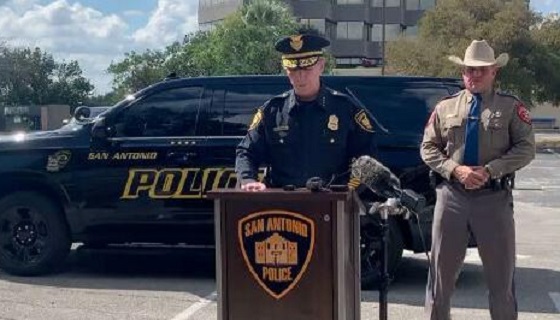
San Antonio Police Chief Bill McManus announced the results of a multi-agency task force operation launched after the SAPD received complaints “about multiple narcotics violations, human trafficking, and threats to apartment personnel” at an apartment complex in the northern part of the city.
The task force had information that TDA members “were in control of the area and committing various crimes” at the complex, he said. SAPD officers and DPS troopers cleared nearly 300 vacant apartments there on Saturday and processed over 20 people they arrested. Four are confirmed TDA members; one is a confirmed enforcer for the gang, he said. U.S. Immigration and Customs Enforcement-Enforcement and Removal Operations officers took all four into custody.
Of the 20 arrested, 19 have 15 ICE holds against them, he said. Several arrested have confirmed warrants; multiple individuals already had removal orders, he said.
“We want to assure the community and members of the public that we are committed to their safety,” he said. “We are on top of this TDA issue” and Saturday’s operation “is just one example of that commitment.” The apartment complex they targeted was “just the first one. We’ve got other places that we are going to hit,” he said.
The operation is ongoing, had been in the works for weeks and the gang had been operating in the city for several months, he said.
He also issued a warning to TDA gang members, saying: “We are on to you and we’re coming for you. We know where you are and we’re coming for you.”
Farther north, four Venezuelan TDA gang members were recently arrested for aggravated robbery of a woman in her home near the Dallas Fort Worth Airport after an hours-long stand-off with police, Fox 4 News reported. The robbery survivor was beaten with a gun, tied up and threatened to have her fingers cut off, WFAA News reported.
All four Venezuelan men arrested are illegally in the country and have ICE detainers. One was previously arrested by Colleyville police and was released one day before the robbery. Two others aren’t in custody.
In Houston, a Texas DPS special agent assigned to the Texas Anti-Gang Center arrested a TDA member also in the U.S. He was scheduled for an asylum hearing Oct. 7, Texas DPS announced.
He “was wanted out of Pearland, Texas for theft,” DPS said. “Over the course of the investigation, investigators observed tattoos on Cova’s arms including a five-point crown and a clock and roses – all known TDA markings.”
The arrests were made after Texas DPS officers arrested TDA members in El Paso and a judge ordered a hotel be shut down there after numerous reports of alleged criminal activity.
The efforts come after Gov. Greg Abbott declared the TDA a foreign terrorist organization and directed resources for law enforcement to pursue them. The designation allows the state to “bring the full weight of the government against the TDA,” he said. It enables “Texas courts to halt their operations using civil asset forfeiture, take their property, and use enhanced criminal penalties to keep them in jail behind bars for longer periods of time.”
Abbott directed law enforcement to aggressively pursue TDA gang members he argues are terrorizing Texans after they illegally entered the U.S., weren’t vetted, and were released into the country because of Biden-Harris administration “open border policies.”
Texas DPS is offering a $5,000 reward for information leading to the arrest of TDA gang members.
“Tren de Aragua has spread terror and carnage in every country they’ve been in, and Texas will not allow them to gain a foothold in our state,” Abbott said. He announced the reward “for any information that leads to the identification and arrest of known or suspected members of this gang who have been or are involved in heinous crimes. Texas will not let these thugs use our state as a base of operations to terrorize our citizens.”
TDA gang members are known for brutal violence, murder, kidnapping, extortion, bribery and human and drug trafficking, Abbott said, and are linked to more than 100 law enforcement investigations nationwide.

From The Center Square
By
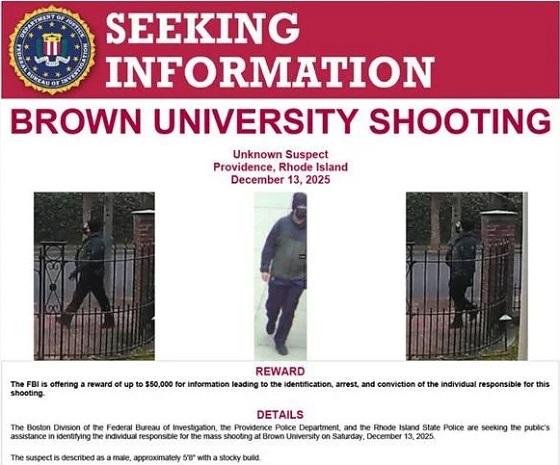
Rhode Island officials said the suspected gunman in the Brown University mass shooting has been found dead of an apparent self-inflicted gunshot wound, more than 50 miles away in a storage facility in southern New Hampshire.
The shooter was identified as Claudio Manuel Neves-Valente, a 48-year-old Brown student and Portuguese national. Neves-Valente was found dead with a satchel containing two firearms inside in the storage facility, authorities said.
“He took his own life tonight,” Providence police chief Oscar Perez said at a press conference, noting that local, state and federal law officials spent days poring over video evidence, license plate data and hundreds of investigative tips in pursuit of the suspect.
Perez credited cooperation between federal state and local law enforcement officials, as well as the Providence community, which he said provided the video evidence needed to help authorities crack the case.
“The community stepped up,” he said. “It was all about groundwork, public assistance, interviews with individuals, and good old fashioned policing.”
Rhode Island Attorney General Peter Neronha said the “person of interest” identified by private videos contacted authorities on Wednesday and provided information that led to his whereabouts.
“He blew the case right open, blew it open,” Neronha said. “That person led us to the car, which led us to the name, which led us to the photograph of that individual.”
“And that’s how these cases sometimes go,” he said. “You can feel like you’re not making a lot of progress. You can feel like you’re chasing leaves and they don’t work out. But the team keeps going.”
The discovery of the suspect’s body caps an intense six-day manhunt spanning several New England states, which put communities from Providence to southern New Hampshire on edge.
“We got him,” FBI special agent in charge for Boston Ted Docks said at Thursday night’s briefing. “Even though the suspect was found dead tonight our work is not done. There are many questions that need to be answered.”
He said the FBI deployed around 500 agents to assist local authorities in the investigation, in addition to offering a $50,000 reward. He says that officials are still looking into the suspect’s motive.
Two students were killed and nine others were injured in the Brown University shooting Saturday, which happened when an undetected gunman entered the Barus and Holley building on campus, where students were taking exams before the holiday break. Providence authorities briefly detained a person in the shooting earlier in the week, but then released them.
Investigators said they are also examining the possibility that the Brown case is connected to the killing of a Massachusetts Institute of Technology professor in his hometown.
An unidentified gunman shot MIT professor Nuno Loureiro multiple times inside his home in Brookline, about 50 miles north of Providence, according to authorities. He died at a local hospital on Tuesday.
Leah Foley, U.S. attorney for Massachusetts, was expected to hold a news briefing late Thursday night to discuss the connection with the MIT shooting.


From the Daily Caller News Foundation
A woman who survived the Hanukkah terrorist attack at Bondi Beach in Australia said on Monday that police officers seemed less concerned about stopping the attack than they were about keeping her from fighting back.
A father and son of Pakistani descent opened fire on a Hanukkah celebration Sunday, killing at least 15 people and wounding 40, with one being slain on the scene by police and the other wounded and taken into custody. Vanessa Miller told Erin Molan about being separated from her three-year-old daughter during Monday’s episode of the “Erin Molan Show.”
“I tried to grab one of their guns,” Miller said. “Another one grabbed me and said ‘no.’ These men, these police officers, they know who I am. I hope they are hearing this. You are weak. You could have saved so many more people’s lives. They were just standing there, listening and watching this all happen, holding me back.”
Dear Readers:
As a nonprofit, we are dependent on the generosity of our readers.
Please consider making a small donation of any amount here.
Thank you!
WATCH:
“Two police officers,” Miller continued. “Where were the others? Not there. Nobody was there.”
New South Wales Minister of Police Yasmin Catley did not immediately respond to a request for comment from the Daily Caller News Foundation about Miller’s comments.
Australian Prime Minister Anthony Albanese vowed to enact further restrictions on guns in response to the attack at Bondi Beach, according to the Associated Press. The new restrictions would include a limit on how many firearms a person could own, more review of gun licenses, limiting the licenses to Australian citizens and “additional use of criminal intelligence” to determine if a license to own a firearm should be granted.
Sajid Akram, 50, and Naveed Akram, 24, reportedly went to the Philippines, where they received training prior to carrying out the Sunday attack, according to the Australian Broadcasting Corporation. Naveed Akram’s vehicle reportedly had homemade ISIS flags inside it.
Australia passed legislation that required owners of semi-automatic firearms and certain pump-action firearms to surrender them in a mandatory “buyback” following a 1996 mass shooting in Port Arthur, Tasmania, that killed 35 people and wounded 23 others. Despite the legislation, one of the gunmen who carried out the attack appeared to use a pump-action shotgun with an extended magazine.


Rulings could affect energy prices everywhere: Climate activists v. the energy industry in 2026

China Stages Massive Live-Fire Encirclement Drill Around Taiwan as Washington and Japan Fortify
Land use will be British Columbia’s biggest issue in 2026

Mainstream media missing in action as YouTuber blows lid off massive taxpayer fraud

The Canadian Energy Centre’s biggest stories of 2025

Why Japan wants Western Canadian LNG

The Global Push for Government Mandated Digital IDs And Why You Should Worry
-
 Energy22 hours ago
The U.S. Just Removed a Dictator and Canada is Collateral Damage
-
 Haultain Research20 hours ago
Trying to Defend Maduro’s Legitimacy
-
 Business1 day ago
Vacant Somali Daycares In Viral Videos Are Also Linked To $300 Million ‘Feeding Our Future’ Fraud
-
International1 day ago
Trump Says U.S. Strike Captured Nicolás Maduro and Wife Cilia Flores; Bondi Says Couple Possessed Machine Guns
-
 International22 hours ago
U.S. Claims Western Hemispheric Domination, Denies Russia Security Interests On Its Own Border
-
 International1 day ago
“Captured and flown out”: Trump announces dramatic capture of Maduro
-
International22 hours ago
US Justice Department Accusing Maduro’s Inner Circle of a Narco-State Conspiracy
-
International19 hours ago
“It’s Not Freedom — It’s the First Step Toward Freedom”