Connect with us
[the_ad id="89560"]

International

Sagrada Familia Basilica in Barcelona is now tallest church in the world

Published

2 minute read

CNA

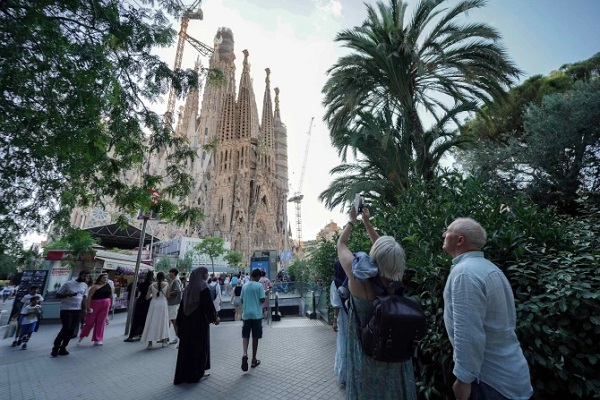
The Sagrada Familia (Holy Family) minor basilica in Barcelona is now the tallest church in the world, standing at 535 ft., surpassing Ulm Germany’s main church, whose construction began in the 14th century.

According to the Sagrada Familia Expiatory Church Construction Board Foundation, as reported Oct. 30 by the Archdiocese of Barcelona, ​​”the first element that forms part of the cross on the tower of Jesus Christ” was installed, marking the beginning of the final phase of construction of the church’s central tower.

This latest addition consists of the lower portion of the cross, measuring over 20 ft. high and weighing 24 tons. “With a double-twist geometry, the lower portion has a square shape at the base that transforms into an octagonal shape at the top,” whose exterior is “clad with white glazed ceramic and glass, materials that stand out for their reflective properties and resistance to atmospheric conditions,” the news brief explains.

The tower of Jesus Christ is the tallest of the central towers of the church designed by Antoni Gaudí, who died a century ago. The completion of this structure “will be a historic milestone for Sagrada Familia and a tribute to its architect.”

More than 140 years of history

The first stone of Sagrada Familia Basilica was laid on March 19, 1882, according to the design of the architect Francisco de Paula del Villar. The following year, Antoni Gaudí took over the project, modifying it according to his architectural genius and renowned Modernist style. From 1914, Gaudí dedicated himself exclusively to this church until his death on June 10, 1926.

On April 14, 2025, Pope Francis declared the architect venerable, in accordance with the criteria set by the Dicastery for the Causes of Saints.

This story was first published by ACI Prensa, CNA’s Spanish-language news partner. It has been translated and adapted by CNA.

Crime

Trump designates fentanyl a ‘weapon of mass destruction’

Published on

From The Center Square

By 

Following an alarming rise in fentanyl deaths in recent years, President Donald Trump is taking another step in cracking down on the deadly drug seeping its way onto American streets by designating it a weapon of mass destruction.

The president signed the executive order Monday during an event in the Oval Office, saying the illicit drug “is closer to a chemical weapon than a narcotic.”

The designation comes on the heels of the administration’s increasing military presence in the Caribbean, targeting narco-terrorists and “successful” meetings with Chinese leaders, who have vowed to crack down on the production of precursors of the drug.

Critics of Trump’s move want to address the fentanyl crisis through a different way. For example, a 2024 bill from attorneys general asking former President Joe Biden to do the same thing expressed concerns about political optics and the language akin to military. Overreach and blurred lines in domestic actions, such as rounding up users.

The order would provide the secretaries of the Department of War and Department of Homeland Security to “update all directives regarding the armed forces’ response to chemical incidents in the homeland to include the threat of illicit fentanyl.”

Trump said the fentanyl drug trade “threatens” national security by fueling “lawlessness” in the Western Hemisphere. This is the area of North America and South America, and the islands near each.

“The production and sale of fentanyl by foreign terrorist organizations and cartels fund these entities’ operations – which include assassinations, terrorist acts, and insurgencies around the world – and allow these entities to erode our domestic security and the well-being of our nation,” the order says in part.

Trump said two cartels are predominantly responsible. The Sinaloa Cartel and the Jalisco New Generation Cartel, known also as CJNG, are based in Mexico.

The Drug Enforcement Agency said last December that in 2023, more than 107,000 people died from drug overdoses, with nearly 70% attributed to opioids, like fentanyl.

In late February, the U.S. Centers for Disease Control and Prevention via its National Vital Statistics System predicted a 24% decline in drug overdose deaths for the 12 months ending in September. The finding was based on 87,000 drug overdose deaths from October 2023 to September 2024, down from 114,000 the year prior.

Trump declared opioid overdose a public health emergency in 2017 during his first term.

Continue Reading

International

Russia Now Open To Ukraine Joining EU, Officials Briefed On Peace Deal Say

Published on


From the Daily Caller News Foundation

By Wallace White

Russia has expressed willingness to let Ukraine join the European Union (EU) as part of a future peace deal, U.S. officials told the Daily Caller News Foundation.

In addition to possible EU membership, Russia might also accept a new security guarantee for Ukraine that provides NATO-like protections as part of the deal, the officials told the DCNF. U.S. Special Envoy Steve Witkoff and Jared Kushner are currently in Berlin for peace negotiations with European leaders and Ukraine, and are expected to meet with Ukrainian President Volodymyr Zelenskyy to discuss the peace talks, the officials said.

“Russia, in a final deal, has indicated they would be willing…to Ukraine joining the EU,” one official told the DCNF.

The officials expressed confidence they have resolved “90%” of the issues between Russia and Ukraine in the new deal, but did not elaborate on the outstanding issues from Russian President Vladimir Putin or Zelenskyy.

Ukraine has said it was willing to give up its NATO aspirations in a peace deal with Russia, marking a major shift from Zelenskyy’s previous position at the start of the conflict. President Donald Trump previously urged the leader to drop his NATO push in August, saying he would end the “almost immediately” if Ukraine gave it up.

Discussions in Berlin with Zelenskyy mainly focused on the U.S. security guarantee, though it is unclear how the new agreement would provide Article 5-like protections in practice and whether the deal would be binding, the officials told the DCNF. The officials also said that involved European nations have expressed approval of the new guarantees.

Earlier, European leaders strongly objected to the initial 20-point proposal set forth by the Trump administration in November.

Zelenskyy’s administration has also been mired in a corruption scandal that threatens to undo his grip on power, as the National Anti-Corruption Bureau of Ukraine launched a probe into Zelenskyy’s business partners who allegedly laundered $100 million from Ukraine’s nuclear energy company.

Continue Reading

Trending

X