
Alberta
Province of Alberta will hold referendum on equalization next year


From the Province of Alberta
Getting a fair deal for Alberta
Premier Jason Kenney has released the next step of Alberta’s strategy to secure a fair deal in the federation, addressing the unprecedented levels of frustration expressed with the barriers placed in the way of Alberta’s economy.

The Fair Deal Panel report recommends 25 ways to ensure Alberta has a stronger voice in Confederation, including fairer funding allocations from Ottawa, better representation for Alberta in the House of Commons, and exploration of an Alberta Pension Plan and Alberta Police Force.
More than 40,000 Albertans participated in the Fair Deal Panel engagement, providing input on ideas that could give the province a stronger role within Canada, increase control in areas of provincial jurisdiction and advance our province’s vital economic interests. The panel’s report to government contains 25 separate recommendations that address the frustrations many Albertans shared with the panel.
“Albertans have told us what a fair deal looks like for our province – it consists of more autonomy, better representation and a renewed respect for all provinces and territories. Our government agrees, and work on many of these areas is already underway. We are eager to take further action on the panel’s recommendations to ensure Albertans have a strong voice and a fair deal when we need it most.”
Government has already taken action or started work on a number of initiatives related to the panel’s recommendations, such as moving forward on reforming the Fiscal Stabilization Program, establishing a provincial chief firearms officer, and working with other provinces and territories to further explore the development of economic resource corridors to move our products to market. Government is committed to further analyzing all the recommendations to ensure they get the attention they deserve.
“Working with Albertans and hearing their stories, frustrations and ideas about how to empower our province on the national stage has been an incredible honour. Albertans told us they want government to take action to strengthen the province and assert our jurisdiction, so I think they’ll be pleased with just how much work is happening in the areas they stressed as top priorities.”
“Albertans know we’ve been getting a raw deal and that there is no fair deal without tackling equalization, so it’s great to see the Fair Deal Panel acknowledge the importance of the equalization referendum. There’s still a lot more work to do, but this report and the equalization referendum are the crucial first few steps in Alberta’s fight for fairness.”
“As a group of businesses who believe in our province and our country, we are very supportive of the report and Alberta getting a fair deal. Everyone will win when we can strengthen inter-provincial trade and build our country by making Confederation fairer. We believe that the Fair Deal report is a step in that direction.”
Actions to date
Since being elected, the government has kept its word to secure a fair deal for Alberta with concrete actions to implement platform commitments, including:
Carbon Tax Repeal
Commitment:
- “Introduce the Carbon Tax Repeal Act, and challenge the constitutionality of the federal carbon tax by filing a judicial reference to the Court of Appeal, while continuing to support similar challenges by the governments of Saskatchewan and Ontario.”
Action:
- Passed the Carbon Tax Repeal Act, effective May 30, 2019, and secured a declaration from the Alberta Appeal Court that the federal carbon tax is unconstitutional. Also supporting appeals by Saskatchewan and Ontario on the federal carbon tax to the Supreme Court of Canada.
Pipelines
Commitment:
- “Immediately file a constitutional challenge to strike the federal government’s ‘No More Pipelines’ Bill C-69 as a violation of Section 92 of the Constitution Act, which gives Alberta clear, exclusive jurisdiction over the production of oil and gas.”
Action:
- Filed a constitutional challenge of Bill C-69 at the Alberta Court of Appeal. Decision is pending.
Market Access
Commitment:
- “To proclaim into law Preserving Canada’s Economic Prosperity Act, to make it clear that Alberta will defend the value of its resources against provincial governments that seek to block pipelines.”
Action:
- Proclaimed the Preserving Canada’s Economic Prosperity Act on April 30, 2019.
Indigenous participation in resource development
Commitment:
- “Create a $10 million litigation fund to support pro-development First Nations in defending their right to be consulted on major energy projects.”
Action:
- Alberta created the Indigenous Litigation Fund which is now supporting the Woodland Cree First Nation’s constitutional challenge of the federal “tanker ban” Bill C-48.
- The government further supports Indigenous participation through the creation of the Indigenous Opportunities Corporation, backed by up to $1 billion to support Indigenous financial participation in major resource projects.
CMHC stress test:
Commitment:
- “Challenge the federal government’s unfair one-size-fits-all approach to mortgages by demanding Canada Mortgage and Home Corporation (CMHC) stress tests are removed from Alberta residents.”
Action:
- Alberta has worked to continually advocate for changes to the CMHC stress test, which through its unilateral application does not reflect the needs of Alberta homebuyers. While the federal government announced changes to the program, they still do not take into account the different circumstances of the Alberta housing market and continue to disadvantage Alberta homebuyers and make it even more difficult for Albertans to qualify for CMHC mortgage insurance.
Employment Insurance reforms:
Commitment:
- “Demand reforms to Canada’s Employment Insurance (EI) program so that Albertans who lose their jobs are not penalized and treated unfairly compared to other Canadians.”
Action:
- Alberta has continued to raise this issue with the federal government, most recently during the December 2019 Ministers’ Mission to Ottawa. At that time, Alberta noted that Alberta employers and workers consistently pay more into the EI program than they receive. Alberta would like EI program reform to ensure equitable treatment of Albertans who lose their jobs and employers who pay EI premiums.
Development of an Alberta Parole Board
Commitment:
- “End Alberta’s agreement with the Parole Board of Canada and pass legislation to create an Alberta Parole Board.”
Action:
- In June 2020, Alberta announced our intention to create our own parole board to provide a fairer, faster and more responsive justice system that helps end the “revolving door” that enables repeat offenders to target Albertans, particularly in rural areas.
Resource corridors:
Commitment:
- “Seek to form federal and provincial agreement on resource corridors, which are pre-approved land corridors to expedite major resource project approvals; a key part of these corridors would be facilitating aboriginal co-ownership of financial participation, where relevant.”
Action:
- After Premier Kenney raised this topic at the Summer 2019 Council of the Federation (COF) meeting, all jurisdictions agreed to do further work on this concept. Alberta officials are working with other provinces and territories to prepare a report that explores ways to enhance the existing connections between provinces and territories to provide a more co-ordinated and strategic approach for transportation and transmission of resources across Canada. This report will be presented to premiers in advance of the 2020 COF meeting, and will provide options for future collaborative work.
Canadian free trade
Commitment:
- “Support the vital rights of Canadians to sell their goods and services and exercise their trades and professions in every part of Canada.”
Action:
- Alberta has unilaterally scrapped 21 of 27 exemptions under the Canada Free Trade Agreement, becoming the province with the lowest internal trade barriers.
- Led an effort to expand Central and Eastern Canadian provinces in the New West Partnership Agreement.
- Continuing policy work on the potential unilateral recognition of Canadian trade and professional certification.
National support for pipelines:
Commitment:
- “Build an interprovincial coalition of provinces that supports jobs pipelines, and our energy industry, making it a top issue in federal-provincial relations.”
Action:
- Secured support from 12 of 13 provinces and territories for “national resource and energy corridors, including oil and gas pipelines.”
Fair Deal Panel recommendations and actions underway
Recommendation 1: Press strenuously for the removal of the current constraints on the Fiscal Stabilization Program, which prevent Albertans from receiving a $2.4 billion equalization rebate.
Action
- The Government of Alberta advocated for retroactive changes to the Fiscal Stabilization Program at the December 2019 Council of the Federation meeting, where all provinces and territories agreed to support changes to the program, including a retroactive rebate to address the unfair per capital cap on payments that affects jurisdictions such as Alberta. The province has raised this demand with the Government of Canada as a central issue over the past year.
- A Fair Deal for Alberta, a chapter in Budget 2020 dedicated to federal-provincial fiscal issues, outlined Alberta’s case for reforming the Fiscal Stabilization Program.
Recommendation 2: Proceed with the proposed referendum on equalization, asking a clear question along the lines of: “Do you support the removal of Section 36, which deals with the principle of equalization, from the Constitution Act, 1982?”
Action:
- Agreed to in principle.
- Further work will be done to analyze what an appropriate referendum question on equalization would be.
- This referendum could be held in conjunction with the 2021 municipal elections.
Recommendation 3: Collaborate with other jurisdictions to reduce trade barriers within Canada and pressure the federal government to enforce free trade in Canada.
Action:
- Alberta has taken a leadership role in reducing trade barriers within Canada:
- In 2019, Alberta lifted 21 trade exceptions under the Canada Free Trade Agreement and narrowed two others to become the jurisdiction with the fewest number of exceptions in Canada.
- Alberta continues to call on the federal government and other jurisdictions to follow Alberta’s lead and eliminate trade barriers, is leading efforts to expand the New West Partnership Trade Agreement (NWPTA) to include other provinces, and continues work on the possible unilateral recognition of trade and professional qualifications.
Recommendation 4: Collaborate with other jurisdictions and stakeholders to secure cross-border rights-of-way and create unobstructed resource corridors within Canada to tidewater and world markets.
Action:
- Alberta secured unanimous support from western and northern premiers for “energy and resource corridors, including oil and gas pipelines,” and unanimous agreement amongst all 13 premiers at the Council of the Federation to support “economic corridors (to) expand markets for Canadian energy, including hydroelectricity and natural gas.”
- All jurisdictions have agreed to do further work on this concept, and Alberta officials continue to work with other provinces and territories to provide a more co-ordinated and strategic approach for transporting and transmitting resources across Canada.
- A report on this work will be presented to premiers in advance of the 2020 Council of the Federation meeting.
- Alberta is participating in the work of the Pan-Canadian Competitive Trade Corridor Initiative.
- Ministers responsible for Transportation and Highways across Canada are working to find ways to enhance internal and international trade.
- Government provided a grant to the University of Calgary’s School of Public Policy to support its Canadian Northern Corridor Program.
- Alberta will create a task force to work with industry, First Nations, municipalities and other provinces to move resource corridors from concept to reality.
Recommendation 5: Collaborate with other jurisdictions to design and advance regional strategies for northern development; pressure the federal government to implement those strategies.
Action:
- The Northern Alberta Development Council (NADC) is a public agency accountable to the Minister of Economic Development, Trade and Tourism. Its ongoing work includes investigating, monitoring, evaluating, planning and promoting practical measures to foster and advance development in northern Alberta.
- The NADC will continue to focus on the development of one or more multi-modal corridors across the north, which would include broadband, utilities, roadways and rail.
- Work has started to develop a Northern Strategy for Alberta to further develop the corridor concepts and complement the work of other provincial and territorial members of the Northern Ministers’ Development Forum.
Recommendations 6 A & B: Support and press for the strictest possible application of the principle of representation by population in the House of Commons. Work with other provinces and the federal government to democratize the Senate appointment process.
Action:
- Government recently reintroduced the Senatorial Selection Act to ensure a democratic appointment process for current and future Senate appointments.
- Senate elections will be held in conjunction with the 2021 municipal elections.
- Work on a request to the federal government advocating for a more representative share of House of Commons seats is currently underway.
Recommendation 7: Secure a fairer share of federal civil service opportunities and federal offices in Western Canada.
Action:
- This recommendation requires further analysis and work before it can be implemented.
- Executive Council will develop a plan to address this recommendation.
Recommendation 8: Abolish or at least change the residency requirement for the federal courts.
Action:
- Agreed to in principle.
- Alberta will immediately begin to advocate for the elimination of the long-standing and archaic rule to have federal court judges reside within the National Capital Region, which has unfairly punished Alberta residents.
Recommendation 9: Assert more control over immigration for the economic benefit of Alberta.
Action:
- Agreed to in principle.
- Alberta will continue to advocate for economic policies that strengthen Alberta, including immigration policies.
- The province will seek a more active role in setting immigration numbers and policies with the federal government as part of the Alberta Advantage Immigration Strategy.
Recommendation 10: Collaborate with other provinces and industry to advance market-based approaches to environment protection, including a reduction in greenhouse gas (GHG) emissions.
Action:
- Alberta continues to work with other jurisdictions that share the common objective of ensuring climate change response plans are locally developed and reflective of the unique circumstances in each province and territory. This includes balancing energy development with the need to address climate change.
- Government has worked with industry and stakeholders to develop the Technology Innovation and Emission Reduction regulation for large emitters, which supports the overall reduction in greenhouse gas emissions in Alberta while maintaining industry competitiveness.
- Alberta worked with industry and stakeholder partners to establish a provincial methane regulatory approach that is more cost-effective than proposed federal regulations.
Recommendation 11: Continue to challenge federal legislation that affects provincial jurisdiction.
Action:
- Alberta succeeded in obtaining a judicial reference from the Court of Appeal declaring the federal carbon tax unconstitutional, and is awaiting a decision from the Court of Appeal challenging the constitutionality of federal Bill C-69, commonly known as the “No More Pipelines Act.”
- Alberta will continue to defend its economy and constitutional jurisdiction against intrusive federal legislation as necessary.
Recommendation 12: Work with other provinces to secure a federal-provincial agreement prohibiting the federal government from spending, taxing, legislation or treaty making in areas of provincial or joint jurisdiction without the consent of the affected province(s).
Action:
- Agreed to in principle.
- As the Minister of Intergovernmental Relations, Premier Kenney will champion an agreement that restricts federal overreach to respect the constitutional authority of Canada’s provinces.
Recommendations 13 A & B: Develop a comprehensive plan to create an Alberta Pension Plan and withdraw from the Canada Pension Plan. Subsequently, provide Albertans the opportunity, via a referendum, to vote for or against withdrawing from the Canada Pension Plan and creating the Alberta Pension Plan.
Action:
- Treasury Board and Finance will develop a detailed analysis of the costs, benefits and structure of a potential Alberta Pension Plan, to be completed and released in 2021. Alberta would only proceed with the creation of a provincial pension plan if supported by a majority of voters in a referendum.
Recommendation 14: Create an Alberta Police Service to replace the Royal Canadian Mounted Police.
Action:
- The Department of Justice and Solicitor General will commence a detailed study into the costs, benefits and structure of a potential provincial police service. This study will be completed and released in 2021.
Recommendation 15: Appoint an Alberta Chief Firearms Officer (CFO).
Action:
- Alberta will appoint a provincial CFO and is starting the process of negotiating this change with the federal government.
- Alberta established the Alberta Firearms Advisory Committee (AFAC) to provide recommendations on how to structure a provincial CFO.
Recommendation 16: Secure a seat at the table when the federal government negotiates and implements international agreements and treaties affecting Alberta’s interests.
Action:
- Alberta has pushed the federal government for a more formal, consistent and appropriate role for the province at all international negotiations.
- Alberta will continue this advocacy work on both an ad hoc basis (i.e. as agreements and treaties arise) and in a more deliberate fashion with the federal government.
- Alberta will strenuously pursue advocacy work in this area, starting with a formal request to the federal government to ensure a seat for Alberta at the international negotiating table.
Recommendation 17: Strengthen Alberta’s presence in Ottawa.
Action:
- Alberta will open advocacy offices in Ottawa and Quebec to work with elected officials; federal departments, agencies, boards and commissions; and foreign missions to advance Alberta’s interests
Recommendation 18: Opt out of new federal cost-shared programs, subject to Alberta receiving full compensation.
Action:
- Alberta will seek to opt out of any federal programs that are inconsistent with Alberta’s interests, and will seek full compensation from the federal government, as appropriate.
- This will be Alberta’s approach with respect to the proposed federal approach to pharmaceuticals.
Recommendation 19: Resist federal intrusions into health and social programming, and do not seek to exchange cash payments for tax points at this time.
Action:
- The Government of Alberta committed to seeking an exchange of tax points for existing tax payments in its election platform, so this recommendation requires modification to align with an existing government commitment.
- Work will proceed to scope and analyze the most effective approaches and timing for seeking such a fundamental shift in Canada’s fiscal arrangements, along with potential alternative reforms that would advance Alberta’s interests.
Recommendation 20: Continue to diversify Alberta’s economy in the energy sector and beyond.
Action:
- This recommendation is accepted, and is reflected in the Government’s Blueprint for Jobs. Policies that support diversification will be further advanced in Alberta’s post-COVID Economic Recovery Strategy, to be released this summer.
Recommendation 21: Vigorously pursue access to markets for Alberta’s exports.
Action:
- Government has strongly advocated for all major pipeline projects that support getting our resources to market.
- This includes the significant $1.5 billion equity investment and $6 billion loan guarantee to accelerate construction of the Keystone XL Pipeline project.
- The province has a strong international presence with 12 international offices, including Washington, D.C., and Beijing. These offices play a vital role in advancing Alberta’s interests globally through trade promotion, investment attraction and advocacy initiatives.
- Alberta appointed James Rajotte to lead Alberta’s Washington, D.C., trade office as it advances the province’s interests and opens the American market to new Alberta exports.
- Alberta will continue to vigorously pursue the completion of all pipeline projects that support getting our resources to market, including advocating for the completion of the Trans Mountain Expansion Project and Enbridge Line 3 Replacement Project.
Recommendation 22: Make no changes, at this time, to the administration of agreements that Alberta public agencies and municipalities have with the Government of Canada.
Action:
- Working with public bodies to ensure federal funding aligns with desired provincial outcomes and has the greatest impact for Albertans is of vital importance.
- While government does not anticipate any changes to the relationship between public agencies and other governments at this time, it is a subject that may be revisited in the future.
Recommendations 23 A & B: Make no changes to tax collection in Alberta at this time and support Quebec in its bid to collect the federal and provincial portions of personal income taxes and, if Quebec is successful, pursue the same strategy if it is advantageous.
Action:
- Alberta supports Quebec in its effort to pursue the collection of both the provincial and federal portions of personal income taxes.
- Further analysis is required on the feasibility of a provincial tax collection agency, including understanding the benefits of policy flexibility against the cost of additional compliance and administrative requirements.
Recommendation 24: Use democratic tools such as referenda and citizens’ initiatives to seek Albertans’ guidance on selected Fair Deal Panel proposals and other initiatives.
Action:
- The Government of Alberta will introduce citizens’ initiative legislation, and will use referendums to consult Albertans on major issues, as appropriate.
Recommendation 25: Explore ways and means to affirm Alberta’s cultural, economic and political uniqueness in law and government policy.
Action:
Alberta accepts this recommendation. While we currently work to affirm our cultural identity, more can be done. The Minister of Culture, Multiculturalism and Status of Women will be tasked with developing an action plan to implement this recommendation.

Alberta
Trump’s Venezuela Geopolitical Earthquake Shakes up Canada’s Plans as a “Net Zero” Energy Superpower


From Energy Now
By Ron Wallace
Get the Latest Canadian Focused Energy News Delivered to You! It’s FREE: Quick Sign-Up Here
Prime Minister Carney’s ‘well-laid plans’ for Canada to become a net zero energy superpower may suddenly be at risk – with significant consequences for Alberta. Recent events in Venezuela should force a careful re-examination of the economic viability of producing “decarbonized” heavy oil.
Having amassed military forces in the Caribbean throughout 2025 under Operation Southern Spear, on 3 January 2026 the Trump administration launched Operation Absolute Resolve, termed one of the most dramatic U.S. military actions in the Western Hemisphere since Operation Just Cause in Panama in 1989. Targeting multiple locations across Venezuela it led to the capture and removal of Venezuelan President Nicolás Maduro and his wife Cilia Flores. Initially held aboard the USS Iwo Jima they have been taken to the U.S. to face criminal charges for “narcoterrorism” and other offences.
In what has been termed a “$17 trillion reset”, Alberta may be at risk of losing its hard-won U.S. Gulf Coast (USGC) dominance to a resurgent rival – this coming at a time when Alberta and Canada are proposing to expend billions on “decarbonized” oil with punitive regulatory conditions that would not apply to Venezuelan, or any other international producers, of heavy oil. With U.S. forces capturing President Nicolás Maduro and President Trump declaring American administration of Venezuela to “get the oil flowing” again, the revival of Venezuela’s vast heavy crude reserves—over 300 billion barrels, the world’s largest—could flood the market with a cheaper, proximate supply tailored to U.S. refineries.
Historically, Alberta capitalized on Venezuela’s collapse when production there plummeted, due to mismanagement and sanctions, from 3 million barrels per day in the mid-2000’s to under 1 million today. This allowed Canadian heavy blends like Western Canadian Select to become the dominant feedstock for U.S. Gulf Coast refiners. In 2025, Canada supplied over one-third of the region’s heavy imports, tightening differentials and bolstering Alberta’s revenues.
A U.S.-revived Venezuelan oil industry, even if investment for infrastructure takes years to implement, would be a serious threat that risks displacing Canadian oil with lower-cost alternative supplies that also are geographically closer to U.S. refiners. This seismic geopolitical shift now confronts Prime Minister Mark Carney and Premier Danielle Smith as they attempt to implement their November 2025 Memorandum of Understanding (MoU), one that commits Alberta to produce “decarbonized” oil through massive carbon capture projects like Pathways Plus associated with Carbon Pricing Equivalency Agreements, are vastly expensive measures that could undermine Canadian price competitiveness against unsanctioned Venezuelan crude. Possibly of greater importance, Canadian insistence on “net zero” targets associated with pipelines and heavy oil production, policies that have caused significant capital flight from the Canadian energy sector, may further diminish the attractiveness of Alberta oil projects to international investors. Since 2015 Canada has experienced a flight of investment capital approaching CAD$650 billion due to lost, or deferred, resource projects – particularly in the energy sector. Will these policies and plans for the Alberta-Canada MoU allow Canada to become an “energy superpower” in this new age of international competition?
While short-term disruptions from the U.S. intervention might temporarily tighten heavy supply (and therefore benefit Canadian producers) the long-term prospect of U.S.-controlled Venezuelan oil production unquestionably represents a sea-change for international oil markets and may, potentially strengthen the economic case, if not urgency, for new Canadian Pacific pipelines to provide market access away from the U.S.
Historically, the U.S.–Venezuela oil trade relationship was a highly integrated system that was seriously disrupted, beginning in the 1970’s, by nationalization programs and by subsequent U.S. sanctions. The U.S. Gulf Coast (USGC) refinery complex is among the most highly developed in the world, one that required billions in investments for coking, desulfurization and hydrocracker units specifically designed to process heavy, sour Venezuelan crude. Importing approximately 40 million barrels of heavy crude per month in 2025, the USGC refiners scrambled to replace lost, sanctioned Venezuelan oil with Canadian Cold Lake, Mexican Maya and Brazilian heavy grades. Canada, offering a supply that was stable, pipeline‑connected and geopolitically low‑risk was the only producer with enough heavy crude to meaningfully offset those Venezuelan losses. In the twelve months ending February 2025, Canada supplied 13.6 million barrels/month representing 34% (the largest single source) to those U.S. refiners. As a result, Canadian Cold Lake and WCS differentials tightened with the Cold Lake WTI discount narrowing from $13.57/bbl (February) to $9.45/bbl (May).
However, with a federal government consumed with concerns about emissions and the attainment of an improbable national goal of Net Zero, and with terms in an MoU that will require material capital expenditures to produce “decarbonized” oil, Alberta and Canada would be wise to recognize that this geopolitical sea-change will affect not just prior assumptions about Canadian oil production (and MoU’s) but may yet work to change the fundamental economic assumptions of global oil economics.
Premier Smith has consistently argued that Canada needs to develop an “alternate reality” one in which Alberta oil producers and international export pipelines allow Canada to contribute to global energy security in ways that preclude “economic self-destruction.” In face of these geopolitical events, especially at a time of mounting national deficits, Canada may have precious little time to get its act together to effectively, and competitively, maintain and secure international markets for Alberta oil.
Dr. Ron Wallace is a former National Energy Board member who has also worked in the Venezuelan heavy oil sector.
From the Canadian Energy Centre
Canada’s energy landscape changed significantly in 2025, with mounting U.S. economic pressures reinforcing the central role oil and gas can play in safeguarding the country’s independence.
Here are the Canadian Energy Centre’s top five most-viewed stories of the year.
5. Alberta’s massive oil and gas reserves keep growing – here’s why

The Northern Lights, aurora borealis, make an appearance over pumpjacks near Cremona, Alta., Thursday, Oct. 10, 2024. CP Images photo
Analysis commissioned this spring by the Alberta Energy Regulator increased the province’s natural gas reserves by more than 400 per cent, bumping Canada into the global top 10.
Even with record production, Alberta’s oil reserves – already fourth in the world – also increased by seven billion barrels.
According to McDaniel & Associates, which conducted the report, these reserves are likely to become increasingly important as global demand continues to rise and there is limited production growth from other sources, including the United States.
4. Canada’s pipeline builders ready to get to work

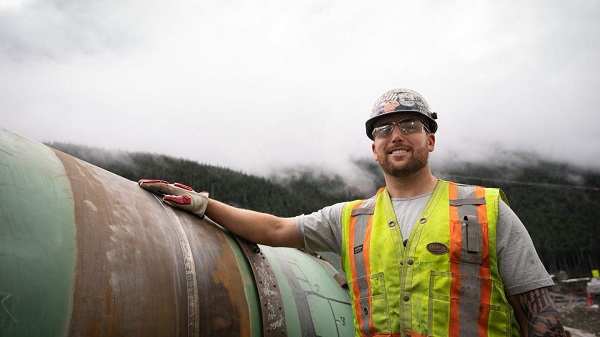
Photo courtesy Coastal GasLink
Canada could be on the cusp of a “golden age” for building major energy projects, said Kevin O’Donnell, executive director of the Mississauga, Ont.-based Pipe Line Contractors Association of Canada.
That eagerness is shared by the Edmonton-based Progressive Contractors Association of Canada (PCA), which launched a “Let’s Get Building” advocacy campaign urging all Canadian politicians to focus on getting major projects built.
“The sooner these nation-building projects get underway, the sooner Canadians reap the rewards through new trading partnerships, good jobs and a more stable economy,” said PCA chief executive Paul de Jong.
3. New Canadian oil and gas pipelines a $38 billion missed opportunity, says Montreal Economic Institute

Steel pipe in storage for the Trans Mountain Pipeline expansion in 2022. Photo courtesy Trans Mountain Corporation
In March, a report by the Montreal Economic Institute (MEI) underscored the economic opportunity of Canada building new pipeline export capacity.
MEI found that if the proposed Energy East and Gazoduq/GNL Quebec projects had been built, Canada would have been able to export $38 billion worth of oil and gas to non-U.S. destinations in 2024.
“We would be able to have more prosperity for Canada, more revenue for governments because they collect royalties that go to government programs,” said MEI senior policy analyst Gabriel Giguère.
“I believe everybody’s winning with these kinds of infrastructure projects.”
2. Keyera ‘Canadianizes’ natural gas liquids with $5.15 billion acquisition

Keyera Corp.’s natural gas liquids facilities in Fort Saskatchewan, Alta. Photo courtesy Keyera Corp.
In June, Keyera Corp. announced a $5.15 billion deal to acquire the majority of Plains American Pipelines LLP’s Canadian natural gas liquids (NGL) business, creating a cross-Canada NGL corridor that includes a storage hub in Sarnia, Ontario.
The acquisition will connect NGLs from the growing Montney and Duvernay plays in Alberta and B.C. to markets in central Canada and the eastern U.S. seaboard.
“Having a Canadian source for natural gas would be our preference,” said Sarnia mayor Mike Bradley.
“We see Keyera’s acquisition as strengthening our region as an energy hub.”
1. Explained: Why Canadian oil is so important to the United States

Enbridge’s Cheecham Terminal near Fort McMurray, Alberta is a key oil storage hub that moves light and heavy crude along the Enbridge network. Photo courtesy Enbridge
The United States has become the world’s largest oil producer, but its reliance on oil imports from Canada has never been higher.
Many refineries in the United States are specifically designed to process heavy oil, primarily in the U.S. Midwest and U.S. Gulf Coast.
According to the Alberta Petroleum Marketing Commission, the top five U.S. refineries running the most Alberta crude are:
- Marathon Petroleum, Robinson, Illinois (100% Alberta crude)
- Exxon Mobil, Joliet, Illinois (96% Alberta crude)
- CHS Inc., Laurel, Montana (95% Alberta crude)
- Phillips 66, Billings, Montana (92% Alberta crude)
- Citgo, Lemont, Illinois (78% Alberta crude)

The Canadian Energy Centre’s biggest stories of 2025

Minneapolis day care filmed empty suddenly fills with kids

Resurfaced Video Shows How Somali Scammers Used Day Care Centers To Scam State

Dark clouds loom over Canada’s economy in 2026

The Real Reason Canada’s Health Care System Is Failing

The U.S. Just Removed a Dictator and Canada is Collateral Damage

Ottawa Is Still Dodging The China Interference Threat
-
 Opinion2 days ago
Hell freezes over, CTV’s fabrication of fake news and our 2026 forecast is still searching for sunshine
-
 Frontier Centre for Public Policy20 hours ago
Is Canada still worth the sacrifice for immigrants?
-
 Canadian Energy Centre20 hours ago
Five reasons why 2026 could mark a turning point for major export expansions
-
 International10 hours ago
Poilievre, Carney show support for Maduro capture as NDP’s interim leader denounces it
-
 International18 hours ago
Network of Nonprofits with Marxist and CCP Ties, and Elected Socialists Race to Counter Washington’s Narrative of the Maduro Raid
-
 Entertainment7 hours ago
Nearly half of Netflix kids shows push LGBTQ content, watchdog warns
-
 Education18 hours ago
Mother petitions Supreme Court after school hid daughter’s ‘gender transition’
-
 International7 hours ago
Watch your a** Petro. Trump threatens Colombian President