
Business
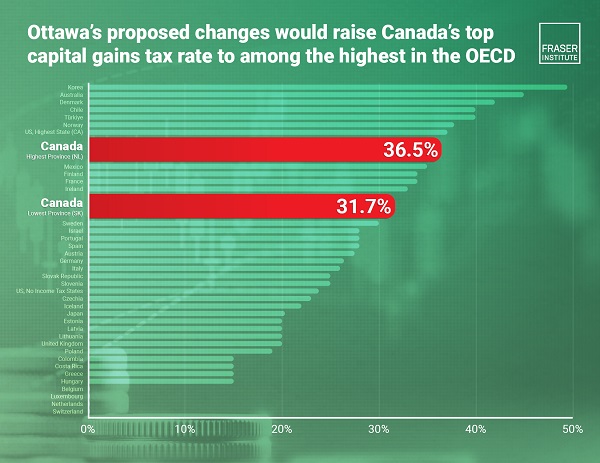
Proposed federal tax hike would make Canada’s top capital gains tax rate among the highest of 37 advanced countries


From the Fraser Institute
By Jake Fuss and Grady Munro

Ottawa’s proposed increase to the effective capital gains tax rate will result in Canada having among the highest—and least competitive—top capital gains tax rates in the industrialized world, finds a new study released today by the Fraser Institute, an independent, non-partisan, Canadian public policy think-tank.
“The evidence is clear—taxing capital gains deters investment, particularly smaller and start-up firms, which in turn slows productivity gains and innovation, all things Canada needs right now to raise living standards for workers,” said Jake Fuss, director of fiscal studies at the Fraser Institute and co-author of Canada’s Waning Competitiveness on Capital Gains Taxes.
The study finds that by increasing the inclusion rate, the federal government has made Canada less competitive compared to other advanced countries. At a 50 per cent inclusion rate, Canada’s top capital gains tax rate ranked between 17th and 23rd (depending on the province) out of 37 high-income developed countries in the Organization for Economic Co-operation and Development (OECD).
Raising the inclusion rate to 66.7 per cent means Canada’s top capital gains tax rate would be among the highest and least competitive (between 8th and 13th highest, depending on the province).
The study notes that if Canada’s capital gains inclusion rate were lowered to 33.3 per cent, Canada would be among the most competitive in the OECD, ranking 30th and 31st, again, depending on the province.
“Instead of raising taxes on capital gains, policymakers should consider reducing taxes as a way of attracting much-needed investment, and reversing Canada’s current economic slump,” Fuss said.

Jake Fuss
Director, Fiscal Studies, Fraser Institute

Grady Munro

Business
Some Of The Wackiest Things Featured In Rand Paul’s New Report Alleging $1,639,135,969,608 In Gov’t Waste


From the Daily Caller News Foundation
Republican Kentucky Sen. Rand Paul released the latest edition of his annual “Festivus” report Tuesday detailing over $1 trillion in alleged wasteful spending in the U.S. government throughout 2025.
The newly released report found an estimated $1,639,135,969,608 total in government waste over the past year. Paul, a prominent fiscal hawk who serves as the chairman of the Senate Homeland Security and Governmental Affairs Committee, said in a statement that “no matter how much taxpayer money Washington burns through, politicians can’t help but demand more.”
“Fiscal responsibility may not be the most crowded road, but it’s one I’ve walked year after year — and this holiday season will be no different,” Paul continued. “So, before we get to the Feats of Strength, it’s time for my Airing of (Spending) Grievances.”
Dear Readers:
As a nonprofit, we are dependent on the generosity of our readers.
Please consider making a small donation of any amount here.
Thank you!
The 2025 “Festivus” report highlighted a spate of instances of wasteful spending from the federal government, including the Department of Health and Human Services (HHS) spent $1.5 million on an “innovative multilevel strategy” to reduce drug use in “Latinx” communities through celebrity influencer campaigns, and also dished out $1.9 million on a “hybrid mobile phone family intervention” aiming to reduce childhood obesity among Latino families living in Los Angeles County.
The report also mentions that HHS spent more than $40 million on influencers to promote getting vaccinated against COVID-19 for racial and ethnic minority groups.
The State Department doled out $244,252 to Stand for Peace in Islamabad to produce a television cartoon series that teaches children in Pakistan how to combat climate change and also spent $1.5 million to promote American films, television shows and video games abroad, according to the report.
The Department of Veterans Affairs (VA) spent more than $1,079,360 teaching teenage ferrets to binge drink alcohol this year, according to Paul’s report.
The report found that the National Science Foundation (NSF) shelled out $497,200 on a “Video Game Challenge” for kids. The NSF and other federal agencies also paid $14,643,280 to make monkeys play a video game in the style of the “Price Is Right,” the report states.
Paul’s 2024 “Festivus” report similarly featured several instances of wasteful federal government spending, such as a Las Vegas pickleball complex and a cabaret show on ice.
The Trump administration has been attempting to uproot wasteful government spending and reduce the federal workforce this year. The administration’s cuts have shrunk the federal workforce to the smallest level in more than a decade, according to recent economic data.
Festivus is a humorous holiday observed annually on Dec. 23, dating back to a popular 1997 episode of the sitcom “Seinfeld.” Observance of the holiday notably includes an “airing of grievances,” per the “Seinfeld” episode of its origin.

From the Fraser Institute
By Nadeem Esmail and Mackenzie Moir
It’s an exciting time in Canadian health-care policy. But even the slew of new reforms in Alberta only go part of the way to using all the policy tools employed by high performing universal health-care systems.
For 2026, for the sake of Canadian patients, let’s hope Alberta stays the path on changes to how hospitals are paid and allowing some private purchases of health care, and that other provinces start to catch up.
While Alberta’s new reforms were welcome news this year, it’s clear Canada’s health-care system continued to struggle. Canadians were reminded by our annual comparison of health care systems that they pay for one of the developed world’s most expensive universal health-care systems, yet have some of the fewest physicians and hospital beds, while waiting in some of the longest queues.
And speaking of queues, wait times across Canada for non-emergency care reached the second-highest level ever measured at 28.6 weeks from general practitioner referral to actual treatment. That’s more than triple the wait of the early 1990s despite decades of government promises and spending commitments. Other work found that at least 23,746 patients died while waiting for care, and nearly 1.3 million Canadians left our overcrowded emergency rooms without being treated.
At least one province has shown a genuine willingness to do something about these problems.
The Smith government in Alberta announced early in the year that it would move towards paying hospitals per-patient treated as opposed to a fixed annual budget, a policy approach that Quebec has been working on for years. Albertans will also soon be able purchase, at least in a limited way, some diagnostic and surgical services for themselves, which is again already possible in Quebec. Alberta has also gone a step further by allowing physicians to work in both public and private settings.
While controversial in Canada, these approaches simply mirror what is being done in all of the developed world’s top-performing universal health-care systems. Australia, the Netherlands, Germany and Switzerland all pay their hospitals per patient treated, and allow patients the opportunity to purchase care privately if they wish. They all also have better and faster universally accessible health care than Canada’s provinces provide, while spending a little more (Switzerland) or less (Australia, Germany, the Netherlands) than we do.
While these reforms are clearly a step in the right direction, there’s more to be done.
Even if we include Alberta’s reforms, these countries still do some very important things differently.
Critically, all of these countries expect patients to pay a small amount for their universally accessible services. The reasoning is straightforward: we all spend our own money more carefully than we spend someone else’s, and patients will make more informed decisions about when and where it’s best to access the health-care system when they have to pay a little out of pocket.
The evidence around this policy is clear—with appropriate safeguards to protect the very ill and exemptions for lower-income and other vulnerable populations, the demand for outpatient healthcare services falls, reducing delays and freeing up resources for others.
Charging patients even small amounts for care would of course violate the Canada Health Act, but it would also emulate the approach of 100 per cent of the developed world’s top-performing health-care systems. In this case, violating outdated federal policy means better universal health care for Canadians.
These top-performing countries also see the private sector and innovative entrepreneurs as partners in delivering universal health care. A relationship that is far different from the limited individual contracts some provinces have with private clinics and surgical centres to provide care in Canada. In these other countries, even full-service hospitals are operated by private providers. Importantly, partnering with innovative private providers, even hospitals, to deliver universal health care does not violate the Canada Health Act.
So, while Alberta has made strides this past year moving towards the well-established higher performance policy approach followed elsewhere, the Smith government remains at least a couple steps short of truly adopting a more Australian or European approach for health care. And other provinces have yet to even get to where Alberta will soon be.
Let’s hope in 2026 that Alberta keeps moving towards a truly world class universal health-care experience for patients, and that the other provinces catch up.


Alberta’s new diagnostic policy appears to meet standard for Canada Health Act compliance

RFK Jr reversing Biden-era policies on gender transition care for minors

Geopolitics no longer drives oil prices the way it used to

Canadian university censors free speech advocate who spoke out against Indigenous ‘mass grave’ hoax

Top constitutional lawyer warns against Liberal bills that could turn Canada into ‘police state’

Carney Floor Crossing Raises Counterintelligence Questions aimed at China, Former Senior Mountie Argues

Ex-FDA Commissioners Against Higher Vaccine Standards Took $6 Million From COVID Vaccine Makers
-
 Energy2 days ago
Western Canada’s supply chain for Santa Claus
-
 Alberta2 days ago
Ottawa-Alberta agreement may produce oligopoly in the oilsands
-
 Energy2 days ago
The Top News Stories That Shaped Canadian Energy in 2025 and Will Continue to Shape Canadian Energy in 2026
-
 International2 days ago
$2.6 million raised for man who wrestled shotgun from Bondi Beach terrorist
-
 armed forces23 hours ago
Remembering Afghanistan and the sacrifices of our military families
-
 Opinion24 hours ago
Pope Leo XIV’s Christmas night homily
-
 Fraser Institute23 hours ago
How to talk about housing at the holiday dinner table
-
 Frontier Centre for Public Policy23 hours ago
Tent Cities Were Rare Five Years Ago. Now They’re Everywhere