
Connect with us
[the_ad id="89560"]

Economy

Prime minister and premier combine to reduce living standards in B.C.

Published

4 minute read

From the Fraser Institute

By Jake Fuss

In B.C., the Eby government is following the prime minister’s lead. After nearly two decades of spending restraint  (1999/00 to 2016/17), the province has experienced an explosion in government spending. Program spending will increase from $46.1 billion in 2016-17 to a projected $85.3 billion this year, a nominal increase of more than 85 per cent.

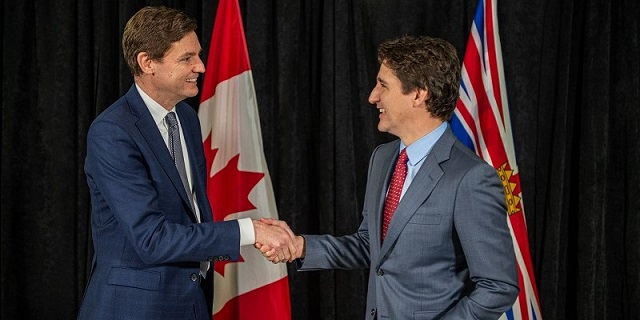
Recently, Prime Minister Justin Trudeau and Premier David Eby had a tête-à-tête and vowed to always “work together on important issues.” While they belong to two different political parties, their visions rely on a larger role for government, which includes more spending, regulation, borrowing and higher taxes. Unsurprisingly, this economic strategy hasn’t worked and has instead led to stagnant living standards in British Columbia and across Canada.

Under the NDP, British Columbians have seen their incomes completely stagnate. B.C.’s per-person GDP, a broad measure of living standards, is expected to be lower this year than in 2018, and decline by an average annual rate of 0.9 per cent from 2022 to 2024—the third biggest drop among the provinces during this period.

This represents a marked departure from the economic results under the previous government. From 2001 to 2017, per-person GDP grew (on average) by 1.4 per cent. And the average British Columbian’s income increased by 27 per cent over these 16 years.

The decline in living standards is also occurring nationally. Canada’s per-person GDP was lower at the end of 2023  than it was in 2014.

Why?

Since first elected in 2015, Prime Minister Trudeau has greatly expanded the federal government’s role in the Canadian economy. Federal program spending (total spending excluding debt interest costs) will increase from $256.2 billion in the final full year of the Harper government to a projected $483.6 billion in 2024-25, an increase of nearly 90 per cent over a decade. The government has financed this spending surge through tax increases and borrowing.

Specifically, the Trudeau government in 2016 raised the top personal income tax rate (which applies to many entrepreneurs and businessowners) and also opaquely increased taxes on middle-income Canadians by eliminating several tax credits (as a result, 86 per cent of middle-income families now pay higher taxes). Federal debt has spiked considerably to finance the government’s insatiable appetite for spending, reaching nearly $2.1 trillion this year, almost double the level in 2014-15.

In B.C., the Eby government is following the prime minister’s lead. After nearly two decades of spending restraint  (1999/00 to 2016/17), the province has experienced an explosion in government spending. Program spending will increase from $46.1 billion in 2016-17 to a projected $85.3 billion this year, a nominal increase of more than 85 per cent.

With Premier Eby’s plan to ramp up spending further in the next few years and incur substantial deficits, B.C.’s net government debt is projected to reach a whopping $128.8 billion by 2026/27—a 227 per cent increase since 2016-17.

The B.C. NDP has also raised one tax after another to feed its appetite for spending. The government hiked personal income tax rates from 14.7 per cent to 16.8 per cent on income between roughly $181,000 and $253,000, and introduced a new top tax rate of 20.5 per cent for top-income earners. And raised the business tax rate from 11.0 to 12.0 per cent in 2018, deterring badly needed investment in the province.

Prime Minister Trudeau and Premier Eby are pursuing the same policies and achieving the same miserable economic results. Simply put, the Trudeau-Eby zero economic growth alliance has reduced the living standards of British Columbians and Canadians.

Before Post

Todayville is a digital media and technology company. We profile unique stories and events in our community. Register and promote your community event for free.

Follow Author

Economy

What the Data Shows About the New Canada-Alberta Pipeline Opportunity

Published on

From Energy Now

By Canada Powered by Women

Canada has entered a new period of energy cooperation, marking one of the biggest shifts in federal–provincial alignment on energy priorities in years.


Get the Latest Canadian Focused Energy News Delivered to You! It’s FREE: Quick Sign-Up Here


Last week as Prime Minister Mark Carney and Alberta Premier Danielle Smith signed a memorandum of understanding (MOU) that outlines how both governments will approach a potential pipeline to British Columbia’s coast.

The agreement, which has been described as a “new starting point” after years of tension, lays the groundwork for a privately financed pipeline while also linking this commitment to a broader set of infrastructure priorities across oil and gas, LNG, renewables, critical minerals and electricity transmission.

It also sets out how a privately financed project, moving roughly 300,000 to 400,000 barrels of oil to global markets each day, will be reviewed.

Now that the announcement is behind us, attention has turned to how (or if) a pipeline is going to get built.

Alberta has set out its ambitionsBritish Columbia has its conditions, and the federal government has its own expectations. Together, these positions are shaping what some are calling a “grand bargain” which will be made up of trade-offs.

Trade-offs are not a new concept for the engaged women that Canada Powered by Women (CPW) represents, as they’ve been showing up in our research for several years now. And anyone who reads us also knows we like to look at what the data says.

According to new polling from the Angus Reid Institute, a clear majority of Canadians support a pipeline, with national backing above 60 per cent. And there’s strong support for the pipeline among those in B.C. This aligns with other emerging data points that show Canadians are looking for practical solutions that strengthen affordability and long-term reliability.

By the numbers:

• 60 per cent of Canadians support the pipeline concept, while 25 per cent oppose it.
• 53 per cent of people support in British Columbia, compared to 37 percent opposed.
• 74 per cent of people in Alberta and Saskatchewan support the pipeline.

Our research shows the same trends.

A large majority (85 per cent) of engaged women agree that building pipelines and refining capacity within the country should be prioritized. They favour policies that will progress stability, affordability and long-term economic opportunity.

A key feature of the MOU is the expectation of Indigenous ownership and benefit sharing, which Alberta and B.C. governments identify as essential, and which aligns with public opinion. As of right now, Indigenous groups remain split on support for a pipeline.

The agreement also signals that changes to the federal Oil Tanker Moratorium Act may need to be considered. The moratorium, in place since 2019, is designed to limit large tanker traffic on the North Coast of B.C. because of navigation risks in narrow channels and the need to protect sensitive coastal ecosystems.

Those in favour of the pipeline point to this as a critical barrier to moving Canadian oil to international markets.

Polling from the Angus Reid Institute shows that 47 per cent of Canadians believe the moratorium could be modified or repealed if stronger safety measures are in place. Again, we come back to trade-offs.

The MOU is a starting point and does not replace consultation, environmental review or provincial alignment. These steps are still required before any project can advance. Taken together, the agreement and the data show broad support for strengthening Canada’s energy options.

This will be an issue that engaged women are no doubt going to watch, and the conversation is likely to move from ideas to discussing what trade-offs can be made to bring this opportunity to life.

Continue Reading

Business

US Energy Secretary says price of energy determined by politicians and policies

Published on


From the Daily Caller News Foundation

By David Blackmon

During the latest marathon cabinet meeting on Dec. 2, Energy Secretary Chris Wright made news when he told President Donald Trump that “The biggest determinant of the price of energy is politicians, political leaders, and polices — that’s what drives energy prices.”

He’s right about that, and it is why the back-and-forth struggle over federal energy and climate policy plays such a key role in America’s economy and society. Just 10 months into this second Trump presidency, the administration’s policies are already having a profound impact, both at home and abroad.

While the rapid expansion of AI datacenters over the past year is currently being blamed by many for driving up electric costs, power bills were skyrocketing long before that big tech boom began, driven in large part by the policies of the Obama and Biden administration designed to regulate and subsidize an energy transition into reality. As I’ve pointed out here in the past, driving up the costs of all forms of energy to encourage conservation is a central objective of the climate alarm-driven transition, and that part of the green agenda has been highly effective.

Dear Readers:

As a nonprofit, we are dependent on the generosity of our readers.

Please consider making a small donation of any amount here.

Thank you!

President Trump, Wright, and other key appointees like Interior Secretary Doug Burgum and EPA Administrator Lee Zeldin have moved aggressively throughout 2025 to repeal much of that onerous regulatory agenda. The GOP congressional majorities succeeded in phasing out Biden’s costly green energy subsidies as part of the One Big Beautiful Bill Act, which Trump signed into law on July 4. As the federal regulatory structure eases and subsidy costs diminish, it is reasonable to expect a gradual easing of electricity and other energy prices.

This year’s fading out of public fear over climate change and its attendant fright narrative spells bad news for the climate alarm movement. The resulting cracks in the green facade have manifested rapidly in recent weeks.

Climate-focused conflict groups that rely on public fears to drive donations have fallen on hard times. According to a report in the New York Times, the Sierra Club has lost 60 percent of the membership it reported in 2019 and the group’s management team has fallen into infighting over elements of the group’s agenda. Greenpeace is struggling just to stay afloat after losing a huge court judgment for defaming pipeline company Energy Transfer during its efforts to stop the building of the Dakota Access Pipeline.

350.org, an advocacy group founded by Bill McKibben, shut down its U.S. operations in November amid funding woes that had forced planned 25 percent budget cuts for 2025 and 2026. Employees at EDF voted to form their own union after the group went through several rounds of budget cuts and layoffs in recent months.

The fading of climate fears in turn caused the ESG management and investing fad to also fall out of favor, leading to a flood of companies backtracking on green investments and climate commitments. The Net Zero Banking Alliance disbanded after most of America’s big banks – Goldman Sachs, J.P. Morgan Chase, Citigroup, Wells Fargo and others – chose to drop out of its membership.

The EV industry is also struggling. As the Trump White House moves to repeal Biden-era auto mileage requirements, Ford Motor Company is preparing to shut down production of its vaunted F-150 Lightning electric pickup, and Stellantis cancelled plans to roll out a full-size EV truck of its own. Overall EV sales in the U.S. collapsed in October and November following the repeal of the $7,500 per car IRA subsidy effective Sept 30.

The administration’s policy actions have already ended any new leasing for costly and unneeded offshore wind projects in federal waters and have forced the suspension or abandonment of several projects that were already moving ahead. Capital has continued to flow into the solar industry, but even that industry’s ability to expand seems likely to fade once the federal subsidies are fully repealed at the end of 2027.

Truly, public policy matters where energy is concerned. It drives corporate strategies, capital investments, resource development and movement, and ultimately influences the cost of energy in all its forms and products. The speed at which Trump and his key appointees have driven this principle home since Jan. 20 has been truly stunning.

David Blackmon is an energy writer and consultant based in Texas. He spent 40 years in the oil and gas business, where he specialized in public policy and communications.

Continue Reading

Trending

X