
National
Politically Connected Canadian Weed Sellers Push Back in B.C. Court, Seek Distance from Convicted Heroin Trafficker





Case sprawls from Pakistan’s chemical-precursor labs to Vancouver’s cannabis fields and law offices.
A high-stakes North American legal battle—centering on a politically connected Sikh-Canadian businessman at the collision point of Canada’s regulated cannabis sector and what U.S. authorities call a “multiyear, multinational attack” on American markets—and two estranged Vancouver brothers, one a convicted heroin trafficker and the other a cannabis cultivator alleging he was cut out of a Health Canada–licensed venture—has taken a turn in B.C. Supreme Court.
In one action, Emerald Health Sciences and related parties—including former British Columbia physician Avtar Singh Dhillon—have denied allegations by Krishansarup “Kris” Kallu, an estranged relative who says the company was structured to enrich insiders later charged by the U.S. government and to conceal key investors with deep narcotics ties that extend to chemical-precursor labs in Pakistan’s northern mountains—including his brother, Yadvinder “Yad” Kallu.
Dhillon—a British Columbia–educated physician and Sikh community leader now based in California—has long displayed deep political proximity in Canada; among the images circulating online is a photo of his niece with Prime Minister Justin Trudeau.
As Emerald Health stepped back from Dr. Dhillon—later drawn into an SEC case describing his role, along with West Vancouver lawyer Fred Sharp, in a one-billion-dollar stock-fraud network as a “multiyear, multinational attack” on American markets—his former Emerald partners filed a civil indemnity claim in September 2025 to create legal distance from Yadvinder Kallu.
In plain terms, the former executives deny the allegations against Emerald and argue that, if anything improper occurred—which they do not admit—legal responsibility must rest with Yadvinder Kallu alone.
Kris Kallu’s suit centers on the claim that his cousin Avtar Dhillon, Emerald Health Sciences, and Fred Sharp sit at the core of the network targeted by the United States government. He alleges that Sharp and Avtar Dhillon “are the true, direct or indirect controllers of Emerald Health Sciences,” and that “Sharp and [Avtar Dhillon] have been close business associates for many years.”
Kallu’s filings allege that individuals facing fraud charges in United States proceedings were among Emerald Health’s early investors.
They also state that Emerald Health Sciences had more than 200 shareholders on a confidential register maintained in Vancouver by the Canadian law firm Bennett Jones. The Bureau has previously reported on the firm’s ties to Liberal Party figures, and that former British Columbia premier Christy Clark has served as a senior adviser in the firm’s Vancouver office.
 |
The Bureau’s reporting also included reviewing thousands of North American court filings and mapping financial networks tied to that legal share register—networks that span the Western Hemisphere and, through Yad Kallu’s historic narcotics activity, intersect with politically consequential narco-trafficking corridors in northern India and Pakistan.
Kris Kallu’s allegations are blunt: they suggest Emerald Health grew from a poisoned root—an effort to work around his brother Yad’s transnational trafficking history—while a polished corporate vehicle, including the Bennett Jones confidential share register, was built. He alleges that register ultimately benefited suspects tied to the Fred Sharp network.
In a revealing September 2021 email to another Dhillon family member—referring to news of U.S. government charges against the Fred Sharp network—Kallu wrote, according to his affidavit: “I find it very alarming as the key players that are being charged with fraud, money laundering, etc. are also invested in Emerald Health Sciences. I am curious how these investors were provided the opportunity to invest, given this is a private cannabis company and all investors were handpicked.”
According to Dhillon’s testimony in Boston as a cooperating witness, Sharp’s group would merge private companies run by hidden Vancouver investors into publicly traded companies, hire writers to fraudulently tout the companies in order to pump up prices, then sell shares to everyday investors—who were left holding deflated assets. Afterward, the conspirators laundered their proceeds. Key players got cash payments, part of a sprawling stock-fraud scheme allegedly tied to cannabis and biotech firms, shell entities, and a network of shadowy Western Hemisphere control groups.
During his testimony, Dhillon described one Vancouver exchange: “Once those shares were sold, I was in communication with (one of the Fred Sharp actors) about receiving some of the funds, and (the actor) offered and said, ‘Would you like to receive them in cash?’ And I said, ‘Certainly.’” Elaborating further, he said, “(The actor) personally delivered cash to me—usually at a restaurant.” When asked why he preferred cash, Dhillon was candid: “To hide it.”
Tracking further back in the B.C. Supreme Court record, Kris Kallu’s filings reach to Health Canada’s medical-marijuana program to explain how the business took root.
“In 2010, I completed an application form to obtain a designated growing licence,” his affidavit states, describing an effort to gain expertise ahead of regulatory changes. Because his brother Yad carried a trafficking conviction, Kris says the family devised a workaround: “As part of the application process, you had to pass a criminal background check. Yad had a criminal record for drug trafficking, so it was agreed that I would formally apply to become a designated grower for a patient who had a license for 99 plants.”
By 2013, he says, both Yad and their mother held sizeable medical-marijuana licences. He alleges that when Emerald Health was formed, he was told to route share-purchase funds through his mother’s bank account and later learned that some shares were allocated to David Nair, a co-defendant in Yad’s earlier criminal case. The criminal history cited by Kris Kallu relates to Yad Kallu’s involvement in a late-1990s joint DEA–RCMP probe ending with United States federal sentences after a California heroin deal.
B.C. Supreme Court findings describe a DEA operation that implicated Yad Kallu and Vancouver underworld figure Ranjit Singh Cheema, who was extradited to the United States for allegedly planning to import 200 kilograms of heroin and 4,000 kilograms of hashish from Pakistan. Cheema’s Canadian faction reportedly negotiated with Colombian cartels, bartering heroin for 800 kilograms of cocaine. Central to the probe was Mohammed Yusuf Khan, a former Pakistani military officer turned DEA asset, who facilitated the heroin transactions for Cheema’s network while working with RCMP liaisons.
The sting had deep U.S. intelligence roots.
According to a March 20, 1997 debrief by DEA Islamabad personnel—cited in Canadian court records—Mohammed Yusuf Khan told agents he had been approached by Mohamed Shafiq, a retired Pakistani army major and owner of Karam Associates, a chemical importer in Lahore. Khan said Shafiq “routinely diverts acetic anhydride to traffickers” operating in Pakistan’s Northwest Frontier Province—an essential precursor for heroin production—and that the pair were arranging a shipment of approximately 200 kilograms of Southwest Asia white heroin and up to four tons of hashish destined for North America.
Khan reported that Shafiq had already contacted a lab operator in northern Pakistan to stage the heroin for export. Initially, Shafiq “desired that the shipment be sent to Vancouver,” but Khan—who was also in contact with RCMP liaisons and aware of recent Canadian court decisions restricting controlled deliveries—refused to facilitate a Canadian entry. The plan shifted to Los Angeles, where Shafiq “had people in place who could take custody of the load and arrange its distribution.”
After U.S. visas were denied to both Shafiq and Khan, Khan offered to travel to Canada on his own—he held a multiple-entry Canadian visa—to meet “affiliated Canadians” and identify the U.S.-side recipients.
Meanwhile, in B.C. court filings, Emerald Health Sciences denies that Emerald was a conduit for undisclosed payments or a vehicle to hide criminal investors and asks the court to dismiss the Kris Kallu suit.
In a separate civil action dated September 11, 2025, five former Emerald Health Sciences figures closely linked to Avtar Dhillon seek protection from Yad Kallu.
Their claim cites the ongoing lawsuit brought by Kris Kallu and seeks indemnity from Yad, asserting that if any losses occurred, they were caused solely by Yad’s acts—not by the other Emerald parties.
But a narrow focus on Canadian court filings and B.C. hearings can distract from the underlying matter—and from the thematic link between Middle Eastern chemical labs and poppy fields and the fertile farmlands of Richmond, B.C., where narcotics have helped fuel a booming export market in Western Canada.
Industrial-scale grow-operation facilities linked to Emerald Health were the focus of Delta Police investigations in 2020, civil-forfeiture records show.
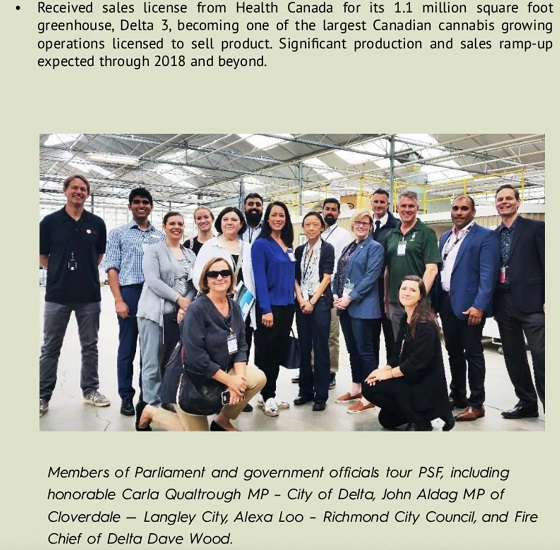
On October 28, 2020, police executed search warrants at multiple Richmond properties; they later described “Project Big Smoke” as the cannabis-production component and “Project Rolling Thunder” as a wider drug-trafficking probe launched in November 2020. Investigators concluded the output from these sites far exceeded the limits of Health Canada licences that Emerald promoted in 2018 through investor materials featuring Members of Parliament Carla Qualtrough and John Aldag, Richmond councillor Alexa Loo and Yad Kallu. Police estimated the facilities could produce roughly 18 million dollars’ worth of cannabis annually.
While cannabis was the primary focus, Delta Police’s “Rolling Thunder” raids—targeting a biker network linked to Emerald-branded marijuana—also uncovered hundreds of individually packaged doses of fentanyl, methamphetamine and crack cocaine, along with approximately one kilogram of powdered cocaine, according to filings in the B.C. Director of Civil Forfeiture’s ongoing case against Emerald-linked properties.
Meanwhile, in his 2023 appearance before a United States jury, Dhillon acknowledged that he agreed to testify against a number of his alleged conspirators, including Sharp, partly to mitigate his sentence. Dhillon testified that he personally earned between six and seven million dollars from these schemes, with proceeds funneled through various means—including offshore accounts in Singapore and Switzerland, cash deliveries, and payments routed through “designees.”
Dhillon’s testimony also illuminated Fred Sharp’s pivotal role in orchestrating these schemes, alleging Sharp established layers of offshore structures to hide beneficial ownership and exploited small-cap and emerging-market companies, including cannabis and biotech firms.
The Bureau is a reader-supported publication.
To receive new posts and support my work, consider becoming a free or paid subscriber.

illegal immigration
While Trump has southern border secure, hundreds of thousands of illegal immigrants still flooding in from Canada

From The Center Square
By
Under the Biden administration, the greatest number of illegal border crossers at the U.S.-Canada border were reported in U.S. history, breaking records nearly every month for four years, The Center Square first reported.
While record high numbers dropped under the Trump administration, illegal entries still remain high in northern border states, with some states reporting more apprehensions in 2025 than during the Biden years.
Fourteen U.S. states share the longest international border in the world with Canada, totaling 5,525 miles across land and water.
The majority of illegal border crossers were apprehended and encountered in five northern border states, according to U.S. Customs and Border Protection data analyzed by The Center Square. Nearly half were reported in New York. Washington, Vermont, Maine and Montana recorded the next greatest numbers.
The majority of northern border states reported the greatest number of illegal entries in U.S. history in 2024, the last year of the Biden administration, according to CBP data. At the height of the border crisis, illegal entries reached nearly 200,000 at the northern border in 2024 and in 2023, first reported by The Center Square.
For fiscal years 2022 through 2025, 754,928 illegal border crossers were reported in 14 northern border states, according to the latest available CBP data.
From west to east, illegal entries at the northern border totaled:
-
Alaska: 7,380
-
Washington: 135,116
-
Idaho: 620
-
Montana: 32,036
-
North Dakota: 14,818
-
Minnesota: 8,315
-
Wisconsin: 118
-
Michigan: 50,321
-
Ohio: 1,546
-
Pennsylvania: 19,145
-
New York: 363,910
-
Vermont: 61,790
-
New Hampshire: 82
-
Maine: 59,731
Notably, Alaska, Idaho, New York, Pennsylvania and Wisconsin reported record high illegal crossings in 2023. Although Montana and North Dakota saw a drop in 2025 from record highs in 2024, the number of illegal border crossers apprehended in the two states in 2025 were greater than they were in 2022; in Montana they were more than double.
The data only includes nine months of the Trump administration. The CBP fiscal year goes from Oct. 1 through Sept. 30. Biden administration data includes the first three months of fiscal 2025, nine months of fiscal 2021, and all of fiscal years 2022, 2023 and 2024. Combined, illegal northern border crosser apprehensions totaled roughly one million under the Biden administration, according to CBP data.
The data excludes “gotaways,” the official term used by CBP to describe foreign nationals who illegally enter between ports of entry to evade capture, don’t make immigration claims and don’t return to their country of origin. CBP does not publicly report gotaway data. The Center Square exclusively obtained it from Border Patrol agents. More than two million gotaways were identified by Border Patrol agents under the Biden administration, although the figure is expected to be much higher, The Center Square first reported.
For decades, the northern border has been largely unmanned and unprotected with increased threats of terrorism and lack of operational control, The Center Square reported.
Unlike the 1,954-mile U.S.-Mexico border, there is no border wall, significantly less technological equipment exists and far fewer agents are stationed there.
Officials have explained that the data represents a fraction of illegal border crossers – it remains unclear how many really came through largely remote areas where one Border Patrol agent may be responsible for patrolling several hundred miles, The Center Square has reported.
Despite being understaffed and having far less resources, Border Patrol and CBP agents at the U.S.-Canada border apprehended the greatest number of known or suspected terrorists (KSTs) in U.S. history during the Biden administration – 1,216, or 64% of the KSTs apprehended nationwide, The Center Square exclusively reported.
In February, President Donald Trump for the first time in U.S. history declared a national emergency at the northern border, also ordering the U.S. military to implement border security measures there. After shutting down illegal entries at the southwest border, the administration acknowledged the majority of fentanyl and KSTs were coming through the northern border, The Center Square reported.
The Trump administration has also prioritized increased funding, recruitment and hiring and investment in technological capabilities at the northern border.

From Energy Now
By Stewart Muir
For years, a conservation NGO supported by major foreign foundations has taken on the guise of Indigenous governance authority on British Columbia’s north coast. Meanwhile, rights-holding First Nations with an economic agenda are reshaping the region, yet their equal weight is overlooked. A clash of values has resulted.
For more than a decade, British Columbians have been told — mostly by well-meaning journalists and various pressure groups — that an organization called Coastal First Nations speaks with authority for the entire coast. The name sounds official. It sounds governmental. It sounds like a coalition of Indigenous governments with jurisdiction over marine waters.
It isn’t any of those things.
Coastal First Nations (CFN) is a non-governmental organization, incorporated under the BC Societies Act as The Great Bear Initiative Society. It doesn’t hold Indigenous rights or title. It has no legislated role to provide benefits or services to First Nations members. It has no jurisdiction over shipping, marine safety, forestry, fisheries, energy development, or environmental regulation. Yet its statements are frequently treated as if they carry the weight of sovereign authority.
It’s time to say out loud what many leaders — municipal, Indigenous, and industry — already know: CFN is an advocacy group, not a government. Case in point, a recent news story with the following lede: “B.C.’s Coastal First Nations say they will use ‘every tool in their toolbox’ to keep oil tankers out of the northern coastal waters.” A spokesperson claimed to represent “the Rights and Title Holders of the Central and North Coast and Haida Gwaii,” yet notwithstanding the rights of any individual First Nation, CFN does not hold any formal authority.
Here’s why this matters. The truth is, Alberta has already struck its grand bargain with the rest of Canada. Now it’s time to confront the uncomfortable truth that the country is still one bargain short of a functioning national deal.
In 2026, with Canadians increasingly alert to who is shaping national conversations, there is a reasonable expectation that debates affecting our economic future should be led and conducted by Canadians — not by foreign foundations, not by out-of-country campaign strategists, and not by NGOs built to advance someone else’s policy objectives.
Where the confusion came from
CFN’s rise in public visibility traces back to the “Great Bear Rainforest” era, when U.S. philanthropic foundations poured large sums of money into environmental campaigns in British Columbia. A Senate of Canada committee document notes that the Gordon & Betty Moore Foundation alone provided approximately $25 million directly to Coastal First Nations, delivered as twenty-five nearly $1 million installments.
CFN also played a central role in the Great Bear Rainforest negotiations, which were financed by a coalition of foreign philanthropies including the Packard Foundation, Hewlett Foundation, Wilburforce Foundation, Rockefeller Brothers Fund, Nature Conservancy/Nature United, and Tides Canada Foundation. These foundations collectively contributed tens of millions of dollars to the “conservation financing” model that anchored CFN’s operating environment.
This history isn’t speculative. It’s well documented in foundation reports, Canadian Parliamentary evidence, and the publicly disclosed financial architecture behind the Great Bear Rainforest. For a generation, well-funded U.S. environmental campaigns have worked to make Canadians afraid of their own shadow by seeding doubt, stoking paralysis, and teaching a resource nation to second-guess the very wealth that built it.
Between 2010 and 2018, an independent forensic accounting review by Deloitte Forensic (backed by the Alberta government) found that foreign foundations provided roughly $788.1 million in grants for Canadian environmental initiatives. The largest single category — by a wide margin — was marine-based initiatives, totalling $297.2 million. In Deloitte’s categorization, “marine-based” overwhelmingly refers to coastal campaigns: Great Bear Rainforest–related advocacy, anti-tanker/shipping activism, marine-use regulation campaigns, marine ecological programs, and other coastal political work.

Land-based initiatives were the second-largest category ($191 million), followed by wildlife preservation ($173 million).
The forensic review also showed that of the $427.2 million that physically entered Canada, 82% — approximately $350.3 million — was spent in British Columbia, with the dominant share directed specifically toward coastal and marine initiatives.
Taken together, these findings confirm that foreign-funded environmental activity in Canada has been geographically concentrated in British Columbia and thematically concentrated on the coast – exactly the domain where CFN has been positioned as a public-facing authority.
The real authority lies with the nations themselves
If British Columbians want to understand who truly governs the coast, they should look to the Indigenous governments that hold rights, title, citizens, and accountability — not NGOs that comment from the sidelines. That means not overlooking:
- Haisla Nation, leaders of Cedar LNG
- Nisga’a Nation, co-developers of Ksi Lisims LNG
- Gitxaala Nation, asserting legal and territorial authority
- Kitselas and Kitsumkalum, both shaping regional development
These governments are also coastal First Nations. They negotiate major economic partnerships, steward lands and waters, and make decisions grounded in their own legal orders. Moreover, representation is the key measure of accountability in a democracy: First Nations governing councils are elected by their members. The CFN is not elected. The nations are accountable to their own people — not to U.S. philanthropies or to the strategic objectives of foreign-backed environmental campaigns.
The Haisla Nation once belonged to CFN, but quit in protest in 2012 when the body opposed LNG. The Haisla council went on to fully embrace economic development via liquefied natural gas and own the upcoming Cedar LNG project.
Meanwhile, the central and northern coastal regions where CFN has opposed numerous economic opportunities continue to suffer the worst child poverty in British Columbia.
In the delicate politics of the region’s First Nations alliances, relationships are constantly in motion and governed by inviolable traditions of mutual respect. From these threads, it has to be said that the CFN’s strategy of weaving the appearance of unanimity is truly a fabrication. In point of fact, CFN represents just one half of the story. My data source tells the story, by drawing together the latest available economic and demographic information for 216 British Columbia First Nations:
- Status Indian residents of CFN communities on the north coast number 5,484, with a total membership near and far of 20,447.
- The pro-development group noted earlier numbers 5,505 living local out of a total membership of 16,830.
In other words, virtually equal. Hence it’s obvious that any media report citing CFN as the singular authority for local First Nations interests is a misleading one. CFN speaks for only a slice of the North Coast, not the whole, and the numbers make that impossible to ignore.
When a CFN motion opposing responsible resource development was adopted by the Assembly of First Nations (see Dec. 2 news), it was further evidence that the deck is stacked against First Nations that are accountable and position themselves as having broad responsibilities, including but not limited to raising the standard of living of their members.
The future belongs to the nations
The politics of LNG on the North Coast can’t be grasped without staring directly at the tanker ban — not as scripture, but as the political curiosity it has become. Anyone who knows these waters understands it’s mostly theatre: it doesn’t question letting Alaska oil tanker ships transit our exclusive economic zone when we cannot, and it doesn’t touch the real risks coastal people actually worry about. Yet waving it away is naïve. The ban behaves like a trickster spirit in our public life — capricious, emotionally loaded, and capable of turning a routine policy debate into a cultural conflagration with barely a flick of its tail.
This is why Coastal First Nations retain such gravitational pull. For years, the ban has served as the moral architecture of their Great Bear Sea campaign. CFN represents a long-game strategy — build legitimacy, occupy the moral high ground, and shape the destiny of a nation by holding the symbolic centre. Their concerns seem genuine and rooted in lived stewardship – yet were shaped by Madison Avenue minds hired by American philanthropists to affect our politics. But a near equal number of coastal nation residents unified by a different outlook also have skin in the game. They are charting futures grounded in prosperity, environmental care, and sovereignty on their own terms, and their authority is the real thing — born of title, law, and accountability to their own people.
And here is the irony worth heeding: the tanker ban’s pageantry masks a solution. It is dragging into daylight a conversation the province has avoided for decades — a conversation that will soon prove inevitable as court rulings unsettle the very foundation of property rights in British Columbia. This is the hinge that the moment turns on.
Canada cannot resolve its growing national contradictions without moving its energy to global markets. Alberta has already made its grand bargain with the country. Now British Columbia must craft its own — harnessing the prosperity of energy development to discharge political debts and finally settle the title question that has defined the province’s modern era.
Stewart Muir


IEA peak-oil reversal gives Alberta long-term leverage
Healthcare And Pipelines Are The Front Lines of Canada’s Struggle To Stay United

Net Zero goal is a fundamental flaw in the Ottawa-Alberta MOU
Canadians love Nordic-style social programs as long as someone else pays for them
Trump vows to pause migration after D.C. shooting

Alberta can’t fix its deficits with oil money: Lennie Kaplan

Alleged Liberal vote-buying scandal lays bare election vulnerabilities Canada refuses to fix
-
 Alberta2 days ago
Alberta Sports Hall of Fame Announces Class of 2026 Inductees
-
 Business2 days ago
Canada’s climate agenda hit business hard but barely cut emissions
-
 Business1 day ago
Carney’s Toronto cabinet meetings cost $530,000
-
 Bruce Dowbiggin1 day ago
Integration Or Indignation: Whose Strategy Worked Best Against Trump?
-
 Artificial Intelligence2 days ago
AI is accelerating the porn crisis as kids create, consume explicit deepfake images of classmates
-
 MAiD1 day ago
101-year-old woman chooses assisted suicide — press treats her death as a social good
-
 Energy2 days ago
Canada following Europe’s stumble by ignoring energy reality
-
 Censorship Industrial Complex2 days ago
Conservative MP Leslyn Lewis slams Liberal plan targeting religious exemption in hate speech bil