
espionage
One in five mail-in voters admitted to committing voter fraud during 2020 election: Rasmussen poll


From LifeSiteNews

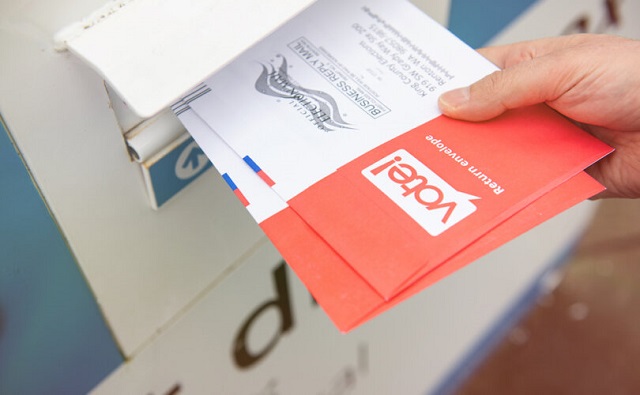
21% of mail-in voters admitted to illegally filling out a ballot on someone else’s behalf, and 17% admitted to voting from a state where they are not a legal resident.
One-fifth of voters who cast mail-in ballots during the 2020 presidential election admitted to committing at least one kind of voter fraud, according to the results of a recent poll conducted by Rasmussen Reports and The Heartland Institute.
Tucker Carlson posted to X on Friday an excerpt of a discussion with Justin Haskins, director of the Socialism Research Center at the Heartland Institute, in which Haskins explained how a poll conducted together with Rasmussen Reports revealed widespread illegal voter activity among mail-in voters during the 2020 election. The poll was first published in December, 2023.
About one in five mail-in ballots in the last election was fraudulent, handing Biden the presidency. We know this because the people who committed the fraud have admitted it in a new poll. pic.twitter.com/fxHL9hT4sw
— Tucker Carlson (@TuckerCarlson) April 26, 2024
Respondents who indicated that they voted by mail in the 2020 election were asked a series of questions probing for illegal, fraudulent activity, although the questions did not explicitly label these activities as “fraud.”
“For example, we asked people, ‘Did you vote in a state where you’re no longer a legal resident? If you’re not a permanent resident of a state, you can’t vote there. 17% of people, nearly one in five, said yes,” Haskins told Carlson.
He further shared that 21% of mail-in voters admitted to filling out a ballot on behalf of someone else, another illegal activity, and 17% admitted to forging a signature on someone else’s behalf, “with or without their permission.”
“So all told, it’s at least one in five mail-in ballots involved some kind of fraudulent activity,” said Haskins.
Of all voter respondents — both those who voted by mail and those who voted in person —10% said that “a friend, family member, co-worker, or other acquaintance” admitted to them that they voted by mail in a state other than the one they are registered in as their state of permanent residence.
“The results of this survey are nothing short of stunning,” Haskins remarked following the poll results. “For the past three years, Americans have repeatedly been told that the 2020 election was the most secure in history. But if this poll’s findings are reflective of reality, the exact opposite is true. This conclusion isn’t based on conspiracy theories or suspect evidence, but rather from the responses made directly by the voters themselves.”
“A democratic republic cannot survive if election laws allow voters to commit fraud easily, and that’s exactly what occurred during the 2020 election,” he continued. “Although some progress has been made in more than a dozen states since the conclusion of the 2020 election, much more work is needed in most regions of the United States. If America’s election laws do not improve soon, voters and politicians will continue to question the truthfulness and fairness of all future elections.”
Carlson pointed out that claims that the 2020 presidential election results were based on fraudulent votes are considered a “criminal offense” now in the U.S., at least to the extent that “that crime appears to form the basis of one of Trump’s pending indictments.” The indictment in question claims that Trump used “false claims of election fraud to obstruct the federal government function by which those results are collected, counted, and certified.”
Mounds of evidence of fraud in the 2020 general election have emerged, but this has been widely ignored by the mainstream media.
For example, in 2022, a peer-reviewed paper from accomplished economist and former senior researcher for the Department of Justice (DOJ), John Lott, compiled statistical evidence of voter fraud in the 2020 election, specifically, of about “255,000 excess votes (possibly as many as 368,000) for Joe Biden in six swing states where Donald Trump lodged accusations of fraud.”
Batches of votes that were suspiciously tallied overwhelmingly for Biden were reported the night of the election, reversing a former Trump lead in states like Pennsylvania and Wisconsin. And before the election, Project Veritas released a video showing voters being bribed and coaxed to vote for Democrats, including by changing their votes on the ballot.



By Stephen Nagy for Inside Policy
Beijing understands what many Canadians still resist: that our greatest national virtues, including our desire to be an “honest broker” on the world stage, have become our most exploitable weaknesses.
On December 1, 2018, RCMP officers arrested Huawei CFO Meng Wanzhou at Vancouver International Airport. As Canadians know well, within days, China seized two Canadians, Michael Kovrig and Michael Spavor, on fabricated espionage charges. For 1,019 days, they endured arbitrary detention while Canada faced an impossible choice of abandoning the rule-of-law or watching its citizens suffer in Chinese prisons.
This was hostage diplomacy. But more insidiously, it was also the opening move in a broader campaign against Canada, guided by the ancient Chinese proverb “借刀杀人” (Jiè dāo shā rén), or “Kill with a borrowed knife.” Beijing’s strategy, like the proverb, exploits others to do its bidding while remaining at arm’s length. In this case, it seeks to exploit Canadian vulnerabilities such as our resource-dependent economy, our multicultural identity, our loosely governed Arctic territories, and our naïve belief that we can balance relationships with all major powers – even when those powers are in direct conflict with one another.
With its “borrowed knife” campaign, Beijing understands what many Canadians still resist: that our greatest national virtues, including our desire to be an “honest broker” on the world stage, have become our most exploitable weaknesses.
The Weaponization of Canadian Niceness
Canadian foreign policy rests on the Pearsonian tradition. It is the belief that our lack of imperial history and (now irrelevant) middle-power status uniquely positions us as neutral mediators. We pride ourselves on sending peacekeepers, not warfighters. We build bridges through dialogue and compromise.
Beijing exploited this subjective, imagined identity. When Canada arrested Meng pursuant to our extradition treaty with the United States, Chinese state media framed it as Canada “choosing sides” and betraying its honest broker role. This narrative trapped Canadian political culture. Our mythology says we transcend conflicts through enlightened multilateralism. But the modern world increasingly demands choosing sides.
When former Prime Minister Jean Chrétien and former Ambassador John McCallum advocated releasing Meng to free the “Two Michaels,” they weren’t acting as Chinese agents. They were expressing a genuinely Canadian impulse that conflict resolves through compromise. Yet this “Canadian solution” was precisely what Beijing sought, abandoning legal principles under pressure.
China’s economic coercion has followed a similar logic. When Beijing blocked Canadian canola, pork, and beef exports – targeting worth $2.7 billion worth of Prairie agricultural products – the timing was transparently political. However, China maintained the fiction of “quality concerns,” making it extremely difficult for Canada to challenge the restrictions via the World Trade Organization. At the same time, Prairie farmers pressured Ottawa to accommodate Beijing.
The borrowed knife was Canadian democratic debate itself, turned against Canadian interests. Beijing didn’t need to directly change policy, it mobilized Canadian farmers, business lobbies, and opposition politicians to do it instead.
The Arctic: Where Mythology Meets Reality
No dimension better illustrates China’s strategy than the Arctic. Canada claims sovereignty over vast northern territories while fielding six icebreakers to Russia’s forty. We conduct summer sovereignty operations that leave territories ungoverned for nine months annually. Chinese state-owned enterprises invest in Arctic mining, Chinese research vessels map Canadian waters, and Beijing now calls itself a “near-Arctic state,” a term appearing nowhere in international law.
This campaign weaponizes the gap between Canadian mythology and capacity. When China proposes infrastructure investment, our reflex is “economic opportunity.” When Chinese researchers request Arctic access, our instinct is accommodation because we’re co-operative multilateralists. Each accommodation establishes precedent, each precedent normalizes Chinese presence, and each normalized presence constrains future Canadian options.
Climate change accelerates these dynamics. As ice melts, the Northwest Passage becomes navigable. Canada insists these are internal waters. China maintains they’re international straits allowing passage. The scenario exposes Canada’s dilemma perfectly. Does Ottawa escalate against our second-largest trading partner over waters we cannot patrol, or accept Chinese transits as fait accompli? Either choice represents failure.
The Diaspora Dilemma
Canada’s multiculturalism represents perhaps our deepest national pride. The Chinese Communist Party has systematically weaponized this openness through United Front Work Department operations, an ostensibly independent community organization that provides genuine services while advancing Beijing’s agenda including: monitoring dissidents, mobilizing Chinese-Canadians for CCP-approved candidates, organizing counter-protests against Tibetan and Uyghur activists, and creating environments where criticism of Beijing risks community ostracism and threats to relatives in China.
The establishment of illegal Chinese police stations in Toronto and Vancouver represents this operation’s logical endpoint. These “overseas service centres” conducted intimidation operations, pressured targets to return to China, and maintained surveillance on diaspora communities.
Canada’s response illuminates our vulnerability. When investigations exposed how Chinese organized crime groups, operating with apparent CCP protection, laundered billions through Vancouver real estate while financing fentanyl trafficking, initial reactions accused investigators of anti-Chinese bias. When CSIS warned that MPs might be compromised, debate focused on whether the warning represented racial profiling rather than whether compromise occurred.
Beijing engineered this trap brilliantly. Legitimate criticism of CCP operations becomes conflated with anti-Chinese racism. Our commitment to multiculturalism gets inverted into paralysis when a foreign government exploits ethnic networks for political warfare. The borrowed knife is Canadian anti-racism, wielded against Canadian sovereignty and this leaves nearly two million Chinese-Canadians under a cloud of suspicion while actual operations continue with limited interference.

What Resistance Requires
Resisting comprehensive pressure demands abandoning comfortable myths and making hard choices.
First, recognize that 21st-century middle-power independence is increasingly fictional. The global order is re-polarizing. Canada cannot maintain equidistant relationships with Washington and Beijing during strategic competition. We can trade with China, but not pretend shared rhetoric outweighs fundamental disagreements about sovereignty and human rights. The Pearsonian honest-broker role is obsolete when major powers want you to choose sides.
Second, invest in sovereignty capacity, not just claims. Sovereignty is exercised or forfeited. This requires sustained investment in military forces, intelligence services, law enforcement, and Arctic infrastructure. It means higher defence spending, more robust counterintelligence, and stricter foreign investment screening, traditionally un-Canadian approaches, which is precisely why we need them.
Third, build coalitions with countries facing similar pressures. Australia, Japan, South Korea, Lithuania, and others have faced comparable campaigns. When China simultaneously blocks Canadian canola, Australian wine, and Lithuanian dairy, that’s not separate trade disputes but a pattern requiring coordinated democratic response. The borrowed knife only works when we’re isolated.
Fourth, Ottawa must do much more to protect diaspora communities while confronting foreign operations. Effective policy must shut down United Front operations and illegal police stations while ensuring actions don’t stigmatize communities. Success requires clear communication that we’re targeting a foreign government’s operations, not an ethnic community.
Finally, we must accept the necessity of selective economic diversification. Critical infrastructure, sensitive technologies, and strategic resources cannot be integrated with an authoritarian state weaponizing interdependence. This means higher costs and reduced export opportunities – but maximum efficiency sometimes conflicts with strategic resilience. Canada can achieve this objective with a synergistic relationship with the US and other allies and partners that understand the tangential link between economic security and national security.
Conclusion
Canada’s myths, that we transcend conflicts, that multiculturalism creates only strength, that resource wealth brings pure prosperity and positivity, coupled with our deep vein of light-but-arrogant anti-Americanism, have become exploitable weaknesses. Beijing systematically tested each myth and used the gap between self-conception and reality as leverage.
The borrowed knife strategy works because we keep handing over the knife. Our openness becomes the vector for interference. Our trade dependence becomes the lever for coercion. Our niceness prevents us from recognizing we’re under attack.
Resistance doesn’t require abandoning Canadian values. It requires understanding that defending them demands costs we’ve historically refused to pay. The Chinese “Middle Kingdom” that tells the world it has had 5,000 years of peaceful history has entered a world that doesn’t reward peaceability, it exploits it. The question is whether we’ll recognize the borrowed knife for what it is and put it down before we bleed out from self-inflicted wounds.
Stephen R. Nagy is a professor of politics and international studies at the International Christian University in Tokyo and a senior fellow and China Project lead at the Macdonald-Laurier Institute (MLI). The title for his forthcoming monograph is “Japan as a Middle Power State: Navigating Ideological and Systemic Divides.”

From LifeSiteNews
Of the Royal Canadian Mounted Police’s fleet of 1,200 drones, 79% pose national security risks due to them being made in China
Canada’s top police force spent millions on now near-useless and compromised security drones, all because they were made in China, a nation firmly controlled by the Communist Chinese Party (CCP) government.
An internal report by the Royal Canadian Mounted Police (RCMP) to Canada’s Senate national security committee revealed that $34 million in taxpayer money was spent on a fleet of 973 Chinese-made drones.
Replacement drones are more than twice the cost of the Chinese-made ones between $31,000 and $35,000 per unit. In total, the RCMP has about 1,228 drones, meaning that 79 percent of its drone fleet poses national security risks due to them being made in China.
The RCMP said that Chinese suppliers are “currently identified as high security risks primarily due to their country of origin, data handling practices, supply chain integrity and potential vulnerability.”
In 2023, the RCMP put out a directive that restricted the use of the made-in-China drones, putting them on duty for “non-sensitive operations” only, however, with added extra steps for “offline data storage and processing.”
The report noted that the “Drones identified as having a high security risk are prohibited from use in emergency response team activities involving sensitive tactics or protected locations, VIP protective policing operations, or border integrity operations or investigations conducted in collaboration with U.S. federal agencies.”
The RCMP earlier this year said it was increasing its use of drones for border security.
Senator Claude Carignan had questioned the RCMP about what kind of precautions it uses in contract procurement.
“Can you reassure us about how national security considerations are taken into account in procurement, especially since tens of billions of dollars have been announced for procurement?” he asked.
“I want to make sure national security considerations are taken into account.”
The use of the drones by Canada’s top police force is puzzling, considering it has previously raised awareness of Communist Chinese interference in Canada.
Indeed, as reported by LifeSiteNews, earlier in the year, an RCMP internal briefing note warned that agents of the CCP are targeting Canadian universities to intimidate them and, in some instances, challenge them on their “political positions.”
The final report from the Foreign Interference Commission concluded that operatives from China may have helped elect a handful of MPs in both the 2019 and 2021 Canadian federal elections. It also concluded that China was the primary foreign interference threat to Canada.
Chinese influence in Canadian politics is unsurprising for many, especially given former Prime Minister Justin Trudeau’s past admiration for China’s “basic dictatorship.”
As reported by LifeSiteNews, a Canadian senator appointed by Trudeau told Chinese officials directly that their nation is a “partner, not a rival.”
China has been accused of direct election meddling in Canada, as reported by LifeSiteNews.
As reported by LifeSiteNews, an exposé by investigative journalist Sam Cooper claims there is compelling evidence that Carney and Trudeau are strongly influenced by an “elite network” of foreign actors, including those with ties to China and the World Economic Forum. Despite Carney’s later claims that China poses a threat to Canada, he said in 2016 the Communist Chinese regime’s “perspective” on things is “one of its many strengths.”

Canada’s EV Mandate Is Running On Empty

Why Does Canada “Lead” the World in Funding Racist Indoctrination?

US Condemns EU Censorship Pressure, Defends X

Trump Deals Biden’s EV Dreams A Death Blow

Will this deal actually build a pipeline in Canada?

Loblaws Owes Canadians Up to $500 Million in “Secret” Bread Cash

They know they are lying, we know they are lying and they know we know but the lies continue
-
 Alberta15 hours ago
The Recall Trap: 21 Alberta MLA’s face recall petitions
-
 Digital ID2 days ago
Canada considers creating national ID system using digital passports for domestic use
-
 Alberta2 days ago
Here’s why city hall should save ‘blanket rezoning’ in Calgary
-
 Fraser Institute2 days ago
Claims about ‘unmarked graves’ don’t withstand scrutiny
-
Business2 days ago
Too nice to fight, Canada’s vulnerability in the age of authoritarian coercion
-
 Energy2 days ago
Meet REEF — the massive new export engine Canadians have never heard of
-
 Energy2 days ago
Tanker ban politics leading to a reckoning for B.C.
-
 Business2 days ago
UNDRIP now guides all B.C. laws. BC Courts set off an avalanche of investment risk