
Addictions
No, drug prohibition is not ‘white supremacy’



From Break The Needle
British Columbia’s top doctor released a report arguing that the legalization of all drugs combats “racism” and “colonialism.” That’s historically illiterate.
The notion that drug prohibition is inherently racist has become exceedingly popular within the harm reduction world and, by extension, inside many public health institutions and graduate programs. Yet anyone with even a cursory knowledge of history can see that this is absurd. Societies from all across the world have long understood the dangers of addictive substances and supported efforts to criminalize them—so why is this being ignored?

Though the “prohibition is racist” movement usually flies under the public’s radar, it was thrust into the limelight earlier this month when B.C.’s top doctor, Bonnie Henry, released a report calling for the legalization of all drugs. Not only did Henry recommend that dangerous substances—including meth, cocaine and fentanyl—be sold in stores much like alcohol and cannabis, her team asserted that prohibitionist policies are “based on a history of racism, white supremacy, paternalism, colonialism, classism and human rights violations.”
One would hope such sweeping declarations would have been backed with fulsome arguments and historical references, but that didn’t happen here.
Instead, the report simply emphasized how Canada’s original drug laws, dating back to the late 19th and early 20th centuries, were motivated by racist animus against Chinese immigrants. As opium was popular among these immigrants, the drug was believed to pose a special moral threat to white society and was among the first substances to be harshly policed. This, in turn, gave the state a new legal tool to harass Chinese Canadians and, in some cases, deport them.
After briefly explaining this point, Henry’s report concluded that, “Over time, the moral panic associated with drug use expanded to target many more groups of people, including Indigenous people, Black people, women, people of colour, and people of lower socioeconomic status.” This extrapolation was presented as a self-evident fact, without any evidence or citations to explain or substantiate it.
Henry’s recommendations were immediately rejected by the provincial government and savagely ridiculed in the media. Yet the views articulated in her report, shocking as they may have been to many, were not actually exceptional. They only rehashed the dominant beliefs of the harm reduction world—beliefs have also, over the past decade or so, permeated deeply into Canada’s public health bureaucracies.
Henry’s report may be dead in the water, but the underlying ideas which animated it are still very much alive and will, in all likelihood, continue to influence Canadian policymakers within the cloistered hallways of the civil service. This is a shame, because it is difficult to overstate how strange these kinds of beliefs are.
To argue that drug prohibition is broadly based on a history of racism, mostly because it was misused for racist purposes a century ago, is kindergarten-level reasoning. There are ample examples of non-European societies, past and present, embracing criminalization. This is glaringly obvious and, in many cases, common knowledge.
Subscribe for free to get our latest news and analysis – or donate to our investigative journalism fund.
Non-Western drug prohibition throughout the ages
Perhaps one of the greatest examples of non-European drug prohibition is Sharia law, which has banned the consumption of mind-altering substances since the 7th century. One wonders how harm reduction activists can claim, with a straight face, that prohibition is rooted in “colonialism” and “white supremacy” when Islam’s religious and legal texts supported it centuries before global European empires emerged.
Since harm reduction scholars are so concerned about Chinese experiences, it would be instructive to look toward China itself, where prohibition is also popular.
In the late 18th century, the British began exporting large quantities of opium to the Qing Empire (China), which quickly fomented a wave of addiction and social disorder. Soon after, Qing officials embarked on a multi-decade campaign to criminalize the drug. “Opium is a poison, undermining our good customs and morality. Its use is prohibited by law,” wrote the Daoguang Emperor in an edict issued in 1810.
By the mid-19th century, the Qing worried that, without drastic action, China would be left bereft of money and productive men—so they banned all sales of opium and destroyed any supply of it they could find, including European wares. This angered the British, who profited handsomely off the opium trade, and led them to victoriously wage war against the Qing—not once, but twice—to forcibly stop prohibition.
Narcotics thus continued to flow through the veins of China’s body politic, wreaking havoc for generations. Since then, Chinese nationalists have bitterly remembered the Opium Wars as a colonial crime which marked the beginning of China’s “century of humiliation.”
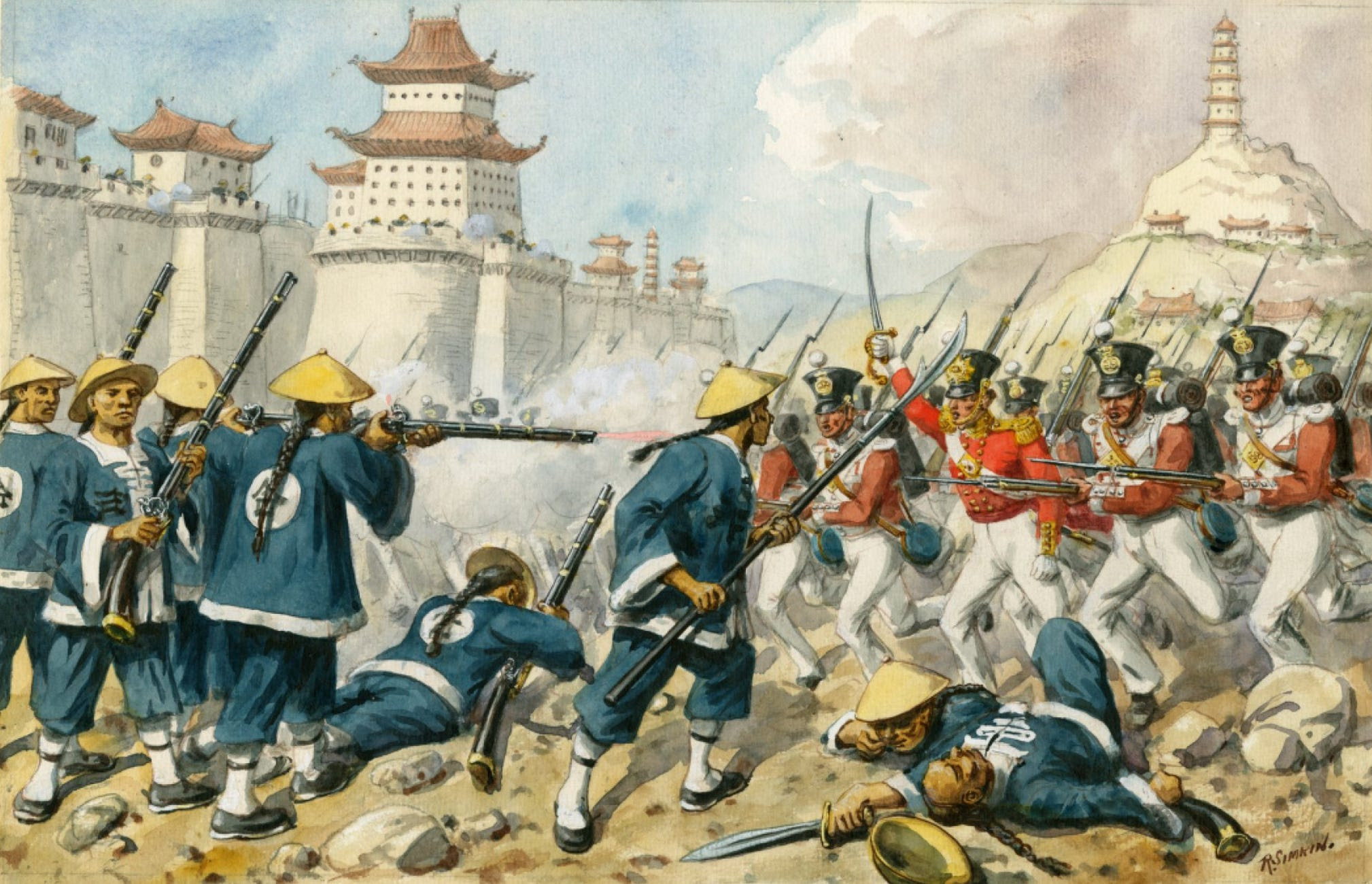 |
The 98th Regiment of Foot at the attack on Chin-Kiang-Foo (Zhenjiang), 21 July 1842, resulting in the defeat of the Manchu government. Watercolour by military illustrator Richard Simkin (1840–1926).
This raises an important question: how exactly can anyone square this history with the ideological framework of the harm reduction movement? Were the Qing embodying some mystical form of white supremacy? Perhaps we should be grateful that the British sent their anti-racist warships to decolonize China’s drug laws.
Even today, the legacy of the Opium Wars continues to inform Chinese attitudes towards drugs—both within China itself (where strict prohibitionism is the norm) and in the diaspora.
In San Francisco, America’s petri dish for drug liberalization, it is Chinese-Americans who are leading a public backlash against progressive policies and calling for greater prohibition. Similarly, Chinese-Canadians were instrumental to Vancouver’s political pivot during the 2022 municipal elections, wherein the centrist ABC party swept the city council and the mayor’s office. Just this spring, Chinese-Canadian protestors in Richmond, the most ethnically Chinese city in North America , thwarted the launch of a new supervised consumption site, only to have a white progressive woman shout “Go back to Hong Kong” at them. No doubt another anti-racist activist.
When I interviewed almost a dozen Chinese-Canadian small business owners and workers in Vancouver’s historical Chinatown last summer, their support for prohibition was clear—and the legacy of the Opium Wars was invoked several times. Many other ethnic groups are processing similar historical traumas, and facing similar erasure. Do harm reduction activists forget, for example, that early European colonists devastated North American Indigenous communities by plying them with alcohol?
Indigenous leaders did not respond to that crisis by calling for more booze. On the contrary, they pushed for prohibition. Illustratively, when Treaties No. 6 and 7 were negotiated during the 1870s, Indigenous representatives asked for the “exclusion of fire water” from Saskatchewan, and that “no intoxicating liquor be allowed to be introduced or sold” on reserves. Even today, dozens of “dry” Indigenous reserves throughout Canada continue to ban alcohol and drugs to whatever extent they can.
When I interviewed over a dozen Indigenous elders and community members in Calgary last summer, their opposition to drug liberalization was clear—some went so far as to condemn decriminalization and “safer supply” programs as “pharmaceutical colonialism.” Ronnie Chickite, chief of the We Wai Kai Nation in British Columbia, told me this spring that his entire band council was “entirely against” decriminalization and that provincial officials had allegedly ignored them.
Building upon these interviews, two senior contacts in the Ontario government confirmed to me earlier this year that Indigenous leaders across the province seem to commonly hold prohibitionist beliefs. Who would have thought that Indigenous people could be such raging white supremacists?
Surveying the world today, it is clear that drug prohibition is actually strongest in non-European states—particularly East Asian and Middle Eastern ones—while liberalization is actually more popular in the West. It is telling that the harm reduction movement seems intent on ignoring this, or, alternatively, positioning non-white prohibitionism as a symptom of corrupting European influences. Both responses are, ironically, more than a little racist—how else can one describe the systematic erasure of non-European voices?
How is it that harm reduction advocates, who make such a theatre of their own “anti-racism,” cannot grasp that non-white communities have intellectual and cultural agency and do not simply let white people dictate their beliefs? In their obsessive disdain for European civilization, these advocates close their eyes to the rest of the world and inadvertently reproduce the same cultural narcissism that they ostensibly condemn—their calls for racial justice conceal a Eurocentric mindset sopping with paternalism.
How is this possible? How has this happened? A glimpse of an answer can be found in the “Acknowledgements” section of Henry’s report this month, where brief biographies of the report’s contributors were provided. Each contributor fixated on their ethnicity and, in many cases, proclaimed themselves as “third generation settlers” or “occupiers.” Unsurprisingly, almost everyone on the team was white. Though there were some Indigenous voices (who were seemingly relegated to working on exclusively Indigenous-related tasks, of course), not a single Asian, black or Middle-Eastern voice could be found.
The B.C. provincial health officer report’s contributors section:
 |
So it seems that a bunch of white progressive bureaucrats produced a document that fixated on “colonialism” and “racism” while ignoring the actual beliefs of many, if not most, non-white communities. Nothing could encapsulate the harm reduction zeitgeist more perfectly: the privileging of empty gestures over real consultation, the self-indulgent self-flagellation of the white bourgeoisie, the patronizing assumption that minority communities have homogenous political beliefs that happen to align with progressive causes.
All of this would be comedic if lives weren’t at stake.
It should be clarified that there are many valid ways to criticize drug laws from a racial justice lens. Laws are just tools which we use to order society, and, like any tool, they can be abused—so it is fair to explore how some laws, in some contexts, have racist intentions or outcomes.
This is best illustrated by the wealth of scholarship criticizing American cannabis laws—in this case, critics have been able to concretely show that specific laws, in specific contexts, are being enforced unfairly and exacerbating inequities without producing justificatory social benefits.
Yet this mode of analysis, which focuses heavily on outcomes and concrete data, is an entirely different beast from the essentialist arguments recklessly flung around by the harm reduction movement. It makes sense to test measurable hypotheses about specific laws and their implementations. But to argue that drug prohibition is intrinsically “racist” is to succumb to ideological hallucination.
This essay originally appeared in The Hub and has been syndicated to Break The Needle through a co-publishing agreement.
Our content is always free – but if you want to help us commission more high-quality journalism, consider getting a voluntary paid subscription.


From the Brownstone Institute
Every morning, hundreds of millions of people perform a socially approved ritual. They line up for coffee. They joke about not being functional without caffeine. They openly acknowledge dependence and even celebrate it. No one calls this addiction degenerate. It is framed as productivity, taste, wellness—sometimes even virtue.
Now imagine the same professional discreetly using a nicotine pouch before a meeting. The reaction is very different. This is treated as a vice, something vaguely shameful, associated with weakness, poor judgment, or public health risk.
From a scientific perspective, this distinction makes little sense.
Caffeine and nicotine are both mild psychoactive stimulants. Both are plant-derived alkaloids. Both increase alertness and concentration. Both produce dependence. Neither is a carcinogen. Neither causes the diseases historically associated with smoking. Yet one has become the world’s most acceptable addiction, while the other remains morally polluted even in its safest, non-combustible forms.
This divergence has almost nothing to do with biology. It has everything to do with history, class, marketing, and a failure of modern public health to distinguish molecules from mechanisms.
Two Stimulants, One Misunderstanding
Nicotine acts on nicotinic acetylcholine receptors, mimicking a neurotransmitter the brain already uses to regulate attention and learning. At low doses, it improves focus and mood. At higher doses, it causes nausea and dizziness—self-limiting effects that discourage excess. Nicotine is not carcinogenic and does not cause lung disease.
Caffeine works differently, blocking adenosine receptors that signal fatigue. The result is wakefulness and alertness. Like nicotine, caffeine indirectly affects dopamine, which is why people rely on it daily. Like nicotine, it produces tolerance and withdrawal. Headaches, fatigue, and irritability are routine among regular users who skip their morning dose.
Pharmacologically, these substances are peers.
The major difference in health outcomes does not come from the molecules themselves but from how they have been delivered.
Combustion Was the Killer
Smoking kills because burning organic material produces thousands of toxic compounds—tar, carbon monoxide, polycyclic aromatic hydrocarbons, and other carcinogens. Nicotine is present in cigarette smoke, but it is not what causes cancer or emphysema. Combustion is.
When nicotine is delivered without combustion—through patches, gum, snus, pouches, or vaping—the toxic burden drops dramatically. This is one of the most robust findings in modern tobacco research.
And yet nicotine continues to be treated as if it were the source of smoking’s harm.
This confusion has shaped decades of policy.
How Nicotine Lost Its Reputation
For centuries, nicotine was not stigmatized. Indigenous cultures across the Americas used tobacco in religious, medicinal, and diplomatic rituals. In early modern Europe, physicians prescribed it. Pipes, cigars, and snuff were associated with contemplation and leisure.
The collapse came with industrialization.
The cigarette-rolling machine of the late 19th century transformed nicotine into a mass-market product optimized for rapid pulmonary delivery. Addiction intensified, exposure multiplied, and combustion damage accumulated invisibly for decades. When epidemiology finally linked smoking to lung cancer and heart disease in the mid-20th century, the backlash was inevitable.
But the blame was assigned crudely. Nicotine—the named psychoactive component—became the symbol of the harm, even though the damage came from smoke.
Once that association formed, it hardened into dogma.
How Caffeine Escaped
Caffeine followed a very different cultural path. Coffee and tea entered global life through institutions of respectability. Coffeehouses in the Ottoman Empire and Europe became centers of commerce and debate. Tea was woven into domestic ritual, empire, and gentility.
Crucially, caffeine was never bound to a lethal delivery system. No one inhaled burning coffee leaves. There was no delayed epidemic waiting to be discovered.
As industrial capitalism expanded, caffeine became a productivity tool. Coffee breaks were institutionalized. Tea fueled factory schedules and office routines. By the 20th century, caffeine was no longer seen as a drug at all but as a necessity of modern life.
Its downsides—dependence, sleep disruption, anxiety—were normalized or joked about. In recent decades, branding completed the transformation. Coffee became lifestyle. The stimulant disappeared behind aesthetics and identity.
The Class Divide in Addiction
The difference between caffeine and nicotine is not just historical. It is social.
Caffeine use is public, aesthetic, and professionally coded. Carrying a coffee cup signals busyness, productivity, and belonging in the middle class. Nicotine use—even in clean, low-risk forms—is discreet. It is not aestheticized. It is associated with coping rather than ambition.
Addictions favored by elites are rebranded as habits or wellness tools. Addictions associated with stress, manual labor, or marginal populations are framed as moral failings. This is why caffeine is indulgence and nicotine is degeneracy, even when the physiological effects are similar.
Where Public Health Went Wrong
Public health messaging relies on simplification. “Smoking kills” was effective and true. But over time, simplification hardened into distortion.
“Smoking kills” became “Nicotine is addictive,” which slid into “Nicotine is harmful,” and eventually into claims that there is “No safe level.” Dose, delivery, and comparative risk disappeared from the conversation.
Institutions now struggle to reverse course. Admitting that nicotine is not the primary harm agent would require acknowledging decades of misleading communication. It would require distinguishing adult use from youth use. It would require nuance.
Bureaucracies are bad at nuance.
So nicotine remains frozen at its worst historical moment: the age of the cigarette.
Why This Matters
This is not an academic debate. Millions of smokers could dramatically reduce their health risks by switching to non-combustion nicotine products. Countries that have allowed this—most notably Sweden—have seen smoking rates and tobacco-related mortality collapse. Countries that stigmatize or ban these alternatives preserve cigarette dominance.
At the same time, caffeine consumption continues to rise, including among adolescents, with little moral panic. Energy drinks are aggressively marketed. Sleep disruption and anxiety are treated as lifestyle issues, not public health emergencies.
The asymmetry is revealing.
Coffee as the Model Addiction
Caffeine succeeded culturally because it aligned with power. It supported work, not resistance. It fit office life. It could be branded as refinement. It never challenged institutional authority.
Nicotine, especially when used by working-class populations, became associated with stress relief, nonconformity, and failure to comply. That symbolism persisted long after the smoke could be removed.
Addictions are not judged by chemistry. They are judged by who uses them and whether they fit prevailing moral narratives.
Coffee passed the test. Nicotine did not.
The Core Error
The central mistake is confusing a molecule with a method. Nicotine did not cause the smoking epidemic. Combustion did. Once that distinction is restored, much of modern tobacco policy looks incoherent. Low-risk behaviors are treated as moral threats, while higher-risk behaviors are tolerated because they are culturally embedded.
This is not science. It is politics dressed up as health.
A Final Thought
If we applied the standards used against nicotine to caffeine, coffee would be regulated like a controlled substance. If we applied the standards used for caffeine to nicotine, pouches and vaping would be treated as unremarkable adult choices.
The rational approach is obvious: evaluate substances based on dose, delivery, and actual harm. Stop moralizing chemistry. Stop pretending that all addictions are equal. Nicotine is not harmless. Neither is caffeine. But both are far safer than the stories told about them.
This essay only scratches the surface. The strange moral history of nicotine, caffeine, and acceptable addiction exposes a much larger problem: modern institutions have forgotten how to reason about risk.
Author


From the Frontier Centre for Public Policy
Manitoba is choosing to expand the same drug policy model that other provinces are abandoning, policies that normalize addiction while sidelining treatment, recovery, and public safety.
The New Democrat premier of British Columbia, David Eby, stood before reporters last spring and called his government’s decision to permit public drug use in certain spaces a failure.
The policy was part of the broader “harm reduction” strategy meant to address overdose deaths. Instead, it had stirred public anger, increased street disorder and had helped neither users nor the communities that host them. “We do not accept street disorder that makes communities feel unsafe,” Eby said. The province scrapped the plan.
In Alberta, the Conservative government began shutting down safer-supply prescribing due to concerns about drug diversion and misuse. The belief that more opioids can resolve the opioid crisis is losing credibility.
Ontario Progressive Conservatives are moving away from harm reduction by shutting down supervised consumption sites near schools and limiting safer-supply prescribing. Federal funding for programs is decreasing, and the province is shifting its focus to treatment models, even though not all sites are yet closed.
Yet amid these non-partisan reversals, Manitoba’s government has announced its intention to open a supervised drug-use site in Winnipeg. Premier Wab Kinew said, “We have too many Manitobans dying from overdose.” True. But it does not follow that repeating failed approaches will yield different results.
Reversing these failed policies is not a rejection of compassion. It is a recognition that good intentions do not produce good outcomes. Vancouver and Toronto have hosted supervised drug-use sites for years. The death toll keeps rising. Drug deaths in British Columbia topped 2,500 in 2023, even with the most expansive harm reduction infrastructure in the country. A peer-reviewed study published this year found that hospitalizations from opioid poisoning rose after B.C.’s safer-supply policy was implemented. Emergency department visits increased by more than three cases per 100,000 population, with no corresponding drop in fatal overdoses.
And the problem persists day to day. Paramedics in B.C. responded to nearly 4,000 overdose calls in July 2024 alone. The monthly call volume has exceeded 3,000 almost every month this year. These are signs of crisis management without a path to recovery.
There are consequences beyond public health. These policies change the character of neighbourhoods. Businesses suffer. Residents feel unsafe. And most tragically, the person using drugs is offered little more than a cot, a nurse and a quiet signal to continue. Real help, like treatment, housing and purpose, remains out of reach.
Somewhere along the way, bureaucracies stopped asking what recovery looks like. They have settled for managing human decline. They call it compassion. But it is really surrender, wrapped in medical language.
Harm reduction had its time. It made sense when it first emerged, during the AIDS crisis, when dirty needles spread HIV. Back then, the goal was to stop a deadly virus. Today, that purpose has been lost.
When policy drifts into ideology, reality becomes an afterthought. Underneath today’s approach is the belief that drug use is inevitable, that people cannot change, that liberty means letting others fade away quietly. These ideas do not reflect science. They do not reflect hope. They reflect despair. They reflect a politics that prioritizes the appearance of compassion over effectiveness.
What Manitoba needs is treatment access that meets the scale of the problem. That means detox beds, recovery homes and long-term care focused on restoring lives. These may not generate the desired headlines, but they work. They are demanding. They are slow. And they offer respect to the person behind the addiction.
There are no shortcuts. No policy will undo decades of pain overnight. But a policy that keeps people stuck using is not mercy. It is maintenance with no way out.
A government that believes in its people should not copy failure.
Marco Navarro-Genie is vice-president of research at the Frontier Centre for Public Policy and co-author, with Barry Cooper, of Canada’s COVID: The Story of a Pandemic Moral Panic (2023).

Sweden Fixed What Canada Won’t Even Name

Rulings could affect energy prices everywhere: Climate activists v. the energy industry in 2026

China Stages Massive Live-Fire Encirclement Drill Around Taiwan as Washington and Japan Fortify

The Canadian Energy Centre’s biggest stories of 2025

Mainstream media missing in action as YouTuber blows lid off massive taxpayer fraud

The Global Push for Government Mandated Digital IDs And Why You Should Worry

What Do Loyalty Rewards Programs Cost Us?
-
 Energy20 hours ago
The U.S. Just Removed a Dictator and Canada is Collateral Damage
-
 Haultain Research17 hours ago
Trying to Defend Maduro’s Legitimacy
-
 Business1 day ago
Vacant Somali Daycares In Viral Videos Are Also Linked To $300 Million ‘Feeding Our Future’ Fraud
-
 International1 day ago
“Captured and flown out”: Trump announces dramatic capture of Maduro
-
International1 day ago
Trump Says U.S. Strike Captured Nicolás Maduro and Wife Cilia Flores; Bondi Says Couple Possessed Machine Guns
-
 International19 hours ago
U.S. Claims Western Hemispheric Domination, Denies Russia Security Interests On Its Own Border
-
International20 hours ago
US Justice Department Accusing Maduro’s Inner Circle of a Narco-State Conspiracy
-
International2 days ago
Maduro says he’s “ready” to talk