
Frontier Centre for Public Policy
New Book Warns The Decline In Marriage Comes At A High Cost



From the Frontier Centre for Public Policy

Travis Smith reviews I… Do? by Andrea Mrozek and Peter Jon Mitchell, showing that marriage is a public good, not just private choice, arguing culture, not politics, must lead any revival of this vital institution.
Andrea Mrozek and Peter Jon Mitchell, in I… Do?, write that the fading value of marriage is a threat to social stability
I… Do? by Andrea Mrozek and Peter Jon Mitchell manages to say something both obvious and radical: marriage matters. And not just for sentimental reasons. Marriage is a public good, the authors attest.
The book is a modestly sized but extensively researched work that compiles decades of social science data to make one central point: stable marriages improve individual and societal well-being. Married people are generally healthier, wealthier and more resilient. Children from married-parent homes do better across almost every major indicator: academic success, mental health, future earnings and reduced contact with the justice system.
The authors refer to this consistent pattern as the “marriage advantage.” It’s not simply about income. Even in low-income households, children raised by married parents tend to outperform their peers from single-parent families. Mrozek and Mitchell make the case that marriage functions as a stabilizing institution, producing better outcomes not just for couples and kids but for communities and, by extension, the country.
While the book compiles an impressive array of empirical findings, it is clear the authors know that data alone can’t fix what’s broken. There’s a quiet but important concession in these pages: if statistics alone could persuade people to value marriage, we would already be seeing a turnaround.
Marriage in Canada is in sharp decline. Fewer people are getting married, the average age of first marriage continues to climb, and fertility rates are hitting historic lows. The cultural narrative has shifted. Marriage is seen less as a cornerstone of adult life and more as a personal lifestyle choice, often put off indefinitely while people wait to feel ready, build their careers or find emotional stability.
The real value of I… Do? lies in its recognition that the solutions are not primarily political. Policy changes might help stop making things worse, but politicians are not going to rescue marriage. In fact, asking them to may be counterproductive. Looking to politicians to save marriage would involve misunderstanding both marriage and politics. Mrozek and Mitchell suggest the best the state can do is remove disincentives, such as tax policies and benefit structures that inadvertently penalize marriage, and otherwise get out of the way.
The liberal tradition once understood that family should be considered prior to politics for good reason. Love is higher than justice, and the relationships based in it should be kept safely outside the grasp of bureaucrats, ideologues, and power-seekers. The more marriage has been politicized over recent decades, the more it has been reshaped in ways that promote dependency on the impersonal and depersonalizing benefactions of the state.
The book takes a brief detour into the politics of same-sex marriage. Mrozek laments that the topic has become politically untouchable. I would argue that revisiting that battle is neither advisable nor desirable. By now, most Canadians likely know same-sex couples whose marriages demonstrate the same qualities and advantages the authors otherwise praise.
Where I… Do? really shines is in its final section. After pages of statistics, the authors turn to something far more powerful: culture. They explore how civil society—including faith communities, neighbourhoods, voluntary associations and the arts can help revive a vision of marriage that is compelling, accessible and rooted in human experience. They point to storytelling, mentorship and personal witness as ways to rebuild a marriage culture from the ground up.
It’s here that the book moves from description to inspiration. Mrozek and Mitchell acknowledge the limits of top-down efforts and instead offer the beginnings of a grassroots roadmap. Their suggestions are tentative but important: showcase healthy marriages, celebrate commitment and encourage institutions to support rather than undermine families.
This is not a utopian manifesto. It’s a realistic, often sobering look at how far marriage has fallen off the public radar and what it might take to put it back. In a political climate where even mentioning marriage as a public good can raise eyebrows, I… Do? attempts to reframe the conversation.
To be clear, this is not a book for policy wonks or ideologues. It’s for parents, educators, community leaders and anyone concerned about social cohesion. It’s for Gen Xers wondering if their children will ever give them grandchildren. It’s for Gen Zers wondering if marriage is still worth it. And it’s for those in between, hoping to build something lasting in a culture that too often encourages the opposite.
If your experiences already tell you that strong, healthy marriages are among the greatest of human goods, I… Do? will affirm what you know. If you’re skeptical, it won’t convert you overnight, but it might spark a much-needed conversation.
Travis D. Smith is an associate professor of political science at Concordia University in Montreal. This book review was submitted by the Frontier Centre for Public Policy.

From the Frontier Centre for Public Policy
By Jay Goldberg
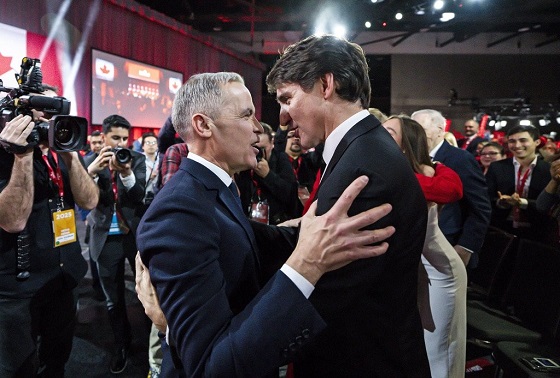
Rosy projections, chronic deficits, and opaque budgeting. If nothing changes, Carney’s credibility could collapse under the same weight.
Carney promised a fresh start. His budget makes it look like we’re still stuck with the same old Trudeau playbook
It turns out the Trudeau government really did look at Canada’s economy through rose-coloured glasses. Is the Carney government falling into the same pattern?
New research from the Frontier Centre for Public Policy shows that federal budgets during the Trudeau years “consistently overestimated [Canada’s] fiscal health” when it came to forecasting the state of the nation’s economy and finances over the long term.
In his research, policy analyst Conrad Eder finds that, when looking specifically at projections of where the economy would be four years out, Trudeau-era budgets tended to have forecast errors of four per cent of nominal GDP, or an average of $94.4 billion.
Because budgets were so much more optimistic about long-term growth, they consistently projected that government revenue would grow at a much faster pace. The Trudeau government then made spending commitments, assuming the money would be there. And when the forecasts did not keep up, deficits simply grew.
As Eder writes, “these dramatic discrepancies illustrate how the Trudeau government’s longer-term projections consistently underestimated the persistence of fiscal challenges and overestimated its ability to improve the budgetary balance.”
Eder concludes that politics came into play and influenced how the Trudeau government framed its forecasts. Rather than focusing on the long-term health of Canada’s finances, the Trudeau government was focused on politics. But presenting overly optimistic forecasts has long-term consequences.
“When official projections consistently deviate from actual outcomes, they obscure the scope of deficits, inhibit effective fiscal planning, and mislead policymakers and the public,” Eder writes.
“This disconnect between projected and actual fiscal outcomes undermines the reliability of long-term planning tools and erodes public confidence in the government’s fiscal management.”
The public’s confidence in the Trudeau government’s fiscal management was so low, in fact, that by the end of 2024 the Liberals were polling in the high teens, behind the NDP.
The key to the Liberal Party’s electoral survival became twofold: the “elbows up” rhetoric in response to the Trump administration’s tariffs, and the choice of a new leader who seemed to have significant credibility and was disconnected from the fiscal blunders of the Trudeau years.
Mark Carney was recruited to run for the Liberal leadership as the antidote to Trudeau. His résumé as governor of the Bank of Canada during the Great Recession and his subsequent years leading the Bank of England seemed to offer Canadians the opposite of the fiscal inexperience of the Trudeau years.
These two factors together helped turn around the Liberals’ fortunes and secured the party a fourth straight mandate in April’s elections.
But now Carney has presented a budget of his own, and it too spills a lot of red ink.
This year’s deficit is projected to be a stunning $78.3 billion, and the federal deficit is expected to stay over $50 billion for at least the next four years.
The fiscal picture presented by Finance Minister François-Philippe Champagne was a bleak one.
What remains to be seen is whether the chronic politicking over long-term forecasts that plagued the Trudeau government will continue to be a feature of the Carney regime.
As bad as the deficit figures look now, one has to wonder, given Eder’s research, whether the state of Canada’s finances is even worse than Champagne’s budget lets on.
As Eder says, years of rose-coloured budgeting undermined public trust and misled both policymakers and voters. The question now is whether this approach to the federal budget continues under Carney at the helm.
Budget 2025 significantly revises the economic growth projections found in the 2024 fall economic statement for both 2025 and 2026. However, the forecasts for 2027, 2028 and 2029 were left largely unchanged.
If Eder is right, and the Liberals are overly optimistic when it comes to four-year forecasts, then the 2025 budget should worry Canadians. Why? Because the Carney government did not change the Trudeau government’s 2029 economic projections by even a fraction of a per cent.
In other words, despite the gloomy fiscal numbers found in Budget 2025, the Carney government may still be wearing the same rose-coloured budgeting glasses as the Trudeau government did, at least when it comes to long-range fiscal planning.
If the Carney government wants to have more credibility than the Trudeau government over the long term, it needs to be more transparent about how long-term economic projections are made and be clear about whether the Finance Department’s approach to forecasting has changed with the government. Otherwise, Carney’s fiscal credibility, despite his résumé, may meet the same fate as Trudeau’s.
Jay Goldberg is a fellow with the Frontier Centre for Public Policy.

From the Frontier Centre for Public Policy
By Collin May
Targeting comedians is a sign of political insecurity
A democracy that fears its comedians is a democracy in trouble. That truth landed hard when Graham Linehan, the Irish writer behind Father Ted and The IT Crowd, stepped off a plane at Heathrow on Sept. 1, 2025, and was met by five London Metropolitan Police officers ready to arrest him for three posts on X.
Returning to the UK from Arizona, he was taken into custody on the charge of “suspicion of inciting violence”, an allegation levelled with increasing ease in an age wary of offence. His actual “crime” amounted to three posts, the most contentious being a joke about trans-identified men in exclusively female spaces and a suggestion that violated women respond with a swift blow to a very sensitive part of the male’s not-yet-physically-transitioned anatomy.
The reaction to Linehan’s arrest, from J.K. Rowling to a wide array of commentators, was unqualified condemnation. Many wondered whether free speech had become a museum piece in the UK. Asked about the incident, British Prime Minister Keir Starmer defended his country’s reputation for free expression but declined to address the arrest itself.
Canada has faced its own pressures on comedic expression. In 2022, comedian Mike Ward saw a 12-year legal saga end when the Supreme Court of Canada ruled five-to-four that the Quebec Human Rights Commission had no jurisdiction to hear a complaint about comments Ward made regarding a disabled Quebec boy. The ruling confirmed that human rights bodies cannot police artistic expression when no discrimination in services or employment has occurred. In that case, comic licence survived narrowly.
These cases reveal a broader trend. Governments and institutions increasingly frame comedy as a risk rather than a social pressure valve. In an environment fixated on avoiding perceived harm, humour becomes an easy and symbolic target. Linehan’s arrest underscores the fragility of free speech, especially in comedic form, in countries that claim to value democratic openness.
Comedy has long occupied an unusual place in public life. One of its earliest literary appearances is in Homer’s Iliad. A common soldier, Thersites, is ugly, sharp-tongued and irreverent. He speaks with a freedom others will not risk, mocking Agamemnon and voicing the frustrations of rank-and-file soldiers. He represents the instinct to puncture pretension. In this sense, comedy and philosophy share a willingness to speak uncomfortable truths that power prefers to avoid.
Aristotle, in his Poetics, noted that tragedy imitates noble actions and depicts people who are to be taken seriously. Comedy, by contrast, imitates those who appear inferior. Yet this lowly status is precisely what gives comedy its political usefulness. It allows performers to say what respectable voices cannot, revealing hypocrisies that formal discourse leaves untouched.
In the Iliad, Thersites does not escape punishment. Odysseus, striving to restore order, strikes him with Agamemnon’s staff, and the soldiers laugh as Thersites is silenced. The scene captures a familiar dynamic. Comedy can expose authority’s flaws, but authority often responds by asserting its dominance. The details shift across history, but the pattern endures.
Modern democracies are showing similar impatience. Comedy provides a way to question conventions without inviting formal conflict. When governments treat jokes as misconduct, they are not protecting the public from harm. They are signalling discomfort with scrutiny. Confident systems do not fear irreverence; insecure ones do.
The growing targeting of comedians matters because it reflects a shift toward institutions that view dissent, even in comedic form, as a liability. Such an approach narrows the space for open dialogue and misunderstands comedy’s role in democratic life. A society confident in itself tolerates mockery because it trusts its citizens to distinguish humour from harm.
In October, the British Crown Prosecution Service announced it would not pursue charges against Linehan. The London Metropolitan Police Service also said it would stop recording “non-crime hate incidents”, a controversial category used to document allegations of hateful behaviour even when no law has been broken. These reversals are welcome, but they do not erase the deeper unease that allowed the arrest to happen.
Comedy survives, but its environment is shifting. In an era where leaders are quick to adopt moral language while avoiding meaningful accountability, humour becomes more necessary, not less. It remains one of the few public tools capable of exposing the distance between political rhetoric and reality.
The danger is that in places where Agamemnon’s folly, leadership driven by pride and insecurity, takes root, those who speak uncomfortable truths may find themselves facing not symbolic correction but formal sanctions. A democracy that begins by targeting its jesters rarely stops there.
Collin May is a Senior Fellow with the Frontier Centre for Public Policy, a lawyer, and Adjunct Lecturer in Community Health Sciences at the University of Calgary, with degrees in law (Dalhousie University), a Masters in Theological Studies (Harvard) and a Diplome d’etudes approfondies (Ecole des hautes etudes, Paris).


Net Zero goal is a fundamental flaw in the Ottawa-Alberta MOU

Eco-radical Canadian Cabinet minister resigns after oil deal approved

Learning the Truth about “Children’s Graves” and Residential Schools is More Important than Ever

Canadians will soon be versed in massive West Coast LPG mega-project
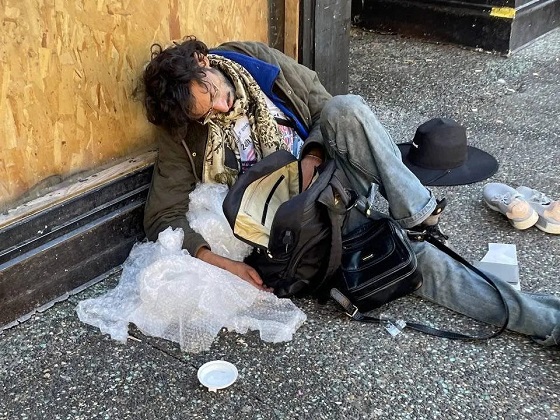
Manitoba Is Doubling Down On A Failed Drug Policy

Canada Still Serves Up Food Dyes The FDA Has Banned

The dangers of mRNA vaccines explained by Dr. John Campbell
-
 illegal immigration1 day ago
While Trump has southern border secure, hundreds of thousands of illegal immigrants still flooding in from Canada
-
 COVID-192 days ago
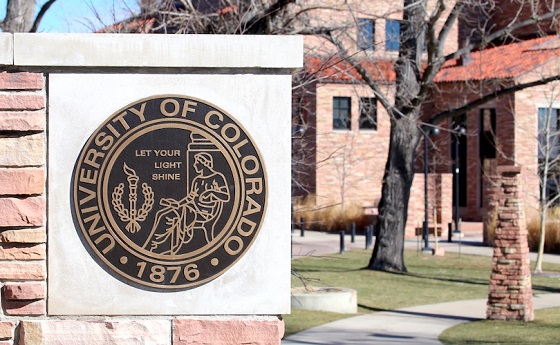
University of Colorado will pay $10 million to staff, students for trying to force them to take COVID shots
-
 Censorship Industrial Complex1 day ago
Canadian bishops condemn Liberal ‘hate speech’ proposal that could criminalize quoting Scripture
-
 Business2 days ago
Oil tanker traffic surges but spills stay at zero after Trans Mountain Expansion
-
 COVID-192 days ago
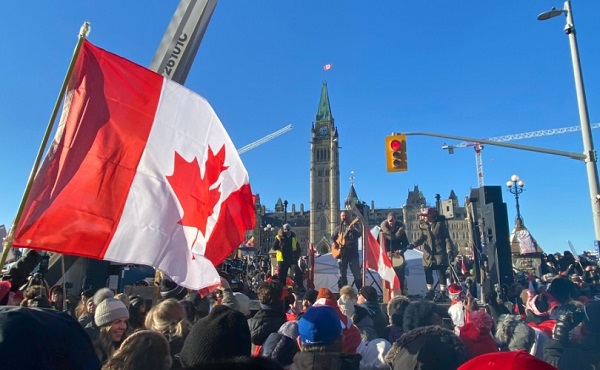
Canadian legislator introduces bill to establish ‘Freedom Convoy Recognition Day’ as a holiday
-
 Energy2 days ago
A look inside the ‘floatel’ housing B.C.’s LNG workforce
-
 Economy1 day ago
What the Data Shows About the New Canada-Alberta Pipeline Opportunity
-
 Censorship Industrial Complex6 hours ago
Frances Widdowson’s Arrest Should Alarm Every Canadian