
illegal immigration
Legacy Media Deems LA ICE Riots Are Merely ‘Protests’ As Rioters Take Torch To City



From the Daily Caller News Foundation
By Jason Cohen
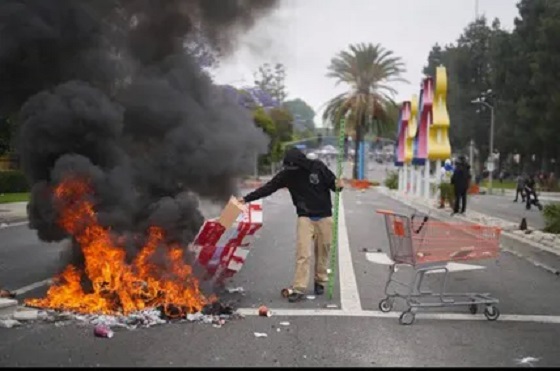
Legacy media outlets have framed violent unrest that began Friday in Los Angeles, California, over Immigration and Customs Enforcement (ICE) raids as “protests,” despite extensive vandalism, arson and attacks on police.

Riots commenced on Friday after ICE raids in Los Angeles County, prompting President Donald Trump to deploy the National Guard to the city on Saturday. Despite the violent and destructive nature of the demonstrations, several legacy media outlets opted not to describe them as “riots.”
WATCH:
Here’s the actual video of this insane quote. https://t.co/jBt8KbdaFQ pic.twitter.com/cFYh9OOuJa
— WM (@APTeacher1754) June 9, 2025
For instance, The Associated Press published a Sunday piece noting that protesters impeded access to a significant freeway and set fire to self-driving cars, but neglected to use the terms “riots” or “rioters” when describing the demonstrations.
In fact, the story even compared the Los Angeles riots to previous riots in the city in what appeared to be an attempt to downplay the violence. “The protests did not reach the size of past demonstrations that brought the National Guard to Los Angeles, including the Watts and Rodney King riots, and the 2020 protests against police violence, in which [Democratic California Gov. Gavin] Newsom requested the assistance of federal troops,” the AP wrote.
Masked rioters vandalized property, lit fires and threw rocks and fireworks at law enforcement officers in neighborhoods such as Paramount. Some also spray-painted anti-ICE slogans like “F–K ICE” and “KILL ICE” on public property.
Trump announced a deployment of 2,000 National Guard troops to Los Angeles following two days of violent clashes, although Newsom publicly objected. Federal agents conducting ICE operations arrested over 100 illegal immigrants, including people with gang and drug trafficking allegations, prompting a wave of unrest.
ABC News published a Sunday piece with a headline that even noted the protests were “violent,” but the outlet also chose not to use the term “rioters” except in quotes by ICE acting Director Todd Lyons.
The outlet reported that there were “clashes between protesters and police” and that “multiple people were seen looting a gas station store in Paramount.”
These are merely "protests," guys. Ignore the stuff being set on fire. You do you, LA Times. 🤦 pic.twitter.com/ILhKrI89Fl
— Ryan Meilstrup (@MeilstrupR36989) June 8, 2025
The Los Angeles Times also published a Sunday headline calling the riots “protests,” despite featuring an image of a fire that rioters ignited on Saturday in Paramount.
Moreover, ABC7 Los Angeles anchor Marc Brown on Sunday appeared to downplay the riots as the outlet showed footage of a car burning downtown.
“It could turn very volatile if you move law enforcement in there the wrong way and turn what is just a bunch of people having fun watching cars burn into a massive confrontation and altercation between officers and demonstrators,” Brown said.
CBS News also published a Monday piece that neglected to use the terms “riots” or “rioters,” while reporting on the anti-police violence that occurred on Sunday.
“[S]ome of those remaining threw objects at police from behind a makeshift barrier that spanned the width of a street and others hurled chunks of concrete, rocks, electric scooters and fireworks at California Highway Patrol officers and their vehicles parked on the closed southbound 101 Freeway,” the outlet wrote. “Officers ran under an overpass to take cover.”
Like the AP, CBS News also compared the anti-ICE riots to previous riots to give “some perspective on the protests,” posting a nearly identical paragraph. The outlet noted that the AP “contributed” to its article.


President Trump’s Department of Homeland Security is marking what officials are calling a landmark moment in U.S. immigration enforcement, announcing Wednesday that more than 2.5 million illegal aliens have now left the country since Trump returned to the Oval Office in January. DHS Secretary Kristi Noem said the surge reflects a sweeping, sustained crackdown driven by Immigration and Customs Enforcement teams that — according to internal tallies — have already removed more than 605,000 illegal aliens, most of whom were facing criminal charges or carrying prior convictions. Nearly two million more have opted to self-deport, a wave Noem attributes to stepped-up enforcement and the administration’s aggressive public messaging. She again urged those still in the country illegally to use the government’s CBP Home app, which offers a free one-way flight and a $1,000 stipend to expedite departure.
Senior DHS officials say arrests have climbed as well, with almost 600,000 illegal aliens taken into custody since January 20. “Illegal aliens are hearing our message to leave now,” DHS official McLaughlin said this week. “They know if they don’t, we will find them, we will arrest them, and they will never return.”
The administration argues the impact is being felt far beyond immigration courts and detention facilities, pointing to the U.S. housing market as one of the clearest signs of change. For six straight months, DHS says not a single illegal alien has been released into the interior from the southern border — a dramatic shift after years of mass inflows under President Biden. That decline, they say, is finally filtering into rent and home-price data after years of punishing increases.
Housing and Urban Development Secretary Scott Turner said Americans have now seen four consecutive months of rent decreases — the first sustained drop in years — as fewer illegal aliens compete for housing. Vice President JD Vance emphasized the connection even more bluntly: “The connection between illegal immigration and skyrocketing housing costs is as clear as day. We are proud to be moving in the right direction. Still so much to do.”
Research abroad and at home backs up the administration’s argument. Economists in Denmark released findings earlier this year showing that a one-percentage-point rise in local immigration over a five-year period drove private rental prices up roughly 6 percent and home prices up about 11 percent. The Center for Immigration Studies presented similar data to Congress last year, with researcher Steven Camarota testifying that a 5-percentage-point increase in a metro area’s recent-immigrant share was tied to a 12-percent rise in rent for U.S.-born households.
As DHS leaders frame it, Trump’s second-term enforcement machine is reshaping both border policy and household budgets — an approach they say is finally delivering relief to Americans who spent years squeezed by soaring housing costs and unchecked migration.
illegal immigration
EXCLUSIVE: Canadian groups, First Nation police support stronger border security
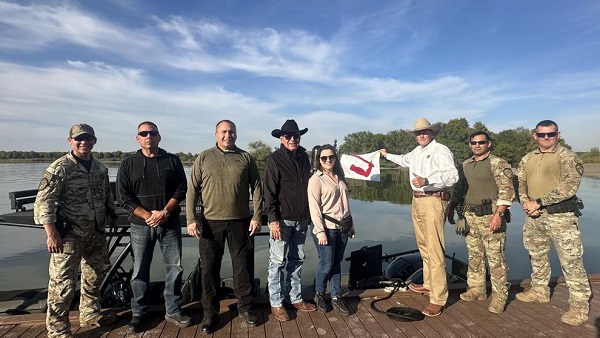
First Nation police chiefs join Texas Department of Public Safety marine units to patrol the Rio Grande River in Hidalgo County, Texas. L-R: Dwayne Zacharie, President of the First Nations Chiefs of Police Association, Ranatiiostha Swamp, Chief of Police of the Akwesasne Mohawk Territory, Brooks County Sheriff Benny Martinez, Jamie Tronnes, Center for North American Prosperity and Security, Goliad County Sheriff Roy Boyd. Photo: Bethany Blankley for The Center Square
From The Center Square
By
Despite Canadian officials arguing that the “Canada-U.S. border is the best-managed and most secure border in the world,” some Canadian groups and First Nation tribal police chiefs disagree.
This week, First Nation representatives traveled to Texas for the first time in U.S.-Canadian history to find ways to implement stronger border security measures at the U.S.-Canada border, including joining an Operation Lone Start Task Force, The Center Square exclusively reported.
Part of the problem is getting law enforcement, elected officials and the general public to understand the reality that Mexican cartels and transnational criminal organizations are operating in Canada; another stems from Trudeau administration visa policies, they argue.
When it comes to public perception, “If you tell Canadians we have a cartel problem, they’ll laugh at you. They don’t believe it. If you tell them we have a gang problem, they will absolutely agree with you 100%. They don’t think that gangs and cartels are the same thing. They don’t see the Hells Angels as equal to the Sinaloa Cartel because” the biker gang is visible, wearing vests out on the streets and cartel operatives aren’t, Jamie Tronnes, executive director of the Center of North American Prosperity and Security, told The Center Square in an exclusive interview.
The center is a US-based project of the MacDonald-Laurier Institute, the largest think tank in Canada. Tronnes previously served as a special assistant to the cabinet minister responsible for immigration and has a background in counterterrorism. She joined First Nation police chiefs to meet with Texas law enforcement and officials this week.
Another Canadian group, Future Borders Coalition, argues, “Canada has become a critical hub for transnational organized crime, with networks operating through its ports, banks, and border communities.” The Sinaloa and Jalisco New Generation Mexican cartels control the fentanyl, methamphetamine and cocaine business in Canada, partnering with local gangs like the Hells Angels and Chinese Communist Party (CCP)-linked actors, who launder profits through casinos, real estate, and shell companies in Vancouver and Toronto, Ammon Blair, a senior fellow at the Texas Public Policy Foundation, and others said at a coalition event prior to First Nation police chiefs and Tronnes coming to Texas.
“The ’Ndrangheta (Italian Mafia) maintains powerful laundering and import operations in Ontario and Quebec, while MS-13 and similar Central American gangs facilitate human smuggling and enforcement. Financial networks tied to Hezbollah and other Middle Eastern groups support laundering and logistics for these criminal alliances,” the coalition reports.
“Together, they form interconnected, technology-driven enterprises that exploit global shipping, cryptocurrency, and AI-enabled communications to traffic whatever yields profit – narcotics, weapons, tobacco, or people. Taking advantage of Canada’s lenient disclosure laws, fragmented jurisdictions, and weak cross-border coordination, these groups have embedded themselves within legitimate sectors, turning Canada into both a transit corridor and safe haven for organized crime,” the coalition reports.
Some First Nation reservations impacted by transnational crime straddle the U.S.-Canada border. One is the Akwesasne Mohawk Reservation, located in Ontario, Quebec, and in two upstate New York counties, where human smuggling and transnational crime is occurring, The Center Square reported. Another is the Tsawwassen First Nation (TWA) Reservation, located in a coastal region south of Vancouver in British Columbia stretching to Point Roberts in Washington state, which operates a ferry along a major smuggling corridor.
Some First Nation reservations like the TWA are suffering from CCP organized crime, Tronnes said. Coastal residents observe smugglers crossing their back yards, going through the reserve; along Canada’s western border, “a lot of fentanyl is being sent out to Asia but it’s also being made in Canada,” Tronnes said.
Transnational criminal activity went largely unchecked under the Trudeau government, during which “border security, national security and national defense were not primary concerns,” Tronnes told The Center Square. “It’s not to say they weren’t concerns, but they weren’t top of mind concerns. The Trudeau government preferred to focus on things like climate change, international human rights issues, a feminist foreign policy type of situation where they were looking more at virtue signaling rather than securing the country.”
Under the Trudeau administration, the greatest number of illegal border crossers, including Canadians, and the greatest number of known, suspected terrorists (KSTs) were reported at the U.S.-Canada border in U.S. history, The Center Square first reported. They include an Iranian with terrorist ties living in Canada and a Canadian woman who tried to poison President Donald Trump, The Center Square reported.
“Had it been a priority for the government to really crack down and provide resources for national security,” federal, provincial and First Nation law enforcement would be better equipped, funded and staffed, Tronnes said. “They would have better ways to understand what’s really happening at the border.”
In February, President Donald Trump for the first time in U.S. history declared a national emergency at the northern border and ordered U.S. military intervention. Months later, his administration acknowledged the majority of fentanyl and KSTs were coming from Canada, The Center Square reported.
Under a new government and in response to pressure from Trump, Canada proposed a $1.3 billion border plan. However, more is needed, the groups argue, including modernizing border technology and an analytics infrastructure, reforming disclosure and privacy rules to enable intelligence sharing, and recognizing and fully funding First Nation police, designating them as essential services and essential to border security.
“National security doesn’t exist without First Nation policing at the border,” Dwayne Zacharie, First Nations Chiefs of Police president, told The Center Square.


The Recall Trap: 21 Alberta MLA’s face recall petitions

Taxpayers Federation calls on politicians to reject funding for new Ottawa Senators arena

Canada’s free speech record is cracking under pressure

Albertans give most on average but Canadian generosity hits lowest point in 20 years

100 Catholic schoolchildren rescued, Nigeria promises release of remaining hostages
Canada considers creating national ID system using digital passports for domestic use

Claims about ‘unmarked graves’ don’t withstand scrutiny
-
 armed forces2 days ago
Ottawa’s Newly Released Defence Plan Crosses a Dangerous Line
-
 Daily Caller1 day ago
Paris Climate Deal Now Decade-Old Disaster
-
 Business19 hours ago
Ottawa Pretends To Pivot But Keeps Spending Like Trudeau
-
 Energy18 hours ago
Liberals Twisted Themselves Into Pretzels Over Their Own Pipeline MOU
-
 Censorship Industrial Complex16 hours ago
How Wikipedia Got Captured: Leftist Editors & Foreign Influence On Internet’s Biggest Source of Info
-
 Alberta1 day ago
Alberta’s huge oil sands reserves dwarf U.S. shale
-
 Community2 days ago
Charitable giving on the decline in Canada
-
 Daily Caller1 day ago
Hegseth Planning Huge Shakeup Of Top Military Command: REPORT