
C2C Journal
Learning the Truth about “Children’s Graves” and Residential Schools is More Important than Ever


This is a special preview article from the:
By Tom Flanagan

When the book Grave Error was published by True North in late 2023, it became an instant best-seller. People wanted to read the book because it contained well-documented information not readily available elsewhere concerning the history of Canada’s Indian Residential Schools (IRS) and the facts surrounding recent claims about “unmarked graves.”
Dead Wrong: How Canada Got the Residential School Story So Wrong is the just-published sequel to Grave Error. Edited by Chris Champion and me, with chapters written by knowledgeable academics, journalists, researchers and even several contributors who once worked directly in residential schools or dedicated Indian hospitals, Dead Wrong was published because the struggle for accurate information on this contentious subject continues. Let me share with you a little of what’s in Dead Wrong.
Outrageously, the New York Times, the world’s most influential newspaper among liberals and “progressives”, has never retracted its outrageously false headline that “mass graves” were uncovered at Kamloops in 2021. Journalist Jonathan Kay exposes that scandal.
With similarly warped judgment, the legacy media were enthused about last year’s so-called documentary Sugarcane, a feature-length film sponsored by National Geographic and nominated for an Academy Award. The only reporter to spot Sugarcane’s dozens of egregious factual errors was independent journalist Michelle Stirling; her expose is included in Dead Wrong.
In spring 2024, the small Interior B.C. city of Quesnel made national news when the mayor’s wife bought ten copies of Grave Error for distribution to friends. After noisy protests by people who had never read the book, Quesnel city council voted to censure Mayor Ron Paull and tried to force him from office. It’s all described in Dead Wrong.
Also not to be forgotten is how the Law Society of B.C. has forced upon its members training materials that assert against all evidence that children’s remains have been discovered at Kamloops. As told by James Pew, B.C. MLA Dallas Brodie was expelled not from the NDP but from the Conservative caucus for daring to point out this obvious and incontrovertible
falsehood. But the facts are that ground-penetrating radar (used at the former Kamloops IRS) can detect only “anomalies” or “disturbances”, not identify what those might be; that no excavations have been carried out; and that no human remains whatsoever, let alone “215 children’s bodies”, have been found there. Brodie is completely correct.
Then there is the story of Jim McMurtry, suspended by the Abbotsford District School Board shortly after the May 2021 Kamloops announcement. McMurtry’s offence was to tell students the truth that, while some Indigenous students did die in residential schools, the main cause was tuberculosis. His own book The Scarlet Lesson is excerpted in Dead Wrong.
Historian Ian Gentles and former IRS teacher Pim Wiebel offer a richly detailed analysis of health and medical conditions in the schools. They show that these were much better than what prevailed in the Indian reserves from which most students came.
Another important contribution to understanding the medical issues is by Dr. Eric Schloss, narrating the history of the Charles Camsell Indian Hospital in Edmonton. IRS facilities usually included small clinics, but students with serious problems were often transferred to Indian Hospitals for more intensive care. Schloss, who worked in the Camsell, describes how it delivered state-of-the-art medicine, probably better than the care available to most non-native children anywhere in Canada at the time.
Rodney Clifton’s contribution, “They would call me a ‘Denier,’” describes his personal experiences working in two IRS in the 1960s. Clifton does not tell stories of hunger, brutal punishment and suppression of Indigenous culture, but of games, laughter and trying to learn native languages from his Indian and Inuit charges.
And far from the IRS system being a deliberate, sustained program of cultural genocide, as Toronto lawyer and historian Greg Piasetzki explains, the historical fact is that “Canada Wanted to Close All Residential Schools in the 1940s. Here’s why it couldn’t.” That’s because for many Aboriginal parents, particularly single parents and/or those with large numbers of children,
residential schools were the best deal available. In addition to schooling their kids, they offered paid employment to large numbers of Indigenous Canadians as cooks, janitors, farmers and health care workers, and later as teachers and even principals.
Another gravely important issue is the recent phenomenon of charging critics with “residential school denialism.” This is a false accusation hurled by true believers in what has become known as the “Kamloops narrative”, aimed at shutting down criticism or questions. A key event in this process was when NDP MP Leah Gazan in 2022 persuaded the House of Commons to approve a
resolution “That, in the opinion of the House this government must recognize what happened in Canada’s Indian residential schools as genocide.”
In 2024, Gazan took the next step by introducing a private member’s bill to criminalize dissent about the IRS system. Remember, the slur of “denialist” is a term drawn from earlier debates about the Holocaust. Gazan’s bill failed to pass, but she reintroduced it in 2025. Had such provisions been in force back in 2021, it might well have become a crime to point out that the
Kamloops GPR survey had identified soil anomalies, not buried bodies. Frances Widdowson examines this sordid political campaign of denunciation.
As the proponents of the Kamloops narrative fail to provide convincing hard evidence for it, they hope to mobilize the authority of the state to stamp out dissent. One of the main goals behind publication of Dead Wrong is to head off this drive toward authoritarianism.
Happily, Dead Wrong is already an Amazon best-seller based on pre-publication orders. The struggle for truth continues.
The original, full-length version of this article was recently published by C2C Journal.
Tom Flanagan is the author of many books on Indigenous history and policy, including (with C.P. Champion) the best-selling Grave Error: How the Media Misled Us and the Truth about Residential Schools.

Business
Climate Climbdown: Sacrificing the Canadian Economy for Net-Zero Goals Others Are Abandoning
By Gwyn Morgan
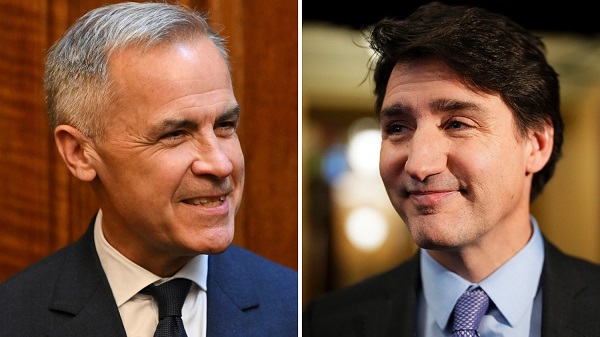
Canada has spent the past decade pursuing climate policies that promised environmental transformation but delivered economic decline. Ottawa’s fixation on net-zero targets – first under Justin Trudeau and now under Prime Minister Mark Carney – has meant staggering public expenditures, resource project cancellations and rising energy costs, all while failing to
reduce the country’s dependence on fossil fuels. Now, as key international actors reassess the net-zero doctrine, Canada stands increasingly alone in imposing heavy burdens for negligible gains.
The Trudeau government launched its agenda in 2015 by signing the Paris Climate Agreement aimed at limiting the forecast increase in global average temperature to 1.5°C by the end of the century. It followed the next year with the Pan-Canadian Framework on Clean Growth and Climate Change that imposed more than 50 measures on the economy, key among them a
carbon “pricing” regime – Liberal-speak for taxes on every Canadian citizen and industry. Then came the 2030 Emissions Reduction Plan, committing Canada to cut greenhouse gas emissions to 40 percent below 2005 levels by 2030, and to achieve net-zero by 2050. And then the “On-Farm Climate Action Fund,” the “Green and Inclusive Community Buildings Program” and the “Green Municipal Fund.”
It’s a staggering list of nation-impoverishing subsidies, taxes and restrictions, made worse by regulatory measures that hammered the energy industry. The Trudeau government cancelled the fully-permitted Northern Gateway pipeline, killing more than $1 billion in private investment and stranding hundreds of billions of dollars’ worth of crude oil in the ground. The
Energy East project collapsed after Ottawa declined to challenge Quebec’s political obstruction, cutting off a route that could have supplied Atlantic refineries and European markets. Natural gas developers fared no better: 11 of 12 proposed liquefied natural gas export terminals were abandoned amid federal regulatory delays and policy uncertainty. Only a single LNG project in Kitimat, B.C., survived.
None of this has had the desired effect. Between Trudeau’s election in 2015 and 2023, fossil fuels’ share of Canada’s energy supply actually increased from 75 to 77 percent. As for saving the world, or even making some contribution towards doing so, Canada contributes just 1.5 percent of global GHG emissions. If our emissions went to zero tomorrow, the emissions
growth from China and India would make that up in just a few weeks.
And this green fixation has been massively expensive. Two newly released studies by the Fraser Institute found that Ottawa and the four biggest provinces have either spent or foregone a mind-numbing $158 billion to create just 68,000 “clean” jobs – an eye-watering cost of over $2.3 million per job “created”. At that, the green economy’s share of GDP crept up only 0.3
percentage points.
The rest of the world is waking up to this folly. A decade after the Paris Agreement, over 81 percent of the world’s energy still comes from fossil fuels. Environmental statistician and author Bjorn Lomborg points out that achieving global net-zero by 2050 would require removing the equivalent of the combined emissions of China and the United States in each of the next five
years. “This puts us in the realm of science fiction,” he wrote recently.
In July, the U.S. Department of Energy released a major assessment assembled by a team of highly credible climate scientists which asserted that “CO 2 -induced warming appears to be less damaging economically than commonly believed,” and that aggressive mitigation policies might be “more detrimental than beneficial.” The report found no evidence of rising frequency or severity of hurricanes, floods, droughts or tornadoes in U.S. historical data, while noting that U.S. emissions reductions would have “undetectably small impacts” on global temperatures in any case.
U.S. Energy Secretary Chris Wright welcomed the findings, noting that improving living standards depends on reliable, affordable energy. The same day, the Environmental Protection Agency proposed rescinding the 2009 “endangerment finding” that had designated CO₂ and other GHGs as “pollutants.” It had led to sweeping restrictions on oil and gas development and fuelled policies that the current administration estimates cost the U.S. economy at least US$1 trillion in lost growth.
Even long-time climate alarmists are backtracking. Ted Nordhaus, a prominent American critic, recently acknowledged that the dire global warming scenarios used by the Intergovernmental Panel on Climate Change rely on implausible combinations of rapid population growth, strong economic expansion and stagnant technology. Economic growth typically reduces population increases and accelerates technological improvement, he pointed out, meaning emissions trends will likely be lower than predicted. Even Bill Gates has tempered his outlook, writing that climate change will not be “cataclysmic,” and that although it will hurt the poor, “it will not be the only or even the biggest threat to their lives and welfare.” Poverty and disease pose far greater threats and resources, he wrote, should be focused where they can do the most good now.
Yet Ottawa remains unmoved. Prime Minister Carney’s latest budget raises industrial carbon taxes to as much as $170 per tonne by 2030, increasing the competitive disadvantage of Canadian industries in a time of weak productivity and declining investment. These taxes will not measurably alter global emissions, but they will deepen Canada’s economic malaise and
push production – and emissions – toward jurisdictions with more lax standards. As others retreat from net-zero delusions, Canada moves further offside global energy policy trends – extending our country’s sad decline.
The original, full-length version of this article was recently published in C2C Journal.
Gwyn Morgan is a retired business leader who has been a director of five global corporations.
Business
Judges are Remaking Constitutional Law, Not Applying it – and Canadians’ Property Rights are Part of the Collateral Damage
By Peter Best
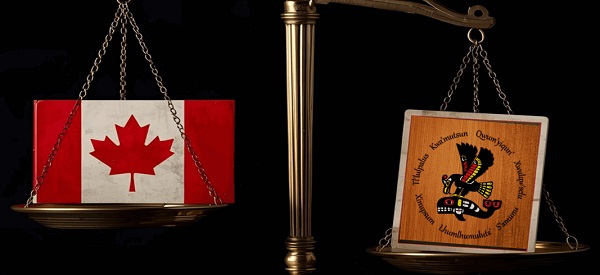
The worst thing that can happen to a property owner isn’t a flood or a leaky foundation. It’s learning that you don’t own your property – that an Aboriginal band does. This summer’s Cowichan Tribes v. Canada decision presented property owners in Richmond B.C. with exactly that horrible reality, awarding Aboriginal
title to numerous properties, private and governmental, situated within a large portion of Richmond’s Fraser River riverfront area, to Vancouver Island’s
Cowichan Tribes. For more than 150 years, these properties had been owned privately or by the government. The Cowichan Tribes had never permanently lived
there.
But B.C. Supreme Court Justice Barbara Young ruled that because the lands had never been formally surrendered by the Cowichans to the Crown by treaty, (there
were no land-surrender treaties for most of B.C.), the first Crown grants to the first settlers were in effect null and void and thus all subsequent transfers down
the chain of title to the present owners were defective and invalid.
The court ordered negotiations to “reconcile” Cowichan Aboriginal title with the interests of the current owners and governments. The estimated value of the
property and government infrastructure at stake is $100 billion.
This ruling, together with previous Supreme Court of Canada rulings in favour of the concept of Aboriginal title, vapourizes more than 150 years of legitimate
ownership and more broadly, threatens every land title in most of the rest of B.C. and in any other area in Canada not subject to a clear Aboriginal land surrender
treaty.
Behind this decision lies a revolution – one being waged not in the streets but in the courts.
In recent years Canadian judges, inspired and led by the Supreme Court of Canada, have become increasingly activist in favour of Aboriginal rights, in effect
unilaterally amending our constitutional order, without public or legislative input, to invent the “consult and accommodate” obligation, decree Aboriginal title and grant Canadian Aboriginal rights to American Indians. No consideration of the separation of powers doctrine or the national interest has ever been evidenced by
the Court in this regard.
Following the Supreme Court’s lead, Canadian judges have increasingly embraced the rhetoric of Aboriginal activism over restrained, neutral language, thus
sacrificing their need to appear to be impartial at all times.
In the Cowichan case the judge refused to use the constitutional and statutory term “Indian,” calling it harmful, thereby substituting her discretion for that of our
legislatures. She thanked Aboriginal witnesses with the word “Huychq’u”, which she omitted to translate for the benefit of others reading her decision. She didn’t
thank any Crown witnesses.
What seems like courtesy in in fact part of a larger pattern: judges in Aboriginal rights cases appearing to adopt the idiom, symbolism and worldview of the
Aboriginal litigant. From eagle staffs in the courtroom, to required participation in sweat lodge ceremonies, as in the Supreme Court-approved Restoule decision,
Canada’s justice system has drifted from impartial adjudication toward the appearance of ritualized, Aboriginal-cause solidarity.
The pivot began with the Supreme Court’s 1997 Delgamuukw v. British Columbia decision, which first accepted Aboriginal “oral tradition” hearsay evidence. Chief
Justice Lamer candidly asked in effect, “How can Aboriginals otherwise prove their case?” And with that question centuries of evidentiary safeguards intended
to ensure reliability vanished.
In Cowichan Justice Young acknowledged that oral tradition hearsay can be “subjective” and is often “not focused on establishing objective truth”, yet she
based much of her ruling on precisely such “evidence”.
The result: inherently unreliable hearsay elevated to gospel, speculation hardened into Aboriginal title, catastrophe caused to Richmond private and government property owners, the entire land titles systems of Canadian non-treaty areas undermined, and Crown sovereignty, the fount and source of all real property rights generally, further undermined.
Peter Best is a retired lawyer living in Sudbury, Ontario.
The original, full-length version of this article was recently published in C2C Journal.


From Underdog to Top Broodmare
Beijing’s blueprint for breaking Canada-U.S. unity
Alberta introducing dual practice health care model to increase options and shorten wait times while promising protection for publicly funded services
Boris Johnson Urges Ukraine to Continue War

More than 200 children will receive dangerous puberty blockers for new UK study
US Supreme Court may end ‘emergency’ tariffs, but that won’t stop the President

Premier Smith explains how private clinics will be introduced in Alberta
-
 Alberta1 day ago
Net Zero goal is a fundamental flaw in the Ottawa-Alberta MOU
-
 Daily Caller2 days ago
John Kerry Lurches Back Onto Global Stage For One Final Gasp
-
 Food1 day ago
Canada Still Serves Up Food Dyes The FDA Has Banned
-
 National1 day ago
Eco-radical Canadian Cabinet minister resigns after oil deal approved
-
 COVID-1921 hours ago
The dangers of mRNA vaccines explained by Dr. John Campbell
-
 Addictions1 day ago
Manitoba Is Doubling Down On A Failed Drug Policy
-
 Alberta21 hours ago
Keynote address of Premier Danielle Smith at 2025 UCP AGM
-
 Artificial Intelligence13 hours ago
‘Trouble in Toyland’ report sounds alarm on AI toys