“If Trump had a full USSS security detail following J13, the shooter at Mar-a-Lago wouldn’t have gone unnoticed for 12 hours”
U.S. lawmakers are calling for changes in how the U.S. Secret Service protects former President Donald Trump after a second assassination attempt Sunday.
Ryan Wesley Routh, 58, was able to hide outside a golf course where Trump was golfing. Authorities say Routh pointed the barrel of an assault-style rifle through a chain-link fence toward the golf course, was spotted by an agent, who fired at Routh. The suspect was soon arrested after fleeing the scene.
Routh reportedly waited for 12 hours outside the golf course but was only spotted just in time, raising ongoing concerns about the Secret Service’s work and Trump’s safety.
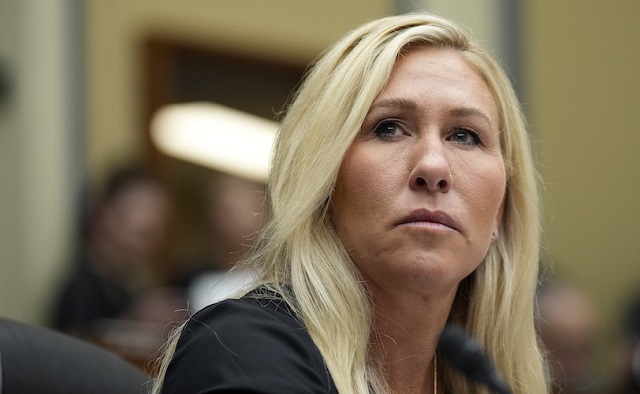
“If Trump had a full USSS security detail following J13, the shooter at Mar-a-Lago wouldn’t have gone unnoticed for 12 hours,” U.S. Rep. Pat Fallon, R-Texas, wrote on X, formerly known as Twitter, one of several lawmakers to call for an increase to Trump’s security detail.
The near-miss encounter comes just two months after Trump was nearly fatally shot July 13 in Butler County, Pennsylvania, when a shooter was able to get on a rooftop overlooking the former president’s position and fired several shots. Trump was grazed in his ear, one rally attendee was killed and two others were wounded. The Secret Service’s handling of that incident – from allowing the shooter to get a direct line of sight to the poor pre-planning to the nearly nonexistent communication with local officers – was widely criticized across the political spectrum and led to the resignation of the agency’s head.
U.S. Sen. Marsha Blackburn, R-Tenn., called for Trump to receive the same protection as President Joe Biden, given the circumstances.
“While we are still awaiting more details about this horrific event, I am thankful that the perpetrator was unsuccessful and the Secret Service agent acted swiftly to ensure that the former president is safe,” Blackburn said in a statement. “But one thing is abundantly clear: within the span of a mere two months, there have been two assassination attempts against a major presidential candidate and former president in the United States of America. It is unfathomable and unacceptable that this incident occurred.”
A coalition of Senators sent a letter to Acting Secret Service Director Ronald Rowe calling on him to allocate more resources to Trump.
Previous Trump requests for more security have reportedly been rejected.
Since Trump is not currently president, he does not receive as large of a team of agents as Biden. Department of Homeland Security Secretary Alejandro Mayorkas told Congress after the first assassination attempt that Trump’s threat-level status would be increased.
Security experts have echoed that concern. Chris Ragone, owner of Virginia-based Executive Security Concepts who has worked with the Secret Service on presidential security in the past, told The Center Square that if a full presidential-level team of Secret Service agents had been assigned to Trump, they would have found the suspect much faster.
“If they were taking this threat serious… the entire perimeter should have been checked, and they would have found this guy,” Ragone told The Center Square. “You know, if he had parked his car 30 minutes before and got out, OK, but we now know that guy was there for 12 hours, which means there were no resources that checked that entire perimeter. And that’s always the first thing we do is check a perimeter and lock it down.
“I think it wasn’t noticed it because it was a manpower issue,” he added.
As The Center Square previously reported, President Joe Biden told reporters that the U.S. Secret Service “needs more help” though he failed to give specifics when asked.
Sen. Ted Cruz, R-Texas, called on Vice President Kamala Harris to support presidential-level security for Trump as well.
“Two attempted assassinations in 64 days, two failures by Secret Service for having woefully insufficient personnel,” Cruz said on his show, “The Verdict” Monday. “If President Trump wins in November, less than two months away, he will instantly get full presidential Secret Service protection on Election Day. Given that fact, and given the threats and the failures we have seen, the only reasonable and rational thing to do is assign President Trump right now, a full presidential detail that includes the perimeter coverage so that you can’t get a sniper that close, and if Joe Biden doesn’t do it, and by the way, if Kamala Harris had any sense at all, she would join in the call to do this.”
Todayville is a digital media and technology company. We profile unique stories and events in our community. Register and promote your community event for free.
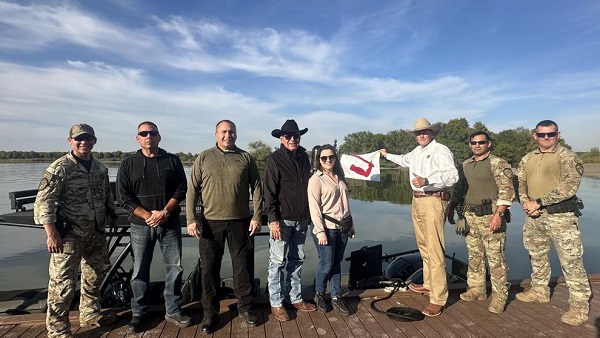
First Nation police chiefs join Texas Department of Public Safety marine units to patrol the Rio Grande River in Hidalgo County, Texas. L-R: Dwayne Zacharie, President of the First Nations Chiefs of Police Association, Ranatiiostha Swamp, Chief of Police of the Akwesasne Mohawk Territory, Brooks County Sheriff Benny Martinez, Jamie Tronnes, Center for North American Prosperity and Security, Goliad County Sheriff Roy Boyd. Photo: Bethany Blankley for The Center Square
Despite Canadian officials arguingthat the “Canada-U.S. border is the best-managed and most secure border in the world,” some Canadian groups and First Nation tribal police chiefs disagree.
This week, First Nation representatives traveled to Texas for the first time in U.S.-Canadian history to find ways to implement stronger border security measures at the U.S.-Canada border, including joining an Operation Lone Start Task Force, The Center Square exclusively reported.
Part of the problem is getting law enforcement, elected officials and the general public to understand the reality that Mexican cartels and transnational criminal organizations are operating in Canada; another stems from Trudeau administration visa policies, they argue.
When it comes to public perception, “If you tell Canadians we have a cartel problem, they’ll laugh at you. They don’t believe it. If you tell them we have a gang problem, they will absolutely agree with you 100%. They don’t think that gangs and cartels are the same thing. They don’t see the Hells Angels as equal to the Sinaloa Cartel because” the biker gang is visible, wearing vests out on the streets and cartel operatives aren’t, Jamie Tronnes, executive director of the Center of North American Prosperity and Security, told The Center Square in an exclusive interview.
The center is a US-based project of the MacDonald-Laurier Institute, the largest think tank in Canada. Tronnes previously served as a special assistant to the cabinet minister responsible for immigration and has a background in counterterrorism. She joined First Nation police chiefs to meet with Texas law enforcement and officials this week.
Another Canadian group, Future Borders Coalition, argues, “Canada has become a critical hub for transnational organized crime, with networks operating through its ports, banks, and border communities.” The Sinaloa and Jalisco New Generation Mexican cartels control the fentanyl, methamphetamine and cocaine business in Canada, partnering with local gangs like the Hells Angels and Chinese Communist Party (CCP)-linked actors, who launder profits through casinos, real estate, and shell companies in Vancouver and Toronto, Ammon Blair, a senior fellow at the Texas Public Policy Foundation, and others said at a coalition event prior to First Nation police chiefs and Tronnes coming to Texas.
“The ’Ndrangheta (Italian Mafia) maintains powerful laundering and import operations in Ontario and Quebec, while MS-13 and similar Central American gangs facilitate human smuggling and enforcement. Financial networks tied to Hezbollah and other Middle Eastern groups support laundering and logistics for these criminal alliances,” the coalition reports.
“Together, they form interconnected, technology-driven enterprises that exploit global shipping, cryptocurrency, and AI-enabled communications to traffic whatever yields profit – narcotics, weapons, tobacco, or people. Taking advantage of Canada’s lenient disclosure laws, fragmented jurisdictions, and weak cross-border coordination, these groups have embedded themselves within legitimate sectors, turning Canada into both a transit corridor and safe haven for organized crime,” the coalition reports.
Some First Nation reservations impacted by transnational crime straddle the U.S.-Canada border. One is the Akwesasne Mohawk Reservation, located in Ontario, Quebec, and in two upstate New York counties, where human smuggling and transnational crime is occurring, The Center Square reported. Another is the Tsawwassen First Nation (TWA) Reservation, located in a coastal region south of Vancouver in British Columbia stretching to Point Roberts in Washington state, which operates a ferry along a major smuggling corridor.
Some First Nation reservations like the TWA are suffering from CCP organized crime, Tronnes said. Coastal residents observe smugglers crossing their back yards, going through the reserve; along Canada’s western border, “a lot of fentanyl is being sent out to Asia but it’s also being made in Canada,” Tronnes said.
Transnational criminal activity went largely unchecked under the Trudeau government, during which “border security, national security and national defense were not primary concerns,” Tronnes told The Center Square. “It’s not to say they weren’t concerns, but they weren’t top of mind concerns. The Trudeau government preferred to focus on things like climate change, international human rights issues, a feminist foreign policy type of situation where they were looking more at virtue signaling rather than securing the country.”
Under the Trudeau administration, the greatest number of illegal border crossers, including Canadians, and the greatest number of known, suspected terrorists (KSTs) were reported at the U.S.-Canada border in U.S. history, The Center Square first reported. They include an Iranian with terrorist ties living in Canada and a Canadian woman who tried to poison President Donald Trump, The Center Square reported.
“Had it been a priority for the government to really crack down and provide resources for national security,” federal, provincial and First Nation law enforcement would be better equipped, funded and staffed, Tronnes said. “They would have better ways to understand what’s really happening at the border.”
In February, President Donald Trump for the first time in U.S. history declared a national emergency at the northern border and ordered U.S. military intervention. Months later, his administration acknowledged the majority of fentanyl and KSTs were coming from Canada, The Center Square reported.
Under a new government and in response to pressure from Trump, Canada proposed a $1.3 billion border plan. However, more is needed, the groups argue, including modernizing border technology and an analytics infrastructure, reforming disclosure and privacy rules to enable intelligence sharing, and recognizing and fully funding First Nation police, designating them as essential services and essential to border security.
“National security doesn’t exist without First Nation policing at the border,” Dwayne Zacharie, First Nations Chiefs of Police president, told The Center Square.
Beijing understands what many Canadians still resist: that our greatest national virtues, including our desire to be an “honest broker” on the world stage, have become our most exploitable weaknesses.
On December 1, 2018, RCMP officers arrested Huawei CFO Meng Wanzhou at Vancouver International Airport. As Canadians know well, within days, China seized two Canadians, Michael Kovrig and Michael Spavor, on fabricated espionage charges. For 1,019 days, they endured arbitrary detention while Canada faced an impossible choice of abandoning the rule-of-law or watching its citizens suffer in Chinese prisons.
This was hostage diplomacy. But more insidiously, it was also the opening move in a broader campaign against Canada, guided by the ancient Chinese proverb “借刀杀人” (Jiè dāo shā rén), or “Kill with a borrowed knife.” Beijing’s strategy, like the proverb, exploits others to do its bidding while remaining at arm’s length. In this case, it seeks to exploit Canadian vulnerabilities such as our resource-dependent economy, our multicultural identity, our loosely governed Arctic territories, and our naïve belief that we can balance relationships with all major powers – even when those powers are in direct conflict with one another.
With its “borrowed knife” campaign, Beijing understands what many Canadians still resist: that our greatest national virtues, including our desire to be an “honest broker” on the world stage, have become our most exploitable weaknesses.
The Weaponization of Canadian Niceness
Canadian foreign policy rests on the Pearsonian tradition. It is the belief that our lack of imperial history and (now irrelevant) middle-power status uniquely positions us as neutral mediators. We pride ourselves on sending peacekeepers, not warfighters. We build bridges through dialogue and compromise.
Beijing exploited this subjective, imagined identity. When Canada arrested Meng pursuant to our extradition treaty with the United States, Chinese state media framed it as Canada “choosing sides” and betraying its honest broker role. This narrative trapped Canadian political culture. Our mythology says we transcend conflicts through enlightened multilateralism. But the modern world increasingly demands choosing sides.
When former Prime Minister Jean Chrétien and former Ambassador John McCallum advocated releasing Meng to free the “Two Michaels,” they weren’t acting as Chinese agents. They were expressing a genuinely Canadian impulse that conflict resolves through compromise. Yet this “Canadian solution” was precisely what Beijing sought, abandoning legal principles under pressure.
China’s economic coercion has followed a similar logic. When Beijing blocked Canadian canola, pork, and beef exports – targeting worth $2.7 billion worth of Prairie agricultural products – the timing was transparently political. However, China maintained the fiction of “quality concerns,” making it extremely difficult for Canada to challenge the restrictions via the World Trade Organization. At the same time, Prairie farmers pressured Ottawa to accommodate Beijing.
The borrowed knife was Canadian democratic debate itself, turned against Canadian interests. Beijing didn’t need to directly change policy, it mobilized Canadian farmers, business lobbies, and opposition politicians to do it instead.
The Arctic: Where Mythology Meets Reality
No dimension better illustrates China’s strategy than the Arctic. Canada claims sovereignty over vast northern territories while fielding six icebreakers to Russia’s forty. We conduct summer sovereignty operations that leave territories ungoverned for nine months annually. Chinese state-owned enterprises invest in Arctic mining, Chinese research vessels map Canadian waters, and Beijing now calls itself a “near-Arctic state,” a term appearing nowhere in international law.
This campaign weaponizes the gap between Canadian mythology and capacity. When China proposes infrastructure investment, our reflex is “economic opportunity.” When Chinese researchers request Arctic access, our instinct is accommodation because we’re co-operative multilateralists. Each accommodation establishes precedent, each precedent normalizes Chinese presence, and each normalized presence constrains future Canadian options.
Climate change accelerates these dynamics. As ice melts, the Northwest Passage becomes navigable. Canada insists these are internal waters. China maintains they’re international straits allowing passage. The scenario exposes Canada’s dilemma perfectly. Does Ottawa escalate against our second-largest trading partner over waters we cannot patrol, or accept Chinese transits as fait accompli? Either choice represents failure.
The Diaspora Dilemma
Canada’s multiculturalism represents perhaps our deepest national pride. The Chinese Communist Party has systematically weaponized this openness through United Front Work Department operations, an ostensibly independent community organization that provides genuine services while advancing Beijing’s agenda including: monitoring dissidents, mobilizing Chinese-Canadians for CCP-approved candidates, organizing counter-protests against Tibetan and Uyghur activists, and creating environments where criticism of Beijing risks community ostracism and threats to relatives in China.
The establishment of illegal Chinese police stations in Toronto and Vancouver represents this operation’s logical endpoint. These “overseas service centres” conducted intimidation operations, pressured targets to return to China, and maintained surveillance on diaspora communities.
Canada’s response illuminates our vulnerability. When investigations exposed how Chinese organized crime groups, operating with apparent CCP protection, laundered billions through Vancouver real estate while financing fentanyl trafficking, initial reactions accused investigators of anti-Chinese bias. When CSIS warned that MPs might be compromised, debate focused on whether the warning represented racial profiling rather than whether compromise occurred.
Beijing engineered this trap brilliantly. Legitimate criticism of CCP operations becomes conflated with anti-Chinese racism. Our commitment to multiculturalism gets inverted into paralysis when a foreign government exploits ethnic networks for political warfare. The borrowed knife is Canadian anti-racism, wielded against Canadian sovereignty and this leaves nearly two million Chinese-Canadians under a cloud of suspicion while actual operations continue with limited interference.
What Resistance Requires
Resisting comprehensive pressure demands abandoning comfortable myths and making hard choices.
First, recognize that 21st-century middle-power independence is increasingly fictional. The global order is re-polarizing. Canada cannot maintain equidistant relationships with Washington and Beijing during strategic competition. We can trade with China, but not pretend shared rhetoric outweighs fundamental disagreements about sovereignty and human rights. The Pearsonian honest-broker role is obsolete when major powers want you to choose sides.
Second, invest in sovereignty capacity, not just claims. Sovereignty is exercised or forfeited. This requires sustained investment in military forces, intelligence services, law enforcement, and Arctic infrastructure. It means higher defence spending, more robust counterintelligence, and stricter foreign investment screening, traditionally un-Canadian approaches, which is precisely why we need them.
Third, build coalitions with countries facing similar pressures. Australia, Japan, South Korea, Lithuania, and others have faced comparable campaigns. When China simultaneously blocks Canadian canola, Australian wine, and Lithuanian dairy, that’s not separate trade disputes but a pattern requiring coordinated democratic response. The borrowed knife only works when we’re isolated.
Fourth, Ottawa must do much more to protect diaspora communities while confronting foreign operations. Effective policy must shut down United Front operations and illegal police stations while ensuring actions don’t stigmatize communities. Success requires clear communication that we’re targeting a foreign government’s operations, not an ethnic community.
Finally, we must accept the necessity of selective economic diversification. Critical infrastructure, sensitive technologies, and strategic resources cannot be integrated with an authoritarian state weaponizing interdependence. This means higher costs and reduced export opportunities – but maximum efficiency sometimes conflicts with strategic resilience. Canada can achieve this objective with a synergistic relationship with the US and other allies and partners that understand the tangential link between economic security and national security.
Conclusion
Canada’s myths, that we transcend conflicts, that multiculturalism creates only strength, that resource wealth brings pure prosperity and positivity, coupled with our deep vein of light-but-arrogant anti-Americanism, have become exploitable weaknesses. Beijing systematically tested each myth and used the gap between self-conception and reality as leverage.
The borrowed knife strategy works because we keep handing over the knife. Our openness becomes the vector for interference. Our trade dependence becomes the lever for coercion. Our niceness prevents us from recognizing we’re under attack.
Resistance doesn’t require abandoning Canadian values. It requires understanding that defending them demands costs we’ve historically refused to pay. The Chinese “Middle Kingdom” that tells the world it has had 5,000 years of peaceful history has entered a world that doesn’t reward peaceability, it exploits it. The question is whether we’ll recognize the borrowed knife for what it is and put it down before we bleed out from self-inflicted wounds.
Stephen R. Nagy is a professor of politics and international studies at the International Christian University in Tokyo and a senior fellow and China Project lead at the Macdonald-Laurier Institute (MLI). The title for his forthcoming monograph is “Japan as a Middle Power State: Navigating Ideological and Systemic Divides.”