
Daily Caller
Kevin O’Leary Says Trump’s Tariffs A Gateway To US-Canada Economic Unity



From the Daily Caller News Foundation
By Mariane Angela
‘It’s The Beginning Of A Giant Negotiation’
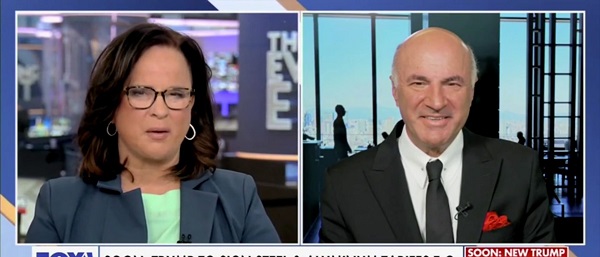
“Shark Tank” co-star Kevin O’Leary said Monday on Fox Business that President Donald Trump’s looming tariff on steel and aluminum imports have broader implications for US-Canada relations.

During an appearance on “The Evening Edit,” O’Leary discussed the impact of tariffs as the start of significant negotiations. He said there is potential for broader economic integration between the U.S. and Canada. Trump plans to impose tariffs of 25% on imports from Mexico and Canada, along with an additional 10% tariff on Canadian oil, natural gas, and electricity. Despite these significant figures, Trump has imposed only a 10% tariff on oil, the cheapest U.S. imports. O’Leary said this is merely the opening move in what could be a transformative economic negotiation.
“So all of this to me, if you separate the signal from the noise, forget the noise. The signal is, let’s get an economic union together,” O’Leary said. O’Leary said there is a global uproar over the U.S.’s proposed 25% tariffs and the reciprocal tariffs from countries like India, which have set their tariffs on some U.S. products at up to 23%.
“Those are two different baskets. Obviously, the one that people are talking about quite a bit tonight is India. They’ve got certain product services in different sectors, up to 23%. Now we’re going to have reciprocal tariffs in the U.S. against them. [Indian Prime Minister Narendra] Modi will immediately fly to Washington. The negotiations will begin,” O’Leary said.
O’Leary, however, said Canada’s situation differs from others.
“It’s the same everywhere. The Canadian situation is unique. Almost the entire 200 million deficit that the president’s talking about comes from one single source. That’s energy coming out of Irving Refineries on the east coast down to Boston, and all of that oil, 4.3 million barrels a day coming in at Alberta into the west,” O’Leary said. “And so that’s the most inexpensive oil [that] the U.S. imports. That’s why he only put a 10% tariff on it. But it’s the beginning of a giant negotiation. Aluminum, 70% of aluminum comes in the U.S. It’s made in Canada for one singular reason.”
While some skeptics doubt Canada’s willingness to merge economies, a growing number of Canadians, O’Leary said, are open to exploring such a possibility.
“What is on the table that now 43% of Canadians want to explore more of? Forget all these tariffs. Let’s join the two economies, become a behemoth, common currency perhaps, and then take on China,” O’Leary added. “I mean, that’s really what we’re talking about here. We’re talking about the security of the north, not the 49th parallel.”
When asked about what the U.S. could gain from such tariffs beyond economic leverage, O’Leary said it’s about the broader geopolitical benefits:
“Let me assure you that 11 out of 10 Canadians would rather trade their Trudeau pesos for American dollars. They already have American dollar accounts. Trudeau has wiped out 41% of their net worth the last nine years. They want an economic union because it’s good for business. Everybody understands that. The two countries are so intertwined, and they both believe in democracy and free speech and freedom and all the rest,” O’Leary said.
O’Leary was asked what can Trump get for the American consumer and the American voter in return for these tariffs.
“Security on energy,” O’Leary said.
“Alberta has five times more oil and gas than the entire United States. Complete security on uranium, aluminum, all of the incredible resources Canada has with only 41 million people there and access to it in a free flow. No tariffs.”
Trump aggressively employed tariffs to coerce Canada and Mexico into making concessions aimed at resolving the crisis at the southern border. In response, Canada has committed to bolstering security along its northern border, while Mexico has agreed to station 10,000 National Guard troops at the border.
During former President Joe Biden’s tenure, approximately 8.5 million migrants were encountered at the U.S.-Mexico border, and this period also saw an increase in fentanyl seizures, primarily driven by Chinese chemical companies. Meanwhile, even though less frequent, illegal crossings at the northern border also surged during the Biden administration.

Daily Caller
Scathing Indictment Claims Nicolás Maduro Orchestrated Drug-Fueled ‘Culture Of Corruption’ Which Plagued Entire Region
From the Daily Caller News Foundation
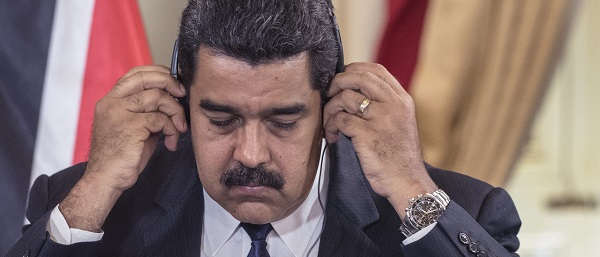
Ousted socialist Venezuelan dictator Nicolás Maduro was the mastermind of a pervasive drug-fueled “culture of corruption” which extended all the way to the U.S.’s backyard, according to the scathing indictment against him, his wife, his son, and others, released Saturday.
Hours after President Donald Trump announced Maduro’s capture and removal from power, Attorney General Pam Bondi confirmed the deposed despot and his wife, Cilia Flores, were indicted in the Southern District of New York on four charges, including narco-terrorism conspiracy, and “will soon face the full wrath of American justice” on U.S. soil. A grand jury found Maduro “and corrupt members of his regime enabled corruption fueled by drug trafficking throughout” the Latin American region, including in Mexico and Central America, and empowered notorious crime syndicates such as Tren de Aragua (TdA), according to the unsealed indictment.
Signed by Trump-appointed U.S. Attorney Jay Clayton, the 25-page indictment names six defendants, including the deposed Maduro, Flores, and Maduro’s 35-year-old son from his first marriage, Nicolás “Nicolasito” Maduro Guerra. It also names as defendants TdA leader Niño Guerrero and two high-profile members of Maduro’s United Socialist Party, Diosdado Cabello Rondón and Ramón Rodríguez Chacín.
Dear Readers:
As a nonprofit, we are dependent on the generosity of our readers.
Please consider making a small donation of any amount here.
Thank you!
Maduro, “like former President [Hugo] Chávez before him[,] participates in, perpetuates, and protects a culture of corruption in which powerful Venezuelan elites enrich themselves through drug trafficking and the protection of their partner drug traffickers,” the indictment alleges. “The profits of that illegal activity flow to corrupt rank-and-file civilian, military, and intelligence officials, who operate in a patronage system run by those at the top-referred to as the Cartel de Los Soles or Cartel of the Suns, a reference to the sun insignia affixed to the uniforms of high-ranking Venezuelan military officials.”
The Trump administration’s State Department announced it was designating the Cartel de Los Soles as a Foreign Terrorist Organization (FTO) in November 2025. Secretary of State Marco Rubio wrote in a statement at the time the cartel “is headed by Nicolás Maduro and other high-ranking individuals of the illegitimate Maduro regime who have corrupted Venezuela’s military, intelligence, legislature, and judiciary.”
The indictment also notes the South American nation “sits in a geographically valuable location for drug traffickers” and that, around the time Chávez came to power in 1999, “Venezuela became a safe haven” for them.
“In that environment, cocaine trafficking flourished,” the indictment continues, citing State Department estimates from arund 2020, with between 200 and 250 tons of the drug being trafficked through the country each year.
The charging document goes on to allege Maduro, his wife, son, and political allies had “partnered with narcotics traffickers and narco-terrorist groups, who dispatched processed cocaine from Venezuela to the United States via transshipment points in the Caribbean and Central America, such as Honduras, Guatemala, and Mexico.”
“Through this drug trafficking, [Maduro] and corrupt members of his regime enabled corruption fueled by drug trafficking throughout the region,” the indictment continues. “The transshipment points in Honduras, Guatemala, and Mexico similarly relied on a culture of corruption, in which cocaine traffickers operating in those countries paid a portion of their own profits to politicians who protected and aided them. In turn, these politicians used the cocaine-fueled payments to maintain and augment their political power.”
Maduro and his regime also “facilitated the empowerment and growth of violent narco-terrorist groups fueling their organizations with cocaine profits,” according to the indictment.
The charging document notably identifies organizations which collaborated with the Maduro regime: Colombian communist militant groups Revolutionary Armed Forces of Colombia (FARC) and National Liberation Army (ELN); Mexican syndicates the Sinaloa Cartel and Los Zetas; and Guerrero’s TdA.
The indictment also alleges Maduro Guerra, the captured dictator’s son, personally “worked to ship hundreds of kilograms of cocaine from Venezuela to Miami, Florida” around the year 2017. Maduro Guerra is a member of his father’s political party and served as a Deputy to the Venezuelan National Assembly since 2021.
“During this time, MADURO GUERRA spoke with his drug trafficking partners about, among other things, shipping low-quality cocaine to New York because it could not be sold in Miami, arranging a 500-kilogram shipment of cocaine to be unloaded from a cargo container near Miami, and using scrap metal containers to smuggle cocaine into the ports of New York,” the document reads.
From the Daily Caller News Foundation
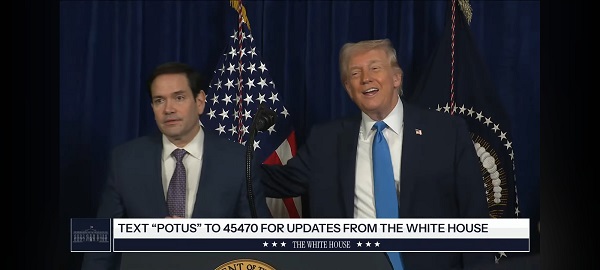
President Donald Trump said during a Saturday press conference that the United States would “run” Venezuela until a “judicious” transition could take place in the country.
Trump announced in a Saturday morning post to Truth Social that U.S. military forces carried out a law enforcement operation capturing Venezuelan President Nicolás Maduro and his wife in Caracas early Saturday morning. During his press conference later that day, Trump said that the United States would also seek to repair the infrastructure of Venezuela’s oil industry.
“We are going to run the country until such time as we can do a safe, proper and judicious transition. So, we don’t want to be involved with having somebody else get in and we have the same situation that we had for the last long period of years,” Trump said. “So, we are going to run the country until such time as we can do a safe, proper and judicious transition, and it has to be judicious because that’s what we’re all about.”
“We want peace, liberty and justice for the great people of Venezuela and that includes many from Venezuela that are now living in the United States and want to go back to their country. It’s their homeland,” Trump continued.
Many Congressional Democrats accused Trump of illegally engaging in a “regime change” operation. Trump said that Venezuela could be “making money” once its infrastructure was repaired.
“We’re there now, but we’re going to stay until such time as the proper transition can take place,” Trump said during the press conference. “We’re going to run it essentially until such time as a proper transition can take place.”
“As everyone knows the oil business in Venezuela has been a bust, a total bust for a long period of time. They were pumping almost nothing by comparison to what they could have been pumping and what could have taken place,” Trump continued. “We’re going to have our very large United States oil companies, the biggest anywhere in the world, go in, spend billions of dollars, fix the badly broken infrastructure, the oil infrastructure, and start making money for the country.”


China Stages Massive Live-Fire Encirclement Drill Around Taiwan as Washington and Japan Fortify

Rulings could affect energy prices everywhere: Climate activists v. the energy industry in 2026

Why Japan wants Western Canadian LNG
Land use will be British Columbia’s biggest issue in 2026

Mainstream media missing in action as YouTuber blows lid off massive taxpayer fraud
The Canadian Energy Centre’s biggest stories of 2025

The Global Push for Government Mandated Digital IDs And Why You Should Worry
-
 Haultain Research22 hours ago
Trying to Defend Maduro’s Legitimacy
-
 Energy1 day ago
The U.S. Just Removed a Dictator and Canada is Collateral Damage
-
 Business1 day ago
Vacant Somali Daycares In Viral Videos Are Also Linked To $300 Million ‘Feeding Our Future’ Fraud
-
 International24 hours ago
U.S. Claims Western Hemispheric Domination, Denies Russia Security Interests On Its Own Border
-
 International1 day ago
“Captured and flown out”: Trump announces dramatic capture of Maduro
-
International1 day ago
Trump Says U.S. Strike Captured Nicolás Maduro and Wife Cilia Flores; Bondi Says Couple Possessed Machine Guns
-
International1 day ago
US Justice Department Accusing Maduro’s Inner Circle of a Narco-State Conspiracy
-
International21 hours ago
“It’s Not Freedom — It’s the First Step Toward Freedom”