
Uncategorized
Huffman, 12 other parents to plead guilty in college scheme


BOSTON — Actress Felicity Huffman and a dozen other prominent parents have agreed to plead guilty in the sweeping college admissions cheating scam that has ensnared wealthy families and athletic coaches at some of the nation’s most selective universities, federal authorities said Monday.

The “Desperate Housewives” star and the other parents will admit to charges in the scheme, which authorities say involved rigging standardized test scores and bribing coaches at such prestigious schools as Yale and Georgetown.
Huffman, 56, was accused of paying a consultant $15,000 disguised as a charitable donation to boost her daughter’s SAT score. Authorities say the actress also discussed going through with the same plan for her younger daughter but ultimately decided not to.
Other parents charged in the scheme include prominent figures in law, finance, fashion, the food and beverage industry and other fields.
It’s the biggest college admissions case ever prosecuted by the Justice Department. The scandal embroiled elite universities across the country and laid bare the lengths to which status-seeking parents will go to secure their children a coveted spot.
The consultant, Rick Singer, met with Huffman and her husband, 69-year-old actor William H. Macy, at their Los Angeles home and explained to them he “controlled” a testing
Macy was not charged. Authorities have not said why.
Huffman will plead guilty to a charge of conspiracy to commit mail fraud and honest-services mail fraud, according to court documents.
In a statement offering her first public comments since her arrest last month, she apologized, took responsibility for her actions and said she would accept the consequences.
“My daughter knew absolutely nothing about my actions, and in my misguided and profoundly wrong way, I have betrayed her. This transgression toward her and the public I will carry for the rest of my life. My desire to help my daughter is no excuse to break the law or engage in dishonesty,” Huffman said.
Michael Center, the former men’s tennis coach at the University of Texas at Austin, has also agreed to plead guilty, prosecutors said Monday. Center was accused of accepting nearly $100,000 to help a non-tennis playing applicant get admitted as a recruit.
California real estate developer Bruce Isackson and his wife, Davina Isackson, who are pleading guilty to participating in both the athletic recruitment and exam rigging schemes, are
“We have worked
Fellow actress Lori Loughlin, who played Aunt Becky on the sitcom “Full House,” and her fashion designer husband, Mossimo Giannulli, are charged with paying $500,000 in bribes to get their two daughters admitted to the University of Southern California as crew recruits, even though neither participated in the sport. They were not among those who agreed to plead guilty, and they have not publicly addressed the allegations.
Singer, the consultant, pleaded guilty to charges including racketeering conspiracy on March 12, the same day the allegations against the parents and coaches were made public in the so-called Operations Varsity Blues investigation. Singer secretly recorded his conversations with the parents, helping to build the case against them, after agreeing to work with investigators in the hopes of getting a lesser sentence.
Several coaches have also been charged, including longtime tennis coach Gordon Ernst who’s accused of getting $2.7 million in bribes to designate at least 12 applicants as recruits to Georgetown. Ernst, who was also the personal tennis coach for former first lady Michelle Obama and her daughters, and other coaches have pleaded not guilty.
Former Yale University women’s soccer coach Rudy Meredith has pleaded guilty to accepting bribes to help students get admitted and has been
Stanford University expelled a student who lied about her sailing credentials in her application, which was linked to the scandal. The university quietly announced it had rescinded the student’s admission in a short statement posted on its
University officials previously said the student was admitted without the recommendation of Vandemoer.
Alanna Durkin Richer, The Associated Press

Uncategorized
Mortgaging Canada’s energy future — the hidden costs of the Carney-Smith pipeline deal


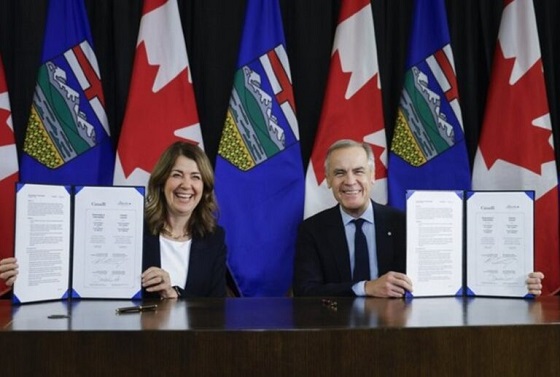
Much of the commentary on the Carney-Smith pipeline Memorandum of Understanding (MOU) has focused on the question of whether or not the proposed pipeline will ever get built.
That’s an important topic, and one that deserves to be examined — whether, as John Robson, of the indispensable Climate Discussion Nexus, predicted, “opposition from the government of British Columbia and aboriginal groups, and the skittishness of the oil industry about investing in a major project in Canada, will kill [the pipeline] dead.”
But I’m going to ask a different question: Would it even be worth building this pipeline on the terms Ottawa is forcing on Alberta? If you squint, the MOU might look like a victory on paper. Ottawa suspends the oil and gas emissions cap, proposes an exemption from the West Coast tanker ban, and lays the groundwork for the construction of one (though only one) million barrels per day pipeline to tidewater.
But in return, Alberta must agree to jack its industrial carbon tax up from $95 to $130 per tonne at a minimum, while committing to tens of billions in carbon capture, utilization, and storage (CCUS) spending, including the $16.5 billion Pathways Alliance megaproject.
Here’s the part none of the project’s boosters seem to want to mention: those concessions will make the production of Canadian hydrocarbon energy significantly more expensive.
As economist Jack Mintz has explained, the industrial carbon tax hike alone adds more than $5 USD per barrel of Canadian crude to marginal production costs — the costs that matter when companies decide whether to invest in new production. Layer on the CCUS requirements and you get another $1.20–$3 per barrel for mining projects and $3.60–$4.80 for steam-assisted operations.
While roughly 62% of the capital cost of carbon capture is to be covered by taxpayers — another problem with the agreement, I might add — the remainder is covered by the industry, and thus, eventually, consumers.
Total damage: somewhere between $6.40 and $10 US per barrel. Perhaps more.
“Ultimately,” the Fraser Institute explains, “this will widen the competitiveness gap between Alberta and many other jurisdictions, such as the United States,” that don’t hamstring their energy producers in this way. Producers in Texas and Oklahoma, not to mention Saudi Arabia, Venezuela, or Russia, aren’t paying a dime in equivalent carbon taxes or mandatory CCUS bills. They’re not so masochistic.
American refiners won’t pay a “low-carbon premium” for Canadian crude. They’ll just buy cheaper oil or ramp up their own production.
In short, a shiny new pipe is worthless if the extra cost makes barrels of our oil so expensive that no one will want them.
And that doesn’t even touch on the problem for the domestic market, where the higher production cost will be passed onto Canadian consumers in the form of higher gas and diesel prices, home heating costs, and an elevated cost of everyday goods, like groceries.
Either way, Canadians lose.
So, concludes Mintz, “The big problem for a new oil pipeline isn’t getting BC or First Nation acceptance. Rather, it’s smothering the industry’s competitiveness by layering on carbon pricing and decarbonization costs that most competing countries don’t charge.” Meanwhile, lurking underneath this whole discussion is the MOU’s ultimate Achilles’ heel: net-zero.
The MOU proudly declares that “Canada and Alberta remain committed to achieving Net-Zero greenhouse gas emissions by 2050.” As Vaclav Smil documented in a recent study of Net-Zero, global fossil-fuel use has risen 55% since the 1997 Kyoto agreement, despite trillions spent on subsidies and regulations. Fossil fuels still supply 82% of the world’s energy.
With these numbers in mind, the idea that Canada can unilaterally decarbonize its largest export industry in 25 years is delusional.
This deal doesn’t secure Canada’s energy future. It mortgages it. We are trading market access for self-inflicted costs that will shrink production, scare off capital, and cut into the profitability of any potential pipeline. Affordable energy, good jobs, and national prosperity shouldn’t require surrendering to net-zero fantasy.If Ottawa were serious about making Canada an energy superpower, it would scrap the anti-resource laws outright, kill the carbon taxes, and let our world-class oil and gas compete on merit. Instead, we’ve been handed a backroom MOU which, for the cost of one pipeline — if that! — guarantees higher costs today and smothers the industry that is the backbone of the Canadian economy.
This MOU isn’t salvation. It’s a prescription for Canadian decline.


The cost of the bureaucracy increased by $6 billion last year, according to newly released numbers in Public Accounts disclosures. The Canadian Taxpayers Federation is calling on Prime Minister Mark Carney to immediately shrink the bureaucracy.
“The Public Accounts show the cost of the federal bureaucracy is out of control,” said Franco Terrazzano, CTF Federal Director. “Tinkering around the edges won’t cut it, Carney needs to take urgent action to shrink the bloated federal bureaucracy.”
The federal bureaucracy cost taxpayers $71.4 billion in 2024-25, according to the Public Accounts. The cost of the federal bureaucracy increased by $6 billion, or more than nine per cent, over the last year.
The federal bureaucracy cost taxpayers $39.6 billion in 2015-16, according to the Public Accounts. That means the cost of the federal bureaucracy increased 80 per cent over the last 10 years. The government added 99,000 extra bureaucrats between 2015-16 and 2024-25.
Half of Canadians say federal services have gotten worse since 2016, despite the massive increase in the federal bureaucracy, according to a Leger poll.
Not only has the size of the bureaucracy increased, the cost of consultants, contractors and outsourcing has increased as well. The government spent $23.1 billion on “professional and special services” last year, according to the Public Accounts. That’s an 11 per cent increase over the previous year. The government’s spending on professional and special services more than doubled since 2015-16.
“Taxpayers should not be paying way more for in-house government bureaucrats and way more for outside help,” Terrazzano said. “Mere promises to find minor savings in the federal bureaucracy won’t fix Canada’s finances.
“Taxpayers need Carney to take urgent action and significantly cut the number of bureaucrats now.”
Table: Cost of bureaucracy and professional and special services, Public Accounts
| Year | Bureaucracy | Professional and special services |
|
$71,369,677,000 |
$23,145,218,000 |
|
|
$65,326,643,000 |
$20,771,477,000 |
|
|
$56,467,851,000 |
$18,591,373,000 |
|
|
$60,676,243,000 |
$17,511,078,000 |
|
|
$52,984,272,000 |
$14,720,455,000 |
|
|
$46,349,166,000 |
$13,334,341,000 |
|
|
$46,131,628,000 |
$12,940,395,000 |
|
|
$45,262,821,000 |
$12,950,619,000 |
|
|
$38,909,594,000 |
$11,910,257,000 |
|
|
$39,616,656,000 |
$11,082,974,000 |


Alberta’s new diagnostic policy appears to meet standard for Canada Health Act compliance
RFK Jr reversing Biden-era policies on gender transition care for minors
Geopolitics no longer drives oil prices the way it used to

Canadian university censors free speech advocate who spoke out against Indigenous ‘mass grave’ hoax

Top constitutional lawyer warns against Liberal bills that could turn Canada into ‘police state’
Carney Floor Crossing Raises Counterintelligence Questions aimed at China, Former Senior Mountie Argues
Ex-FDA Commissioners Against Higher Vaccine Standards Took $6 Million From COVID Vaccine Makers
-
 Energy2 days ago
Western Canada’s supply chain for Santa Claus
-
Alberta2 days ago
Ottawa-Alberta agreement may produce oligopoly in the oilsands
-
 Energy2 days ago
The Top News Stories That Shaped Canadian Energy in 2025 and Will Continue to Shape Canadian Energy in 2026
-
 International2 days ago
$2.6 million raised for man who wrestled shotgun from Bondi Beach terrorist
-
 armed forces1 day ago
Remembering Afghanistan and the sacrifices of our military families
-
 Opinion1 day ago
Pope Leo XIV’s Christmas night homily
-
 Fraser Institute1 day ago
How to talk about housing at the holiday dinner table
-
 Frontier Centre for Public Policy23 hours ago
Tent Cities Were Rare Five Years Ago. Now They’re Everywhere