
Censorship Industrial Complex
How the UK and Canada Are Leading the West’s Descent into Digital Authoritarianism

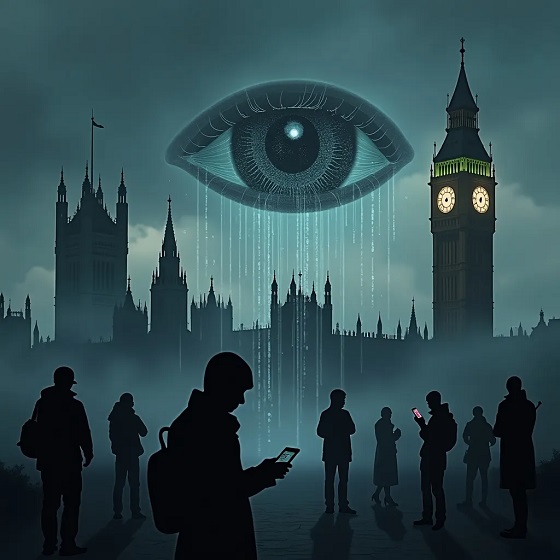


“Big Brother is watching you.” These chilling words from George Orwell’s dystopian masterpiece, 1984, no longer read as fiction but are becoming a bleak reality in the UK and Canada—where digital dystopian measures are unravelling the fabric of freedom in two of the West’s oldest democracies.
Under the guise of safety and innovation, the UK and Canada are deploying invasive tools that undermine privacy, stifle free expression, and foster a culture of self-censorship. Both nations are exporting their digital control frameworks through the Five Eyes alliance, a covert intelligence-sharing network uniting the UK, Canada, US, Australia, and New Zealand, established during the Cold War. Simultaneously, their alignment with the United Nations’ Agenda 2030, particularly Sustainable Development Goal (SDG) 16.9—which mandates universal legal identity by 2030—supports a global policy for digital IDs, such as the UK’s proposed Brit Card and Canada’s Digital Identity Program, which funnel personal data into centralized systems under the pretext of “efficiency and inclusion.” By championing expansive digital regulations, such as the UK’s Online Safety Act and Canada’s pending Bill C-8, which prioritize state-defined “safety” over individual liberties, both nations are not just embracing digital authoritarianism—they’re accelerating the West’s descent into it.
The UK’s digital dragnet
The United Kingdom has long positioned itself as a global leader in surveillance. The British spy agency, Government Communications Headquarters (GCHQ), runs the formerly-secret mass surveillance programme, code-named Tempora, operational since 2011, which intercepts and stores vast amounts of global internet and phone traffic by tapping into transatlantic fibre-optic cables. Knowledge of its existence only came about in 2013, thanks to the bombshell documents leaked by the former National Security Agency (NSA) intelligence contractor and whistleblower, Edward Snowden. “It’s not just a US problem. The UK has a huge dog in this fight,” Snowden told the Guardian in a June 2013 report. “They [GCHQ] are worse than the US.”
Following that, is the Investigatory Powers Act (IPA) 2016, also dubbed the “Snooper’s Charter,” which mandates that internet service providers store users’ browsing histories, emails, texts, and phone calls for up to a year. Government agencies, including police and intelligence services (like MI5, MI6, and GCHQ) can access this data without a warrant in many cases, enabling bulk collection of communications metadata. This has been criticized for enabling mass surveillance on a scale that invades everyday privacy.
Recent expansions under the Online Safety Act (OSA) further empower authorities to demand backdoors in encrypted apps like WhatsApp, potentially scanning private messages for vaguely defined “harmful” content—a move critics like Big Brother Watch, a privacy advocacy group, decry as a gateway to mass surveillance. The OSA, which received Royal Assent on October 26, 2023, represents a sprawling piece of legislation by the UK government to regulate online content and “protect” users, particularly children, from “illegal and harmful material.” Implemented in phases by Ofcom, the UK’s communications watchdog, it imposes duties on a vast array of internet services, including social media, search engines, messaging apps, gaming platforms, and sites with user-generated content forcing compliance through risk assessments and hefty fines. By July 2025, the OSA was considered “fully in force” for most major provisions. This sweeping regime, aligned with global surveillance trends via Agenda 2030’s push for digital control, threatens to entrench a state-sanctioned digital dragnet, prioritizing “safety” over fundamental freedoms.
Elon Musk’s platform X has warned that the act risks “seriously infringing” on free speech, with the threat of fines up to £18 million or 10% of global annual turnover for non-compliance, encouraging platforms to censor legitimate content to avoid punishment. Musk took to X to express his personal view on the act’s true purpose: “suppression of the people.”

In late September, Imgur (an image-hosting platform popular for memes and shared media) made the decision to block UK users rather than comply with the OSA’s stringent regulations. This underscores the chilling effect such laws can have on digital freedom.
The act’s stated purpose is to make the UK “the safest place in the world to be online.” However, critics argue it’s a brazen power grab by the UK government to increase censorship and surveillance, all the while masquerading as a noble crusade to “protect” users.
Another pivotal development is the Data (Use and Access) Act 2025 (DUAA), which received Royal Assent in June. This wide-ranging legislation streamlines data protection rules to boost economic growth and public services but at the cost of privacy safeguards. It allows broader data sharing among government agencies and private entities, including for AI-driven analytics. For instance, it enables “smart data schemes” where personal information from banking, energy, and telecom sectors can be accessed more easily, seemingly for consumer benefits like personalized services—but raising fears of unchecked profiling.
Cybersecurity enhancements further expand the UK’s pervasive surveillance measures. The forthcoming Cyber Security and Resilience Bill, announced in the July 2024 King’s Speech and slated for introduction by year’s end, expands the Network and Information Systems (NIS) Regulations to critical infrastructure, mandating real-time threat reporting and government access to systems. This builds on existing tools like facial recognition technology, deployed extensively in public spaces. In 2025, trials in cities like London have integrated AI cameras that scan crowds in real-time, linking to national databases for instant identification—evoking a biometric police state.

Source: BBC News
The New York Times reported: “British authorities have also recently expanded oversight of online speech, tried weakening encryption and experimented with artificial intelligence to review asylum claims. The actions, which have accelerated under Prime Minister Keir Starmer with the goal of addressing societal problems, add up to one of the most sweeping embraces of digital surveillance and internet regulation by a Western democracy.”
Compounding this, UK police arrest over 30 people a day for “offensive” tweets and online messages, per The Times, often under vague laws, fuelling justifiable fears of Orwell’s thought police.
Yet, of all the UK’s digital dystopian measures, none has ignited greater fury than Prime Minister Starmer’s mandatory “Brit Card” digital ID—a smartphone-based system effectively turning every citizen into a tracked entity.
First announced on September 4, as a tool to “tackle illegal immigration and strengthen border security,” but rapidly the Brit Card’s scope ballooned through function-creep to envelop everyday essentials like welfare, banking and public access. These IDs, stored on smartphones containing sensitive data like photos, names, dates of birth, nationalities, and residency status, are sold “as the front door to all kinds of everyday tasks,” a vision championed by the Tony Blair Institute for Global Change— and echoed by Work and Pensions Secretary Liz Kendall MP in her October 13 parliamentary speech.
Source: TheBritishIntel
This digital shackles system has sparked fierce resistance across the UK. A scathing letter, led by independent MP Rupert Lowe and endorsed by nearly 40 MPs from diverse parties, denounces the government’s proposed mandatory “Brit Card” digital ID as “dangerous, intrusive, and profoundly un-British.” Conservative MP David Davis issued a stark warning, declaring that such systems “are profoundly dangerous to the privacy and fundamental freedoms of the British people.” On X, Davis amplified his critique, citing a £14m fine imposed on Capita after hackers breached pension savers’ personal data, writing: “This is another perfect example of why the government’s digital ID cards are a terrible idea.” By early October, a petition opposing the proposal had garnered over 2.8 million signatures, reflecting widespread public outcry. The government, however, dismissed these objections, stating, “We will introduce a digital ID within this Parliament to address illegal migration, streamline access to government services, and improve efficiency. We will consult on details soon.”
Canada’s surveillance surge
Across the Atlantic, Canada’s surveillance surge under Prime Minister Mark Carney—former Bank of England head and World Economic Forum board member—mirrors the UK’s dystopian trajectory. Carney, with his globalist agenda, has overseen a slew of bills that prioritize “security” over sovereignty. Take Bill C-2, An Act to amend the Customs Act, introduced June 17, 2025, which enables warrantless data access at borders and sharing with U.S. authorities via CLOUD Act (Clarifying Lawful Overseas Use of Data Act) pacts—essentially handing Canadian citizens’ digital lives to foreign powers. Despite public backlash prompting proposed amendments in October, its core—enhanced monitoring of transactions and exports—remains ripe for abuse.
Complementing this, Bill C-8, first introduced June 18, 2025, amends the Telecommunications Act to impose cybersecurity mandates on critical sectors like telecoms and finance. It empowers the government to issue secret orders compelling companies to install backdoors or weaken encryption, potentially compromising user security. These orders can mandate the cutoff of internet and telephone services to specified individuals without the need for a warrant or judicial oversight, under the vague premise of securing the system against “any threat.”
Opposition to this bill has been fierce. In a parliamentary speech Canada’s Conservative MP Matt Strauss, decried the bill’s sections 15.1 and 15.2 as granting “unprecedented, incredible power” to the government. He warned of a future where individuals could be digitally exiled—cut off from email, banking, and work—without explanation or recourse, likening it to a “digital gulag.”
Source: Video shared by Andrew Bridgen
The Canadian Constitution Foundation (CCF) and privacy advocates have echoed these concerns, arguing that the bill’s ambiguous language and lack of due process violate fundamental Charter rights, including freedom of expression, liberty, and protection against unreasonable search and seizure.
Bill C-8 complements the Online Harms Act (Bill C-63), first introduced in February 2024, which demanded platforms purge content like child exploitation and hate speech within 24 hours, risking censorship with vague “harmful” definitions. Inspired by the UK’s OSA and EU’s Digital Services Act (DSA), C-63 collapsed amid fierce backlash for its potential to enable censorship, infringe on free speech, and lack of due process. The CCF and Pierre Poilievre, calling it “woke authoritarianism,” led a 2024 petition with 100,000 signatures. It died during Parliament’s January 2025 prorogation after Justin Trudeau’s resignation.
These bills build on an alarming precedent: during the COVID era, Canada’s Public Health Agency admitted to tracking 33 million devices during lockdown—nearly the entire population—under the pretext of public health, a blatant violation exposed only through persistent scrutiny. The Communications Security Establishment (CSE), empowered by the longstanding Bill C-59, continues bulk metadata collection, often without adequate oversight. These measures are not isolated; they stem from a deeper rot, where pandemic-era controls have been normalized into everyday policy.
Canada’s Digital Identity Program, touted as a “convenient” tool for seamless access to government services, emulates the UK’s Brit Card and aligns with UN Agenda 2030’s SDG 16.9. It remains in active development and piloting phases, with full national rollout projected for 2027–2028.
“The price of freedom is eternal vigilance.” Orwell’s 1984 warns we must urgently resist this descent into digital authoritarianism—through petitions, protests, and demands for transparency—before a Western Great Firewall is erected, replicating China’s stranglehold that polices every keystroke and thought.
If you find value in the work I do, please consider a paid subscription or make a one-off donation.

Censorship Industrial Complex
Canadian university censors free speech advocate who spoke out against Indigenous ‘mass grave’ hoax

From LifeSiteNews
Dr. Frances Widdowson was arrested and given a ticket at the University of Victoria campus after trying to engage in conversation about ‘the disputed claims of unmarked graves in Kamloops.’
A Canadian academic who spoke out against claims there are mass unmarked graves of kids on former Indigenous residential schools, and who was arrested on a university campus as a result for trespassing, is fighting back with the help of a top constitutional group.
Dr. Frances Widdowson was arrested and given a ticket on December 2, 2025, at the University of Victoria (UVic) campus after trying to engage in conversation about “the disputed claims of unmarked graves in Kamloops,” noted the Justice Centre for Constitutional Freedoms (JCCF) in a recent news release.
According to the JCCF, Widdowson was trying to initiate a “good faith” conversation with people on campus, along with the leader of OneBC provincial party, Dallas Brodi.
“My arrest at the University of Victoria is an indication of an institution that is completely unmoored from its academic purpose,” said Widdowson in a statement made available to LifeSiteNews.
She added that the “institution” has been “perpetuating the falsehood” of the remains of 215 children “being confirmed at Kamloops since 2021, and is intent on censoring any correction of this claim.”
“This should be of concern for everyone who believes that universities should be places of open inquiry and critical thinking, not propaganda and indoctrination,” she added.
UVic had the day before Widdowson’s arrest warned on its website that those in favor of free speech were “not permitted to attend UVic property for the purpose of speaking publicly.”
Despite the warning, Widdowson, when she came to campus, was met with some “100 aggressive protesters assembled where she intended to speak at Petch Fountain,” noted the JCCF.
The protesters consisted of self-identified Communists, along with Antifa-aligned people and Hamas supporters.
When Widdowson was confronted by university security, along with local police, she was served with a trespass notice.
“When she declined to leave, she was arrested, detained for about two hours, and charged under British Columbia’s Trespass Act—an offence punishable by fines up to $2,000 or up to six months’ imprisonment,” said the JCCF.
According to Constitutional lawyer Glenn Blackett, UVic actions are shameful, as it “receives hundreds of millions of taxpayer dollars annually while it facilitates the arrest of Canadians attempting to engage in free inquiry on campus.”
Widdowson’s legal team, with the help of the JCCF, will be defending her ticket to protect her “Charter-protected freedoms of expression and peaceful assembly.”
Widdowson served as a tenured professor at Mount Royal University in Calgary, Alberta, before she was fired over criticism of her views on identity politics and Indigenous policy, notes the JCCF. She was vindicated, however, as an arbitrator later found her termination was wrongful.
In 2021 and 2022, the mainstream media ran with inflammatory and dubious claims that hundreds of children were buried and disregarded by Catholic priests and nuns who ran some Canadian residential schools. The reality is, after four years, there have been no mass graves discovered at residential schools.
However, as the claims went unfounded, over 120 churches, most of them Catholic and many of them on Indigenous lands that serve the local population, have been burned to the ground, vandalized, or defiled in Canada since the spring of 2021.
Last year, retired Manitoba judge Brian Giesbrecht said Canadians are being “deliberately deceived by their own government” after blasting the former Trudeau government for “actively pursuing” a policy that blames the Catholic Church for the unfounded “deaths and secret burials” of Indigenous children.
As reported by LifeSiteNews, new private members’ Bill C-254, “An Act To Amend The Criminal Code” introduced by New Democrat MP Leah Gazan, looks to give jail time to people who engage in so-called “Denialism.” The bill would look to jail those who question the media and government narrative surrounding Canada’s “Indian Residential School system” that there are mass graves despite no evidence to support this claim.
Censorship Industrial Complex
Top constitutional lawyer warns against Liberal bills that could turn Canada into ‘police state’

From LifeSiteNews
‘Freedom in Canada is dying slowly and gradually, not by a single fell swoop, but by a thousand cuts,’ wrote John Carpay of the JCCF.
One of Canada’s top constitutional legal experts has warned that freedom in the nation is “dying slowly” because of a host of laws both passed and now proposed by the Liberal federal government of Prime Minister Mark Carney, saying it is “up to citizens” to urge lawmakers to reverse course.
In an opinion piece that was published in the Epoch Times on December 15, John Carpay, who heads the Justice Centre for Constitutional Freedoms (JCCF), gave a bleak outlook on no less than six Liberal laws, which he warned will turn Canada into a “police state.”
“Freedom in Canada is dying slowly and gradually, not by a single fell swoop, but by a thousand cuts,” he wrote.
Carpay gave the example of laws passed in the United Kingdom dealing with freedom of online speech, noting how in Canada “too few Canadians have spoken out against the federal government gradually taking over the internet through a series of bills with innocuous and even laudable titles.”
“How did the United Kingdom end up arresting thousands of its citizens (more than 30 per day) over their Facebook, X, and other social media posts? This Orwellian nightmare was achieved one small step at a time. No single step was deemed worthy of fierce and effective opposition by British citizens,” he warned.
Carpay noted how UK citizens essentially let it happen that their rights were taken away from them via mass “state surveillance.”
He said that in Canada Bill C-11, also known as the Online Streaming Act, passed in 2023, “undermines net neutrality.” Bill C-11 mandates that Big Tech companies pay to publish Canadian content on their platforms. As a result, Meta, the parent company of Facebook and Instagram, blocked all access to news content in Canada.
“The Online Streaming Act undermines net neutrality (all online content being treated equally) and amounts to an aggressive expansion of government control over the internet and media companies. The CRTC now has broad power over what Canadians watch, hear, and access online, deciding what is discoverable, permissible, or even visible,” noted Carpay.
Carpay also warned about two recent bills before the House of Commons: Bill C-2, the Strong Borders Act, Bill C-8, and Bill C-9, as well as the Combating Hate Act.
He cautioned that Bill C-2, as it reads, “authorizes warrantless demands for subscriber data and metadata from online providers.”
“Bill C-2 should be called the Strong Surveillance Act, as it gives sweeping powers to a host of non-police government officials to conduct warrantless searches,” warned Carpay.
He observed how Bill C-2 would grant law enforcement “unprecedented powers to monitor Canadians’ digital activity,” without any “judicial oversight.”
“Any online service provider—including social media and cloud platforms, email domain hosts and even smaller service providers—would be compelled to disclose subscriber information and metadata,” he warned.
When it comes to Bill C-8, or The Critical Cyber Systems Protection Act, Carpay warned that if passed it would “allow government to kick Canadians off the internet.”
“The government’s pretext for the Critical Cyber Systems Protection Act is to ‘modernize’ Canada’s cybersecurity framework and protect it against any threats of ‘interference, manipulation, disruption or degradation,’” wrote Carpay.
“Sadly, it remains entirely unclear whether ‘disinformation’ (as defined by government) would constitute ‘interference, manipulation, disruption or degradation’.”
Lawyer warns new laws ‘grant government unprecedented control’
Bill C-9, the Combating Hate Act, has been blasted by constitutional experts as allowing empowered police and the government to go after those it deems have violated a person’s “feelings” in a “hateful” way.
Carpay, who has warned about this bill and others, noted that when it comes to Bill C-9, it affects Canadians’ right to religious freedom, as it “removes needed protection from religious leaders (and others) who wish to proclaim what their sacred scriptures teach about human sexuality.”
“Marc Miller, Minister of Canadian Identity and Culture, has stated publicly that he views certain Bible and Koran passages as hateful. Bill C-9 would chill free speech, especially on the internet where expression is recorded indefinitely, and particularly for activists, journalists, and other people expressing opinions contrary to government-approved narratives,” he wrote.
“This law also vastly increases the maximum sentences that could be imposed if a judge feels that the offence was ‘motivated by hatred,’ and creates new offences. It prohibits merely displaying certain symbols linked to hate or terrorism in public, and extends criminal liability to peaceful protest activity.”
Carpay said that both C-8 and C-9 together “collectively grant government unprecedented control over online speech, news, streaming services, and digital infrastructure.”
He said that the Liberal federal government is “transforming Canada’s centuries-old traditions of free speech and privacy rights into something revocable at the pleasure of the CRTC, politicians, and bureaucrats,” adding that Canadians need to wake up.
“Laziness and naivete are not valid reasons for failing to rise up (peacefully!) and revolt against all of these bills, which are slowly but surely turning Canada into a police state,” he wrote.
Carpay said that Canadians need to contact their MPs and “demand the immediate repeal of the Online Streaming Act and the Online News Act,” and “reject” the other bills before the House.
When it comes to Bill C-9, as reported by LifeSiteNews, the Canadian Constitution Foundation (CCF) launched a petition demanding that a Liberal government bill that would criminalize parts of the Bible dealing with homosexuality under Canada’s new “hate speech” laws be fully rescinded.
The amendments to Bill C-9 have been condemned by the Canadian Conference of Catholic Bishops, who penned an open letter to the Carney Liberals, blasting the proposed amendment and calling for its removal.


Inflation Reduction Act, Green New Deal Causing America’s Energy Crisis

Terror in Australia: 12 killed after gunmen open fire on Hanukkah celebration

Canada’s sudden rediscovery of energy ambition has been greeted with a familiar charge: hypocrisy

Chinese Billionaire Tried To Build US-Born Baby Empire As Overseas Elites Turn To American Surrogates

Canadian gov’t considers sharing census data on gender-confused children
Major tax changes in 2026: Report

Canada Hits the Brakes on Population
-
 Crime2 days ago
Brown University shooter dead of apparent self-inflicted gunshot wound
-
 Alberta1 day ago
Alberta’s new diagnostic policy appears to meet standard for Canada Health Act compliance
-
 Health1 day ago
RFK Jr reversing Biden-era policies on gender transition care for minors
-
 Business2 days ago
Trump signs order reclassifying marijuana as Schedule III drug
-
Censorship Industrial Complex1 day ago
Canadian university censors free speech advocate who spoke out against Indigenous ‘mass grave’ hoax
-
 Business21 hours ago
Geopolitics no longer drives oil prices the way it used to
-
 Business21 hours ago
Argentina’s Milei delivers results free-market critics said wouldn’t work
-
 Daily Caller1 day ago
Ex-FDA Commissioners Against Higher Vaccine Standards Took $6 Million From COVID Vaccine Makers