
Education
Higher spending on K-12 education does not result in better student outcomes



From the Fraser Institute
By Derek J. Allison

Higher levels of per-student spending do not achieve higher student scores on standardized tests, either internationally or among the provinces, finds a new report published today by the Fraser Institute, an independent, non-partisan Canadian public policy think-tank.
“Just spending more on K-12 education does not lead to better student outcomes,” said Derek J. Allison, Fraser Institute senior fellow and author of School Spending and Performance in Canada and Other High-Income Countries.
The study compares provincial per-student spending on K-12 education in 2018 (the last year of comparable data) to other high-income countries in the OECD and to performance on the OECD’s Programme for International Student Assessment (PISA).
It finds that higher per-student spending levels are not associated with stronger academic achievement. In fact, in 2018, 10 countries—or one third—of the high income OECD countries included in the analysis spent more per student than Canada but achieved significantly lower PISA scores.
Similarly, among the provinces, Saskatchewan was the highest per-student spender among the provinces but ranked 8th out of 10 on PISA scores. Manitoba was the second-highest per-student spender and recorded the lowest PISA scores nationwide. Conversely, British Columbia was the lowest spender per student in Canada and achieved the fourth-highest PISA scores.
“The evidence is clear—simply spending more on established K-12 schools without finding new and better ways to help kids learn will not improve student outcomes,” Allison said.
Provincial per-student spending (2018) compared to core PISA score
Province Spending Core PISA score
Saskatchewan Highest spender 8th
Manitoba 2nd Lowest PISA score
Alberta 3rd Highest PISA score
Nova Scotia 4th 5th
Ontario 5th 3rd
New Brunswick 6th 9th
Quebec 7th 2nd
P.E.I. 8th 7th
Newfoundland and Labrador 9th 6th
British Columbia Lowest spender 4th

Click here to see the full report


From the Fraser Institute
Odds are, you can’t tell whether this sentence was written by AI. Schools across Canada face the same problem. And happily, some are finding simple solutions.
Manitoba’s Division Scolaire Franco-Manitobaine recently issued new guidelines for teachers, to only assign optional homework and reading in grades Kindergarten to six, and limit homework in grades seven to 12. The reason? The proliferation of generative artificial intelligence (AI) chatbots such as ChatGPT make it very difficult for teachers, juggling a heavy workload, to discern genuine student work from AI-generated text. In fact, according to Division superintendent Alain Laberge, “Most of the [after-school assignment] submissions, we find, are coming from AI, to be quite honest.”
This problem isn’t limited to Manitoba, of course.
Two provincial doors down, in Alberta, new data analysis revealed that high school report card grades are rising while scores on provincewide assessments are not—particularly since 2022, the year ChatGPT was released. Report cards account for take-home work, while standardized tests are written in person, in the presence of teaching staff.
Specifically, from 2016 to 2019, the average standardized test score in Alberta across a range of subjects was 64 while the report card grade was 73.3—or 9.3 percentage points higher). From 2022 and 2024, the gap increased to 12.5 percentage points. (Data for 2020 and 2021 are unavailable due to COVID school closures.)
In lieu of take-home work, the Division Scolaire Franco-Manitobaine recommends nightly reading for students, which is a great idea. Having students read nightly doesn’t cost schools a dime but it’s strongly associated with improving academic outcomes.
According to a Programme for International Student Assessment (PISA) analysis of 174,000 student scores across 32 countries, the connection between daily reading and literacy was “moderately strong and meaningful,” and reading engagement affects reading achievement more than the socioeconomic status, gender or family structure of students.
All of this points to an undeniable shift in education—that is, teachers are losing a once-valuable tool (homework) and shifting more work back into the classroom. And while new technologies will continue to change the education landscape in heretofore unknown ways, one time-tested winning strategy is to go back to basics.
And some of “the basics” have slipped rapidly away. Some college students in elite universities arrive on campus never having read an entire book. Many university professors bemoan the newfound inability of students to write essays or deconstruct basic story components. Canada’s average PISA scores—a test of 15-year-olds in math, reading and science—have plummeted. In math, student test scores have dropped 35 points—the PISA equivalent of nearly two years of lost learning—in the last two decades. In reading, students have fallen about one year behind while science scores dropped moderately.
The decline in Canadian student achievement predates the widespread access of generative AI, but AI complicates the problem. Again, the solution needn’t be costly or complicated. There’s a reason why many tech CEOs famously send their children to screen-free schools. If technology is too tempting, in or outside of class, students should write with a pencil and paper. If ChatGPT is too hard to detect (and we know it is, because even AI often can’t accurately detect AI), in-class essays and assignments make sense.
And crucially, standardized tests provide the most reliable equitable measure of student progress, and if properly monitored, they’re AI-proof. Yet standardized testing is on the wane in Canada, thanks to long-standing attacks from teacher unions and other opponents, and despite broad support from parents. Now more than ever, parents and educators require reliable data to access the ability of students. Standardized testing varies widely among the provinces, but parents in every province should demand a strong standardized testing regime.
AI may be here to stay and it may play a large role in the future of education. But if schools deprive students of the ability to read books, structure clear sentences, correspond organically with other humans and complete their own work, they will do students no favours. The best way to ensure kids are “future ready”—to borrow a phrase oft-used to justify seesawing educational tech trends—is to school them in the basics.

Paige MacPherson
Senior Fellow, Education Policy, Fraser Institute
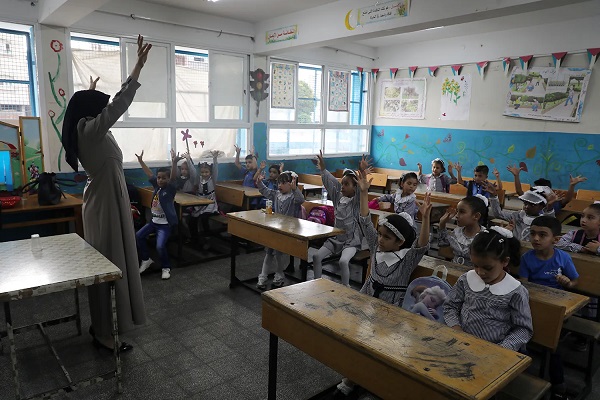

IMPACT-se just released their Review of the 2025-2026 Palestinian Authority School Curriculum (Grades 1-12). They reviewed 290 text books and 71 teacher guides (both printed and digital) currently in use by schools charged with educating Palestinian children. The results were unambiguous:
“The review finds that the 2025–2026 Palestinian Authority curriculum continues to systematically violate UNESCO principles and educational standards. Published in September 2025, the curriculum incites antisemitism and violence, promotes jihad and martyrdom, glorifies terrorism, rejects peacemaking and the two-state solution, and erases Israel from maps. It has not been substantively modified since the 2020–2021 school year, maintaining the same ideological framework first established in the 2016 reform cycle.”
In other words, the glorification of violence and deep racial hatred is, by design, woven into the fabric of every topic and virtually every lesson Palestinian children are taught.
The offensive examples were hardly rare exceptions throughout those 361 books. There were, for example:
- 50 examples (taking up a full 70 pages in the report) depicting Israelis or Jews as demonic or motiveless aggressors
- 47 examples of erasure of Israel from maps and language (declaring Palestine “from river to sea”)
- 56 examples of the encouragement of martyrdom and violent jihad
- 12 examples of the overt politicization of science and math
In addition, since 2016, 29 references to peace agreements, Israel, and Jews were removed from PA curriculum texts.
Overall, around 60 percent of the report’s examples come from material aimed at grades 9-11. Nevertheless, 17 examples of indoctrination (around 4 percent of the total) came from grades 1-4.
But what does all that have to do with Canada? Well, Canada has been a steady and reliable funder for UNRWA (United Nations Relief and Works Agency for Palestine Refugees in the Near East), UNICEF (United Nations Children’s Fund), UNESCO (United Nations Educational, Scientific and Cultural Organization), and the World Bank’s provision of educational services to Palestinians.
So what? Don’t all Western nations provide the same support? Not exactly.
- A May 2025 resolution adopted by the European Parliament demanded that EU financial assistance be made conditional on removal of hate material, and urged full compliance with standards of peace and tolerance for education.
- The U.K. has, in past years, cut or reduced its funding to UNRWA over concerns about incitement in educational textbooks.
- The U.S. hasn’t provided any support for UNRWA since the Biden administration paused funding in January, 2024.
- It seems that both Sweden and the Netherlands have either cut or are phasing out their UNRWA funding.
But in May 2024, Canada committed to $65 million in new funding – which follows a brief and meaningless “pause” in UNRWA funding (where no scheduled payments were actually interrupted). That brings the funding total since 2016 to $259 million. And there’s no public record of any of that money being conditional on changes to educational textbooks.
The Global Affairs Canada officials who make these spending decisions are the ones responsible for applying official government policy. And the message driving that policy is pretty clear (pro forma “antisemitism is not who we are” press releases notwithstanding). The Government of Canada is absolutely down with pouring millions into the promotion of race-driven violence.
Is Global Affairs Canada Wasting Your Tax Dollars Abroad?

It seems like forever since I last wrote about program spending at Global Affairs Canada (GAC). I’m not aware of any big-picture changes to department policy in the meantime, but their Project Browser tool is still there – and it’s still a welcome resource for transparency.
How Does UNRWA Spend the Funding it Receives From the Canadian Government?

The government of Canada – through Global Affairs Canada – has long been among the major financial supporters of The United Nations Relief and Works Agency for Palestine Refugees in the Near East (UNRWA). The 75 year-old United Nations agency has a yearly budget that’s grown to more than 900 million US dollars, and has long been accused of antisemitism,…
Paying for Bad Government Choices

Who picks up the tab when budgetary bets go horribly wrong? Taxpayers, of course. Duh.

The Climate-Risk Industrial Complex and the Manufactured Insurance Crisis
Inside the Fortified Sinaloa-Linked Compound Canada Still Can’t Seize After 12 Years of Legal War

The $50 Billion Question: EVs Never Delivered What Ottawa Promised

The Recall Trap: 21 Alberta MLA’s face recall petitions

They never wanted a pipeline! – Deputy Conservative Leader Melissa Lantsman

Liberals gain support for ‘hate speech’ bill targeting Bible passages against homosexuality

The Data That Doesn’t Exist
-
 Business2 days ago
Inflation Reduction Act, Green New Deal Causing America’s Energy Crisis
-
 Crime2 days ago
Terror in Australia: 12 killed after gunmen open fire on Hanukkah celebration
-
 Media1 day ago
Reporters determined to drive their industry and its reputation into the abyss one Tweet at a time
-
 Crime2 days ago
Hero bystander disarms shooter in Australian terror attack
-
 Censorship Industrial Complex6 hours ago
Death by a thousand clicks – government censorship of Canada’s internet
-
International11 hours ago
At Least 15 Killed In Shooting Targeting Jewish Community At Australia’s Bondi Beach, Police Say
-
Alberta8 hours ago
Schools should go back to basics to mitigate effects of AI
-
 Business7 hours ago
Major tax changes in 2026: Report