
Business
Health-care costs for typical Canadian family will reach over $19,000 this year


From the Fraser Institute
By Nadeem Esmail, Nathaniel Li and Milagros Palacios

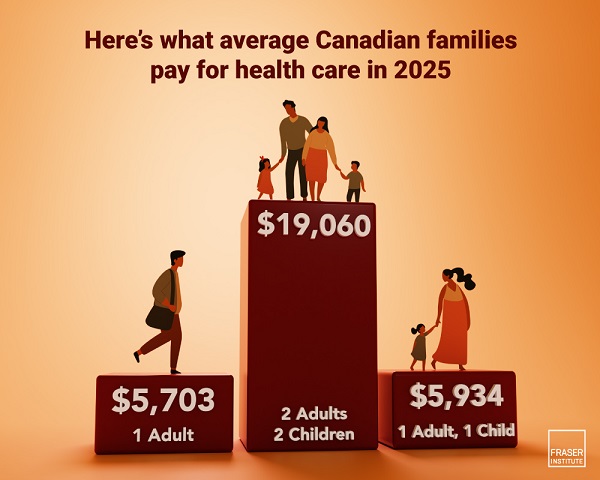
A typical Canadian family of four will pay an estimated $19,060 for public health-care insurance this year, finds a new study released today by the Fraser Institute, an independent, non-partisan Canadian public policy think-tank.
“Canadians pay a substantial amount of money for health care through a variety of taxes—even if we don’t pay directly for medical services,” said Nadeem Esmail, director of health policy studies at the Fraser Institute and co-author of The Price of Public Health Care Insurance, 2025.
Most Canadians are unaware of the true cost of health care because they never see a bill for medical services, may only be aware of partial costs collected via employer health taxes and contributions (in provinces that impose them), and because general government revenue—not a dedicated tax—funds Canada’s public health-care system.
The study estimates that a typical Canadian family consisting of two parents and two children with an average household income of $188,691 will pay $19,060 for public health care this year. Couples without dependent children will pay an estimated $17,338. Single Canadians will pay $5,703 for health care insurance, and single parents with one child will pay $5,934.
Since 1997, the first year for which data is available, the cost of healthcare for the average Canadian family has increased substantially, and has risen more quickly than its income. In fact, the cost of public health care insurance for the average Canadian family increased 2.2 times as fast as the cost of food, 1.6 times as fast as the cost of housing, and 1.6 times as fast as the average income.
“Understanding how much Canadians actually pay for health care, and how much that amount has increased over time, is an important first step for taxpayers to assess the value and performance of the health-care system, and whether it’s financially sustainable,” Esmail said.
The Price of Public Health Care Insurance, 2025
- Canadians often misunderstand the true cost of our public health care system. This occurs partly because Canadians do not incur direct expenses for their use of health care, and partly because Canadians cannot readily determine the value of their contribution to public health care insurance.
- In 2025, preliminary estimates suggest the average payment for public health care insurance ranges from $5,213 to $19,060 for six common Canadian family types, depending on the type of family.
- Between 1997 and 2025, the cost of public health care insurance for the average Canadian family increased 2.2 times as fast as the cost of food, 1.6 times as fast as the average income, and 1.6 times as fast as the cost of shelter. It also increased much more rapidly than the average cost of clothing, which has fallen in recent years.
- The 10 percent of Canadian families with the lowest incomes will pay an average of about $702 for public health care insurance in 2025. The 10 percent of Canadian families who earn an average income of $88,725 will pay an average of $8,292 for public health care insurance, and the families among the top 10 percent of income earners in Canada will pay $58,853.


Canadians were told freezing bank accounts was “necessary.” We were told sending billions overseas without a vote was “solidarity.” And now we’re told that Chrystia Freeland the architect of some of the most aggressive financial overreach in modern Canadian history advising a foreign government on economic policy is “normal.” It isn’t. It’s a closed circle of power rewarding itself, while ordinary Canadians are expected to forget what was done to them and quietly foot the bill.
I don’t believe in coincidences in politics and I don’t believe in “honourary” appointments when billions of dollars and unchecked power are involved. So when Chrystia Freeland, the same woman who helped freeze Canadians’ bank accounts, torched public trust, and oversaw economic decisions that hollowed out this country is suddenly appointed as an economic adviser to Ukraine, Canadians should stop and ask a very uncomfortable question.
Kelsi Sheren is a reader-supported publication.
To receive new posts and support my work, consider becoming a free or paid subscriber.
Who exactly is Chrystia serving? Because it doesn’t look like us and doesn’t feel like us at all. I’m going to make something very clear and spell it out for Canadians… this is the same elite just moved to a different country.
Chrystia Freeland did not leave politics because she failed. She didn’t resign because she was rejected. She exited after years of consolidating power at the highest levels of government and immediately landed an advisory role with a foreign head of state.
That is not a fall from grace. That is a lateral move inside the same elite ecosystem.
Multiple Canadian outlets have now confirmed that Freeland has been named an economic adviser to Ukrainian President Zelenskyy. This is not symbolic. This is not charity. This is about economic reconstruction, international financing, sanctions, and the movement of billions of dollars, much of it, if not all of it is Western taxpayer money.
Including ours.
Has everyone forgotten what this women did to Canadians?? Before anyone starts calling this “statesmanship,” let’s remember the record.
Chrystia Freeland was a central figure during one of the most dangerous moments in modern Canadian governance: the normalization of financial punishment against citizens.
Under her watch, the federal government froze bank accounts without criminal charges, without due process, and without judicial oversight. Whatever your view of the Freedom Convoy, that precedent should have terrified you and if it doesn’t you need to wake up.
Once a government proves it can financially erase you for dissent, it never unlearns that lesson.
She also presided over years of reckless spending, inflationary pressure, and policies that pushed Canadians into a cost-of-living crisis while telling them everything was fine. Housing exploded. Food prices surged. Small businesses collapsed.
And now — suddenly — she’s being handed influence over another country’s economic future? The money no one voted on is now gone with no recourse and she knows it.
Canada has already sent billions of dollars to Ukraine, including roughly $2.5 billion tied to frozen Russian assets — without any direct vote from Canadians and with minimal parliamentary scrutiny.
Let that sit for a minute.
Our government helped set a precedent where foreign sovereign assets are frozen, leveraged, and redirected — and now one of the architects of that approach is advising the very government receiving the funds.
You don’t need to be a lawyer to understand how rotten that looks. At minimum, this is a conflict of interest. At worst, it’s a closed-loop system where the same political actors make the rules, move the money, and then step into advisory roles on the receiving end.
That’s not democracy. That’s managed power. People will say, “Ukraine needs help rebuilding.” Fine. That’s not the argument. The argument is who decides, who benefits, and who is accountable.
Chrystia Freeland still carries enormous influence inside Canada’s political and financial institutions. Her appointment creates a pipeline — informal, opaque, and unaccountable between Canadian decision-makers and a foreign government dependent on Western funds.
If an average Canadian MP took a paid or unpaid advisory role with a foreign government, alarms would be ringing, but when it’s Chrystia Freeland, we’re told it’s noble. Necessary. Above criticism.
That’s how corruption survives. Not through secrecy, but through normalization.
Canadians are always last, here’s the pattern Canadians are starting to see clearly, I hope. Canadians are being forced to tighten their belts. Canadians lose purchasing power on almost everything and Canadians are told to accept less and the sad part is Canadians are good with this.
Meanwhile, political elites move effortlessly between governments, NGOs, global institutions, and advisory boards. All it is, is different flags. Same class of people.
The people who suffered under Freeland’s economic policies don’t get to resign into prestige. They get debt. They get anxiety. They get silence.
She gets influence.
In case your wondering, this isn’t really about Ukraine, this is not an attack on Ukraine or its people. This is about Canadian democracy, accountability, and the dangerous precedent being set when unelected influence replaces public consent.
If Canadians are expected to fund wars, reconstruction, and foreign policy projects — then Canadians deserve transparency, debate, and representation.
Instead, we’re getting appointments behind closed doors and press releases that assume we won’t ask questions.
That era is long over.
Chrystia Freeland didn’t disappear. She didn’t retreat. She repositioned.
If Canadians don’t start calling this what it is — elite continuity without consent — then we shouldn’t be surprised when the same tactics used against citizens at home are exported abroad.
Power always practices somewhere first.
KELSI SHEREN
– – – – – – – – – – – –
One Time Donation! – Paypal – https://paypal.me/
Buy me a coffee! – https://buymeacoffee.com/
Let’s connect!
Youtube – https://www.youtube.com/@
Instagram: https://www.instagram.com/
Substack: https://substack.com/@
TikTok – https://x.com/KelsiBurns

From the Fraser Institute
By Julio Mejía and Elmira Aliakbari
According to a new survey of mining investors, despite the rich mineral potential of many Canadian jurisdictions, government policies are deterring investment
Canada is renowned for its abundant minerals and network of engineering firms with mining experience. These advantages, coupled with the rising global demand for copper, lithium, nickel, cobalt and rare-earth elements, should spur growing interest in our mining sector among investors. Yet, mining investment in Canada is on the wane.
In nominal terms, exploration investment alone fell from $4.4 billion in 2022 to $4.2 billion in 2023, with preliminary numbers for 2024 suggesting a further 2 per cent drop. And several leading exploration companies including Solaris Resources Inc., Falcon Energy Materials and Barrick Mining Corporation (the world’s second-largest mining company) have either moved their headquarters out of Canada or are considering doing so.
This downward trend extends beyond just exploration investment. In 2023 (the latest year of available data) investment in Canada’s mining sector totalled $15.2 billion, 26 per cent below the record-high $20.5 billion in 2012 (inflation-adjusted).
So, why is one of the most mineral-rich countries on Earth losing investor interest?
According to a new survey of mining investors, despite the rich mineral potential of many Canadian jurisdictions, government policies are deterring investment.
Take British Columbia, Yukon and Manitoba, for example. Although all three rank among the world’s top 10 most attractive jurisdictions for their mineral endowment, all three fall far behind in policy perception, ranking 32nd, 40th and 43rd out of 82 jurisdictions, respectively. The Northwest Territories (56th), Nunavut (59th) and Nova Scotia (76th) also rank low in terms of policy, while Saskatchewan (3rd), Newfoundland and Labrador (6th) and Alberta (9th) are the only Canadian jurisdictions that perform well.
Indeed, in multiple editions of the mining survey over many years, investors have cited policy uncertainty as a key deterrent to investment in many Canadian jurisdictions. In particular, uncertainty around disputed land claims, protected areas and environmental regulations.
Of course, Canadian jurisdictions compete with jurisdictions around the world including in the United States. And the differences in investor perception are striking. While a strong majority of survey respondents for B.C. (76 per cent), Manitoba (75 per cent) and the Yukon (69 per cent) say uncertainty around disputed land claims deters investment, the percentages are much smaller for Nevada (13 per cent) and Arizona (16 per cent). Similarly, the percentage of respondents who say uncertainty around protected areas deters investment for B.C. (76 per cent), the Yukon (76 per cent) and Manitoba (63 per cent) was much larger than for Wyoming (11 per cent) and Nevada (27 per cent).
To build new mining projects, develop technologies that improve productivity, create jobs and help spread prosperity, Canadian jurisdictions must attract investment. In 2023, mining was Canada’s second-leading export, trailing only energy, and contributed $117 billion to Canada’s total economic output. More importantly, that same year the industry provided a livelihood for 711,000 Canadians while paying wages that nearly double the average of other industries. And according to a 2021 census, the sector provided jobs to more than 17,300 First Nations people, making it one of the largest employers of Indigenous workers in the country.
Bad policies create uncertainty and deter investment. If policymakers are serious about unleashing Canada’s mining potential, they must eliminate regulatory uncertainty and establish a predictable policy framework. Otherwise, the country will keep declining in the eyes of investors.

Julio Mejía
Policy Analyst

Elmira Aliakbari

The Canadian Energy Centre’s biggest stories of 2025

Minneapolis day care filmed empty suddenly fills with kids

Resurfaced Video Shows How Somali Scammers Used Day Care Centers To Scam State

Dark clouds loom over Canada’s economy in 2026

The U.S. Just Removed a Dictator and Canada is Collateral Damage

Ottawa Is Still Dodging The China Interference Threat

The Real Reason Canada’s Health Care System Is Failing
-
 Opinion2 days ago
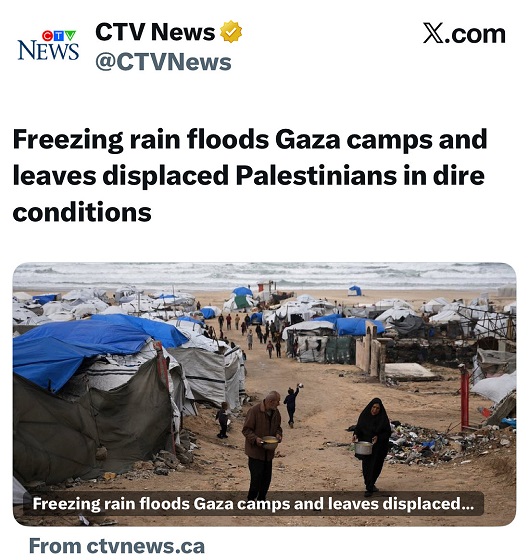
Hell freezes over, CTV’s fabrication of fake news and our 2026 forecast is still searching for sunshine
-
 Frontier Centre for Public Policy15 hours ago
Is Canada still worth the sacrifice for immigrants?
-
 Education13 hours ago
Mother petitions Supreme Court after school hid daughter’s ‘gender transition’
-
 Environment13 hours ago
Left-wing terrorists sabotage German power plant, causing massive power outage
-
 Alberta12 hours ago
Trump’s Venezuela Geopolitical Earthquake Shakes up Canada’s Plans as a “Net Zero” Energy Superpower
-
 Energy12 hours ago
Trump’s Venezuela Move: A $17 Trillion Reset of Global Geopolitics and a Pivotal Shift in US Energy Strategy
-
 COVID-192 days ago
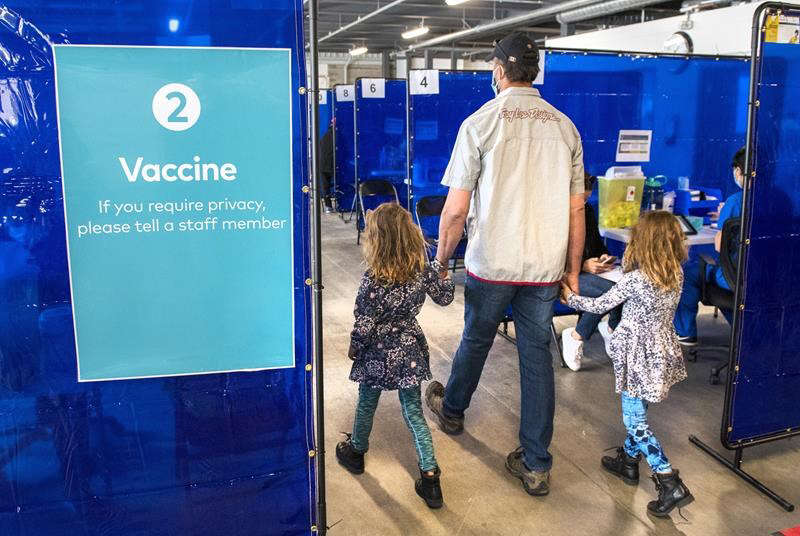
A new study proves, yet again, that the mRNA Covid jabs should NEVER have been approved for young people.
-
 Energy12 hours ago
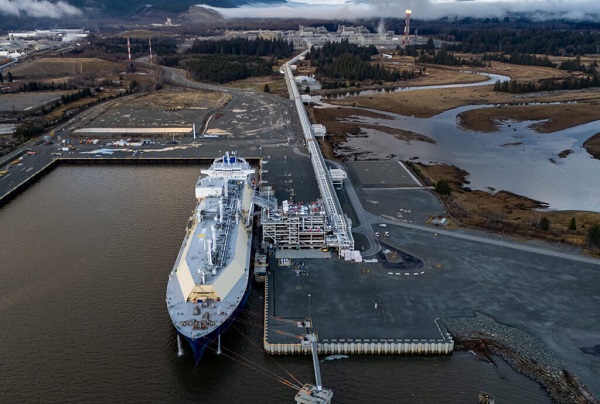
The global math: Why exporting Canadian energy is a climate win