
COVID-19
Freedom Convoy leaders’ lawyers argue defendants encouraged peaceful protesting


From LifeSiteNews

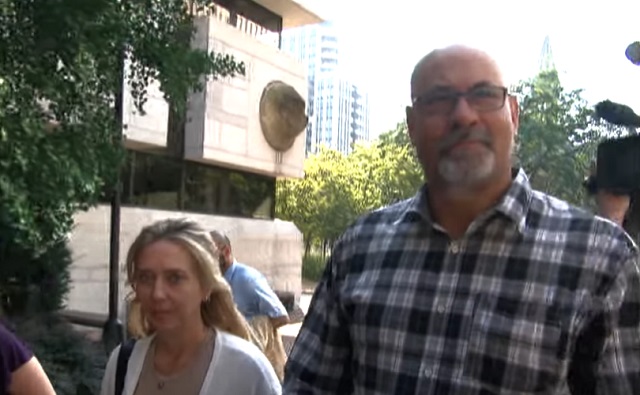
Freedom Convoy leader Chris Barber’s legal counsel argued that text messages he sent to both police and fellow protesters during the convoy prove he was not encouraging people to commit crimes
On day 30 of the trial against Freedom Convoy leaders Tamara Lich and Chris Barber, the defense detailed to the court how text message exchanges from one of the leaders showed he was trying to ensure protestors were as respectful as possible and wanted to work with police.
According to a day 30 update from the Democracy Fund (TDF), which is crowdfunding Lich’s legal costs, defense counsel for Barber, Diane Magas, said that a text conversation between Barber and an “individual known as ‘Big Baller,’” show that “Barber expressed his efforts to cease honking and persuade other truck drivers to follow suit,” in attempt to abide by law enforcement’s request.
Magas also highlighted how a text message exchange between Barber and an Ottawa Police Services (OPS) officer, asking for a “slow roll” on Parliament Hill, “received police support.”
“These instances, according to Magas, illustrated Barber’s intent for a lawful protest,” noted TDF.
Magas questioned the Crown’s allegation that the leaders had planned a conspiracy, noting a February 12, 2022, agreement letter between the convoy protesters and the mayor’s office.
“She questioned whether the Crown implied the mayor’s office was part of the alleged conspiracy,” noted TDF.
“Magas highlighted a TikTok video on February 16, 2022, with Barber and Canadian lawyer Keith Wilson, where Wilson emphasized that the declaration of the Emergencies Act still permitted peaceful protests. Magas concluded her submissions by asserting that, considering the totality of evidence, the court couldn’t find an agreement for the alleged conspiracies without speculation.”
In response, the Crown’s counsel said that a “directed verdict would be appropriate if there were no evidence of criminality,” but again argued for their Carter application to proceed.
On Monday, which was Day 28 of the trial, the defense argued that a Crown request to make it so that criminal charges against one leader should apply to the other leader as well, and vice versa, should not be allowed to take place, as there is no evidence the pair worked in a conspiratorial manner.
The defense teams for Lich and Barber told the court they intended to bring forth two applications, the first being a call to dismiss the Crown’s “Carter application.”
The Crown’s so-called “Carter Application” asks that the judge consider “Barber’s statements and actions to establish the guilt of Lich, and vice versa,” TDF stated.
TDF noted that this type of application is very “complicated” and requires that the Crown prove “beyond a reasonable doubt” that there was a “conspiracy or plan in place and that Lich was a party to it based on direct evidence.”
On Wednesday in court, the Crown claimed that they did not think of the protests as violent, but “disputed the defense’s characterization of the protests as peaceful.”
The Crown claimed that non-violent protests could still be “disruptive and result in criminal charges,” as noted by TDF, adding that the court should consider limitations to Charter rights when looking at charges made against the leaders.
In court, Judge Heather Perkins-McVey reminded the Crown that not everyone involved in the Freedom Convoy was working together. The Crown agreed this was the case.
On Day 29, Lich’s legal counsel argued that her use of the rallying cry “hold the line” during the 2022 protests did not imply she was calling for people to engage in illegal activity.
Lich and Barber are facing multiple charges from the 2022 protests, including mischief, counseling mischief, counseling intimidation and obstructing police for taking part in and organizing the anti-mandate Freedom Convoy. As reported by LifeSiteNews at the time, despite the non-violent nature of the protest and the charges, Lich was jailed for weeks before she was granted bail.
The defense’s application came after the Crown abruptly decided to end its case last Monday, telling the court it would not call forth any new witnesses.
In early 2022, the Freedom Convoy saw thousands of Canadians from coast to coast come to Ottawa to demand an end to COVID mandates in all forms. Despite the peaceful nature of the protest, Prime Minister Justin Trudeau’s government enacted the Emergencies Act on February 14.
During the clear-out of protesters after the EA was put in place, one protester, an elderly lady, was trampled by a police horse, and one conservative female reporter was beaten by police and shot with a tear gas canister.
Lich and Barber’s trial has thus far taken more time than originally planned. LifeSiteNews has been covering the trial extensively.

From LifeSiteNews
A judge ruled that the Ontario Court of Justice is already ‘satisfied’ with Chris Barber’s sentence and taking away his very livelihood would be ‘disproportionate.’
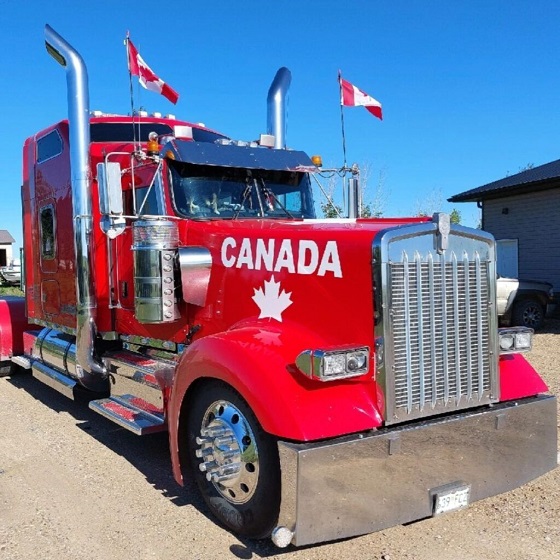
A Canadian judge has dismissed a demand from Canadian government lawyers to seize Freedom Convoy leader Chris Barber’s “Big Red” semi-truck.
On Friday, Ontario Court of Justice Judge Heather Perkins-McVey denied the Crown’s application seeking to forfeit Barber’s truck.
She ruled that the court is already “satisfied” with Barber’s sentence and taking away his very livelihood would be “disproportionate.”
“This truck is my livelihood,” said Barber in a press release sent to LifeSiteNews.
“Trying to permanently seize it for peacefully protesting was wrong, and I’m relieved the court refused to allow that to happen,” he added.
Criminal defense lawyer Marwa Racha Younes was welcoming of the ruling as well, stating, “We find it was the right decision in the circumstances and are happy with the outcome.”
John Carpay, president of the Justice Centre for Constitutional Freedoms (JCCF), said the decision is “good news for all Canadians who cherish their Charter freedom to assemble peacefully.”
READ: Freedom Convoy protester appeals after judge dismissed challenge to frozen bank accounts
“Asset forfeiture is an extraordinary power, and it must not be used to punish Canadians for participating in peaceful protest,” he added in the press release.
As reported recently by LifeSiteNews, the Canadian government claimed that Barber’s truck is an “offence-related property” relating to his involvement in the 2022 protests against Canada’s COVID mandates.
At this time, the court ruling ends any forfeiture proceedings for the time being, however Barber will continue to try and appeal his criminal conviction and house arrest sentence.
Barber’s truck, a 2004 Kenworth long-haul he uses for business, was a focal point in the 2022 protests. He drove it to Ottawa, where it was parked for an extended period of time, but he complied when officials asked him to move it.
On October 7, 2025, after a long trial, Ontario Court Justice Perkins-McVey sentenced Barber and Tamara Lich, the other Freedom Convoy leader, to 18 months’ house arrest. They had been declared guilty of mischief for their roles as leaders of the 2022 protest against COVID mandates, and as social media influencers.
Lich and Barber have filed appeals of their own against their house arrest sentences, arguing that the trial judge did not correctly apply the law on their mischief charges.
Government lawyers for the Crown have filed an appeal of the acquittals of Lich and Barber on intimidation charges.
The pair’s convictions came after a nearly two-year trial despite the nonviolent nature of the popular movement.

From LifeSiteNews
Protestor Evan Blackman’s legal team argues Trudeau’s Emergencies Act-based bank account freezes were punitive state action tied directly to protest participation.
A Freedom Convoy protester whose bank accounts were frozen by the Canadian government says a judge erred after his ruling did not consider the fact that the funds were frozen under the Emergencies Act, as grounds for a stay of proceedings.
In a press release sent out earlier this week, the Justice Centre for Constitutional Freedoms (JCCF) said that Freedom Convoy protestor Evan Blackman will challenge a court ruling in his criminal case via an appeal with the Ontario Superior Court of Justice.
“This case raises serious questions about how peaceful protest is treated in Canada and about the lasting consequences of the federal government’s unlawful use of the Emergencies Act,” noted constitutional lawyer Chris Fleury. “The freezing of protestors’ bank accounts was part of a coordinated effort to suppress dissent, and courts ought to be willing to scrutinize that conduct.”
Blackman was arrested on February 18, 2022, during the police crackdown on Freedom Convoy protests against COVID restrictions, which was authorized by the Emergencies Act (EA). The EA was put in place by former Prime Minister Justin Trudeau’s Liberal government, which claimed the protests were violent, despite no evidence that this was the case.
Blackman’s three bank accounts with TD Bank were frozen due to his participation in the Freedom Convoy, following a directive ordered by Trudeau.
As reported by LifeSiteNews, in November of this year, Blackman was convicted at his retrial even though he had been acquitted at his original trial. In 2023, Blackman’s “mischief” and “obstructing police” charges were dismissed by a judge due to lack of evidence and the “poor memory of a cop regarding key details of the alleged criminal offences.”
His retrial resulted in Blackman getting a conditional discharge along with 12 months’ probation and 122 hours of community service, along with a $200 victim fine surcharge.
After this, Blackman’s application for a stay of proceedings was dismissed by the court. He had hoped to have his stay of proceedings, under section 24(1) of the Charter of Rights and Freedoms, allowed. However, the judge ruled that the freezing of his bank accounts was legally not related to his arrest, and because of this, the stay of proceedings lacked standing.
The JCCF disagreed with this ruling, noting, it “stands in contrast to a Federal Court decision finding that the government’s invocation of the Emergencies Act was unreasonable and violated Canadians’ Charter rights, including those targeted by the financial measures used against Freedom Convoy protestors.”
As of press time, a hearing date has not been scheduled.
In 2024, Federal Court Justice Richard Mosley ruled that Trudeau was “not justified” in invoking the Emergencies Act.
In early 2022, the Freedom Convoy saw thousands of Canadians from coast to coast come to Ottawa to demand an end to COVID mandates in all forms. Despite the peaceful nature of the protest, Trudeau’s federal government enacted the EA in mid-February.
After the protesters were cleared out, which was achieved through the freezing of bank accounts of those involved without a court order as well as the physical removal and arrest of demonstrators, Trudeau revoked the EA on February 23, 2022.

Sweden Fixed What Canada Won’t Even Name
What Do Loyalty Rewards Programs Cost Us?

China Stages Massive Live-Fire Encirclement Drill Around Taiwan as Washington and Japan Fortify

The Canadian Energy Centre’s biggest stories of 2025

Rulings could affect energy prices everywhere: Climate activists v. the energy industry in 2026

The Global Push for Government Mandated Digital IDs And Why You Should Worry

In Contentious Canada Reality Is Still Six Degrees Of Hockey
-
 International6 hours ago
“Captured and flown out”: Trump announces dramatic capture of Maduro
-
 International6 hours ago
Trump Says U.S. Strike Captured Nicolás Maduro and Wife Cilia Flores; Bondi Says Couple Possessed Machine Guns
-
International1 day ago
Maduro says he’s “ready” to talk
-
 Business6 hours ago
Vacant Somali Daycares In Viral Videos Are Also Linked To $300 Million ‘Feeding Our Future’ Fraud
-
Energy33 mins ago
The U.S. Just Removed a Dictator and Canada is Collateral Damage
-
 Bruce Dowbiggin1 day ago
The Rise Of The System Engineer: Has Canada Got A Prayer in 2026?
-
 International1 day ago
LOCKED AND LOADED: Trump threatens U.S. response if Iran slaughters protesters
-
 International49 mins ago
US Justice Department Accusing Maduro’s Inner Circle of a Narco-State Conspiracy