
Censorship Industrial Complex
Elon Musk pledges support to doctor fighting sanctions for opposing COVID vaccine mandate



Dr. Kulvinder Gill
From LifeSiteNews

The Tesla billionaire said X will help Dr. Kulvinder Kaur Gill, an Ontario pediatrician who has been embroiled in a legal battle with the College of Physicians and Surgeons of Ontario for her anti-COVID views.
A Canadian physician who became well known for speaking out against draconian COVID mandates in her home province on social media and then was sanctioned by her medical college and forced into costly legal battles, has received the support of billionaire Tesla owner Elon Musk.
Dr. Kulvinder Kaur Gill, an Ontario pediatrician who has been embroiled in a legal battle with the College of Physicians and Surgeons of Ontario (CPSO) for her anti-COVID views, last Thursday asked Musk for help.
“As one of the first Canadian MDs to oppose lockdowns on Twitter in 2020 … I’ve been persecuted for four years solely due to my tweets. Please help a fellow Canadian! ~$300k in court-ordered costs due in four days,” Gill wrote on X (formerly Twitter) on March 21.
Gill included an image of a screenshot from an August 2023 X post from Musk in which he vowed to support anyone facing hardships from anything they said on X and were then censored or attacked for it.
“If you were unfairly treated by your employer due to posting or liking something on this platform, we will fund your legal bill. No limit. Please let us know,” Musk wrote in August 2023.
A short while after Gill’s Thursday post, Musk replied, writing, “We will help.”
Gill thanked Musk after his post, writing, “Thank you @elonmusk@X! Welcome to #TeamHumanity I hope your team reaches out very soon.”
Gill’s X post also linked to a recent interview she had with Dr. Jay Bhattacharya, who created the Great Barrington Declaration, about her ordeal with the CPSO.
“I was starting to read about the devastating, catastrophic harms of the actual lockdowns. All of this compelled me to speak out in the summer of 2020 about everything that was being ignored, both in the media’s coverage and in the daily conversations that Canadians were having. I didn’t anticipate the response that I received,” Gill said.
Gill noted that she had “suddenly” found herself going “against the narrative,” and was then “seen as a black sheep and as someone who should be shunned.”
Gill is a specialist practicing in the Greater Toronto area, and has extensive experience and training in “pediatrics, and allergy and clinical immunology, including scientific research in microbiology, virology and vaccinology.”
Last September, disciplinary proceedings against her were withdrawn by the CPSO. However, last year, Gill was ordered to pay $1 million in legal costs after her libel suit was struck down, and she has now been told she must pay ordered to pay $300,000 by the end of March.
The CPSO began disciplinary investigations against Gill in August 2020, with The Democracy Fund (TDF) noting she was the target of “an online campaign by other doctors, media and members of the public to generate complaints against her.”
Gill has a large following on X (formerly Twitter) and since mid-2020 has been active on the platform criticizing COVID mandates. She was one of the few Canadian doctors who spoke out strongly against the COVID dictates early on and would take to X regularly to share her views.
Due to Gill’s social media posts, she has faced continued investigations as well as disciplinary actions by the CPSO. There have also been public complaints made against her, which the CPSO investigated.
The Democracy Fund has full details of those proceedings against Gill.
In late 2020, she took legal action against a group of some 23 doctors, academics, reporters and even the former president of the Ontario Medical Association, who she claimed had allegedly damaged her reputation as a “medical professional for unfairly attacking her anti-lockdown stance.”
Physician confirms Musk’s offer to her all set to go
On March 24, X News posted that X it “is proud to help defend Dr. Kulvinder Kaur Gill against the government-supported efforts to cancel her speech.”
Musk also wrote to Gill that he is in full “support of your right to speak.”
On the same day, Gill confirmed that X reached out to her “directly” about their offer to help her appeal her three CPSO cautions relating to her 2020 tweets.
“@elonmusk’s @X contacted me directly confirming Elon’s commitment to pay remainder of campaign to reach $300K AND Elon has committed to assisting my appeal of 3 CPSO cautions, for my 2020 tweets opposing lockdowns, to the very end (ONCA & SCC if needed). May Waheguru bless you,” she wrote.
Gill also launched a fundraiser of her own to help her pay her legal costs. Thus far, Gill has raised close to $200,000 of her $300,000 goal.
Many Canadian doctors who spoke out against COVID mandates and the experimental mRNA injections have been censured by their medical boards.
In an interview with LifeSiteNews at its annual general meeting in July 2023 near Toronto, canceled doctors Mary O’Connor, Mark Trozzi, Chris Shoemaker, and Byram Bridle were asked to state their messages to the medical community regarding how they have had to fight censure because they have opinions contrary to the COVID mainstream narrative.

Censorship Industrial Complex
Death by a thousand clicks – government censorship of Canada’s internet


The Justice Centre for Constitutional Freedoms announces its latest publication, Death by a thousand clicks: The rise of internet censorship and control in Canada, authored by veteran journalist and researcher Nigel Hannaford. The report outlines how recommendations from the Broadcasting and Telecommunications Legislative Review Panel in 2020 set the stage for a series of federal bills that have collectively transformed Canada’s once open internet into a state-managed digital environment that restricts what Canadians may access, share, and say online.
The report highlights the following federal legislation:
Online Streaming Act (C-11): Passed in 2023, this Bill gives the CRTC power to regulate online videos and other content, including material created by everyday Canadians. It also lets the government influence online “discoverability,” meaning it can push certain content to the top of your feeds while making other content harder to find.
Online News Act (C-18): Also passed in 2023, this Bill forces platforms to pay approved news outlets, a measure that led to increased dependence of media organizations on the government and widespread blocking of Canadian news as a result of Meta’s news ban on Facebook and Instagram.
Online Harms Act (C-63): Although this Bill was halted by the 2025 election, it would have empowered a new “Digital Safety Commission” to order content removals, demand platform data, levy severe financial penalties on service providers for non-compliance with regulations created by the federal cabinet, and impose house arrest on Canadians who had not been charged with or convicted of any crime. It also would have allowed the Canadian Human Rights Commission to pursue Canadians over non-criminal “discriminatory” speech, together creating a sweeping censorship regime under the guise of addressing so-called “harms” that were already illegal.
Strong Borders Act (C-2): Introduced in June 2025 and currently at second reading, this Bill authorizes law enforcement to obtain subscriber information and metadata without a warrant, chilling anonymous online expression and eroding digital privacy.
An Act respecting cyber security, amending the Telecommunications Act and making consequential amendments to other Acts (C-8): Introduced in April 2025 and now before committee, this Bill expands government access to private networks and enables federal officials to direct telecommunications providers to kick individual Canadians off the internet without due process or appeal.
Combatting Hate Act (C-9): Introduced in September 2025 and currently before Parliament, this Bill broadens “hate-propaganda” offences, removes Attorney General oversight for prosecutions, encourages widespread self-censorship, and makes Canada more like the United Kingdom, where thousands of citizens are arrested over their social media commentary.
Report author Nigel Hannaford said, “It is important for Canadians to know that these bills are not isolated technical updates. Together they form a coordinated shift toward state-managed digital speech.”
“If we value open debate, privacy, and democratic accountability, we need to repeal the laws already passed and stop the ones now before Parliament,” he added.
Benjamin Klassen, Research and Education Coordinator for the Justice Centre, said, “It is important Canadians stay informed about these important issues. An informed public is essential to a free society.”
“Through research reports like this one, our Education team works to explain complex legislation in a way that empowers Canadians to participate in the national debate around important policies and defend their rights and freedoms,” he added.
To protect free expression online, Canadians should demand the repeal of Bills C-11 and C-18, insist that MPs vote against Bills C-2, C-8, and C-9, and elect representatives committed to restoring a free and open internet.
From the Frontier Centre for Public Policy
By Lee Harding
Ottawa says Bill C-9 fights hate. Critics say it turns ordinary disagreement into a potential crime.
Discriminatory hate is not a good thing. Neither, however, is the latest bill by the federal Liberal government meant to fight it. Civil liberties organizations and conservative commentators warn that Bill C-9 could do more to chill legitimate speech than curb actual hate.
Bill C-9 creates a new offence allowing up to life imprisonment for acts motivated by hatred against identifiable groups. It also creates new crimes for intimidation or obstruction near places of worship or community buildings used by identifiable groups. The bill adds a new hate propaganda offence for displaying terrorism or hate symbols.
The Canadian Civil Liberties Association (CCLA) warns the legislation “risks criminalizing some forms of protected speech and peaceful protest—two cornerstones of a free and democratic society—around tens of thousands of community gathering spaces in Canada.” The CCLA sees no need to add to existing hate laws.
Bill C-9 also removes the requirement that the Attorney General consent to lay charges for existing hate propaganda offences. The Canadian Constitution Foundation (CCF) calls this a major flaw, noting it removes “an important safeguard for freedom of expression that has been part of Canada’s law for decades.” Without that safeguard, decisions to prosecute may depend more on local political pressures and less on consistent national standards.
Strange as it sounds, hatred just will not be what it used to be if this legislation passes. The core problem begins with how the bill redefines the term itself.
Previously, the Supreme Court of Canada said hatred requires “extreme manifestations” of detestation or vilification that involve destruction, abhorrence or portraying groups as subhuman or innately evil. Instead, Bill C-9 defines hatred as “detestation or vilification,” stronger than “disdain or dislike.” That is a notably lower threshold. This shift means that ordinary political disagreement or sharp criticism could now be treated as criminal hatred, putting a wide range of protected expression at real risk.
The bill also punishes a hateful motivation more than the underlying crime. For example, if a criminal conviction prompted a sentence of two years to less than five years, a hateful motivation would add as much as an additional five years of jail time.
On paper, most Canadians may assume they will never be affected by these offences. In practice, the definition of “hate” is already stretched far beyond genuine threats or violence.
Two years ago, the 1 Million March for Children took place across Canada to protest the teaching of transgender concepts to schoolchildren, especially the very young. Although such opposition is a valid position, unions, LGBT advocates and even Newfoundland and Labrador Conservatives adopted the “No Space For Hate” slogan in response to the march. That label now gets applied far beyond real extremism.
Public pressure also shapes how police respond to protests. If citizens with traditional values protest a drag queen story hour near a public library, attendees may demand that police lay charges and accuse officers of implicit hatred if they refuse. The practical result is clear: officers may feel institutional pressure to lay charges to avoid being accused of bias, regardless of whether any genuine threat or harm occurred.
Police, some of whom take part in Pride week or work in stations decorated with rainbow colours in June, may be wary of appearing insensitive or intolerant. There have also been cases where residents involved in home invasion incidents were charged, and courts later determined whether excessive force was used. In a similar way, officers may lay charges first and allow the courts to sort out whether a protest crossed a line. Identity-related considerations are included in many workplace “sensitivity training” programs, and these broader cultural trends may influence how such situations are viewed. In practice, this could mean that protests viewed as ideologically unfashionable face a higher risk of criminal sanction than those aligned with current political priorities.
If a demonstrator is charged and convicted for hate, the Liberal government could present the prosecution as a matter for the justice system rather than political discretion. It may say, “It was never our choice to charge or convict these people. The system is doing its job. We must fight hate everywhere.”
Provincial governments that support prosecution will be shielded by the inability to show discretion, while those that would prefer to let matters drop will be unable to intervene. Either way, the bill could increase tensions between Ottawa and the provinces. This could effectively centralize political authority over hate-related prosecutions in Ottawa, regardless of regional differences in values or enforcement priorities.
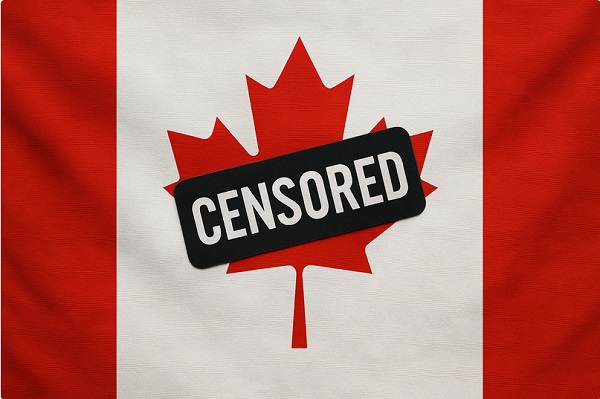
The bill also raises concerns about how symbols are interpreted. While most Canadians would associate the term “hate symbol” with a swastika, some have linked Canada’s former flag to extremism. The Canadian Anti-Hate Network did so in 2022 in an educational resource entitled “Confronting and preventing hate in Canadian schools.”
The flag, last used nationally in 1965, was listed under “hate-promoting symbols” for its alleged use by the “alt-right/Canada First movement” to recall when Canada was predominantly white. “Its usage in modern times is an indicator of hate-promoting beliefs,” the resource insisted. If a historic Canadian symbol can be reclassified this easily, it shows how subjective and unstable the definition of a “hate symbol” could become under this bill.
These trends suggest the legislation jeopardizes not only symbols associated with Canada’s past, but also the values that supported open debate and free expression. Taken together, these changes do not merely target hateful behaviour. They create a legal framework that can be stretched to police dissent and suppress unpopular viewpoints. Rest in peace, free speech.
Lee Harding is a research fellow for the Frontier Centre for Public Policy.


The $50 Billion Question: EVs Never Delivered What Ottawa Promised
The Recall Trap: 21 Alberta MLA’s face recall petitions

Wisdom of Our Elders: The Contempt for Memory in Canadian Indigenous Policy

Canada’s free speech record is cracking under pressure

Taxpayers Federation calls on politicians to reject funding for new Ottawa Senators arena

U.S. seizes Cuba-bound ship with illicit Iranian oil history

Growing Alberta’s fresh food future
-
 Daily Caller2 days ago
Chinese Billionaire Tried To Build US-Born Baby Empire As Overseas Elites Turn To American Surrogates
-
 Digital ID1 day ago
Canada releases new digital ID app for personal documents despite privacy concerns
-
 Business2 days ago
Major tax changes in 2026: Report
-
 Daily Caller2 days ago
Two states designate Muslim group as terrorist
-
 International2 days ago
Russia Now Open To Ukraine Joining EU, Officials Briefed On Peace Deal Say
-
Censorship Industrial Complex2 days ago
Death by a thousand clicks – government censorship of Canada’s internet
-
 Energy1 day ago
Canada’s sudden rediscovery of energy ambition has been greeted with a familiar charge: hypocrisy
-
 Alberta2 days ago
Schools should go back to basics to mitigate effects of AI