
Alberta
Education negotiations update: Minister Horner


President of Treasury Board and Minister of Finance Nate Horner issued the following statement about the ongoing negotiations with TEBA and the ATA:
“I am pleased to share that TEBA and the ATA met in an Alberta Labour Relations Board (LRB) resolution conference today to discuss the unfair labour practice complaint launched against the ATA, by TEBA.

“As a result of the resolution conference, the LRB issued a consent order, which is an agreement by the parties to resolve the complaint.
“The consent order clarifies that there are only three outstanding bargaining issues. They are:
- The timing for implementation of the unified grid;
- The ATA’s proposal for an annual 1.5% long service allowance for teachers at the maximum step of the grid; and,
- Coverage of the COVID-19 vaccination.
“This consent order makes clear that none of the outstanding items under negotiation are about classroom complexity, class size or support for students.
“Alberta’s government has already addressed these concerns though our current offer which would add 3000 more teachers to classrooms. In addition, Budget 2025 invested$1.6 billion to support diverse learning needs and complexity in classrooms. This includes $53 million for classroom complexity grants.
“I trust that this order will assist Alberta’s families and teachers in understanding the true nature of the ongoing negotiations.”

Alberta
Trump’s Venezuela Geopolitical Earthquake Shakes up Canada’s Plans as a “Net Zero” Energy Superpower


From Energy Now
By Ron Wallace
Get the Latest Canadian Focused Energy News Delivered to You! It’s FREE: Quick Sign-Up Here
Prime Minister Carney’s ‘well-laid plans’ for Canada to become a net zero energy superpower may suddenly be at risk – with significant consequences for Alberta. Recent events in Venezuela should force a careful re-examination of the economic viability of producing “decarbonized” heavy oil.
Having amassed military forces in the Caribbean throughout 2025 under Operation Southern Spear, on 3 January 2026 the Trump administration launched Operation Absolute Resolve, termed one of the most dramatic U.S. military actions in the Western Hemisphere since Operation Just Cause in Panama in 1989. Targeting multiple locations across Venezuela it led to the capture and removal of Venezuelan President Nicolás Maduro and his wife Cilia Flores. Initially held aboard the USS Iwo Jima they have been taken to the U.S. to face criminal charges for “narcoterrorism” and other offences.
In what has been termed a “$17 trillion reset”, Alberta may be at risk of losing its hard-won U.S. Gulf Coast (USGC) dominance to a resurgent rival – this coming at a time when Alberta and Canada are proposing to expend billions on “decarbonized” oil with punitive regulatory conditions that would not apply to Venezuelan, or any other international producers, of heavy oil. With U.S. forces capturing President Nicolás Maduro and President Trump declaring American administration of Venezuela to “get the oil flowing” again, the revival of Venezuela’s vast heavy crude reserves—over 300 billion barrels, the world’s largest—could flood the market with a cheaper, proximate supply tailored to U.S. refineries.
Historically, Alberta capitalized on Venezuela’s collapse when production there plummeted, due to mismanagement and sanctions, from 3 million barrels per day in the mid-2000’s to under 1 million today. This allowed Canadian heavy blends like Western Canadian Select to become the dominant feedstock for U.S. Gulf Coast refiners. In 2025, Canada supplied over one-third of the region’s heavy imports, tightening differentials and bolstering Alberta’s revenues.
A U.S.-revived Venezuelan oil industry, even if investment for infrastructure takes years to implement, would be a serious threat that risks displacing Canadian oil with lower-cost alternative supplies that also are geographically closer to U.S. refiners. This seismic geopolitical shift now confronts Prime Minister Mark Carney and Premier Danielle Smith as they attempt to implement their November 2025 Memorandum of Understanding (MoU), one that commits Alberta to produce “decarbonized” oil through massive carbon capture projects like Pathways Plus associated with Carbon Pricing Equivalency Agreements, are vastly expensive measures that could undermine Canadian price competitiveness against unsanctioned Venezuelan crude. Possibly of greater importance, Canadian insistence on “net zero” targets associated with pipelines and heavy oil production, policies that have caused significant capital flight from the Canadian energy sector, may further diminish the attractiveness of Alberta oil projects to international investors. Since 2015 Canada has experienced a flight of investment capital approaching CAD$650 billion due to lost, or deferred, resource projects – particularly in the energy sector. Will these policies and plans for the Alberta-Canada MoU allow Canada to become an “energy superpower” in this new age of international competition?
While short-term disruptions from the U.S. intervention might temporarily tighten heavy supply (and therefore benefit Canadian producers) the long-term prospect of U.S.-controlled Venezuelan oil production unquestionably represents a sea-change for international oil markets and may, potentially strengthen the economic case, if not urgency, for new Canadian Pacific pipelines to provide market access away from the U.S.
Historically, the U.S.–Venezuela oil trade relationship was a highly integrated system that was seriously disrupted, beginning in the 1970’s, by nationalization programs and by subsequent U.S. sanctions. The U.S. Gulf Coast (USGC) refinery complex is among the most highly developed in the world, one that required billions in investments for coking, desulfurization and hydrocracker units specifically designed to process heavy, sour Venezuelan crude. Importing approximately 40 million barrels of heavy crude per month in 2025, the USGC refiners scrambled to replace lost, sanctioned Venezuelan oil with Canadian Cold Lake, Mexican Maya and Brazilian heavy grades. Canada, offering a supply that was stable, pipeline‑connected and geopolitically low‑risk was the only producer with enough heavy crude to meaningfully offset those Venezuelan losses. In the twelve months ending February 2025, Canada supplied 13.6 million barrels/month representing 34% (the largest single source) to those U.S. refiners. As a result, Canadian Cold Lake and WCS differentials tightened with the Cold Lake WTI discount narrowing from $13.57/bbl (February) to $9.45/bbl (May).
However, with a federal government consumed with concerns about emissions and the attainment of an improbable national goal of Net Zero, and with terms in an MoU that will require material capital expenditures to produce “decarbonized” oil, Alberta and Canada would be wise to recognize that this geopolitical sea-change will affect not just prior assumptions about Canadian oil production (and MoU’s) but may yet work to change the fundamental economic assumptions of global oil economics.
Premier Smith has consistently argued that Canada needs to develop an “alternate reality” one in which Alberta oil producers and international export pipelines allow Canada to contribute to global energy security in ways that preclude “economic self-destruction.” In face of these geopolitical events, especially at a time of mounting national deficits, Canada may have precious little time to get its act together to effectively, and competitively, maintain and secure international markets for Alberta oil.
Dr. Ron Wallace is a former National Energy Board member who has also worked in the Venezuelan heavy oil sector.
From the Canadian Energy Centre
Canada’s energy landscape changed significantly in 2025, with mounting U.S. economic pressures reinforcing the central role oil and gas can play in safeguarding the country’s independence.
Here are the Canadian Energy Centre’s top five most-viewed stories of the year.
5. Alberta’s massive oil and gas reserves keep growing – here’s why

The Northern Lights, aurora borealis, make an appearance over pumpjacks near Cremona, Alta., Thursday, Oct. 10, 2024. CP Images photo
Analysis commissioned this spring by the Alberta Energy Regulator increased the province’s natural gas reserves by more than 400 per cent, bumping Canada into the global top 10.
Even with record production, Alberta’s oil reserves – already fourth in the world – also increased by seven billion barrels.
According to McDaniel & Associates, which conducted the report, these reserves are likely to become increasingly important as global demand continues to rise and there is limited production growth from other sources, including the United States.
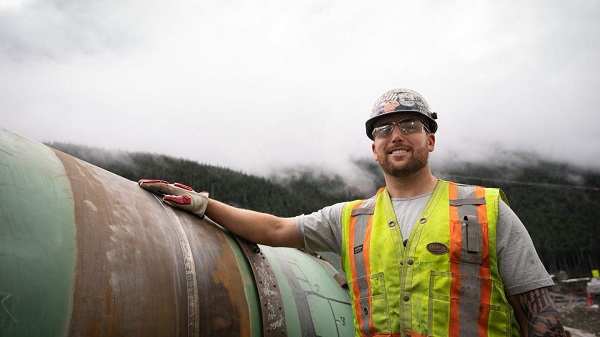
4. Canada’s pipeline builders ready to get to work

Photo courtesy Coastal GasLink
Canada could be on the cusp of a “golden age” for building major energy projects, said Kevin O’Donnell, executive director of the Mississauga, Ont.-based Pipe Line Contractors Association of Canada.
That eagerness is shared by the Edmonton-based Progressive Contractors Association of Canada (PCA), which launched a “Let’s Get Building” advocacy campaign urging all Canadian politicians to focus on getting major projects built.
“The sooner these nation-building projects get underway, the sooner Canadians reap the rewards through new trading partnerships, good jobs and a more stable economy,” said PCA chief executive Paul de Jong.
3. New Canadian oil and gas pipelines a $38 billion missed opportunity, says Montreal Economic Institute

Steel pipe in storage for the Trans Mountain Pipeline expansion in 2022. Photo courtesy Trans Mountain Corporation
In March, a report by the Montreal Economic Institute (MEI) underscored the economic opportunity of Canada building new pipeline export capacity.
MEI found that if the proposed Energy East and Gazoduq/GNL Quebec projects had been built, Canada would have been able to export $38 billion worth of oil and gas to non-U.S. destinations in 2024.
“We would be able to have more prosperity for Canada, more revenue for governments because they collect royalties that go to government programs,” said MEI senior policy analyst Gabriel Giguère.
“I believe everybody’s winning with these kinds of infrastructure projects.”
2. Keyera ‘Canadianizes’ natural gas liquids with $5.15 billion acquisition

Keyera Corp.’s natural gas liquids facilities in Fort Saskatchewan, Alta. Photo courtesy Keyera Corp.
In June, Keyera Corp. announced a $5.15 billion deal to acquire the majority of Plains American Pipelines LLP’s Canadian natural gas liquids (NGL) business, creating a cross-Canada NGL corridor that includes a storage hub in Sarnia, Ontario.
The acquisition will connect NGLs from the growing Montney and Duvernay plays in Alberta and B.C. to markets in central Canada and the eastern U.S. seaboard.
“Having a Canadian source for natural gas would be our preference,” said Sarnia mayor Mike Bradley.
“We see Keyera’s acquisition as strengthening our region as an energy hub.”
1. Explained: Why Canadian oil is so important to the United States

Enbridge’s Cheecham Terminal near Fort McMurray, Alberta is a key oil storage hub that moves light and heavy crude along the Enbridge network. Photo courtesy Enbridge
The United States has become the world’s largest oil producer, but its reliance on oil imports from Canada has never been higher.
Many refineries in the United States are specifically designed to process heavy oil, primarily in the U.S. Midwest and U.S. Gulf Coast.
According to the Alberta Petroleum Marketing Commission, the top five U.S. refineries running the most Alberta crude are:
- Marathon Petroleum, Robinson, Illinois (100% Alberta crude)
- Exxon Mobil, Joliet, Illinois (96% Alberta crude)
- CHS Inc., Laurel, Montana (95% Alberta crude)
- Phillips 66, Billings, Montana (92% Alberta crude)
- Citgo, Lemont, Illinois (78% Alberta crude)


The U.S. Just Removed a Dictator and Canada is Collateral Damage

Dark clouds loom over Canada’s economy in 2026

The Real Reason Canada’s Health Care System Is Failing

Vacant Somali Daycares In Viral Videos Are Also Linked To $300 Million ‘Feeding Our Future’ Fraud

Federal funds FROZEN after massive fraud uncovered: Trump cuts off Minnesota child care money

Coffee, Nicotine, and the Politics of Acceptable Addiction

Trying to Defend Maduro’s Legitimacy
-
 Frontier Centre for Public Policy1 day ago
Is Canada still worth the sacrifice for immigrants?
-
 Business1 day ago
Policy uncertainty continues to damage Canada’s mining potential
-
 International24 hours ago
Maduro, wife plead not guilty in first court appearance
-
 Courageous Discourse23 hours ago
Largest rollback of routine childhood vaccination in U.S. history
-
 Bruce Dowbiggin1 day ago
The Olympic Shutout: No Quebec Players Invited For Canada
-
 Business22 hours ago
Chrystia Freeland Didn’t Leave Power. She Just Took It Somewhere Else
-
 Canadian Energy Centre1 day ago
Five reasons why 2026 could mark a turning point for major export expansions
-
 International18 hours ago
Poilievre, Carney show support for Maduro capture as NDP’s interim leader denounces it