
Economy
Degrowth: How to Make the World Poorer, Polluted and Miserable



From StosselTV
Activists have a new goal: “DEgrowth.”

They say “growth is killing us.” They couldn’t be MORE wrong.
“Growth is not killing us. It’s saving us!” says author Johan Norberg. He explains why growth is essential to human progress, especially for poor people. “In poor countries, if you manage to grow by 4% annually over 20 years,” he points out, “that reduces poverty in that country on average by 80%.
But DEgrowth activists insist that growth means “climate chaos.” They say a smaller economy would be “sweeter.” They say “We must urgently dismantle capitalism!” It’s destructive nonsense. This video explains why.
————
To get our new weekly video from Stossel TV, sign up here: https://www.johnstossel.com/#subscribe
————
After 40+ years of reporting, I now understand the importance of limited government and personal freedom.
——————————————
Libertarian journalist John Stossel created Stossel TV to explain liberty and free markets to young people.
Prior to Stossel TV he hosted a show on Fox Business and co-anchored ABC’s primetime newsmagazine show, 20/20. Stossel’s economic programs have been adapted into teaching kits by a non-profit organization, “Stossel in the Classroom.” High school teachers in American public schools now use the videos to help educate their students on economics and economic freedom. They are seen by more than 12 million students every year.
Stossel has received 19 Emmy Awards and has been honored five times for excellence in consumer reporting by the National Press Club.
Other honors include the George Polk Award for Outstanding Local Reporting and the George Foster Peabody Award.



People criticize capitalism. A recent Axios-Generation poll says, “College students prefer socialism to capitalism.”
Why?
Because they believe absurd myths. Like the claim that the Soviet Union “wasn’t real socialism.”
Socialism guru Noam Chomsky tells students that. He says the Soviet Union “was about as remote from socialism as you could imagine.”
Give me a break.
The Soviets made private business illegal.
If that’s not socialism, I’m not sure what is.
“Socialism means abolishing private property and … replacing it with some form of collective ownership,” explains economist Ben Powell. “The Soviet Union had an abundance of that.”
Socialism always fails. Look at Venezuela, the richest country in Latin America about 40 years ago. Now people there face food shortages, poverty, misery and election outcomes the regime ignores.
But Al Jazeera claims Venezuela’s failure has “little to do with socialism, and a lot to do with poor governance … economic policies have failed to adjust to reality.”
“That’s the nature of socialism!” exclaims Powell. “Economic policies fail to adjust to reality. Economic reality evolves every day. Millions of decentralized entrepreneurs and consumers make fine tuning adjustments.”
Political leaders can’t keep up with that.
Still, pundits and politicians tell people, socialism does work — in Scandinavia.
“Mad Money’s Jim Cramer calls Norway “as socialist as they come!”
This too is nonsense.
“Sweden isn’t socialist,” says Powell. “Volvo is a private company. Restaurants, hotels, they’re privately owned.”
Norway, Denmark and Sweden are all free market economies.
Denmark’s former prime minister was so annoyed with economically ignorant Americans like Bernie Sanders calling Scandanavia “socialist,” he came to America to tell Harvard students that his country “is far from a socialist planned economy. Denmark is a market economy.”
Powell says young people “hear the preaching of socialism, about equality, but they don’t look on what it actually delivers: poverty, starvation, early death.”
For thousands of years, the world had almost no wealth creation. Then, some countries tried capitalism. That changed everything.
“In the last 20 years, we’ve seen more humans escape extreme poverty than any other time in human history, and that’s because of markets,” says Powell.
Capitalism makes poor people richer.
Former Rep. Jamaal Bowman (D-N.Y.) calls capitalism “slavery by another name.”
Rep. Alexandria Ocasio-Cortez (D-N.Y.) claims, “No one ever makes a billion dollars. You take a billion dollars.”
That’s another myth.
People think there’s a fixed amount of money. So when someone gets rich, others lose.
But it’s not true. In a free market, the only way entrepreneurs can get rich is by creating new wealth.
Yes, Steve Jobs pocketed billions, but by creating Apple, he gave the rest of us even more. He invented technology that makes all of us better off.
“I hope that we get 100 new super billionaires,” says economist Dan Mitchell, “because that means 100 new people figured out ways to make the rest of our lives better off.”
Former Labor Secretary Robert Reich advocates the opposite: “Let’s abolish billionaires,” he says.
He misses the most important fact about capitalism: it’s voluntary.
“I’m not giving Jeff Bezos any money unless he’s selling me something that I value more than that money,” says Mitchell.
It’s why under capitalism, the poor and middle class get richer, too.
“The economic pie grows,” says Mitchell. “We are much richer than our grandparents.”
When the media say the “middle class is in decline,” they’re technically right, but they don’t understand why it’s shrinking.
“It’s shrinking because more and more people are moving into upper income quintiles,” says Mitchell. “The rich get richer in a capitalist society. But guess what? The rest of us get richer as well.”
I cover more myths about socialism and capitalism in my new video.
From the Fraser Institute
A report published by the Fraser Institute reaffirms just how much more economically free some states are compared with others. These are places where citizens are allowed to make more of their economic choices. Their taxes are lighter, and their regulatory burdens are easier. The benefits for workers, consumers and businesses have been clear for a long time.
There’s another group of states to watch: “movers” that have become much freer in recent decades. These are states that may not be the freest, but they have been cutting taxes and red tape enough to make a big difference.
How do they fare?
I recently explored this question using 22 years of data from the same Economic Freedom of North America index. The index uses 10 variables encompassing government spending, taxation and labour regulation to assess the degree of economic freedom in each of the 50 states.
Some states, such as New Hampshire, have long topped the list. It’s been in the top five for three decades. With little room to grow, the Granite State’s level of economic freedom hasn’t budged much lately. Others, such as Alaska, have significantly improved economic freedom over the last two decades. Because it started so low, it remains relatively unfree at 43rd out of 50.
Three states—North Carolina, North Dakota and Idaho—have managed to markedly increase and rank highly on economic freedom.
In 2000, North Carolina was the 19th most economically free state in the union. Though its labour market was relatively unhindered by the state’s government, its top marginal income tax rate was America’s ninth-highest, and it spent more money than most states.
From 2013 to 2022, North Carolina reduced its top marginal income tax rate from 7.75 per cent to 4.99 per cent, reduced government employment and allowed the minimum wage to fall relative to per-capita income. By 2022, it had the second-freest labour market in the country and was ninth in overall economic freedom.
North Dakota took a similar path, reducing its 5.54 per cent top income tax rate to 2.9 per cent, scaling back government employment, and lowering its minimum wage to better reflect local incomes. It went from the 27th most economically free state in the union in 2000 to the 10th freest by 2022.
Idaho saw the most significant improvement. The Gem State has steadily improved spending, taxing and labour market freedom, allowing it to rise from the 28th most economically free state in 2000 to the eighth freest in 2022.
We can contrast these three states with a group that has achieved equal and opposite distinction: California, Delaware, New Jersey and Maryland have managed to decrease economic freedom and end up among the least free overall.
What was the result?
The economies of the three liberating states have enjoyed almost twice as much economic growth. Controlling for inflation, North Carolina, North Dakota and Idaho grew an average of 41 per cent since 2010. The four repressors grew by just 24 per cent.
Among liberators, statewide personal income grew 47 per cent from 2010 to 2022. Among repressors, it grew just 26 per cent.
In fact, when it comes to income growth per person, increases in economic freedom seem to matter even more than a state’s overall, long-term level of freedom. Meanwhile, when it comes to population growth, placing highly over longer periods of time matters more.
The liberators are not unique. There’s now a large body of international evidence documenting the freedom-prosperity connection. At the state level, high and growing levels of economic freedom go hand-in-hand with higher levels of income, entrepreneurship, in-migration and income mobility. In economically free states, incomes tend to grow faster at the top and bottom of the income ladder.
These states suffer less poverty, homelessness and food insecurity and may even have marginally happier, more philanthropic and more tolerant populations.
In short, liberation works. Repression doesn’t.


Religion on trial: what could happen if Canada passes its new hate speech legislation

Australian PM booed at Bondi vigil as crowd screams “shame!”

Mortgaging Canada’s energy future — the hidden costs of the Carney-Smith pipeline deal
The “Disruptor-in-Chief” places Canada in the crosshairs

Canada’s EV gamble is starting to backfire
End Supply Management—For the Sake of Canadian Consumers

UK Police Pilot AI System to Track “Suspicious” Driver Journeys
-
 Business1 day ago
“Magnitude cannot be overstated”: Minnesota aid scam may reach $9 billion
-
 Business1 day ago
Largest fraud in US history? Independent Journalist visits numerous daycare centres with no children, revealing massive scam
-
 Censorship Industrial Complex1 day ago
US Under Secretary of State Slams UK and EU Over Online Speech Regulation, Announces Release of Files on Past Censorship Efforts
-
 Haultain Research3 hours ago
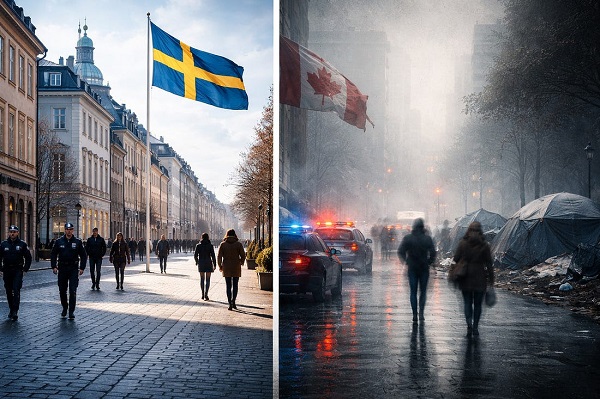
Sweden Fixed What Canada Won’t Even Name
-
Business2 days ago
Socialism vs. Capitalism
-
 Business2 hours ago
What Do Loyalty Rewards Programs Cost Us?
-
 Energy2 days ago
Canada’s debate on energy levelled up in 2025
-
 Daily Caller2 days ago
Is Ukraine Peace Deal Doomed Before Zelenskyy And Trump Even Meet At Mar-A-Lago?