
National
Conservative MP defends petition calling for no-confidence vote against Trudeau from ‘angry,’ ‘wild socialists’

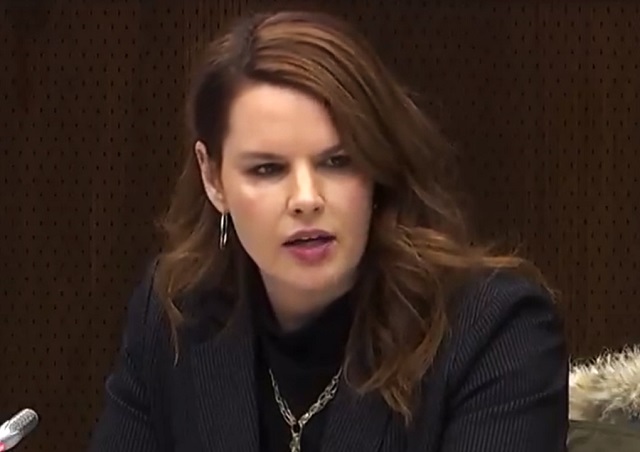

From LifeSiteNews

The popular petition, supported by MP Michelle Ferreri, has received more than 273,000 signatures.
A Conservative Party of Canada (CPC) MP who backed a petition demanding a vote of no confidence and election call against Prime Minister Justin Trudeau and his Liberal government is defending her petition from “angry” and “wild socialists” after it exploded to move than a quarter of a million signatures.
The official petition, initiated by Peterborough, Ontario resident Melissa Outwater and sponsored by CPC Michelle Ferreri, who represents the Peterborough-Kawartha, Ontario riding, has as of this writing more than 273,000 signatures.
“200k signatures in less than 2 weeks,” Ferreri posted recently on X (formerly Twitter) about her petition.
“Canadians want change. Canadians want affordability.”
When LifeSiteNews reported on the petition November 28, it already had more than 70,000 signatures.
The petition opened for signatures on November 24, and remains live until December 24. It reads, “We, the undersigned, citizens and residents of Canada, call upon the House of Commons to call for a vote of no confidence and a federal election 45 days following the vote.”
Ferreri has been defending her petition from what she has called “wild socialists” who are criticizing her efforts by claiming that anyone can “fake” sign it.
“What is hysterical about these wild socialists is they don’t even do basic google research,” she wrote on X (formerly Twitter) yesterday.
“Every email needs to be validated by the clerk to count. 2. You can only sign the petition once. 3. You must be a Canadian resident or Canadian citizen to sign any HOC petition. 4. Any Canadian citizen can start a petition and it is a powerful democratic way to elevate Canadians concerns.”
Petitions to Canada’s House of Commons can be started by anyone but must have the support of five Canadian citizens or residents along with the support of a sitting MP.
Once a petition has more than 500 verified signatures, it is presented to the House of Commons, where it awaits an official government response.
The stipulations the petition lays out for the vote of no confidence to take place reads: “The citizens of Canada have lost confidence in Justin Trudeau and the Liberal/NDP coalition. We call on the house for a vote of no confidence. We ask for an election 45 days after the vote if won.”
The petition stipulates that the current Liberal government under Trudeau is “not acting in the best interest of all citizens” due to its ideologically charged agenda of going after people’s “civil liberties” and “unbalanced immigration policies.”
“The policies of this government aren’t aligning with the crisis Canada is facing: housing costs, infringement of civil liberties, highest inflation in history, unbalanced immigration policies, taxation to the point of poverty, weakening of our economy by importing natural resources that Canada already has and under-utilizes,” it reads.
Additionally, the petition states that after over eight years with Trudeau in charge, Canadians are losing confidence in his leadership, especially “after five ethics investigations” have had to be conducted.
As a result, the petition states that Canada’s “reputation” is “being tarnished on a global scale under his leadership.”
Ferreri said that “Socialists are mad” about her petition because “they don’t support democracy.”
“If you disagree with an idea, at least get your facts straight. Here I’ll leave a link to the petition for you,” she added.
“A lot of the trolls are very angry because this is the fastest-growing online petition in parliamentary history,” Ferreri said last week on X (formerly Twitter).
“They (the trolls) like to protect their sweet precious Justin Trudeau, so they are saying all these (negative) things online.”
Ferreri said that if her petition reaches 300,000 it will be the highest for an “online” petition in Canadian history.
She added while signing the petition may be “symbolic in many ways” they are “very valuable” as they “elevate” people’s “voice to send a very big message that you are unhappy and that is very important when we work here at parliament.”
Recent polls show that the Trudeau Liberals’ scandal-plagued government’s popularity has taken a nosedive with no end in sight.
Per a recent LifeSiteNews report, according to polls, were a Canadian federal election held today the Conservatives under leader Pierre Poilievre would win a majority in the House of Commons over Trudeau’s Liberals.
Trudeau’s popularity has been falling and his government has been embroiled in scandal after scandal, the latest being a controversy around a three-year carbon tax “pause” he announced on home heating oil, but only in Atlantic Canadian provinces.
Even top Liberal party stalwarts have called for him to resign.
However, the New Democratic Party (NDP) has an informal coalition with Trudeau that began last year, agreeing to support and keep the Liberals in power until the next election is mandated by law in 2025. Until the NDP decides to break ranks with the Liberals, an early election call is unlikely.

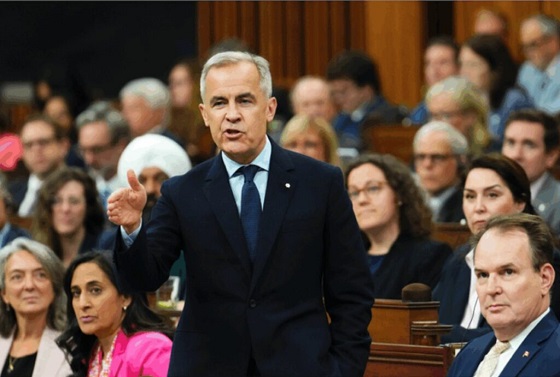
From Energy Now
By Margareta Dovgal
Playing politics with pipelines is a time-honored Canadian tradition. Recent events in the House of Commons offered a delightful twist on the genre.
The Conservatives introduced a motion quoting the Liberals’ own pipeline promises laid out in the Memorandum of Understanding (MOU) with Alberta, nearly verbatim. The Liberals, true to form, killed it 196–139 with enthusiastic help from the NDP, Bloc, and Greens.
We all knew how this would end. Opposition motions like this never pass; no government, especially not one led by Mark Carney, is going to let the opposition dictate the agenda. There’s not much use feigning outrage that the Liberals voted it down. The more entertaining angle has been watching closely as Liberal MPs twist themselves into pretzels explaining why they had to vote “no” on a motion that cheers on a project they claim to support in principle.
Liberal MP Corey Hogan dismissed the motion as “game-playing” designed to “poke at people”.
And he’s absolutely right to call it a “trap” for the Liberals. But traps only work when you walk into them.
Indigenous Services Minister Mandy Gull-Masty deemed the motion an “immature waste of parliamentary time” and “clearly an insult towards Indigenous Peoples” because it didn’t include every clause of the original agreement. Energy Minister Tim Hodgson decried it as a “cynical ploy to divide us” that “cherry-picked” the MOU.
Yet the prize for the most tortured metaphor goes to the prime minister himself. Defending his vote against his own pipeline promise, Carney lectured the House that “you have to eat the entire meal, not just the appetizer.”
It’s a clever line, and it also reveals the problem. The “meal” Carney is serving is stuffed with conditions. Environmental targets or meaningful engagement with Indigenous communities aren’t unrealistic asks. A crippling industrial carbon price as a precondition might be though.
But the prime minister has already said the quiet part out loud.
Speaking in the House a few weeks ago, Carney admitted that the agreement creates “necessary conditions, but not sufficient conditions,” before explicitly stating: “We believe the government of British Columbia has to agree.”
There is the poison pill. Handing a de facto veto to a provincial government that has spent years fighting oil infrastructure is neither constitutionally required nor politically likely. Elevating B.C.’s “agreement” to a condition, which is something the MOU text itself carefully avoids doing, means that Carney has made his own “meal” effectively inedible.
Hodgson’s repeated emphasis that the Liberal caucus supports “the entire MOU, the entire MOU” only reinforces this theory.
This entire episode forces us to ask whether the MOU is a real plan to build a pipeline, or just a national unity play designed to cool down the separatist temperature in Alberta. My sense is that Ottawa knew they had to throw a bone to Premier Danielle Smith because the threat of the sovereignty movement is gaining real traction. But you can’t just create the pretense of negotiation to buy time.
With the MOU getting Smith boo’ed at her own party’s convention by the separatists, it’s debatable whether that bone was even an effective one to throw.
There is a way. The federal government has the jurisdiction. If they really wanted to, they could just do it, provided the duty to consult with and accommodate Indigenous peoples was satisfied. Keep in mind: no reasonable interpretation equates Section 35 of the Charter to a veto.
Instead, the MOU is baked with so many conditions that the Liberals have effectively laid the groundwork for how they’re going to fail.
With overly-hedged, rather cryptic messaging, Liberals have themselves given considerable weight to a cynical theory, that the MOU is a stalling tactic, not a foundation to get more Canadian oil to the markets it’s needed in. Maybe Hodgson is telling the truth, and caucus is unified because the radicals are satisfied that “the entire MOU” ensures that a new oil pipeline will never reach tidewater through BC.
So, hats off to the legislative affairs strategists in the Conservative caucus. The real test of Carney’s political power continues: can he force a caucus that prefers fantasy economics into a mold of economic literacy to deliver on the vision Canadians signed off on? Or will he be hamstrung trying to appease the radicals from within?
Margareta Dovgal is managing director of Resource Works Society.
From the Frontier Centre for Public Policy
New script, same budget playbook. Nothing in the Carney budget breaks from the Trudeau years
Prime Minister Mark Carney’s first budget talks reform but delivers the same failed spending habits that defined the Trudeau years.
While speaking in the language of productivity, infrastructure and capital formation, the diction of grown-up economics, it still follows the same spending path that has driven federal budgets for years. The message sounds new, but the behaviour is unchanged.
Time will tell, to be fair, but it feels like more rhetoric, and we have seen this rhetoric lead to nothing before.
The government insists it has found a new path, one where public investment leads private growth. That sounds bold. However, it is more a rebranding than a reform. It is a shift in vocabulary, not in discipline. The government’s assumptions demand trust, not proof, and the budget offers little of the latter.
Former prime ministers Jean Chrétien and Paul Martin did not flirt with restraint; they executed it. Their budget cuts were deep, restored credibility, and revived Canada’s fiscal health when it was most needed. Ottawa shrank so the country could grow. Budget 2025 tries to invoke their spirit but not their actions. The contrast shows how far this budget falls short of real reform.
Former prime minister Stephen Harper, by contrast, treated balanced budgets as policy and principle. Even during the global financial crisis, his government used stimulus as a bridge, not a way of life. It cut taxes widely and consistently, limited public service growth and placed the long-term burden on restraint rather than rhetoric. Carney’s budget nods toward Harper’s focus on productivity and capital assets, yet it rejects the tax relief and spending controls that made his budgets coherent.
Then there is Justin Trudeau, the high tide of redistribution, vacuous identity politics and deficit-as-virtue posturing. Ottawa expanded into an ideological planner for everything, including housing, climate, childcare, inclusion portfolios and every new identity category.
The federal government’s latest budget is the first hint of retreat from that style. The identity program fireworks are dimmer, though they have not disappeared. The social policy boosterism is quieter. Perhaps fiscal gravity has begun to whisper in the prime minister’s ear.
However, one cannot confuse tone for transformation.
Spending still rises at a pace the government cannot justify. Deficits have grown. The new fiscal anchor, which measures only day-to-day spending and omits capital projects and interest costs, allows Ottawa to present a balanced budget while still adding to the deficit. The budget relies on the hopeful assumption that Ottawa’s capital spending will attract private investment on a scale economists politely describe as ambitious.
The housing file illustrates the contradiction. New funding for the construction of purpose-built rentals and a larger federal role in modular and subsidized housing builds announced in the budget is presented as a productivity measure, yet continues the Trudeau-era instinct to centralize housing policy rather than fix the levers that matter. Permitting delays, zoning rigidity, municipal approvals and labour shortages continue to slow actual construction. These barriers fall under provincial and municipal control, meaning federal spending cannot accelerate construction unless those governments change their rules. The example shows how federal spending avoids the real obstacles to growth.
Defence spending tells the same story. Budget 2025 offers incremental funding and some procurement gestures, but it avoids the core problem: Canada’s procurement system is broken. Delays stretch across decades. Projects become obsolete before contracts are signed. The system cannot buy a ship, an aircraft or an armoured vehicle without cost overruns and missed timelines. The money flows, but the forces do not get the equipment they need.
Most importantly, the structural problems remain untouched: no regulatory reform for major projects, no tax-competitiveness agenda and no strategy for shrinking a federal bureaucracy that has grown faster than the economy it governs. Ottawa presides over a low-productivity country but insists that a new accounting framework will solve what decades of overregulation and policy clutter have created. The budget avoids the hard decisions that make countries more productive.
From an Alberta vantage, the pivot is welcome but inadequate. The economy that pays for Confederation receives more rhetorical respect, yet the same regulatory thicket that blocks pipelines and mines remains intact. The government praises capital formation but still undermines the key sectors that generate it.
Budget 2025 tries to walk like Chrétien and talk like Harper while spending like Trudeau. That is not a transformation. It is a costume change. The country needed a budget that prioritized growth rooted in tangible assets and real productivity. What it got instead is a rhetorical turn without the courage to cut, streamline or reform.
Canada does not require a new budgeting vocabulary. It requires a government willing to govern in the country’s best interests.
Marco Navarro-Genie is vice-president of research at the Frontier Centre for Public Policy and co-author with Barry Cooper of Canada’s COVID: The Story of a Pandemic Moral Panic (2023).

The Recall Trap: 21 Alberta MLA’s face recall petitions

Canada’s free speech record is cracking under pressure

Taxpayers Federation calls on politicians to reject funding for new Ottawa Senators arena

100 Catholic schoolchildren rescued, Nigeria promises release of remaining hostages

Canada considers creating national ID system using digital passports for domestic use

Albertans give most on average but Canadian generosity hits lowest point in 20 years

Claims about ‘unmarked graves’ don’t withstand scrutiny
-
 Daily Caller1 day ago
Paris Climate Deal Now Decade-Old Disaster
-
 armed forces2 days ago
Ottawa’s Newly Released Defence Plan Crosses a Dangerous Line
-
Energy19 hours ago
Liberals Twisted Themselves Into Pretzels Over Their Own Pipeline MOU
-
 Censorship Industrial Complex16 hours ago
How Wikipedia Got Captured: Leftist Editors & Foreign Influence On Internet’s Biggest Source of Info
-
 Alberta1 day ago
Alberta’s huge oil sands reserves dwarf U.S. shale
-
Business19 hours ago
Ottawa Pretends To Pivot But Keeps Spending Like Trudeau
-
 Alberta2 days ago
Canada’s New Green Deal
-
 Business2 days ago
COP30 finally admits what resource workers already knew: prosperity and lower emissions must go hand in hand