
Canadian Energy Centre
Coastal GasLink completion key to unlocking Canadian natural gas for the world

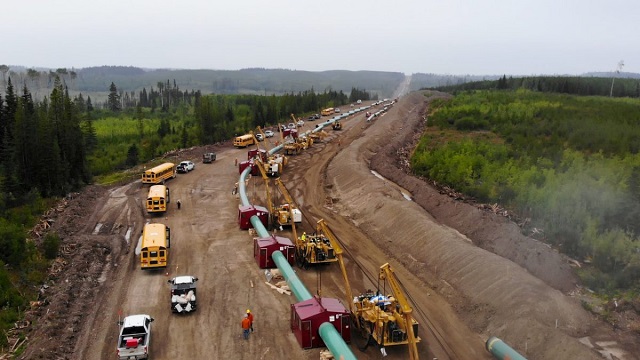

Construction underway on the Coastal GasLink pipeline, which will transport natural gas from northeast BC to the LNG Canada terminal in Kitimat. Photograph courtesy of Coastal GasLink
From the Canadian Energy Centre
By Cody CionaOnce the pipeline is in service, 17 of the twenty First Nations along the pipeline route have signed an agreement for the option to buy a 10 per cent stake
Canada’s natural gas industry has made a major step forward in efforts to export much needed supply to energy-hungry markets in Asia.

The key is the completion of the Coastal GasLink pipeline at the end of 2023.
The project, nearly 12 years in the making, is Canada’s only natural gas export pipeline to the west coast.
It will deliver supply to the port of Kitimat, about 1,400 kilometres northwest of Vancouver. There it will be supercooled and turned into the lowest carbon liquefied natural gas (LNG) in the world and shipped across to global customers from the export facility. That facility is expected to begin operations next year.
It is estimated that the two projects could reduce between 60 to 90 million tonnes of global emissions per year by replacing coal-fired power in Asia
“Coastal GasLink reached mechanical completion in early November 2023 ahead of schedule and is ready to deliver natural gas to LNG Canada’s facility, which will depend on their own commissioning process,” said Natasha Westover, manager of external relations for TC Energy
“Which means, sustainably produced LNG could be shipped to global markets by 2025, via this world-class, safety-leading pipeline.”
The project continues momentum for economic reconciliation with Indigenous communities, with Coastal GasLink set to become one of Canada’s largest infrastructure projects with Indigenous ownership.
Once the pipeline is in service, 17 of the twenty First Nations along the pipeline route have signed an agreement for the option to buy a 10 per cent stake.
“The opportunity was made available to all 20 Indigenous communities holding existing agreements with Coastal GasLink and is an important step on the path to true partnership through equity ownership in the project,” Westover said.
The ownership stakes are in addition to numerous agreements and contracts reached with Indigenous communities along Coastal GasLink’s path. In all, the project spent $1.8 billion with Indigenous and local businesses.
According to TC Energy, the project created more than 25,700 full-time equivalent jobs and took 55 million hours to complete. The project generated $3.2 billion to B.C.’s GDP, some $331 million in tax revenue, and $3.95 billion in spending with B.C. businesses and suppliers.
As well, during construction, Coastal GasLink and TC Energy spent over $13 million in community investments and sponsorships to support local and Indigenous community initiatives.
Once operating, it is estimated that over $26 million in annual tax revenue will be generated for communities along the pipeline’s path. Even with construction coming to an end, local communities will continue to see economic spinoffs. More than $42 million is expected to be generated each year through local economic activity.
“These accomplishments mark the end of the project’s five-year construction phase, during which time our workers, contractors, Indigenous and local communities collaborated to complete Canada’s first pipeline to the west coast in 70 years,” Westover said.
Work will now continue on environmental reclamation and preparing communities and workers for the start of operations.
“Coastal GasLink looks forward to continuing to be a part of the local community as we prepare for safe operations for decades to come,” Westover said.


From the Canadian Energy Centre
For Canada, the path to a stronger economy — and stronger global influence — runs through energy.
That’s the view of David Detomasi, a professor at the Smith School of Business at Queen’s University.
Detomasi, author of Profits and Power: Navigating the Politics and Geopolitics of Oil, argues that there is a moral case for developing Canada’s energy, both for Canadians and the world.

David Detomasi. Photo courtesy Smith School of Business, Queen’s University
CEC: What does being an energy superpower mean to you?
DD: It means Canada is strong enough to affect the system as a whole by its choices.
There is something really valuable about Canada’s — and Alberta’s — way of producing carbon energy that goes beyond just the monetary rewards.
CEC: You talk about the moral case for developing Canada’s energy. What do you mean?
DD: I think the default assumption in public rhetoric is that the environmental movement is the only voice speaking for the moral betterment of the world. That needs to be challenged.
That public rhetoric is that the act of cultivating a powerful, effective economic engine is somehow wrong or bad, and that efforts to create wealth are somehow morally tainted.
I think that’s dead wrong. Economic growth is morally good, and we should foster it.
Economic growth generates money, and you can’t do anything you want to do in social expenditures without that engine.
Economic growth is critical to doing all the other things we want to do as Canadians, like having a publicly funded health care system or providing transfer payments to less well-off provinces.
Over the last 10 years, many people in Canada came to equate moral leadership with getting off of oil and gas as quickly as possible. I think that is a mistake, and far too narrow.
Instead, I think moral leadership means you play that game, you play it well, and you do it in our interest, in the Canadian way.
We need a solid base of economic prosperity in this country first, and then we can help others.
CEC: Why is it important to expand Canada’s energy trade?
DD: Canada is, and has always been, a trading nation, because we’ve got a lot of geography and not that many people.
If we don’t trade what we have with the outside world, we aren’t going to be able to develop economically, because we don’t have the internal size and capacity.
Historically, most of that trade has been with the United States. Geography and history mean it will always be our primary trade partner.
But the United States clearly can be an unreliable partner. Free and open trade matters more to Canada than it does to the U.S. Indeed, a big chunk of the American people is skeptical of participating in a global trading system.
As the United States perhaps withdraws from the international trading and investment system, there’s room for Canada to reinforce it in places where we can use our resource advantages to build new, stronger relationships.
One of these is Europe, which still imports a lot of gas. We can also build positive relationships with the enormous emerging markets of China and India, both of whom want and will need enormous supplies of energy for many decades.
I would like to be able to offer partners the alternative option of buying Canadian energy so that they are less reliant on, say, Iranian or Russian energy.
Canada can also maybe eventually help the two billion people in the world currently without energy access.
CEC: What benefits could Canadians gain by becoming an energy superpower?
DD: The first and primary responsibility of our federal government is to look after Canada. At the end of the day, the goal is to improve Canada’s welfare and enhance its sovereignty.
More carbon energy development helps Canada. We have massive debt, an investment crisis and productivity problems that we’ve been talking about forever. Economic and job growth are weak.
Solving these will require profitable and productive industries. We don’t have so many economic strengths in this country that we can voluntarily ignore or constrain one of our biggest industries.
The economic benefits pay for things that make you stronger as a country.
They make you more resilient on the social welfare front and make increasing defence expenditures, which we sorely need, more affordable. It allows us to manage the debt that we’re running up, and supports deals for Canada’s Indigenous peoples.
CEC: Are there specific projects that you advocate for to make Canada an energy superpower?
DD: Canada’s energy needs egress, and getting it out to places other than the United States. That means more transport and port facilities to Canada’s coasts.
We also need domestic energy transport networks. People don’t know this, but a big chunk of Ontario’s oil supply runs through Michigan, posing a latent security risk to Ontario’s energy security.
We need to change the perception that pipelines are evil. There’s a spiderweb of them across the globe, and more are being built.
Building pipelines here, with Canadian technology and know-how, builds our competitiveness and enhances our sovereignty.
Economic growth enhances sovereignty and provides the resources to do other things. We should applaud and encourage it, and the carbon energy sector can lead the way.
From the Canadian Energy Centre
Bigger project maintains decades-long marine safety record
The Trans Mountain system continues its decades-long record of zero marine spills, even as oil tanker traffic has surged more than 800 per cent since the pipeline’s expansion in May 2024.
The number of tankers calling at Trans Mountain’s Westridge Marine Terminal in the Port of Vancouver in one month now rivals the number that used to go through in one year.
A global trend toward safer tanker operations
Trans Mountain’s safe operations are part of a worldwide trend. Global oil tanker traffic is up, yet spills are down, according to the International Tanker Owners Pollution Federation, a London, UK-based nonprofit that provides data and response support.

Graph courtesy International Tanker Owners Pollution Federation
Transport Canada reports a 95 per cent drop in ship-source oil spills and spill volumes since the 1970s, driven by stronger ship design, improved response and better regulations.
“Tankers are now designed much more safely. They are double-hulled and compartmentalized to mitigate spills,” said Mike Lowry, spokesperson for the Western Canada Marine Response Corporation (WCMRC).
WCMRC: Ready to protect the West Coast

One of WCMRC’s new response vessels arrives in Barkley Sound. Photo courtesy Western Canada Marine Response Corporation
From eight marine bases including Vancouver and Prince Rupert, WCMRC stands at the ready to protect all 27,000 kilometres of Canada’s western coastline.
Lowry sees the corporation as similar to firefighters — training to respond to an event they hope they never have to see.
In September, it conducted a large-scale training exercise for a worst-case spill scenario. This included the KJ Gardner — Canada’s largest spill response vessel and a part of WCMRC’s fleet since 2024.
“It’s part of the work we do to make sure everybody is trained and prepared to use our assets just in case,” Lowry said.
Expanding capacity for Trans Mountain

The K.J. Gardner is the largest-ever spill response vessel in Canada. Photo courtesy Western Canada Marine Response Corporation
WCMRC’s fleet and capabilities were doubled with a $170-million expansion to support the Trans Mountain project.
Between 2012 and 2024, the company grew from 13 people and $12 million in assets to more than 200 people and $213 million in assets.
“About 80 per cent of our employees are mariners who work as deckhands, captains and marine engineers on our vessels,” Lowry said.
“Most of the incidents we respond to are small marine diesel spills — the last one was a fuel leak from a forest logging vessel near Nanaimo — so we have deployed our fleet in other ways.”
Tanker safety starts with strong rules and local expertise

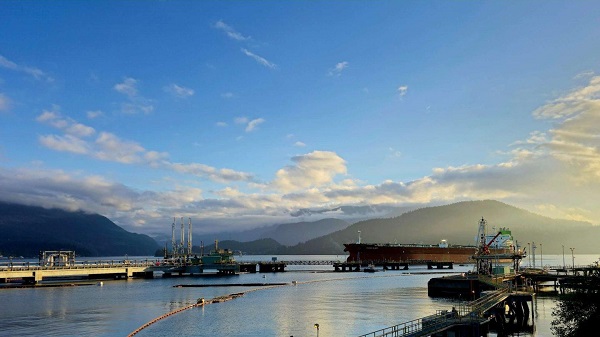
Tanker loading at the Westridge Marine Terminal in the Port of Vancouver. Photo courtesy Trans Mountain Corporation
Speaking on the ARC Energy Ideas podcast, Trans Mountain CEO Mark Maki said tanker safety starts with strong regulations, including the use of local pilots to guide vessels into the harbour.
“On the Mississippi River, you have Mississippi River pilots because they know how the river behaves. Same thing would apply here in Vancouver Harbour. Tides are strong, so people who are familiar with the harbor and have years and decades of experience are making sure the ships go in and out safely,” Maki said.
“A high standard is applied to any ship that calls, and our facility has to meet very strict requirements. And we have rejected ships, just said, ‘Nope, that one doesn’t fit the bill.’ A ship calling on our facilities is very, very carefully looked at.”

Working with communities to protect sensitive areas
Beyond escorting ships and preparing for spills, WCMRC partners with coastal communities to map sensitive areas that need rapid protection including salmon streams, clam beds and culturally important sites like burial grounds.
“We want to empower communities and nations to be more prepared and involved,” Lowry said.
“They can help us identify and protect the areas that they value or view as sensitive by working with our mapping people to identify those areas in advance. If we know where those are ahead of time, we can develop a protection strategy for them.”


The $50 Billion Question: EVs Never Delivered What Ottawa Promised

The Recall Trap: 21 Alberta MLA’s face recall petitions

Liberals gain support for ‘hate speech’ bill targeting Bible passages against homosexuality

Wisdom of Our Elders: The Contempt for Memory in Canadian Indigenous Policy

Canada’s free speech record is cracking under pressure

Storm clouds of uncertainty as BC courts deal another blow to industry and investment

Taxpayers Federation calls on politicians to reject funding for new Ottawa Senators arena
-
 Business1 day ago
Major tax changes in 2026: Report
-
 Digital ID15 hours ago
Canada releases new digital ID app for personal documents despite privacy concerns
-
 Energy14 hours ago
Canada’s sudden rediscovery of energy ambition has been greeted with a familiar charge: hypocrisy
-
 Alberta1 day ago
Schools should go back to basics to mitigate effects of AI
-
 Daily Caller1 day ago
Chinese Billionaire Tried To Build US-Born Baby Empire As Overseas Elites Turn To American Surrogates
-
 Daily Caller1 day ago
Two states designate Muslim group as terrorist
-
 International1 day ago
Russia Now Open To Ukraine Joining EU, Officials Briefed On Peace Deal Say
-
 Censorship Industrial Complex24 hours ago
Death by a thousand clicks – government censorship of Canada’s internet