
Daily Caller
‘Clearly Flawed’: Immigration Hawks Decry Biden-Harris Admin’s Decision To Quickly Resume Mass Parole Program


 From the Daily Caller News Foundation

The Biden-Harris administration has decided to resume a mass parole program that was sidelined due to the discovery of widespread fraud, but immigration hardliners say the vetting process remains critically flawed.
The Department of Homeland Security (DHS) is resuming an immigration program that allows foreign nationals to apply for asylum in their home countries and fly into the U.S. at various airports upon approval, known as the CHNV program, which has allowed hundreds of thousands of migrants from Cuba, Haiti, Nicaragua and Venezuela into the country, a spokesman confirmed to the Daily Caller News Foundation on Thursday. However, border hawks are cautioning that the program has not sufficiently updated its vetting procedures since it was placed on pause last month after the discovery of rampant fraud.
“My Committee has engaged with the department since this pause was announced, and the results were sobering,” House Homeland Security Committee Chairman Mark Green said in a Thursday statement following news of the program’s restart. “Instead of scrapping the clearly flawed program, the department is allowing it to continue without rooting out the fraud or putting adequate safeguards in place to prevent exploitation by sponsors here in the United States.”
Originally launched for Venezuelans in October 2022, the CHNV program was later expanded in January 2023 to include Cubans, Nicaraguans and Haitians. The parole initiative gives foreign nationals two-year authorization into the U.S. and work permits, provided they have not previously entered the country illegally and pass other vetting processes.
Green referred to the CHNV program as a “massive shell game” that allows 30,000 otherwise inadmissible foreign nationals to simply enter the country every month in lieu of crossing the border unlawfully.
At the beginning of August, DHS confirmed that they placed the program on hold following an internal audit. That report — first publicized by the Federation for American Immigration Reform (FAIR) — identified a litany of red flags, such as 100,948 CHNV forms being completed by just 3,218 sponsors, 24 of the 1,000 most used Social Security numbers by sponsors belonging to a deceased person and an IP address located in Tijuana, Mexico, being used more than 1,300 times.
Matt O’Brien, investigation director at the Immigration Reform Law Institute (IRLI), told the DCNF that the CHNV program is inherently susceptible to fraud due to the inherent reliance on sponsors and foreign governments.
“The supposed improvements made by U.S. Citizenship and Immigration Services (USCIS) simply can’t lead to better vetting,” O’Brien said to the DCNF. “The entire structure of the program encourages fraud because it relies on a ‘sponsor’ relationship that is impossible to verify and imposes no enforceable obligations on sponsor or beneficiary.”
“Second, and perhaps more importantly, one cannot vet Cubans, Haitians, Venezuelans or Nicaraguans,” O’Brien continued. “None of these countries have reliable, functioning records systems. And none of them share information with the U.S.”
The program has so far paroled roughly half a million foreign nationals into the U.S. since it launched in January 2023, according to Customs and Border Protection. There are more than 1.6 million other foreign nationals awaiting travel authorization into the country through the CHNV program.
CHNV is being relaunched with bolstered procedures meant to address the issues that initially halted the program, such as manually vetting sponsors in smaller numbers. Sponsors suspected of engaging in fraud in the program will continue to be referred to Immigration and Customs Enforcement for investigation.
However, the House Homeland Security Committee says DHS hasn’t explained what’s improved in the program now that is back up and running.
“DHS resumed issuing travel authorizations but has not provided the Committee with any additional information on how they intend on preventing fraud,” a House Homeland Committee spokesperson stated to the DCNF.
The spokesperson also noted that DHS has not satisfied the committee’s document requests for information following the allegations of mass fraud.
FAIR also noted that the program is better off being abolished.
“DHS announced it has already restarted CHNV, while offering only very vague assurances that they’ve fixed the problems,” FAIR President Dan Stein said in a statement, noting that DHS has not explained how they plan to vet each sponsor. “The American public has every reason to be very skeptical.”
“There is only one way to address the myriad problems with the Biden-Harris CHNV program,” Stein continued. “As House Speaker Mike Johnson tweeted earlier this month when FAIR exposed the rampant fraud: ‘Shut it down permanently.’”
DHS did not respond to a request for comment from the DCNF.
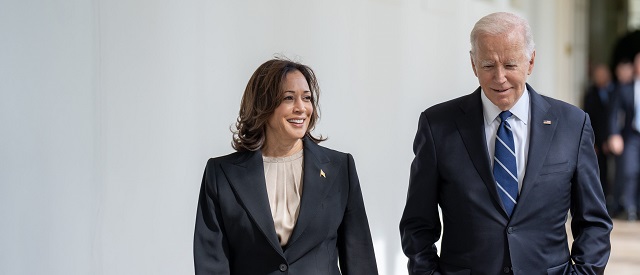
Featured Image: Official White House Photo by Adam Schultz


From the Daily Caller News Foundation
I’ve written frequently here in recent years about the financial fiasco that has hit Ford Motor Company and other big U.S. carmakers who made the fateful decision to go in whole hog in 2021 to feed at the federal subsidy trough wrought on the U.S. economy by the Joe Biden autopen presidency. It was crony capitalism writ large, federal rent seeking on the grandest scale in U.S. history, and only now are the chickens coming home to roost.
Ford announced on Monday that it will be forced to take $19.5 billion in special charges as its management team embarks on a corporate reorganization in a desperate attempt to unwind the financial carnage caused by its failed strategies and investments in the electric vehicles space since 2022.
Cancelled is the Ford F-150 Lightning, the full-size electric pickup that few could afford and fewer wanted to buy, along with planned introductions of a second pricey pickup and fully electric vans and commercial vehicles. Ford will apparently keep making its costly Mustang Mach-E EV while adjusting the car’s features and price to try to make it more competitive. There will be a shift to making more hybrid models and introducing new lines of cheaper EVs and what the company calls “extended range electric vehicles,” or EREVs, which attach a gas-fueled generator to recharge the EV batteries while the car is being driven.
Dear Readers:
As a nonprofit, we are dependent on the generosity of our readers.
Please consider making a small donation of any amount here.
Thank you!
“The $50k, $60k, $70k EVs just weren’t selling; We’re following customers to where the market is,” Farley said. “We’re going to build up our whole lineup of hybrids. It’s gonna be better for the company’s profitability, shareholders and a lot of new American jobs. These really expensive $70k electric trucks, as much as I love the product, they didn’t make sense. But an EREV that goes 700 miles on a tank of gas, for 90% of the time is all-electric, that EREV is a better solution for a Lightning than the current all-electric Lightning.”
It all makes sense to Mr. Farley, but one wonders how much longer the company’s investors will tolerate his presence atop the corporate management pyramid if the company’s financial fortunes don’t turn around fast.
To Ford’s and Farley’s credit, the company has, unlike some of its competitors (GM, for example), been quite transparent in publicly revealing the massive losses it has accumulated in its EV projects since 2022. The company has reported its EV enterprise as a separate business unit called Model-E on its financial filings, enabling everyone to witness its somewhat amazing escalating EV-related losses since 2022:
• 2022 – Net loss of $2.2 billion
• 2023 – Net loss of $4.7 billion
• 2024 – Net loss of $5.1 billion
Add in the company’s $3.6 billion in losses recorded across the first three quarters of 2025, and you arrive at a total of $15.6 billion net losses on EV-related projects and processes in less than four calendar years. Add to that the financial carnage detailed in Monday’s announcement and the damage from the company’s financial electric boogaloo escalates to well above $30 billion with Q4 2025’s damage still to be added to the total.
Ford and Farley have benefited from the fact that the company’s lineup of gas-and-diesel powered cars have remained strongly profitable, resulting in overall corporate profits each year despite the huge EV-related losses. It is also fair to point out that all car companies were under heavy pressure from the Biden government to either produce battery electric vehicles or be penalized by onerous federal regulations.
Now, with the Trump administration rescinding Biden’s harsh mandates and canceling the absurdly unattainable fleet mileage requirements, Ford and other companies will be free to make cars Americans actually want to buy. Better late than never, as they say, but the financial fallout from it all is likely just beginning to be made public.
- David Blackmon is an energy writer and consultant based in Texas. He spent 40 years in the oil and gas business, where he specialized in public policy and communications.
From the Daily Caller News Foundation
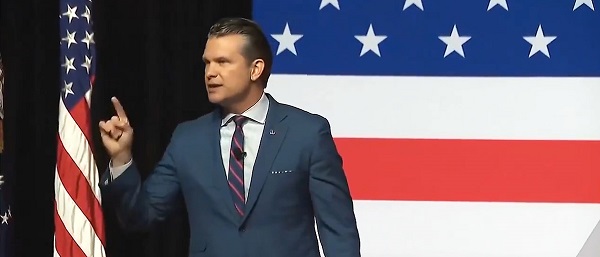
War Secretary Pete Hegseth is moving forward with a massive shakeup of military leadership, restructuring top commands and moving the U.S. focus away from Europe and the Middle East, according to a report out Monday.
Five sources with knowledge of the matter told The Washington Post the Pentagon is set to consolidate U.S. Central Command in the Middle East, U.S. European Command and U.S. Africa Command into a new larger combatant command, the U.S. International Command. Other commands would be similarly consolidated, reducing the total number of combatant commands from 11 to eight. The intended restructuring is designed both to reduce the number of admirals and four star generals and refocus the U.S. military on the Indo-Pacific and Western Hemisphere, according to the sources.
The plan would be one of the most significant changes to the military’s upper echelons in decades, and the move would bring the Pentagon more directly in line with the administration’s refocusing of priorities in the recently released National Security Strategy.
Dear Readers:
As a nonprofit, we are dependent on the generosity of our readers.
Please consider making a small donation of any amount here.
Thank you!
“As a matter of Department of War policy, we will not comment on leaked documents that we cannot authenticate and rumored internal discussions, as well as specifics of architectural discussion or pre-decisional matters,” a War Department official told the Daily Caller News Foundation. “Beyond this, any insinuation there is a divide within the Department is completely false – everyone in the Department is working to achieve the same goal under this administration.”
The Post also reports the proposal was crafted under supervision by Chairman of the Joint Chiefs of Staff Gen. Dan Caine, at Hegseth’s request. Caine will also be sharing two alternate proposals on potential restructures.
Hegseth has been looking for ways to reduce the number of four star generals in the Armed Forces, which has roughly the same amount of generals now as during World War II.


The Recall Trap: 21 Alberta MLA’s face recall petitions

Canada considers creating national ID system using digital passports for domestic use

Claims about ‘unmarked graves’ don’t withstand scrutiny

Here’s why city hall should save ‘blanket rezoning’ in Calgary

Too nice to fight, Canada’s vulnerability in the age of authoritarian coercion
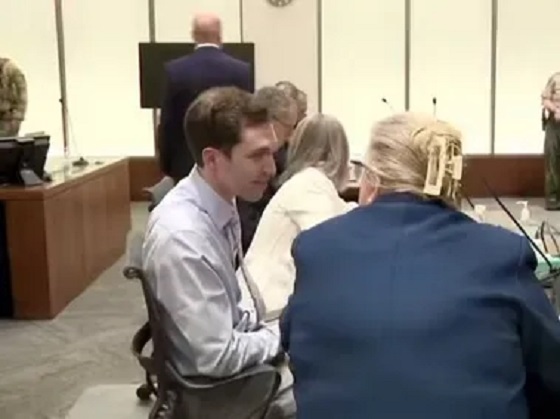
Tyler Robinson shows no remorse in first court appearance for Kirk assassination

Tanker ban politics leading to a reckoning for B.C.
-
 Daily Caller2 days ago
Paris Climate Deal Now Decade-Old Disaster
-
 Business1 day ago
Ottawa Pretends To Pivot But Keeps Spending Like Trudeau
-
 Energy1 day ago
Liberals Twisted Themselves Into Pretzels Over Their Own Pipeline MOU
-
 Censorship Industrial Complex1 day ago
How Wikipedia Got Captured: Leftist Editors & Foreign Influence On Internet’s Biggest Source of Info
-
 Indigenous2 days ago
Residential school burials controversy continues to fuel wave of church arsons, new data suggests
-
 Alberta2 days ago
Alberta’s huge oil sands reserves dwarf U.S. shale
-
 International2 days ago
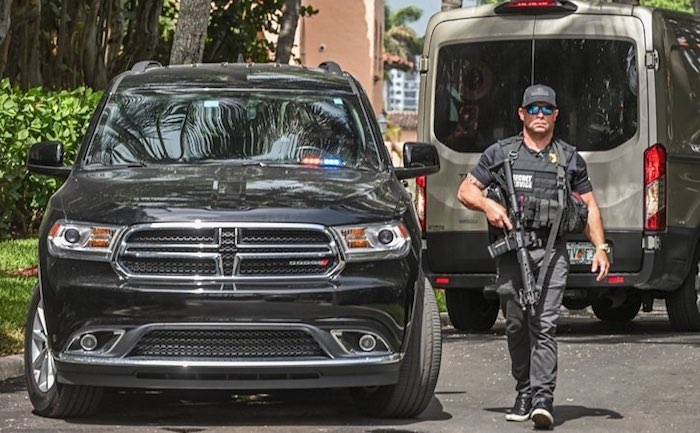
FBI didn’t think it had cause to raid Trump but DOJ did it anyway
-
Daily Caller2 days ago
Hegseth Planning Huge Shakeup Of Top Military Command: REPORT