
Uncategorized
Turkey to Saudi Arabia: Where is Khashoggi’s body?


ANKARA, Turkey — The Saudi officials who killed journalist Jamal Khashoggi in their Istanbul consulate must reveal the location of his body, Turkey’s president said Friday in remarks that were sharply critical of the kingdom’s handling of the case.

President Recep Tayyip Erdogan also said Saudi Arabia’s chief prosecutor will arrive in Turkey on Sunday as part of the investigation and will meet with Turkish counterparts. On Thursday, Saudi prosecutors said Khashoggi’s killing was premeditated, citing Turkish evidence and changing the country’s account again to try to ease international outrage over the slaying of a prominent critic of Crown Prince Mohammed bin Salman.
Turkey has other “information and evidence” about the killing by Saudi officials after Khashoggi entered the consulate on Oct. 2, and it will eventually reveal that information, Erdogan said without elaborating.
“There is no point in being too hasty,” he said in an indication that Turkey is prepared to maintain pressure on Saudi Arabia, even as the kingdom struggles for ways to end the crisis.
CIA director Gina Haspel was in Turkey earlier this week to review evidence, and she briefed U.S. President Donald Trump in Washington on Thursday.
What Trump called “one of the worst
“It is clear that he has been killed but where is it? You have to show the body,” Erdogan said Friday during an address to Turkey’s ruling party leaders.
The Turkish president criticized initial Saudi statements that claimed Khashoggi had left the consulate unharmed after going there for paperwork related to his planned marriage to a Turkish woman.
“He will leave the consulate and not take his fiancee with him? Such childish statements do not go hand in hand with statesmanship,” said Erdogan, again urging Saudi Arabia to turn over 18 suspects that the kingdom said it had arrested and would punish for the crime.
“If you cannot get them to speak … then hand them over to us and let us put them on trial,” he added.
Meanwhile, Khashoggi’s son, Salah, left Saudi Arabia after the kingdom revoked a travel ban, allowing him to travel to the United States.
State Department spokesman Robert Palladino said Washington welcomes the decision to have Salah Khashoggi and his family leave Saudi Arabia. His U.S. destination was not immediately known but his late father lived in the Washington area.
Palladino said Thursday that U.S. Secretary of State Mike Pompeo had discussed Jamal Khashoggi’s son during his recent visit to Riyadh and “made it clear” to Saudi leaders that Washington wanted him free to leave the kingdom.
“We are pleased that he is now able to do so,” Palladino said. Saudi media had showed Khashoggi’s son meeting Tuesday with the crown prince, who reportedly expressed his condolences.
The statement from Saudi prosecutors that evidence showed Khashoggi’s killing was premeditated contradicted an earlier Saudi assertion that rogue officials from the kingdom had killed Khashoggi by mistake in a brawl. That assertion, in turn, backtracked from an initial statement that Saudi authorities knew nothing about what happened to the columnist for The Washington Post.
The shifting explanations indicate Saudi Arabia is scrambling for a way out of the crisis that has enveloped the world’s largest oil exporter and a major U.S. ally in the Middle East. But a solution seems a long way off, partly because of deepening skepticism in Turkey and elsewhere that the brazen crime could have been carried out without the involvement of Prince Mohammed, the kingdom’s heir apparent.
At a conference in Riyadh on Wednesday, the crown prince said the killing was a “heinous crime that cannot be justified” and warned against any efforts to “manipulate” the crisis and drive a wedge between Saudi Arabia and Turkey, which are regional rivals but also diplomatic and business partners.
Khashoggi’s death has derailed the powerful prince’s campaign to project a modern image of the ultraconservative country, instead highlighting the brutal lengths to which some top officials in the government have gone to silence its critics. Khashoggi, who lived in self-imposed exile in the United States for nearly a year before his death, had written critically of Prince Mohammed’s crackdown on dissent.
___
Torchia reported from Istanbul.
Suzan Fraser And Christopher Torchia, The Associated Press

Uncategorized
Mortgaging Canada’s energy future — the hidden costs of the Carney-Smith pipeline deal


Much of the commentary on the Carney-Smith pipeline Memorandum of Understanding (MOU) has focused on the question of whether or not the proposed pipeline will ever get built.
That’s an important topic, and one that deserves to be examined — whether, as John Robson, of the indispensable Climate Discussion Nexus, predicted, “opposition from the government of British Columbia and aboriginal groups, and the skittishness of the oil industry about investing in a major project in Canada, will kill [the pipeline] dead.”
But I’m going to ask a different question: Would it even be worth building this pipeline on the terms Ottawa is forcing on Alberta? If you squint, the MOU might look like a victory on paper. Ottawa suspends the oil and gas emissions cap, proposes an exemption from the West Coast tanker ban, and lays the groundwork for the construction of one (though only one) million barrels per day pipeline to tidewater.
But in return, Alberta must agree to jack its industrial carbon tax up from $95 to $130 per tonne at a minimum, while committing to tens of billions in carbon capture, utilization, and storage (CCUS) spending, including the $16.5 billion Pathways Alliance megaproject.
Here’s the part none of the project’s boosters seem to want to mention: those concessions will make the production of Canadian hydrocarbon energy significantly more expensive.
As economist Jack Mintz has explained, the industrial carbon tax hike alone adds more than $5 USD per barrel of Canadian crude to marginal production costs — the costs that matter when companies decide whether to invest in new production. Layer on the CCUS requirements and you get another $1.20–$3 per barrel for mining projects and $3.60–$4.80 for steam-assisted operations.
While roughly 62% of the capital cost of carbon capture is to be covered by taxpayers — another problem with the agreement, I might add — the remainder is covered by the industry, and thus, eventually, consumers.
Total damage: somewhere between $6.40 and $10 US per barrel. Perhaps more.
“Ultimately,” the Fraser Institute explains, “this will widen the competitiveness gap between Alberta and many other jurisdictions, such as the United States,” that don’t hamstring their energy producers in this way. Producers in Texas and Oklahoma, not to mention Saudi Arabia, Venezuela, or Russia, aren’t paying a dime in equivalent carbon taxes or mandatory CCUS bills. They’re not so masochistic.
American refiners won’t pay a “low-carbon premium” for Canadian crude. They’ll just buy cheaper oil or ramp up their own production.
In short, a shiny new pipe is worthless if the extra cost makes barrels of our oil so expensive that no one will want them.
And that doesn’t even touch on the problem for the domestic market, where the higher production cost will be passed onto Canadian consumers in the form of higher gas and diesel prices, home heating costs, and an elevated cost of everyday goods, like groceries.
Either way, Canadians lose.
So, concludes Mintz, “The big problem for a new oil pipeline isn’t getting BC or First Nation acceptance. Rather, it’s smothering the industry’s competitiveness by layering on carbon pricing and decarbonization costs that most competing countries don’t charge.” Meanwhile, lurking underneath this whole discussion is the MOU’s ultimate Achilles’ heel: net-zero.
The MOU proudly declares that “Canada and Alberta remain committed to achieving Net-Zero greenhouse gas emissions by 2050.” As Vaclav Smil documented in a recent study of Net-Zero, global fossil-fuel use has risen 55% since the 1997 Kyoto agreement, despite trillions spent on subsidies and regulations. Fossil fuels still supply 82% of the world’s energy.
With these numbers in mind, the idea that Canada can unilaterally decarbonize its largest export industry in 25 years is delusional.
This deal doesn’t secure Canada’s energy future. It mortgages it. We are trading market access for self-inflicted costs that will shrink production, scare off capital, and cut into the profitability of any potential pipeline. Affordable energy, good jobs, and national prosperity shouldn’t require surrendering to net-zero fantasy.If Ottawa were serious about making Canada an energy superpower, it would scrap the anti-resource laws outright, kill the carbon taxes, and let our world-class oil and gas compete on merit. Instead, we’ve been handed a backroom MOU which, for the cost of one pipeline — if that! — guarantees higher costs today and smothers the industry that is the backbone of the Canadian economy.
This MOU isn’t salvation. It’s a prescription for Canadian decline.


The cost of the bureaucracy increased by $6 billion last year, according to newly released numbers in Public Accounts disclosures. The Canadian Taxpayers Federation is calling on Prime Minister Mark Carney to immediately shrink the bureaucracy.
“The Public Accounts show the cost of the federal bureaucracy is out of control,” said Franco Terrazzano, CTF Federal Director. “Tinkering around the edges won’t cut it, Carney needs to take urgent action to shrink the bloated federal bureaucracy.”
The federal bureaucracy cost taxpayers $71.4 billion in 2024-25, according to the Public Accounts. The cost of the federal bureaucracy increased by $6 billion, or more than nine per cent, over the last year.
The federal bureaucracy cost taxpayers $39.6 billion in 2015-16, according to the Public Accounts. That means the cost of the federal bureaucracy increased 80 per cent over the last 10 years. The government added 99,000 extra bureaucrats between 2015-16 and 2024-25.
Half of Canadians say federal services have gotten worse since 2016, despite the massive increase in the federal bureaucracy, according to a Leger poll.
Not only has the size of the bureaucracy increased, the cost of consultants, contractors and outsourcing has increased as well. The government spent $23.1 billion on “professional and special services” last year, according to the Public Accounts. That’s an 11 per cent increase over the previous year. The government’s spending on professional and special services more than doubled since 2015-16.
“Taxpayers should not be paying way more for in-house government bureaucrats and way more for outside help,” Terrazzano said. “Mere promises to find minor savings in the federal bureaucracy won’t fix Canada’s finances.
“Taxpayers need Carney to take urgent action and significantly cut the number of bureaucrats now.”
Table: Cost of bureaucracy and professional and special services, Public Accounts
| Year | Bureaucracy | Professional and special services |
|
$71,369,677,000 |
$23,145,218,000 |
|
|
$65,326,643,000 |
$20,771,477,000 |
|
|
$56,467,851,000 |
$18,591,373,000 |
|
|
$60,676,243,000 |
$17,511,078,000 |
|
|
$52,984,272,000 |
$14,720,455,000 |
|
|
$46,349,166,000 |
$13,334,341,000 |
|
|
$46,131,628,000 |
$12,940,395,000 |
|
|
$45,262,821,000 |
$12,950,619,000 |
|
|
$38,909,594,000 |
$11,910,257,000 |
|
|
$39,616,656,000 |
$11,082,974,000 |

The “Disruptor-in-Chief” places Canada in the crosshairs
Canada’s EV gamble is starting to backfire
End Supply Management—For the Sake of Canadian Consumers

UK Police Pilot AI System to Track “Suspicious” Driver Journeys

Judge Declares Mistrial in Landmark New York PRC Foreign-Agent Case

Canadian government launches trial version of digital ID for certain licenses, permits
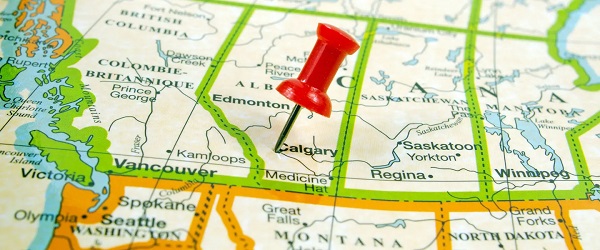
Alberta Next Panel calls to reform how Canada works
-
 Business2 days ago
“Magnitude cannot be overstated”: Minnesota aid scam may reach $9 billion
-
 Business2 days ago
Largest fraud in US history? Independent Journalist visits numerous daycare centres with no children, revealing massive scam
-
 Haultain Research19 hours ago
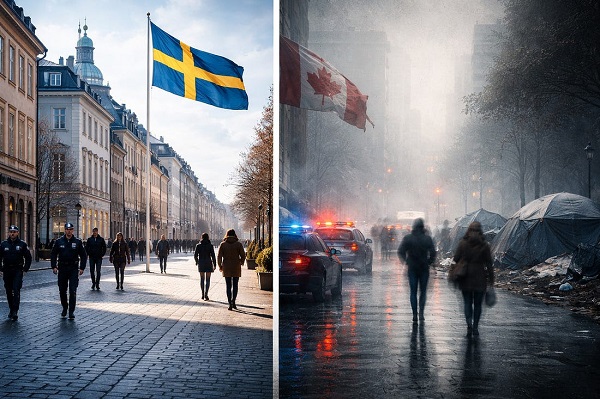
Sweden Fixed What Canada Won’t Even Name
-
 Censorship Industrial Complex2 days ago
US Under Secretary of State Slams UK and EU Over Online Speech Regulation, Announces Release of Files on Past Censorship Efforts
-
 Business19 hours ago
What Do Loyalty Rewards Programs Cost Us?
-
 Business7 hours ago
Land use will be British Columbia’s biggest issue in 2026
-
 Energy8 hours ago
Why Japan wants Western Canadian LNG
-
 Business5 hours ago
Mainstream media missing in action as YouTuber blows lid off massive taxpayer fraud