
Digital ID
Canada’s Liberal government moves forward with plans for digital ID system


From LifeSiteNews

The Department of Social Development hired outside consultants to provide expertise in creating a centralized, ‘single sign-in portal’ to replace about 60 different systems.
The Canadian federal government hired outside consultants who will be tasked with looking into whether or not officials should proceed with creating a digital ID system for all citizens and residents.
Canada’s Department of Social Development claimed in a May 20 note that the proposal is so complex it does not have the expertise to determine whether such a system is needed.
“Building this kind of system is complex and requires certain specialized tools and expertise we don’t have in-house,” the department noted.
“Based on international best practices, we are asking industry to help.”
The cost for hiring the consultants has not been disclosed, as per Blacklock’s Reporter. Also, there has been no parliamentary oversight to investigate the contracting.
The Social Development department said that it is moving “to next steps to our engagement of external contractors,” also noting, “This solution will give departments the ability to issue digital versions of the physical credentials they already provide today.”
The government claims that it is looking at “proceeding with procurements for issuing and verifying digital credentials” because they are “secure, digital versions of physical documents like work permits or boating licenses that can be stored in a digital wallet.”
“They offer a quicker, safer, more secure and more cost-effective way to access government services,” the government note claims.
While the department for now says that such a digital ID system would not be mandatory but “voluntary,” it noted that it is moving toward a centralized, “single sign-in portal” that would replace about 60 different systems.
Canada’s Privy Council research from 2023 noted that there is strong public resistance to the use of digital IDs to access government services.
Current Canadian Prime Minister Mark Carney has a history of supporting central bank digital currencies and in 2022 supported “choking off the money” donated to the Freedom Convoy protests against COVID mandates.
As late as February, the Liberal government under former Prime Minister Justin Trudeau’s immigration ministry, as reported by LifeSiteNews, was secretly asking Canadians via surveys if they would accept a national identification program that would likely end up requiring each citizen to always have a type of “digital” passport on them.
While the Liberal government under Trudeau insisted the program would be optional, Conservative leader Pierre Poilievre nonetheless sounded the alarm by promising to introduce a new bill that would “expressly prohibit” digital IDs in Canada.
Digital IDs and similar systems have long been pushed by globalist groups like the World Economic Forum, an organization with which Liberal Party leader Mark Carney has extensive ties, under the guise of ease of access and security.
Critics, however, have warned that the purpose of such a system is actually to centralize control over citizens. This opinion seems to be mirrored by the general public, with a Bank of Canada survey finding that Canadians are very wary of a government-backed digital currency, concluding that a “significant number” of citizens would resist the implementation of such a system.


corbettreport.com
But it’s another thing altogether for those conspirators to follow through on that psyop and actually achieve their desired end goal: the erection of the biosecurity state.
For those of us who managed to maintain our sanity over the last five years, the question is not whether COVID was a psyop—the answer to that question was obvious from the start—but whether the COVID conspirators have accomplished their objectives.
So, where do we stand in 2025? Did the COVID scamsters win?
Lockdowns
One of the intended effects of the COVID psyop was to take the concept of lockdowns and social distancing from the realm of obscure authoritarian fantasy to stone-cold reality.
As I pointed out in my 2020 video on “What NO ONE is Saying About The Lockdowns,” the idea of using school shutdowns, mandatory lockdowns and social distancing as pandemic prevention measures was first floated by Albequerque high school student Laura Glass for her local science fair project. (For those who are interested, she won third place!)
Prior to 2020, the notion of locking down healthy populations to prevent the spread of disease was still pie-in-the-sky fantasy. No government had seriously attempted to impose lockdowns or social distancing on a mass scale and the very thought of mass quarantines and government-imposed, electronically monitored lockdowns would have been laughed off as conspiracy paranoia.
On the other side of the 2020 divide, however, lockdowns became not only thinkable but an essential tool in the biosecurity state’s toolbelt.
Since 2020, for example, we have seen the extent to which lockdowns penetrated the popular imagination reflected in such ideas as “climate lockdowns.” After all, if locking people in their homes worked for a planetary health emergency, why not use it for a planetary climate emergency?
Yet another example of the mindset shift that has occurred over the past five years arrived last week when the UK Covid-19 Inquiry delivered its verdict that the lockdowns the UK government imposed during the scamdemic were “too little, too late“ and that they could have saved 23,000 lives by locking down earlier.
This is, of course, nonsense. Actually, it’s worse than nonsense; it’s nonsense based on made-up numbers from a known liar. As Off-Guardian point out in their (shadow-banned) tweet on the subject:
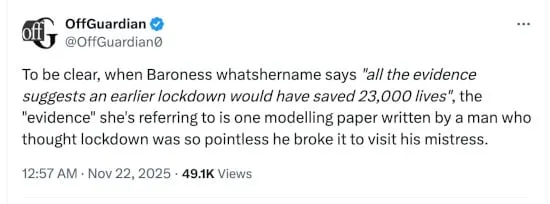
For those who don’t know, the tweet is referring to this passage from the inquiry’s report:
Professor Ferguson told the Inquiry that in later work which analyzed the impact of restrictions in England: “we explicitly modelled the counterfactual scenario of moving the lockdown of 23rd March back to 16th March, and estimated mortality … would have been reduced by 48%.“ That could have equated to a reduction in deaths in England from 48,600 to approximately 25,600 in the first wave up to 1 July 2020.
“Professor Ferguson” is, lest we forget, Neil Ferguson, the “virus modeller” (or should that be the “Liberal Lysenko“?) from Imperial College London who produced the computer model suggesting that 500,000 Britons were destined for the grave unless the UK government imposed a national lockdown. Ferguson has since walked back that claim and now denies calling for a lockdown at all, but it should be kept in mind that his about-face came after he was caught breaking the UK lockdown restrictions to carry on an affair with his married lover.
This is also the same Neil Ferguson who used his amazing “virus modeling” powers to predict 50,000 deaths from the UK’s 2002 mad cow outbreak (actual number of deaths: 177) and up to 200 million deaths from a potential, theoretical bird flu outbreak (which has yet to arrive).
Ferguson’s projection of what could have resulted if the government had locked down faster and earlier suffers from the same “garbage in, garbage out” tomfoolery as the Club of Rome’s environmental apocalypticism. Keep in mind that the number of people who would supposedly have been saved by a quicker UK lockdown is based on a fundamentally flawed input: the number of people who the UK government assert died of COVID. Those of us who called out the scam from the start have been noting for years that these COVID death tolls are statistical chicanery, since they rely on the fraudulent claim that everyone who died with COVID—as measured by the scientifically meaningless PCR test—had in fact died of COVID.
In other words, Ferguson’s numbers are plucked out of thin air and aren’t worth the paper they’re written on. They should not be taken seriously by anyone, whatever their opinion on the efficacy of lockdowns.
But, as usual, the damage has been done. The controlled establishment media has run their headlines about the lives that could have been saved by earlier lockdowns, and the type of people who still get their news from these mockingbird repeaters will now be more certain than ever that social distancing and quarantining populations is the right thing to do in the event of a declared health emergency.
Chalk that one up as a win for the COVID scamsters.
QR Codes, Vaccine Passports and Digital ID
Even more important to the would-be medical tyrants than the normalization of lockdowns and social distancing, however, was the creation of the technological infrastructure upon which the biosecurity state is enabled. This digital infrastructure includes:
- the QR codes that people were habituated into scanning before being allowed access to or egress from various quarantine zones;
- the vaccine passports that were used to assess compliance with vaccine mandates; and
- the various contract tracing apps and self-quarantine apps that were employed to keep track of citizens as they moved from place to place.
If you’ve read about my recent experience trying to order breakfast in Malaysia, you’ll know that, once again, the COVIDians have been remarkably successful in achieving their objectives. As I found out during that Malaysian sojourn, scanning QR codes to access online menus and using cashless payment systems to pay for purchases is becoming so normalized in certain parts of the world that it can be difficult to so much as order breakfast without a smartphone and cellular service. Indeed, the smartphone has become a virtual prerequisite for participation in the public space, and it was the scamdemic that allowed the shift to 100% dependence on smartphones to take place.
One recent demonstration of this smartphone requirement for participation in public life came from an email I received this week from a Corbett Reporter in Canada. He was trying to send a registered letter to the US via Canada Post but was informed that his addressed envelope alone would no longer do. Instead, he now had to fill out an online form and print off a special tracking number in order to mail the item. Not owning a smartphone, he was out of luck. He would have to go home, fill out the online forms on his desktop, print out the paperwork and bring it back to the post office. He opted not to send the letter, vowing instead to never again mail anything to the US.
Living in Japan as I do, the only surprising part of his story is that Canada held off making this change in their postal system for so long. Japan Post implemented the same electronic system for international mail four years ago. Of course, at that time the COVID border closures and postal delivery issues were used as the excuse for the intrusive new policy. But, given that country after country is now bringing in similar measures, the reality is clear: the change to a computer-dependent postal system is a global directive that was pushed, using the cover of COVID contagion, during the scamdemic. The end result is that one must either carry their smartphone with them at all times or spend extra time at home filling out online forms and printing off paperwork if they want to send mail internationally.
Of course, all of these technological “upgrades” to our daily experience—from the smartphone postal system to the QR code menus to the cashless payment systems—serve the same agenda. They are meant to pave the way toward the apotheosis of the biosecurity state: the consolidation of all our information into a single government-issued digital identity app. Soon, we will be giving the government real-time access to all of our daily movements, transactions and interactions and will be signing in with government-issued digital credentials everywhere we go online and in real life.
In the event of the next scamdemic, the scammers will hardly have to do anything at all. The QR code check-ins, vaccine passport checks and cashless payments will already be so much a part of our daily life that we’ll hardly notice any new scamdemic-related restrictions on our activities.
That’s another win for Team COVID. But they’re not done yet.
Clot shots
Another key goal of the scamdemic, of course, was to fast track government approval of mRNA and DNA “vaccine” technologies.
We know this, of course, because the conspirators told us as much in their own words. Who can forget the October 2019 Milken Institute-hosted discussion on the “Universal Flu Vaccine“? In case you have forgotten, that was the conference in which such luminaries as Tony Fauci and Rick Bright lamented that the poor, beleaguered Big Pharma corporations were going to have to spend billions of dollars and at least a decade of hard work proving the safety and efficacy of their DNA/mRNA injection techniques…unless some health emergency arose to justify the emergency approval of these experimental technologies.
So, were Fauci and Bright and their co-conspirators successful in their fast-tracking task? Did they circumvent a decade of regulatory approval work for their Big Pharma buddies? Well, if the point was to invoke a health emergency to get emergency approval for these clot shot monstrosities, then we need look no further than “Operation Warp Speed” for proof that the COVID conspirators were, in fact, remarkably successful.
And let’s never forget that Trump considers the Warp Speed MAGA jabs to be “one of the greatest things ever in politics or in the military!”
Lest there be any doubt about Trump’s devotion to this technology, let’s not forget that he hosted an event launching his $500 billion AI-pushing “Stargate” project on his third day in office earlier this year, at which Larry Ellison discussed using AI to develop personalized mRNA cancer vaccines. And just two months ago, Bill Gates used his place of honor at a White House banquet to boast that he and Trump were discussing “vaccines and gene editing” in their joint effort to “tak[e] American innovation to the next level.”
But this isn’t just about Trump, and it isn’t just about what’s happening in the US. This is a worldwide agenda. And, if this smattering of headlines from the past few months is any indication, the COVID era has given a gigantic shot in the arm (pun intended) to the clot shot “vaccine” manufacturers:
Experimental mRNA flu vaccine shows superior efficacy against symptomatic illness (just don’t ask about the side effects)
COVID Vaccine Tech May Reduce Disabilities in Snakebite Victims
Personalized mRNA Vaccines Will Revolutionize Cancer Treatment—If Funding Cuts Don’t Doom Them
The Dawn of Personalized DNA Vaccines
And, exactly in line with my reporting in Who Is Bill Gates? there’s this recent report
New Gates-Funded Microneedle Patch Implant Installs Both mRNA and Quantum Dot Markings Into the Body
Yes, it’s safe to say we are now ensconced in the era of genetic intervention masquerading as “vaccines.”
That’s another win for the WHO mafia.
Mission Accomplished?
I could go on. I haven’t even mentioned yet the passage of the WHO’s pandemic treaty or how its provisions actually encourage the work of the bioweapons industry…in the name of “defense” against such weapons, naturally. (A “poor man’s nuke,” anyone?)
But you get the point. Just as it’s difficult to deny that the COVID scamdemic was the biggest psyop of our lifetime, it’s equally difficult to deny that the perpetrators of that scam have been remarkably successful, achieving so many of their 2030 Agenda items in one fell swoop.
So, did the conspirators win?
The answer to this question is even more important than it might seem at first glance. History, as we know, is written by the winners, so if the WHO goons and their string-pullers and paymasters did indeed win, then our grandchildren will grow up learning about the terrible plague that threatened to wipe out the global population in 2020. They’ll read about how some crazy kooks resisted the loving lockdowns of the government and warned against the life-saving vaccines. They’ll truly believe we were only saved by the skin of our teeth thanks to our benevolent masters imposing lockdowns, mRNA clot shots and masks on us all (though they should have locked us down sooner and harder!).
This is why spreading the truth about these events is so vital. We must not let the lies stand. If these lies are written into the history books, then the conspirators really have won.
If you agree with me, share this report (or at least the evidence linked herein) with someone you love.
Like this type of essay? Then you’ll love The Corbett Report Subscriber newsletter, which contains my weekly editorial as well as recommended reading, viewing and listening.
If you’re a Corbett Report member, you can sign in to corbettreport.com and read the newsletter today.
Not a member yet? Sign up today to access the newsletter and support this work.
Are you already a member and don’t know how to sign in to the website? Contact me HERE and I’ll be happy to help you get logged in!
Subscribe to The Corbett Report


The platform’s age checks are part of a bigger push to create online spaces policed by biometrics.
|
The rollout begins this week as an optional process and will become compulsory in December in countries including Australia, the Netherlands, and New Zealand, reaching the United States and other regions by early 2026.
The company says these steps are meant to make its vast online world safer for younger audiences, restricting how players of different ages can interact inside user-created “Experiences.”
To take part in chat features, users must now verify their age either by scanning a government-issued ID or recording a short facial video through Persona, an outside verification company.
|
 |
|
Conversations are limited to others in the same or adjacent age groups unless users connect through “Trusted Connections,” which verifies they have a real-world relationship.
Roblox says the goal is to limit unsafe interactions and hopes the model will become “a new industry standard.”
While promoted as a safety improvement, this model also signals a move toward identity-linked participation in online spaces.
Digital ID verification effectively removes the anonymity that has long been part of internet culture.
It ties access to personal credentials, leaving fewer opportunities for users to interact without surrendering identifiable data.
The same technologies now appearing on entertainment platforms are increasingly being discussed by US policymakers as potential requirements for accessing social media, adult content, or even general-purpose platforms.
Several US states have already passed or proposed laws mandating age verification or digital ID checks for online activity, a trend that privacy advocates warn could erode personal freedom and create databases of sensitive personal information.
According to Roblox, “information uploaded to Persona is retained for a period of 30 days” before deletion.
Persona’s privacy policy indicates that it may collect extensive information, including device identifiers, geolocation data, and records from brokers and public sources.
This wide net of data collection extends well beyond what is required to confirm age, deepening concerns about how biometric and ID data could be reused or shared.
The company has not specified exact rollout dates for all markets but expects global enforcement to be completed within a year.
This makes Roblox the first major online platform to require facial age checks for chat participation.
The move comes as Roblox faces ongoing lawsuits and public pressure related to reports of grooming and child exploitation on the platform.
On the same day the company revealed its latest update, advocacy groups UltraViolet and ParentsTogether Action hosted an online protest, submitting a petition signed by 10,000 parents and grandparents calling for stronger child safety rules.
Roblox also introduced a new Safety Center, described as “a dedicated resource for parents and caregivers that provides clear guidance and tools to help them make informed decisions, set up Parental Controls, and support their child’s online experience.”
Still, the underlying trade-off remains significant. Roblox’s “Facial Media Capture Privacy Notice” confirms that it may conduct “other facial media processing” for “safety, assurance, or feature-specific purposes,” though the company says “Roblox does not use such facial media to identify you personally.”
Yet by normalizing ID scans and biometric checks, the company moves closer to a model of online life where anonymity is the exception rather than the rule, a change that could permanently alter how people experience privacy in digital environments.
|

Tech Mogul Gives $6 Billion To 25 Million Kids To Boost Trump Investment Accounts
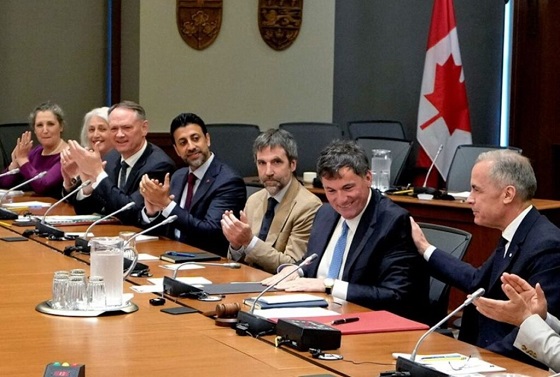
Carney’s Toronto cabinet meetings cost $530,000

Health Canada report finds euthanasia now accounts for over 5% of deaths nationwide

Recent price declines don’t solve Toronto’s housing affordability crisis

Alberta Sports Hall of Fame Announces Class of 2026 Inductees

Integration Or Indignation: Whose Strategy Worked Best Against Trump?

Carney’s pipeline deal hits a wall in B.C.
-
 Business1 day ago
Why Does Canada “Lead” the World in Funding Racist Indoctrination?
-
 Automotive2 days ago
Trump Deals Biden’s EV Dreams A Death Blow
-
 Automotive2 days ago
Canada’s EV Mandate Is Running On Empty
-
 Media1 day ago
They know they are lying, we know they are lying and they know we know but the lies continue
-
 Focal Points1 day ago
The West Needs Bogeymen (Especially Russia)
-
 Censorship Industrial Complex23 hours ago
US Condemns EU Censorship Pressure, Defends X
-
 Banks1 day ago
To increase competition in Canadian banking, mandate and mindset of bank regulators must change
-
 Dan McTeague1 day ago
Will this deal actually build a pipeline in Canada?