
espionage
Canada’s intelligence chief says he personally warned Trudeau about China’s election meddling

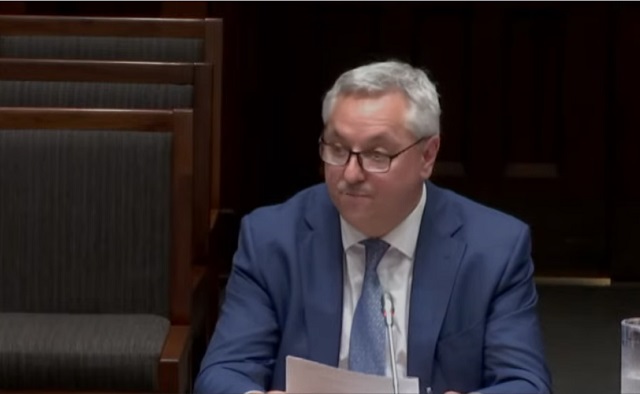

David Vigneault
From LifeSiteNews

Canadian Security Intelligence Service director David Vigneault authenticated memos used during private meetings with the prime minister as well as his staff concerning Chinese Communist deception.
The head of Canada’s intelligence agency testified under oath that he gave Justin Trudeau multiple warnings that agents of the Communist Chinese Party (CCP) were going after Conservative MPs yet the prime minister has denied he ever got these warnings.
In what appears to be a contradiction of Trudeau’s claim that he was not briefed directly about CCP meddling in Canada’s electoral process, Canadian Security Intelligence Service (CSIS) director David Vigneault said late last week at the Foreign Interference Commission that he indeed had “communicated” the issues.
He then authenticated memos used during private meetings with Trudeau as well as his staff concerning CCP deception, which was also noted in a “top secret” memo titled Briefing to the Prime Minister’s Office on Foreign Interference Threats to Canada’s Democratic Institutions, dated February 21, 2023.
The six-page memo went into full detail as to the extent of CCP subterfuge that targeted Canada’s Conservative Party in the 2019 and 2021 federal elections.
The memo read that CCP agents “were almost certainly motivated by a perception the Conservative Party of Canada was promoting a platform that was perceived to be anti-China,” also stating that 2021 election anomalies were “aimed at discouraging Canadians, particularly of Chinese heritage, from supporting the Conservative Party, leader Erin O’Toole and particularly Steveston-Richmond East candidate Kenny Chiu.”
“We know the People’s Republic of China clandestinely and deceptively interfered in both the 2019 and 2021 general elections,” the memo reads.
Vigneault confirmed he used similar language when speaking with Trudeau and political aides.
At the Commission inquiry, Gib van Ert, counsel for Conservative MP Michael Chong, asked Vigneault if “this knowledge something you or the Canadian Security Intelligence Service as a body communicated to the Prime Minister?”
“It is indeed something I communicated,” Vigneault replied.
Thomas Jarmyn, counsel for Erin O’Toole, then asked if “Those words were chosen with intention?”
“Yes, these words are carefully selected,” Vigneault replied.
Earlier this week, LifeSiteNews reported that details from the “top secret” memo have shown that Trudeau’s office was giving explicit warnings by Canadian intelligence that agents of the CCP were an “existential threat to Canadian democracy.”
The Foreign Interference Commission was convened to “examine and assess the interference by China, Russia, and other foreign states or non-state actors, including any potential impacts, to confirm the integrity of, and any impacts on, the 43rd and 44th general elections (2019 and 2021 elections) at the national and electoral district levels.”
The Commission is being headed by Justice Marie-Josée Hogue, who had earlier said that she and her lawyers will remain “impartial” and will not be influenced by politics and began January 29.
In January, Hogue said that she would “uncover the truth whatever it may be.”
Spy head: Trudeau was ‘briefed’
Last week, the commission learned about another “secret” memo from October 26, 2022, about “clandestinely supported candidates” states that “People’s Republic of China officials could be emboldened in their electoral interference efforts by the 2021 defeat of former Richmond MP Kenny Chiu.”
During testimony at the commission, Vigneault confirmed that he mentioned the matter with Trudeau, saying, “This is one of the cases I briefed the Prime Minister on that day.”
Shantona Chaudhury, counsel for the commission, asked him if he was able to recall “whether that is something you conveyed to the Prime Minister?”
“I don’t remember if I used these exact words but talking about that specific case, I put that case in context in relation to other People’s Republic of China activities,” Vigneault replied.
Nando de Luca, counsel for the Conservative Party, then asked Vigneault if the information was specifically communicated to Trudeau.
“I can tell you some of that information was absolutely used to brief on a very specific topic,” Vigneault replied.
Vigneault then noted that all the top-secret memos, which were composed for his meetings with Trudeau’s office, contained many facts as well as similar language he had spoken of many times.
“I have verbalized some of these issues in the past,” Vigneault told the commission.
Despite the warnings given to Trudeau’s office, not once were opposition MPs warned that they were a target of CCP agents.
In May 2023, Trudeau said to reporters that he did not know anything about CCP agents targeting conservative MPs.
“The Canadian Security Intelligence Service knew about certain things but didn’t feel it reached a threshold that required them to pass it up out of CSIS,” he said.
“Was it briefed up out of the Canadian Security Intelligence Service? It was not,” he added, saying that “CSIS made the determination it wasn’t something that needed to be raised to a higher level because it wasn’t a significant enough concern.”


From the Frontier Centre for Public Policy
By Lee Harding
Alarming claims out of P.E.I. point to deep foreign interference, and the federal government keeps stalling. Why?
Explosive new allegations of Chinese interference in Prince Edward Island show Canada’s institutions may already be compromised and Ottawa has been slow to respond.
The revelations came out in August in a book entitled “Canada Under Siege: How PEI Became a Forward Operating Base for the Chinese Communist Party.” It was co-authored by former national director of the RCMP’s proceeds of crime program Garry Clement, who conducted an investigation with CSIS intelligence officer Michel Juneau-Katsuya.
In a press conference in Ottawa on Oct. 8, Clement referred to millions of dollars in cash transactions, suspicious land transfers and a network of corporations that resembled organized crime structures. Taken together, these details point to a vulnerability in Canada’s immigration and financial systems that appears far deeper than most Canadians have been told.
P.E.I.’s Provincial Nominee Program allows provinces to recommend immigrants for permanent residence based on local economic needs. It seems the program was exploited by wealthy applicants linked to Beijing to gain permanent residence in exchange for investments that often never materialized. It was all part of “money laundering, corruption, and elite capture at the highest levels.”
Hundreds of thousands of dollars came in crisp hundred-dollar bills on given weekends, amounting to millions over time. A monastery called Blessed Wisdom had set up a network of “corporations, land transfers, land flips, and citizens being paid under the table, cash for residences and property,” as was often done by organized crime.
Clement even called the Chinese government “the largest transnational organized crime group in the history of the world.” If true, the allegation raises an obvious question: how much of this activity has gone unnoticed or unchallenged by Canadian authorities, and why?
Dean Baxendale, CEO of the China Democracy Fund and Optimum Publishing International, published the book after five years of investigations.
“We followed the money, we followed the networks, and we followed the silence,” Baxendale said. “What we found were clear signs of elite capture, failed oversight and infiltration of Canadian institutions and political parties at the municipal, provincial and federal levels by actors aligned with the Chinese Communist Party’s United Front Work Department, the Ministry of State Security. In some cases, political donations have come from members of organized crime groups in our country and have certainly influenced political decision making over the years.”
For readers unfamiliar with them, the United Front Work Department is a Chinese Communist Party organization responsible for influence operations abroad, while the Ministry of State Security is China’s main civilian intelligence agency. Their involvement underscores the gravity of the allegations.
It is a troubling picture. Perhaps the reason Canada seems less and less like a democracy is that it has been compromised by foreign actors. And that same compromise appears to be hindering concrete actions in response.
One example Baxendale highlighted involved a PEI hotel. “We explore how a PEI hotel housed over 500 Chinese nationals, all allegedly trying to reclaim their $25,000 residency deposits, but who used a single hotel as their home address. The owner was charged by the CBSA, only to have the trial shut down by the federal government itself,” he said. The case became a key test of whether Canadian authorities were willing to pursue foreign interference through the courts.
The press conference came 476 days after Bill C-70 was passed to address foreign interference. The bill included the creation of Canada’s first foreign agent registry. Former MP Kevin Vuong rightly asked why the registry had not been authorized by cabinet. The delay raises doubts about Ottawa’s willingness to confront the problem directly.
“Why? What’s the reason for the delay?” Vuong asked.
Macdonald-Laurier Institute foreign policy director Christopher Coates called the revelations “beyond concerning” and warned, “The failures to adequately address our national security challenges threaten Canada’s relations with allies, impacting economic security and national prosperity.”
Former solicitor general of Canada and Prince Edward Island MP Wayne Easter called for a national inquiry into Beijing’s interference operations.
“There’s only one real way to get to the bottom of what is happening, and that would be a federal public inquiry,” Easter said. “We need a federal public inquiry that can subpoena witnesses, can trace bank accounts, can bring in people internationally, to get to the bottom of this issue.”
Baxendale called for “transparency, national scrutiny, and most of all for Canadians to wake up to the subtle siege under way.” This includes implementing a foreign influence transparency commissioner and a federal registry of beneficial owners.
If corruption runs as deeply as alleged, who will have the political will to properly respond? It will take more whistleblowers, changes in government and an insistent public to bring accountability. Without sustained pressure, the system that allowed these failures may also prevent their correction.
Lee Harding is a research fellow for the Frontier Centre for Public Policy.


AI-driven surveillance is shifting from spotting suspects to mapping ordinary life, turning everyday travel into a stream of behavioral data
|
|


Ottawa-Alberta agreement may produce oligopoly in the oilsands
The Top News Stories That Shaped Canadian Energy in 2025 and Will Continue to Shape Canadian Energy in 2026

Western Canada’s supply chain for Santa Claus

$2.6 million raised for man who wrestled shotgun from Bondi Beach terrorist

Remembering Afghanistan and the sacrifices of our military families

How to talk about housing at the holiday dinner table

Alberta Next Panel calls for less Ottawa—and it could pay off
-
 Alberta15 hours ago
The Canadian Energy Centre’s biggest stories of 2025
-
 Business15 hours ago
Disclosures reveal Minnesota politician’s husband’s companies surged thousands-fold amid Somali fraud crisis
-
 Energy2 days ago
Rulings could affect energy prices everywhere: Climate activists v. the energy industry in 2026
-
 Business14 hours ago
Resurfaced Video Shows How Somali Scammers Used Day Care Centers To Scam State
-
 International2 days ago
China Stages Massive Live-Fire Encirclement Drill Around Taiwan as Washington and Japan Fortify
-
 Digital ID2 days ago
The Global Push for Government Mandated Digital IDs And Why You Should Worry
-
 Business2 days ago
Feds pull the plug on small business grants to Minnesota after massive fraud reports
-
 Business1 day ago
DOOR TO DOOR: Feds descend on Minneapolis day cares tied to massive fraud