
Business
Breaking: Explosive FBI Warning—CCP, Iran, and Mex-Cartels Partnering in Canada to Move Fentanyl and Terrorists Into U.S.



 Sam Cooper
Patel’s warning echoes The Bureau’s exclusive reporting on a criminal convergence linking CCP-backed chemical suppliers, Iranian proxies, and Mexican cartels operating through Vancouver superlabs
In an explosive Sunday interview that will place tremendous pressure on Prime Minister Mark Carney’s new Liberal government, FBI Director Kash Patel alleged that Mexican cartels, Chinese Communist Party operatives, and Iranian threat actors have forged a new axis of criminal cooperation, using Canada’s porous northern border and the Port of Vancouver—not the southern Mexican border—as their preferred entry point to flood fentanyl and terror suspects into the United States.

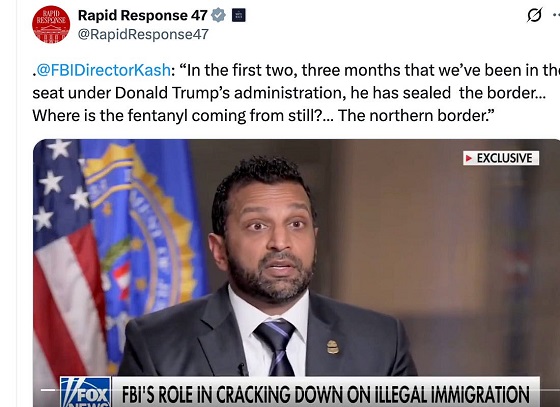
“In the first two, three months that we’ve been in the seat under Donald Trump’s administration, he has sealed the border,” Patel told Fox News’ Maria Bartiromo. “He has stopped border crossings. So where’s all the fentanyl coming from? Still? Where’s the trafficking coming from still? Where are all the narco traffickers going to keep bringing this stuff into the country? The northern border. Our adversaries have partnered up with the CCP and others—Russia, Iran—on a variety of different criminal enterprises. And they’re going and they’re sailing around to Vancouver and coming in by air.”
Patel asserted that adversarial regimes—including Beijing and Tehran—are now working in tandem on “a variety of different criminal enterprises,” and exploiting what he called the “sheer tyranny of distance” on America’s northern frontier, where vast terrain and lax enforcement in Canada have allegedly enabled fentanyl pipelines and terrorist infiltration.
Pointing directly at Carney’s government, Patel continued:
“Now we’re focused on it and we’re calling our state and local law enforcement partners up [at the northern border]. But you know, who has to get to step in is Canada—because they’re making it up there and shipping it down here.”
The FBI director’s warning—posted on the White House’s X account— follows exclusive reporting by The Bureau and a newly released 2025 threat assessment from the U.S. Drug Enforcement Administration, which, for the first time, officially flags Canada as an emerging threat node in the North American drug supply chain.
As The Bureau reported earlier this week, the DEA highlighted the dismantling of a fentanyl “super laboratory” in October 2024 in Falkland, British Columbia—a mountainous corridor between Vancouver and Calgary—as an emerging threat in fentanyl trafficking targeting the United States. Sources pointed to the same converged threat network—China, Iran, and Mexico—mentioned today by FBI Director Kash Patel.
“According to these sources,” The Bureau reported Friday, “the site forms part of a broader criminal convergence involving Chinese, Mexican, and Iranian networks operating across British Columbia, Alberta, Saskatchewan, Manitoba, Ontario, and Quebec. The Bureau’s sources indicate that the Falkland facility was connected to Chinese chemical exporters sanctioned by the United States Treasury, Iranian threat actors, and operatives from Mexican drug cartels.”
In his remarks today, Patel appeared to directly link this criminal convergence to terrorist infiltration.
“And I’ll give you a statistic that I gave to Congress that nobody was paying attention to,” Patel added. “Over 300 known or suspected terrorists crossed into this country last year, illegally… 85 percent of them came in through the northern border.”
Patel also appeared to turn up the political pressure on Ottawa, alluding to President Trump’s recent controversial statements about Canada—which became a flashpoint in the federal election, with many voters embracing the Liberal Party’s campaign framing Carney as a bulwark against Trump.
“I don’t care about getting into this debate about making someone the 51st state or not,” Patel said, referencing Trump’s remarks. “But [Canada] are a partner in the north. And say what you want about Mexico—but they helped us seal the southern border. But facts speak for themselves. It’s the [northern] border that’s open.”
The Bureau will continue to follow this story in the coming week.
The Bureau is a reader-supported publication.
To receive new posts and support my work, consider becoming a free or paid subscriber.
Invite your friends and earn rewards

From the Canadian Energy Centre
Bigger project maintains decades-long marine safety record
The Trans Mountain system continues its decades-long record of zero marine spills, even as oil tanker traffic has surged more than 800 per cent since the pipeline’s expansion in May 2024.
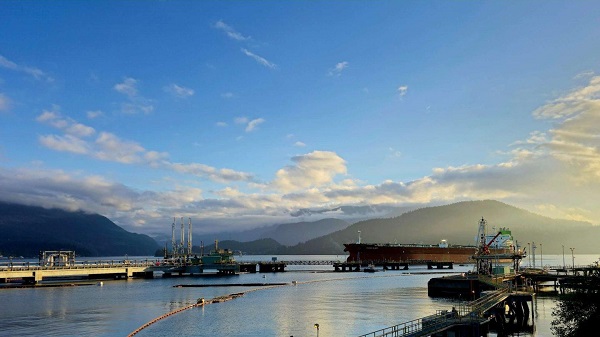
The number of tankers calling at Trans Mountain’s Westridge Marine Terminal in the Port of Vancouver in one month now rivals the number that used to go through in one year.
A global trend toward safer tanker operations
Trans Mountain’s safe operations are part of a worldwide trend. Global oil tanker traffic is up, yet spills are down, according to the International Tanker Owners Pollution Federation, a London, UK-based nonprofit that provides data and response support.

Graph courtesy International Tanker Owners Pollution Federation
Transport Canada reports a 95 per cent drop in ship-source oil spills and spill volumes since the 1970s, driven by stronger ship design, improved response and better regulations.
“Tankers are now designed much more safely. They are double-hulled and compartmentalized to mitigate spills,” said Mike Lowry, spokesperson for the Western Canada Marine Response Corporation (WCMRC).
WCMRC: Ready to protect the West Coast

One of WCMRC’s new response vessels arrives in Barkley Sound. Photo courtesy Western Canada Marine Response Corporation
From eight marine bases including Vancouver and Prince Rupert, WCMRC stands at the ready to protect all 27,000 kilometres of Canada’s western coastline.
Lowry sees the corporation as similar to firefighters — training to respond to an event they hope they never have to see.
In September, it conducted a large-scale training exercise for a worst-case spill scenario. This included the KJ Gardner — Canada’s largest spill response vessel and a part of WCMRC’s fleet since 2024.
“It’s part of the work we do to make sure everybody is trained and prepared to use our assets just in case,” Lowry said.
Expanding capacity for Trans Mountain

The K.J. Gardner is the largest-ever spill response vessel in Canada. Photo courtesy Western Canada Marine Response Corporation
WCMRC’s fleet and capabilities were doubled with a $170-million expansion to support the Trans Mountain project.
Between 2012 and 2024, the company grew from 13 people and $12 million in assets to more than 200 people and $213 million in assets.
“About 80 per cent of our employees are mariners who work as deckhands, captains and marine engineers on our vessels,” Lowry said.
“Most of the incidents we respond to are small marine diesel spills — the last one was a fuel leak from a forest logging vessel near Nanaimo — so we have deployed our fleet in other ways.”
Tanker safety starts with strong rules and local expertise

Tanker loading at the Westridge Marine Terminal in the Port of Vancouver. Photo courtesy Trans Mountain Corporation
Speaking on the ARC Energy Ideas podcast, Trans Mountain CEO Mark Maki said tanker safety starts with strong regulations, including the use of local pilots to guide vessels into the harbour.
“On the Mississippi River, you have Mississippi River pilots because they know how the river behaves. Same thing would apply here in Vancouver Harbour. Tides are strong, so people who are familiar with the harbor and have years and decades of experience are making sure the ships go in and out safely,” Maki said.
“A high standard is applied to any ship that calls, and our facility has to meet very strict requirements. And we have rejected ships, just said, ‘Nope, that one doesn’t fit the bill.’ A ship calling on our facilities is very, very carefully looked at.”

Working with communities to protect sensitive areas
Beyond escorting ships and preparing for spills, WCMRC partners with coastal communities to map sensitive areas that need rapid protection including salmon streams, clam beds and culturally important sites like burial grounds.
“We want to empower communities and nations to be more prepared and involved,” Lowry said.
“They can help us identify and protect the areas that they value or view as sensitive by working with our mapping people to identify those areas in advance. If we know where those are ahead of time, we can develop a protection strategy for them.”


““He knows nothing; and he thinks he knows everything. That points clearly to a political career.” George Bernard Shaw
In the days immediately following Donald Trump’s rude intervention into the 2025 Canadian federal election— suggesting Canada might best choose American statehood— two schools of thought emerged.
The first and most impactful school in the short term was the fainting-goat response of Canadian’s elites. Sensing an opening in which to erode Pierre Poilievre’s massive lead in the 2024 polls over Justin Trudeau, the Laurentian elite concocted Elbows Up, a self-pity response long on hurt feelings and short on addressing the issues Trump had cited in his trashing of the Canadian nation state.
In short order they fired Trudeau into oblivion, imported career banker Mark Carney as their new leader in a sham convention and convinced Canada’s Boomers that Trump had the tanks ready to go into Saskatchewan at a moment’s notice. The Elbows Up meme— citing Gordie Howe— clinched the group pout.

(In fact, Trump has said that America is the world’s greatest market, and if those who’ve used it for free in the past [Canada] want to keep special access they need to pay tariffs to the U.S. or drop protectionist charges on dairy and more against the U.S.)
The ruse worked out better than they could have ever imagined with Trump even saying he preferred to negotiate with Carney over Poilievre. In short order the Tories were shoved aside, the NDP kneecapped and the pet media anointed Carney the genius skewing Canada away from its largest trade partner to the Eurosphere. We remain in that bubble, although the fulsome promises of Carney’s first days are now coming due.
Which brings us to the second reaction. That was Alberta premier Danielle Smith bolting to Mar A Lago in the days following Trump’s comments. Her goal was to put pride aside and accept that a new world order was in play for Canada. She met with U.S. officials and, briefly, with Trump to remind them that Canada’s energy industry was integral to American prosperity and Canadian stability.
Needless to say, the fainting goats pitched a fit that not everyone was clutching pearls and rending garments in the wake of Trump’s dismissive assessment of his northern neighbours. Their solution to Trump was to join China in retaliatory tariffs— the only two nations to do so— and to boycott American products and travel. Like the ascetic monks they cut themselves off from real life. Trump has yet to get back to Carney the Magnificent

And Smith? She was a “traitor” or a “subversive” who should be keel hauled in the North Saskatchewan. For much of the intervening months she has been attacked at home in Alberta by the N-Deeps and in Ottawa by just about everyone on CBC, CTV, Global and the Globe & Mail. “How could she meet with the Cheeto?”
Nonetheless conservatives in the province moved toward a more independence within Canada. Smith articulated her demands for Alberta to prevent a referendum on whether to remain within Confederation. At the top of her list were pipelines and access to tidewater. Ergo, a no-go for BC’s squish premier David Eby who is the process of handing over his province to First Nations.
It became obvious that for all of Carney’s alleged diplomacy in Europe and Asia (is the man ever home?) he had a brewing disaster in the West with Alberta and Saskatchewan growing restless. In a striking move against the status quo, Nutrien announced it would ship its potash to tidewater via the U.S., thereby bypassing Vancouver’s strike-prone, outdated port and denying them billions.

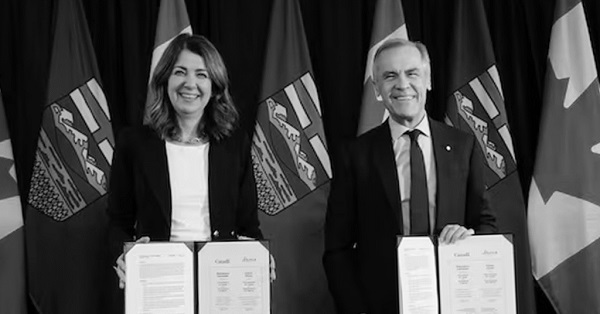
Suddenly, Smith’s business approach began making eminent good sense if the goal is to keep Canada as one. So we saw last week’s “memorandum of understanding” between Alberta and Ottawa trading off carbon capture and carbon taxes for potential pipelines to tidewater on the B.C. coast. A little bit of something for everyone and a surrender on other things.
The most amazing feature of the Mark Carney/Danielle Smith MOU is that both politicians probably need the deal to fail. Carney can tell fossil-fuel enemy Quebec that he tried to reason with Smith, and Smith can say she tried to meet the federalists halfway. Failure suits their larger purposes. Which is for Carney to fold Canada into Euro climate insanity and Smith into a strong leverage against the pro-Canada petitioners in her province.
Soon enough, at the AFN Special Chiefs Assembly, FN Chief Cindy Woodhouse Nepinak told Carney that “Turtle Island” (the FN term for North America popularized by white hippy poet Gary Snyder) belongs to the FN people “from coast to coast to coast.” The pusillanimous Eby quickly piped up about tanker bans and the sanctity of B.C. waters etc.
Others pointed out the massive flaw in a plan to attract private interests to build a vital bitumen pipeline if the tankers it fills are not allowed to sail through the Dixon Entrance to get to Asia.
But then Eby got Nutrien’s message that his power-sharing with the indigenous might cause other provinces to bypass B.C. (imagine California telling Texas it can’t ship through its ports over moral objections to a product). He’s now saying he’s open to pipelines but not to lift the tanker ban along the coast. Whatever.
Meanwhile the kookaburras of isolation back east continue with virtue signalling on American booze— N.S. to sell off its remains stocks — while dreaming that Trump’s departure will lead to the good-old days of reliance on America’s generosity.
But Smith looks to be wining the race. B.C.’s population shrank 0.04 percent in the second quarter of 2025, the only jurisdiction in Canada to do so. Meanwhile, Alberta is heading toward five million people, with interprovincial migrants making up 21 percent of its growth.
But what did you expect from the Carney/ Eby Tantrum Tandem? They keep selling fear in place of GDP. As GBS observed, “You have learnt something. That always feels at first as if you have lost something.”
Bruce Dowbiggin @dowbboy is the editor of Not The Public Broadcaster A two-time winner of the Gemini Award as Canada’s top television sports broadcaster, his new book Deal With It: The Trades That Stunned The NHL And Changed hockey is now available on Amazon. Inexact Science: The Six Most Compelling Draft Years In NHL History, his previous book with his son Evan, was voted the seventh-best professional hockey book of all time by bookauthority.org . His 2004 book Money Players was voted sixth best on the same list, and is available via brucedowbigginbooks.ca.


From Underdog to Top Broodmare

Man overboard as HMCS Carney lists to the right
Higher carbon taxes in pipeline MOU are a bad deal for taxpayers
Canadian government seeking to destroy Freedom Convoy leader, taking Big Red from Chris Barber
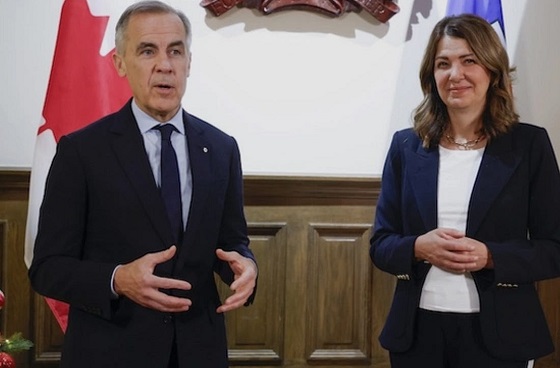
READ IT HERE – Canada-Alberta Memorandum of Understanding – From the Prime Minister’s Office
IEA peak-oil reversal gives Alberta long-term leverage

Quebec proposes to ban public prayer, harden laws against religious symbols
-
 Alberta1 day ago
Alberta Sports Hall of Fame Announces Class of 2026 Inductees
-
 Business22 hours ago
Canada’s climate agenda hit business hard but barely cut emissions
-
 Business2 days ago
New Chevy ad celebrates marriage, raising children
-
 Automotive2 days ago
Power Struggle: Governments start quietly backing away from EV mandates
-
 MAiD1 day ago
From Exception to Routine. Why Canada’s State-Assisted Suicide Regime Demands a Human-Rights Review
-
 Alberta1 day ago
Carney’s pipeline deal hits a wall in B.C.
-
 Alberta2 days ago
This new Canada–Alberta pipeline agreement will cost you more than you think
-
 Energy2 days ago
Unceded is uncertain