
Daily Caller
Blackouts Coming If America Continues With Biden-Era Green Frenzy, Trump Admin Warns



From the Daily Caller News Foundation
By Audrey Streb

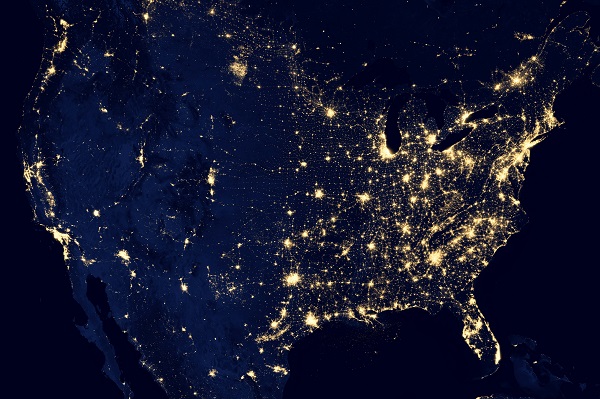
The Department of Energy (DOE) released a new report Monday warning of impending blackouts if the United States continues to shutter power plants without adequately replacing retiring capacity.
DOE warned in its Monday report that blackouts could increase by 100% by 2030 if the U.S. continues to retire power plants without sufficient replacements, and that the electricity grid is not prepared to meet the demand of power-hungry data centers in the years to come without more reliable generation coming online quickly. The report specifically highlighted wind and solar, two resources pushed by Biden, as responsible for eroding grid stability and advised that dispatchable generation from sources like coal, oil, gas and nuclear are necessary to meet the anticipated U.S. power demand.
“This report affirms what we already know: The United States cannot afford to continue down the unstable and dangerous path of energy subtraction previous leaders pursued, forcing the closure of baseload power sources like coal and natural gas,” DOE Secretary Chris Wright said. “In the coming years, America’s reindustrialization and the AI race will require a significantly larger supply of around-the-clock, reliable, and uninterrupted power. President Trump’s administration is committed to advancing a strategy of energy addition, and supporting all forms of energy that are affordable, reliable, and secure. If we are going to keep the lights on, win the AI race, and keep electricity prices from skyrocketing, the United States must unleash American energy.”
Dear Readers:
As a nonprofit, we are dependent on the generosity of our readers.
Please consider making a small donation of any amount here.
Thank you!
All regional grid systems across the U.S. are expected to lose reliability in the coming years without the addition of more reliable power, according to the DOE’s report. The U.S. will need an additional 100 gigawatts of new peak hour supply by 2030, with data centers projected to require as much as half of this electricity, the report estimates; for reference, one gigawatt is enough to power up to one million homes.
President Donald Trump declared a national energy emergency on his first day back in the Oval Office and signed an executive order on April 8 ordering DOE to review and identify at-risk regions of the electrical grid, which the report released Monday does. In contrast, former President Joe Biden cracked down on conventional power sources like coal with stringent regulations while unleashing a gusher of subsidies for green energy developments.
Electricity demand is projected to hit a record high in the next several years, surging 25% by 2030, according to Energy Information Administration (EIA) data and a recent ICF International report. Demand was essentially static for the last several years, and skyrocketing U.S. power demand presents an “urgent need” for electricity resources, according to the North American Electric Reliability Corporation (NERC), a major grid watchdog.
Wright has also issued several emergency orders to major grid operators since April. New Orleans experienced blackouts just two days after Wright issued an emergency order on May 23 to the Midcontinent Independent System Operator (MISO), the regional grid operator covering the New Orleans area.

Daily Caller
Trump Orders Review Of Why U.S. Childhood Vaccination Schedule Has More Shots Than Peer Countries
From the Daily Caller News Foundation
By Emily Kopp
President Donald Trump will direct his top health officials to conduct a systematic review of the childhood vaccinations schedule by reviewing those of other high-income countries and update domestic recommendations if the schedules abroad appear superior, according to a memorandum obtained by the Daily Caller News Foundation.
“In January 2025, the United States recommended vaccinating all children for 18 diseases, including COVID-19, making our country a high outlier in the number of vaccinations recommended for all children,” the memo will state. “Study is warranted to ensure that Americans are receiving the best, scientifically-supported medical advice in the world.”
Trump directs the secretary of the Health and Human Services (HHS) and the director of the Centers for Disease Control and Prevention to adopt best practices from other countries if deemed more medically sound. The memo cites the contrast between the U.S., which recommends vaccination for 18 diseases, and Denmark, which recommends vaccinations for 10 diseases; Japan, which recommends vaccinations for 14 diseases; and Germany, which recommends vaccinations for 15 diseases.
Dear Readers:
As a nonprofit, we are dependent on the generosity of our readers.
Please consider making a small donation of any amount here.
Thank you!
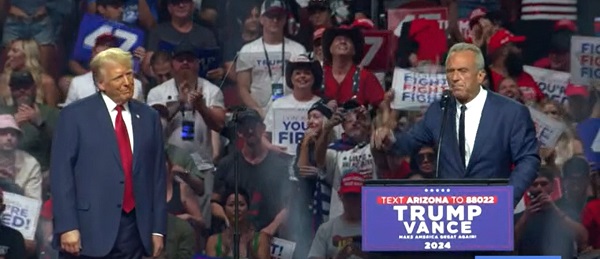
HHS Secretary Robert F. Kennedy Jr. has long been a critic of the U.S. childhood vaccination schedule.
The Trump Administration ended the blanket recommendation for all children to get annual COVID-19 vaccine boosters in perpetuity. Food and Drug Administration (FDA) Commissioner Marty Makary and Chief Medical Officer Vinay Prasad announced in May that the agency would not approve new COVID booster shots for children and healthy non-elderly adults without clinical trials demonstrating the benefit. On Friday, Prasad told his staff at the Center for Biologics Evaluation and Research that a review by career staff traced the deaths of 10 children to the COVID vaccine, announced new changes to vaccine regulation, and asked for “introspection.”
Trump’s memo follows a two-day meeting of vaccine advisors to the Centers for Disease Control and Prevention in which the committee adopted changes to U.S. policy on Hepatitis B vaccination that bring the country’s policy in alignment with 24 peer nations.

Total vaccines in January 2025 before the change in COVID policy. Credit: ACIP
The meeting included a presentation by FDA Center for Drug Evaluation and Research Director Tracy Beth Høeg showing the discordance between the childhood vaccination schedule in the U.S. and those of other developed nations.
“Why are we so different from other developed nations, and is it ethically and scientifically justified?” Høeg asked. “We owe our children science-based recommendations here in the United States.”

From the Daily Caller News Foundation
During the latest marathon cabinet meeting on Dec. 2, Energy Secretary Chris Wright made news when he told President Donald Trump that “The biggest determinant of the price of energy is politicians, political leaders, and polices — that’s what drives energy prices.”
He’s right about that, and it is why the back-and-forth struggle over federal energy and climate policy plays such a key role in America’s economy and society. Just 10 months into this second Trump presidency, the administration’s policies are already having a profound impact, both at home and abroad.
While the rapid expansion of AI datacenters over the past year is currently being blamed by many for driving up electric costs, power bills were skyrocketing long before that big tech boom began, driven in large part by the policies of the Obama and Biden administration designed to regulate and subsidize an energy transition into reality. As I’ve pointed out here in the past, driving up the costs of all forms of energy to encourage conservation is a central objective of the climate alarm-driven transition, and that part of the green agenda has been highly effective.
Dear Readers:
As a nonprofit, we are dependent on the generosity of our readers.
Please consider making a small donation of any amount here.
Thank you!
President Trump, Wright, and other key appointees like Interior Secretary Doug Burgum and EPA Administrator Lee Zeldin have moved aggressively throughout 2025 to repeal much of that onerous regulatory agenda. The GOP congressional majorities succeeded in phasing out Biden’s costly green energy subsidies as part of the One Big Beautiful Bill Act, which Trump signed into law on July 4. As the federal regulatory structure eases and subsidy costs diminish, it is reasonable to expect a gradual easing of electricity and other energy prices.
This year’s fading out of public fear over climate change and its attendant fright narrative spells bad news for the climate alarm movement. The resulting cracks in the green facade have manifested rapidly in recent weeks.
Climate-focused conflict groups that rely on public fears to drive donations have fallen on hard times. According to a report in the New York Times, the Sierra Club has lost 60 percent of the membership it reported in 2019 and the group’s management team has fallen into infighting over elements of the group’s agenda. Greenpeace is struggling just to stay afloat after losing a huge court judgment for defaming pipeline company Energy Transfer during its efforts to stop the building of the Dakota Access Pipeline.
350.org, an advocacy group founded by Bill McKibben, shut down its U.S. operations in November amid funding woes that had forced planned 25 percent budget cuts for 2025 and 2026. Employees at EDF voted to form their own union after the group went through several rounds of budget cuts and layoffs in recent months.
The fading of climate fears in turn caused the ESG management and investing fad to also fall out of favor, leading to a flood of companies backtracking on green investments and climate commitments. The Net Zero Banking Alliance disbanded after most of America’s big banks – Goldman Sachs, J.P. Morgan Chase, Citigroup, Wells Fargo and others – chose to drop out of its membership.
The EV industry is also struggling. As the Trump White House moves to repeal Biden-era auto mileage requirements, Ford Motor Company is preparing to shut down production of its vaunted F-150 Lightning electric pickup, and Stellantis cancelled plans to roll out a full-size EV truck of its own. Overall EV sales in the U.S. collapsed in October and November following the repeal of the $7,500 per car IRA subsidy effective Sept 30.
The administration’s policy actions have already ended any new leasing for costly and unneeded offshore wind projects in federal waters and have forced the suspension or abandonment of several projects that were already moving ahead. Capital has continued to flow into the solar industry, but even that industry’s ability to expand seems likely to fade once the federal subsidies are fully repealed at the end of 2027.
Truly, public policy matters where energy is concerned. It drives corporate strategies, capital investments, resource development and movement, and ultimately influences the cost of energy in all its forms and products. The speed at which Trump and his key appointees have driven this principle home since Jan. 20 has been truly stunning.
David Blackmon is an energy writer and consultant based in Texas. He spent 40 years in the oil and gas business, where he specialized in public policy and communications.

Tech Mogul Gives $6 Billion To 25 Million Kids To Boost Trump Investment Accounts
Carney’s Toronto cabinet meetings cost $530,000

Recent price declines don’t solve Toronto’s housing affordability crisis

Health Canada report finds euthanasia now accounts for over 5% of deaths nationwide

Alberta Sports Hall of Fame Announces Class of 2026 Inductees

Integration Or Indignation: Whose Strategy Worked Best Against Trump?

Carney’s pipeline deal hits a wall in B.C.
-
 Business1 day ago
Why Does Canada “Lead” the World in Funding Racist Indoctrination?
-
 Automotive2 days ago
Trump Deals Biden’s EV Dreams A Death Blow
-
 Automotive2 days ago
Canada’s EV Mandate Is Running On Empty
-
 Media1 day ago
They know they are lying, we know they are lying and they know we know but the lies continue
-
 Focal Points1 day ago
The West Needs Bogeymen (Especially Russia)
-
 Censorship Industrial Complex23 hours ago
US Condemns EU Censorship Pressure, Defends X
-
 Banks1 day ago
To increase competition in Canadian banking, mandate and mindset of bank regulators must change
-
 Agriculture6 hours ago
Canada’s air quality among the best in the world