
Canadian Energy Centre
‘Big vulnerability’: How Ontario and Quebec became reliant on U.S. oil and gas



From the Canadian Energy Centre

ARC Energy Institute leaders highlight the need for a new approach in a new reality
Despite Canada’s status as one of the world’s largest oil and gas producers, more than half of the country’s own population does not have true energy security – uninterrupted, reliable access to the energy they need at an affordable price.
Even though Western Canada produces much of the oil consumed in Ontario and Quebec, in order to get there, it moves on pipelines that run through the United States.
“It’s only energy secure if the Americans are our partners and friends,” leading energy researcher Jackie Forrest said on a recent episode of the ARC Energy Ideas podcast.
Amid rising trade tensions with the United States, energy security is taking on greater importance. But Forrest said the issue is not well understood across Canada.
“The concern is that in the worst-case scenario where the Americans want to really hurt our country, they have the ability to stop all crude oil flows to Ontario,” she said.
That action would also cut off the majority of oil supply to Quebec.
The issue isn’t much better for natural gas, with about half of consumption in Ontario and Quebec supplied by producers in the U.S.
“Tariffs or no tariffs, there is a real vulnerability there,” said Forrest’s co-host Peter Tertzakian, founder of the ARC Energy Research Institute.
The issue won’t go away with increased use of new technology like electric cars, he said.
“This isn’t just about combustion in engines. It’s about securing a vital commodity that is an input into other parts of our manufacturing and sophisticated economy.”
Oil: The Enbridge Mainline
The Enbridge Mainline is the main path for oil from Western Canada to reach refineries in Ontario and Quebec, according to the Canadian Association of Petroleum Producers (CAPP).
 Originating in Edmonton, Alberta, the Enbridge Mainline moves crude oil, refined products, and natural gas liquids through a connected pipeline system. At Superior, Wisconsin, the system splits into Line 5, going north of Lake Michigan, and Lines 6, 14, and 61, going around the southern tip of the lake. The two routes then coalesce and terminate in Sarnia, Ontario, where it is interconnected with Line 9, which is terminated in Montreal, Quebec. Source: Canadian Association of Petroleum Producers
Originally built in 1950 from Edmonton to Superior, Wisconsin, in 1953, it was extended to Sarnia, Ontario through a segment known as Line 5.
CAPP said that at the time, politicians had pushed for an all-Canadian path north of the Great Lakes to increase energy security, but routes through the U.S. were chosen because of lower project costs and faster timelines.
In 1979, an extension of the pipeline called Line 9 opened, allowing oil to flow east from Sarnia to Montreal.
“Line 9 was built after the oil crisis and the OPEC embargo as a way to bring western Canadian crude oil into Quebec,” Forrest said.
But by the 1990s – before the massive growth in Alberta’s oil sands – there was a lack of crude coming from Western Canada. It became more economically attractive for refineries in Quebec and Ontario to import oil from overseas via the St. Lawrence River, CAPP said.
A reversal in 1999 allowed crude in Line 9 to flow west from Montreal to Sarnia.
By the 2010s, the situation had changed again, with production from the Alberta oil sands and U.S. shale plays surging. With more of that oil available, the offshore crude was deemed to be more expensive, Forrest said.
In 2015, Line 9 was reversed to send oil east again from Sarnia to Montreal, displacing oil from overseas but not resolving the energy security risk of Canadian pipelines running through the U.S.
CAPP said the case of Line 5 illustrates this risk. In 2020, the Governor of Michigan attempted to shut down the pipeline over concerns about pipeline leak or potential oil spill in a seven-kilometre stretch under the Straits of Mackinac.
Line 5 has been operating in the Straits for 72 years without a single release.
Enbridge is advancing a project to encase the pipeline in a protective tunnel in the rock beneath the lakebed, but the legal battle with the State of Michigan remains ongoing.
Natural gas: The TC Canadian Mainline
The natural gas pipeline now known as TC Energy’s Canadian Mainline from Alberta was first built in 1958.
 The TC Canadian Mainline (red dashed line) transports natural gas produced in Western Canada to markets in Eastern Canada. Red lines show pipelines regulated by the Canada Energy Regulator, while black lines show pipelines regulated by the United States. Source: Canadian Association of Petroleum Producers
“This pipeline brought gas into Ontario, and then it was extended to go into Quebec, and that was good for a long time,” Forrest said.
“But over time we built more pipelines into the United States, and it was a better economic path to go through the United States.”
The Mainline started running not at its full capacity, which caused tolls to go up and made it less and less attractive compared to U.S. options.
According to CAPP, between 2006 and 2023 the Mainline’s deliveries of gas from Western Canada to Ontario and Quebec were slashed in half.
“We should have said, ‘We need to find a way for this pipeline, over our own soil, to be competitive with the alternative’. But we didn’t,” Forrest said.
“Instead, we lost market share in Eastern Canada. And today we’re in a big bind, because if the Americans were to cut off our natural gas, we wouldn’t have enough natural gas into Quebec and Ontario.”
A different approach for a new reality
Forrest said the TC Mainline, which continues to operate at about half of its capacity, presents an opportunity to reduce Canada’s reliance on U.S. natural gas while at the same time building energy security for oil.
“Those are the same pipes that were going to be repurposed for oil, for Energy East,” Tertzakian said.
“The beauty of the thing is that actually, I don’t think it would take that long if we had the will… It’s doable that we can be energy secure.”
This could come at a higher cost but provide greater value over the long term.
“That’s always been the issue in Canada, when it comes to energy, we always go with the cheapest option and not the most energy secure,” Forrest said.
“And why? Because we always trusted our American neighbor to never do anything that will impact the flow of that energy. And I think we’re waking up to a new reality.”


From the Canadian Energy Centre
For Canada, the path to a stronger economy — and stronger global influence — runs through energy.
That’s the view of David Detomasi, a professor at the Smith School of Business at Queen’s University.
Detomasi, author of Profits and Power: Navigating the Politics and Geopolitics of Oil, argues that there is a moral case for developing Canada’s energy, both for Canadians and the world.

David Detomasi. Photo courtesy Smith School of Business, Queen’s University
CEC: What does being an energy superpower mean to you?
DD: It means Canada is strong enough to affect the system as a whole by its choices.
There is something really valuable about Canada’s — and Alberta’s — way of producing carbon energy that goes beyond just the monetary rewards.
CEC: You talk about the moral case for developing Canada’s energy. What do you mean?
DD: I think the default assumption in public rhetoric is that the environmental movement is the only voice speaking for the moral betterment of the world. That needs to be challenged.
That public rhetoric is that the act of cultivating a powerful, effective economic engine is somehow wrong or bad, and that efforts to create wealth are somehow morally tainted.
I think that’s dead wrong. Economic growth is morally good, and we should foster it.
Economic growth generates money, and you can’t do anything you want to do in social expenditures without that engine.
Economic growth is critical to doing all the other things we want to do as Canadians, like having a publicly funded health care system or providing transfer payments to less well-off provinces.
Over the last 10 years, many people in Canada came to equate moral leadership with getting off of oil and gas as quickly as possible. I think that is a mistake, and far too narrow.
Instead, I think moral leadership means you play that game, you play it well, and you do it in our interest, in the Canadian way.
We need a solid base of economic prosperity in this country first, and then we can help others.
CEC: Why is it important to expand Canada’s energy trade?
DD: Canada is, and has always been, a trading nation, because we’ve got a lot of geography and not that many people.
If we don’t trade what we have with the outside world, we aren’t going to be able to develop economically, because we don’t have the internal size and capacity.
Historically, most of that trade has been with the United States. Geography and history mean it will always be our primary trade partner.
But the United States clearly can be an unreliable partner. Free and open trade matters more to Canada than it does to the U.S. Indeed, a big chunk of the American people is skeptical of participating in a global trading system.
As the United States perhaps withdraws from the international trading and investment system, there’s room for Canada to reinforce it in places where we can use our resource advantages to build new, stronger relationships.
One of these is Europe, which still imports a lot of gas. We can also build positive relationships with the enormous emerging markets of China and India, both of whom want and will need enormous supplies of energy for many decades.
I would like to be able to offer partners the alternative option of buying Canadian energy so that they are less reliant on, say, Iranian or Russian energy.
Canada can also maybe eventually help the two billion people in the world currently without energy access.
CEC: What benefits could Canadians gain by becoming an energy superpower?
DD: The first and primary responsibility of our federal government is to look after Canada. At the end of the day, the goal is to improve Canada’s welfare and enhance its sovereignty.
More carbon energy development helps Canada. We have massive debt, an investment crisis and productivity problems that we’ve been talking about forever. Economic and job growth are weak.
Solving these will require profitable and productive industries. We don’t have so many economic strengths in this country that we can voluntarily ignore or constrain one of our biggest industries.
The economic benefits pay for things that make you stronger as a country.
They make you more resilient on the social welfare front and make increasing defence expenditures, which we sorely need, more affordable. It allows us to manage the debt that we’re running up, and supports deals for Canada’s Indigenous peoples.
CEC: Are there specific projects that you advocate for to make Canada an energy superpower?
DD: Canada’s energy needs egress, and getting it out to places other than the United States. That means more transport and port facilities to Canada’s coasts.
We also need domestic energy transport networks. People don’t know this, but a big chunk of Ontario’s oil supply runs through Michigan, posing a latent security risk to Ontario’s energy security.
We need to change the perception that pipelines are evil. There’s a spiderweb of them across the globe, and more are being built.
Building pipelines here, with Canadian technology and know-how, builds our competitiveness and enhances our sovereignty.
Economic growth enhances sovereignty and provides the resources to do other things. We should applaud and encourage it, and the carbon energy sector can lead the way.
From the Canadian Energy Centre
Bigger project maintains decades-long marine safety record
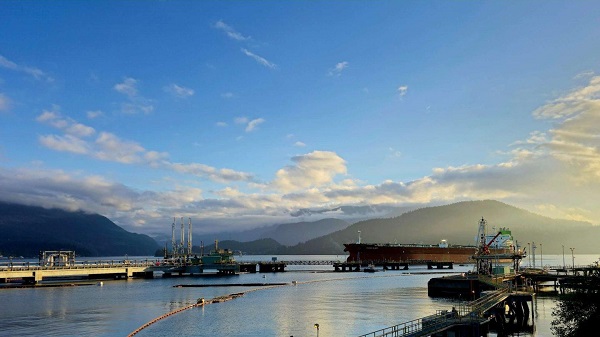
The Trans Mountain system continues its decades-long record of zero marine spills, even as oil tanker traffic has surged more than 800 per cent since the pipeline’s expansion in May 2024.
The number of tankers calling at Trans Mountain’s Westridge Marine Terminal in the Port of Vancouver in one month now rivals the number that used to go through in one year.
A global trend toward safer tanker operations
Trans Mountain’s safe operations are part of a worldwide trend. Global oil tanker traffic is up, yet spills are down, according to the International Tanker Owners Pollution Federation, a London, UK-based nonprofit that provides data and response support.

Graph courtesy International Tanker Owners Pollution Federation
Transport Canada reports a 95 per cent drop in ship-source oil spills and spill volumes since the 1970s, driven by stronger ship design, improved response and better regulations.
“Tankers are now designed much more safely. They are double-hulled and compartmentalized to mitigate spills,” said Mike Lowry, spokesperson for the Western Canada Marine Response Corporation (WCMRC).
WCMRC: Ready to protect the West Coast

One of WCMRC’s new response vessels arrives in Barkley Sound. Photo courtesy Western Canada Marine Response Corporation
From eight marine bases including Vancouver and Prince Rupert, WCMRC stands at the ready to protect all 27,000 kilometres of Canada’s western coastline.
Lowry sees the corporation as similar to firefighters — training to respond to an event they hope they never have to see.
In September, it conducted a large-scale training exercise for a worst-case spill scenario. This included the KJ Gardner — Canada’s largest spill response vessel and a part of WCMRC’s fleet since 2024.
“It’s part of the work we do to make sure everybody is trained and prepared to use our assets just in case,” Lowry said.
Expanding capacity for Trans Mountain

The K.J. Gardner is the largest-ever spill response vessel in Canada. Photo courtesy Western Canada Marine Response Corporation
WCMRC’s fleet and capabilities were doubled with a $170-million expansion to support the Trans Mountain project.
Between 2012 and 2024, the company grew from 13 people and $12 million in assets to more than 200 people and $213 million in assets.
“About 80 per cent of our employees are mariners who work as deckhands, captains and marine engineers on our vessels,” Lowry said.
“Most of the incidents we respond to are small marine diesel spills — the last one was a fuel leak from a forest logging vessel near Nanaimo — so we have deployed our fleet in other ways.”
Tanker safety starts with strong rules and local expertise

Tanker loading at the Westridge Marine Terminal in the Port of Vancouver. Photo courtesy Trans Mountain Corporation
Speaking on the ARC Energy Ideas podcast, Trans Mountain CEO Mark Maki said tanker safety starts with strong regulations, including the use of local pilots to guide vessels into the harbour.
“On the Mississippi River, you have Mississippi River pilots because they know how the river behaves. Same thing would apply here in Vancouver Harbour. Tides are strong, so people who are familiar with the harbor and have years and decades of experience are making sure the ships go in and out safely,” Maki said.
“A high standard is applied to any ship that calls, and our facility has to meet very strict requirements. And we have rejected ships, just said, ‘Nope, that one doesn’t fit the bill.’ A ship calling on our facilities is very, very carefully looked at.”

Working with communities to protect sensitive areas
Beyond escorting ships and preparing for spills, WCMRC partners with coastal communities to map sensitive areas that need rapid protection including salmon streams, clam beds and culturally important sites like burial grounds.
“We want to empower communities and nations to be more prepared and involved,” Lowry said.
“They can help us identify and protect the areas that they value or view as sensitive by working with our mapping people to identify those areas in advance. If we know where those are ahead of time, we can develop a protection strategy for them.”

The $50 Billion Question: EVs Never Delivered What Ottawa Promised

The Recall Trap: 21 Alberta MLA’s face recall petitions

Liberals gain support for ‘hate speech’ bill targeting Bible passages against homosexuality

Wisdom of Our Elders: The Contempt for Memory in Canadian Indigenous Policy

Taxpayers Federation calls on politicians to reject funding for new Ottawa Senators arena

Conservative MP warns Liberals’ national AI plan could increase gov’t surveillance

Canada’s free speech record is cracking under pressure
-
 Business1 day ago
Major tax changes in 2026: Report
-
 Daily Caller1 day ago
Chinese Billionaire Tried To Build US-Born Baby Empire As Overseas Elites Turn To American Surrogates
-
 Digital ID21 hours ago
Canada releases new digital ID app for personal documents despite privacy concerns
-
 Energy20 hours ago
Canada’s sudden rediscovery of energy ambition has been greeted with a familiar charge: hypocrisy
-
 Alberta1 day ago
Schools should go back to basics to mitigate effects of AI
-
 Daily Caller1 day ago
Two states designate Muslim group as terrorist
-
 International1 day ago
Russia Now Open To Ukraine Joining EU, Officials Briefed On Peace Deal Say
-
 Censorship Industrial Complex1 day ago
Death by a thousand clicks – government censorship of Canada’s internet