
Fraser Institute
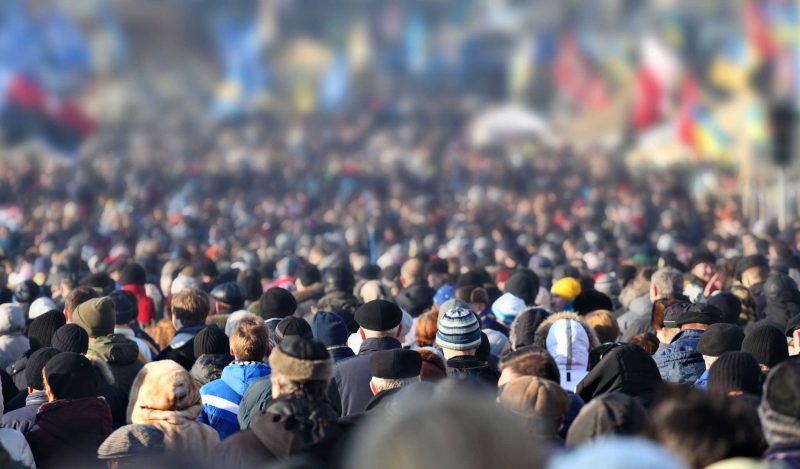
Before Trudeau average annual immigration was 617,800. Under Trudeau number skyrocketted to 1.4 million from 2016 to 2024


From the Fraser Institute
By Jock Finlayson and Steven Globerman

From 2000 to 2015, annual immigration averaged 617,800 immigrants, compared to a more than doubling to 1.4 million annually from 2016 to
2024 (excluding 2020), according to a new study published by the Fraser Institute, an independent non-partisan Canadian think-tank.
“Over the past decade, Canada’s immigration numbers have skyrocketed, most starkly since 2021,” said Jock Finlayson, senior fellow at the Fraser Institute and co-author of Canada’s Changing Immigration Patterns, 2000–2024.
The study finds from 2000 to 2015, immigration (including temporary foreign workers and international students) grew on average by 3.5 per cent per year. However, from 2016 to 2024 (excluding 2020) immigration grew annually at 21.3 per cent—more than six times the 2000-2015 pace.
The sharp rise in recent years reflects both planned increases in permanent immigrant inflows as well as unprecedented and largely unplanned growth in the numbers of temporary foreign workers, international students, and asylum seekers. For example, in 2024 alone, 485,600 permanent immigrants entered Canada, along with 518,200 international students and nearly one million (912,900) temporary foreign workers.
However, due to concerns about the impact of unprecedented in-migration on housing affordability, employment opportunities (or lack thereof), access to health care and other issues, late last year the federal government unveiled plans to substantially reduce immigration levels over the 2025-27 period, affecting permanent immigrants, international students, and other temporary visa holders.
The composition of immigration also changed dramatically during this period. From 2000 to 2015, the average share of total immigrants in the permanent category was 42.1 per cent while the non-permanent share (mainly international students and temporary workers) was 57.9 per cent. From 2016 to 2024 (excluding Covid 2020), permanent immigrants averaged 27.7 per cent of total in-migration versus 72.3 per cent for non-permanent.
“We’re in the midst of a housing crisis in Canada, and the unfortunate truth is we lack the necessary infrastructure to accommodate immigration at the 2022-24 rate,” said Steven Globerman, senior fellow at the Fraser Institute and study co-author.
“While the reductions announced late last year have been confirmed by the new government, the levels of immigration over the next two year will still be well above historic benchmarks.”
This study is the first in a series of papers from the authors on immigration.

Canada’s Changing Immigration Patterns, 2000—2024
- Immigration, after 2000 and especially after 2015, is characterized by substantial increases in the absolute number of immigrants admitted, as well the share admitted as temporary foreign workers and international students.
- For example, from 2000 to 2015, the total number of immigrants increased at a simple average annual rate of 4% compared to 15% from 2016 to 2024. As well, permanent admissions as a share of total admissions declined by .83 percentage points per year from 2000 to 2015 and by 1.1 percentage points per year from 2016 to 2024.
- These recent developments reflect changes in government policy. In particular, the International Mobility Program (IMP) of 2014 enabled Canadian employers to bring in greater numbers of temporary workers from abroad to fill lower-paying jobs.
- The Advisory Council on Economic Growth appointed by the Trudeau government in early 2016 recommended substantial increases in permanent immigration, as well as in the number of international students who would become eligible for permanent status after acquiring Canadian educational credentials. The Trudeau government enthusiastically embraced the recommendation.
- Recent immigrants to Canada seem better equipped to participate in the labour market than earlier cohorts. For example, over the period from 2011 to 2021, the percentage of established immigrants with a bachelor’s degree or higher increased, and the vast majority of admitted immigrants speak at least one of the official languages. Moreover, recent immigrants enjoy higher employment rates than did earlier cohorts.
- Nevertheless, public concern about the impact of increased immigration—primarily on the affordability of housing—has led the federal government to reduce planned levels of future immigration substantially.

Jock Finlayson
Senior Fellow, Fraser Institute

Steven Globerman


From the Fraser Institute
By Matthew Lau
Canada’s lagging productivity growth has been widely discussed, especially after Bank of Canada senior deputy governor Carolyn Rogers last year declared it “an emergency” and said “it’s time to break the glass.” The federal Liberal government, now entering its eleventh year in office, admitted in its recent budget that “productivity remains weak, limiting wage gains for workers.”
Numerous recent reports show just how weak Canada’s productivity has been. A recent study published by the Fraser Institute shows that since 2001, labour productivity has increased only 16.5 per cent in Canada vs. 54.7 per cent in the United States, with our underperformance especially notable after 2017. Weak business investment is a primary reason for Canada’s continued poor economic outcomes.
A recent McKinsey study provides worrying details about how the productivity crisis pervades almost all sectors of the economy. Relative to the U.S., our labour productivity underperforms in: mining, quarrying, and oil and gas extraction; construction; manufacturing; transportation and warehousing; retail trade; professional, scientific, and technical services; real estate and rental leasing; wholesale trade; finance and insurance; information and cultural industries; accommodation and food services; utilities; arts, entertainment and recreation; and administrative and support, waste management and remediation services.
Canada has relatively higher labour productivity in just one area: agriculture, forestry, fishing and hunting. To make matters worse, in most areas where Canada’s labour productivity is less than American, McKinsey found we had fallen further behind from 2014 to 2023. In addition to doing poorly, Canada is trending in the wrong direction.
Broadening the comparison to include other OECD countries does not make the picture any rosier—Canada “is growing more slowly and from a lower base,” as McKinsey put it. This underperformance relative to other countries shows Canada’s economic productivity crisis is not the result of external factors but homemade.
The federal Liberals have done little to reverse our relative decline. The Carney government’s proposed increased spending on artificial intelligence (AI) may or may not help. But its first budget missed a clear opportunity to implement tax reform and cuts. As analyses from the Fraser Institute, University of Calgary, C.D. Howe Institute, TD Economics and others have argued, fixing Canada’s uncompetitive tax regime would help lift productivity.
Regulatory expansion has also driven Canada’s relative economic decline but the federal budget did not reduce the red tape burden. Instead, the Carney government empowered cabinet to decide which large natural resource and infrastructure projects are in the “national interest”—meaning that instead of predictable transparent rules, businesses must answer to the whims of politicians.
The government has also left in place many of its Trudeau-era environmental regulations, which have helped push pipeline investors away for years. It is encouraging that a new “memorandum of understanding” between Ottawa and Alberta may pave the way for a new oil pipeline. A memorandum of undertaking would have been better.
Although the government paused its phased-in ban on conventionally-powered vehicle sales in the face of heavy tariff-related headwinds to Canada’s automobile sector, it still insists that all new light-duty vehicle sales by 2035 must be electric. Liberal MPs on the House of Commons Industry Committee recently voted against a Conservative motion calling for repeal of the EV mandate. Meanwhile, Canadian consumers are voting with their wallets. In September, only 10.2 per cent of new motor vehicle sales were “zero-emission,” an ominous18.2 per cent decline from last year.
If the Carney government continues down its current path, it will only make productivity and consumer welfare worse. It should change course to reverse Canada’s economic underperformance and help give living standards a much-needed boost.

From the Fraser Institute
By Tom Flanagan
The new book Dead Wrong: How Canada Got the Residential School Story So Wrong is a follow-up to Grave Error, published by True North in 2023. Grave Error instantly became a best-seller. People wanted to read the book because it contained well-documented information not readily available elsewhere concerning the history of Canada’s Indian Residential Schools (IRS) and the facts surrounding recent claims about “unmarked graves.”
Why another book? Because the struggle for accurate information continues. Let me share with you a little of what’s in Dead Wrong.
Outrageously, the New York Times, one of the world’s most prestigious newspapers, has never retracted its absurd headline that “mass graves” were uncovered in Kamloops, British Columbia. Jonathan Kay, the North American editor of Quillette, exposes that scandal.
The legacy media were enthused about the so-called documentary Sugarcane, a feature-length film sponsored by National Geographic, which was nominated for an Academy Award. The only reporter to spot the dozens of factual errors in Sugarcane was independent journalist Michelle Stirling; Dead Wrong includes her analysis “The Bitter Roots of Sugarcane.”
In the spring of 2024, the small city of Quesnel, B.C., made national news when the mayor’s wife bought 10 copies of Grave Error for distribution to friends. After noisy protests held by people who had never read the book, Quesnel city council voted to censure Mayor Ron Paull and tried to force him from office. It’s all described in Dead Wrong.
Also not to be forgotten is how the Law Society of B.C. forced upon its members training materials asserting against all evidence that children’s remains have been discovered in Kamloops. As told by James Pew, B.C. MLA Dallas Brodie was expelled from the Conservative caucus for daring to point out the emperor’s lack of clothing.
Then there’s the story of Jim McMurtry, suspended by the Abbotsford District School Board shortly after the 2021 Kamloops announcement about “unmarked graves.” McMurtry’s offence was to tell students the truth that, while some Indigenous students did die in residential schools, the main cause was tuberculosis. His own book The Scarlet Lesson is excerpted here.
Historian Ian Gentles and former IRS teacher Pim Wiebel offer a richly detailed analysis of health and medical conditions in the schools. They show that these were much better than what prevailed in the Indian reserves from which most students came.
Another important contribution to understanding the medical issues is by Dr. Eric Schloss, narrating the history of the Charles Camsell Indian Hospital in Edmonton. IRS facilities usually included small clinics, but students with serious problems were often transferred to Indian Hospitals for more intensive care. Schloss, who worked in the Camsell, describes how it delivered state-of-the-art medicine, probably better than the care available to most children anywhere in Canada at the time.
Rodney Clifton’s contribution, “They would call me a ‘Denier,’” describes his experiences working in two IRS in the 1960s. Clifton does not tell stories of hunger, brutal punishment and suppression of Indigenous culture, but of games, laughter and trying to learn native languages from his Indian and Inuit charges.
Toronto lawyer and historian Greg Piasetzki explains how “Canada Wanted to Close All Residential Schools in the 1940s. Here’s why it couldn’t.” For many Indian parents, particularly single parents and/or those with large numbers of children, the IRS were the best deal available. And they offered paid employment to large numbers of Indians as cooks, janitors, farmers, health-care workers, and even teachers and principals.
Finally, Frances Widdowson analyzes the charge of residential school “denialism” used by true believers in the Kamloops narrative to shut down criticism or questions. Winnipeg Centre MP Leah Gazan in 2022 persuaded the House of Commons to give unanimous consent to a resolution on residential school genocide: “That, in the opinion of the House this government must recognize what happened in Canada’s Indian residential schools as genocide.”
In 2024, Gazan took the next step by introducing a private member’s bill to criminalize dissent about the IRS system. The bill failed to pass, but Gazan reintroduced it in 2025. Had these provisions been in force back in 2021, it might well have become a crime to point out that the Kamloops ground-penetrating radar (GPR) survey had identified soil anomalies, not buried bodies.
While the wheels of legislation and litigation grind and spin, those who wish to limit open discussion of residential schools attack truth-tellers as “denialists,” a term drawn from earlier debates about the Holocaust. As the proponents of the Kamloops narrative fail to provide convincing hard evidence for it, they hope to mobilize the authority of the state to stamp out dissent. One of the main goals of publishing Dead Wrong is to head off this drive toward authoritarianism.
Happily, Dead Wrong, like Grave Error, has already become an Amazon best-seller. The struggle for truth continues.

Canada’s EV Mandate Is Running On Empty
Why Does Canada “Lead” the World in Funding Racist Indoctrination?
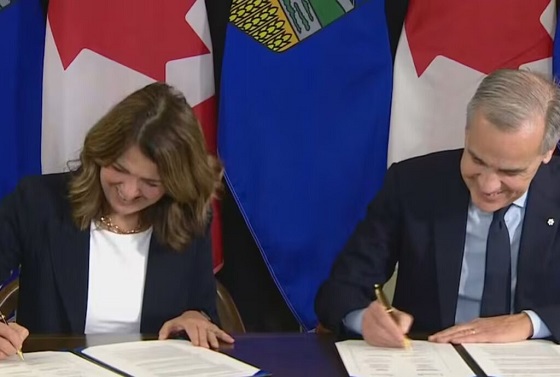
Premier Smith: Canadians support agreement between Alberta and Ottawa and the major economic opportunities it could unlock for the benefit of all

Frances Widdowson’s Arrest Should Alarm Every Canadian

Trump Deals Biden’s EV Dreams A Death Blow

Trump Orders Review Of Why U.S. Childhood Vaccination Schedule Has More Shots Than Peer Countries

A Memorandum of Understanding that no Canadian can understand
-
 National1 day ago
Canada’s free speech record is cracking under pressure
-
 Digital ID1 day ago
Canada considers creating national ID system using digital passports for domestic use
-
 Business1 day ago
Albertans give most on average but Canadian generosity hits lowest point in 20 years
-
Fraser Institute1 day ago
Claims about ‘unmarked graves’ don’t withstand scrutiny
-
 Crime2 days ago
U.S. seizes Cuba-bound ship with illicit Iranian oil history
-
 Daily Caller2 days ago
US Supreme Court Has Chance To End Climate Lawfare
-
 Business1 day ago
Taxpayers Federation calls on politicians to reject funding for new Ottawa Senators arena
-
 Bruce Dowbiggin1 day ago
Carney Hears A Who: Here Comes The Grinch