
Uncategorized
Hospital gunman had been kicked out of firefighting academy


CHICAGO — A man who fatally shot his ex-fiancee outside a Chicago hospital before killing two people inside the building was once kicked out of the city’s firefighting academy after threatening a female cadet, officials said Tuesday.

Juan Lopez, who died following the shooting Monday at Mercy Hospital, was also the subject of a protection order request filed four years ago, and he legally purchased several guns in recent years, police said.
It was unclear whether Lopez shot himself or was fatally shot by police.
Four years ago, fire department officials learned of the threats to the cadet and told Lopez that he would be disciplined. He was dismissed after he went AWOL, fire department spokesman Larry Merritt said.
Merritt did not have any details of the past threats. But they were made the same year a woman sought an order of protection against Lopez because he was incessantly texting her. Police said they have not determined if the woman was granted an order of protection. Lopez was not criminally charged.
On Monday, Lopez’s first victim was Dr. Tamara O’Neal, to whom he had been engaged. O’Neal had recently called off their engagement, and Lopez confronted her about returning the engagement ring, police said.
After shooting the emergency room doctor near a hospital parking lot, the gunman ran into the medical
Lopez had a permit to possess a concealed firearm, but it was unclear if officials knew about the 2014 complaint when the permit was granted, Chicago police spokesman Anthony Guglielmi said.
Lopez had legally purchased four guns in the last five years and worked for the Chicago Housing Authority, Guglielmi said.
Investigators identified the other shooting victims as Dayna Less, 25, who worked in the hospital’s pharmacy and had recently graduated from Purdue University, and Officer Samuel Jimenez, 28, who joined the department in February 2017 and had recently completed his probationary period. Police said he was a married father of three children.
“This officer, all of those officers, are heroes. They saved a lot of lives because we just don’t know how much damage he was prepared to do,” Chicago Police Superintendent Eddie Johnson said late Monday outside another hospital, just minutes after leaving the slain officer’s family.
Mayor Rahm Emanuel, fighting back tears, said the victims were “all going about their day, all doing what they loved.” He added: “This just tears at the soul of our city. It is the face and a consequence of evil.”
Lopez, 32, and O’Neal had been arguing in the hospital parking lot. When one of O’Neal’s friends tried to intervene, “the offender lifted up his shirt and displayed a handgun,” Johnson said.
The friend ran into the hospital to call for help, and the gunfire began seconds later. After O’Neal fell to the ground, Lopez “stood over her and shot her three more times,” a witness named James Gray told reporters.
When officers arrived, the suspect fired at their squad car then ran inside the hospital. The police gave chase.
Inside the medical
Jennifer Eldridge was working in a hospital pharmacy when she heard three or four shots that seemed to come from outside. Within seconds, she barricaded the door, as called for in the building’s active shooter drills. Then there were six or seven more shots that sounded much closer, just outside the door.
“I could tell he was now inside the lobby. There was screaming,” she recalled.
The door jiggled, which Eldridge believed was the shooter trying to get in. Some 15 minutes later, she estimated, a SWAT team officer knocked at the door, came inside and led her away. She looked down and saw blood on the floor but no bodies.
“It may have been 15 minutes, but it seemed like an eternity,” she said.
Maria Correa hid under a desk, clutching her 4-month-old son Angel, while the violence unfolded. Correa was in the waiting area of the hospital for her mother-in-law’s doctor appointment when a hospital employee told them to lock themselves in offices.
She lost track of how many shots she heard while under the desk trying to protect her son for 10 to 15 minutes.
“They were the worst minutes of our lives,” Correa said.
The death of Jimenez comes nine months after another member of the Chicago Police Department, Cmdr. Paul Bauer, was fatally shot while pursuing a suspect in the Loop business district.
Mercy has a rich history as the city’s first chartered hospital. It began in 1852, when the Sisters of Mercy religious group converted a rooming house. During the Civil War, the hospital treated both Union soldiers and Confederate prisoners of war, according to its
___
Associated Press Writer Michael Tarm contributed to this report.
___
For the latest developments in this story: https://bit.ly/2PGjfl3
Amanda Seitz And Don Babwin, The Associated Press

Uncategorized
Mortgaging Canada’s energy future — the hidden costs of the Carney-Smith pipeline deal


Much of the commentary on the Carney-Smith pipeline Memorandum of Understanding (MOU) has focused on the question of whether or not the proposed pipeline will ever get built.
That’s an important topic, and one that deserves to be examined — whether, as John Robson, of the indispensable Climate Discussion Nexus, predicted, “opposition from the government of British Columbia and aboriginal groups, and the skittishness of the oil industry about investing in a major project in Canada, will kill [the pipeline] dead.”
But I’m going to ask a different question: Would it even be worth building this pipeline on the terms Ottawa is forcing on Alberta? If you squint, the MOU might look like a victory on paper. Ottawa suspends the oil and gas emissions cap, proposes an exemption from the West Coast tanker ban, and lays the groundwork for the construction of one (though only one) million barrels per day pipeline to tidewater.
But in return, Alberta must agree to jack its industrial carbon tax up from $95 to $130 per tonne at a minimum, while committing to tens of billions in carbon capture, utilization, and storage (CCUS) spending, including the $16.5 billion Pathways Alliance megaproject.
Here’s the part none of the project’s boosters seem to want to mention: those concessions will make the production of Canadian hydrocarbon energy significantly more expensive.
As economist Jack Mintz has explained, the industrial carbon tax hike alone adds more than $5 USD per barrel of Canadian crude to marginal production costs — the costs that matter when companies decide whether to invest in new production. Layer on the CCUS requirements and you get another $1.20–$3 per barrel for mining projects and $3.60–$4.80 for steam-assisted operations.
While roughly 62% of the capital cost of carbon capture is to be covered by taxpayers — another problem with the agreement, I might add — the remainder is covered by the industry, and thus, eventually, consumers.
Total damage: somewhere between $6.40 and $10 US per barrel. Perhaps more.
“Ultimately,” the Fraser Institute explains, “this will widen the competitiveness gap between Alberta and many other jurisdictions, such as the United States,” that don’t hamstring their energy producers in this way. Producers in Texas and Oklahoma, not to mention Saudi Arabia, Venezuela, or Russia, aren’t paying a dime in equivalent carbon taxes or mandatory CCUS bills. They’re not so masochistic.
American refiners won’t pay a “low-carbon premium” for Canadian crude. They’ll just buy cheaper oil or ramp up their own production.
In short, a shiny new pipe is worthless if the extra cost makes barrels of our oil so expensive that no one will want them.
And that doesn’t even touch on the problem for the domestic market, where the higher production cost will be passed onto Canadian consumers in the form of higher gas and diesel prices, home heating costs, and an elevated cost of everyday goods, like groceries.
Either way, Canadians lose.
So, concludes Mintz, “The big problem for a new oil pipeline isn’t getting BC or First Nation acceptance. Rather, it’s smothering the industry’s competitiveness by layering on carbon pricing and decarbonization costs that most competing countries don’t charge.” Meanwhile, lurking underneath this whole discussion is the MOU’s ultimate Achilles’ heel: net-zero.
The MOU proudly declares that “Canada and Alberta remain committed to achieving Net-Zero greenhouse gas emissions by 2050.” As Vaclav Smil documented in a recent study of Net-Zero, global fossil-fuel use has risen 55% since the 1997 Kyoto agreement, despite trillions spent on subsidies and regulations. Fossil fuels still supply 82% of the world’s energy.
With these numbers in mind, the idea that Canada can unilaterally decarbonize its largest export industry in 25 years is delusional.
This deal doesn’t secure Canada’s energy future. It mortgages it. We are trading market access for self-inflicted costs that will shrink production, scare off capital, and cut into the profitability of any potential pipeline. Affordable energy, good jobs, and national prosperity shouldn’t require surrendering to net-zero fantasy.If Ottawa were serious about making Canada an energy superpower, it would scrap the anti-resource laws outright, kill the carbon taxes, and let our world-class oil and gas compete on merit. Instead, we’ve been handed a backroom MOU which, for the cost of one pipeline — if that! — guarantees higher costs today and smothers the industry that is the backbone of the Canadian economy.
This MOU isn’t salvation. It’s a prescription for Canadian decline.

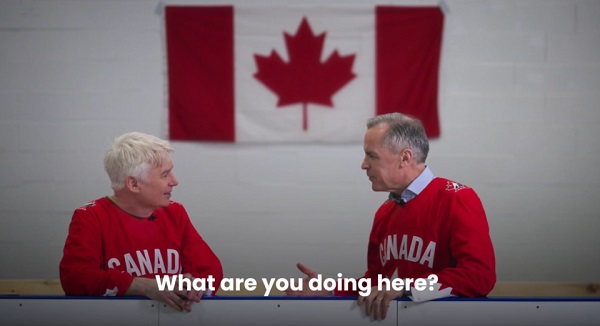

The cost of the bureaucracy increased by $6 billion last year, according to newly released numbers in Public Accounts disclosures. The Canadian Taxpayers Federation is calling on Prime Minister Mark Carney to immediately shrink the bureaucracy.
“The Public Accounts show the cost of the federal bureaucracy is out of control,” said Franco Terrazzano, CTF Federal Director. “Tinkering around the edges won’t cut it, Carney needs to take urgent action to shrink the bloated federal bureaucracy.”
The federal bureaucracy cost taxpayers $71.4 billion in 2024-25, according to the Public Accounts. The cost of the federal bureaucracy increased by $6 billion, or more than nine per cent, over the last year.
The federal bureaucracy cost taxpayers $39.6 billion in 2015-16, according to the Public Accounts. That means the cost of the federal bureaucracy increased 80 per cent over the last 10 years. The government added 99,000 extra bureaucrats between 2015-16 and 2024-25.
Half of Canadians say federal services have gotten worse since 2016, despite the massive increase in the federal bureaucracy, according to a Leger poll.
Not only has the size of the bureaucracy increased, the cost of consultants, contractors and outsourcing has increased as well. The government spent $23.1 billion on “professional and special services” last year, according to the Public Accounts. That’s an 11 per cent increase over the previous year. The government’s spending on professional and special services more than doubled since 2015-16.
“Taxpayers should not be paying way more for in-house government bureaucrats and way more for outside help,” Terrazzano said. “Mere promises to find minor savings in the federal bureaucracy won’t fix Canada’s finances.
“Taxpayers need Carney to take urgent action and significantly cut the number of bureaucrats now.”
Table: Cost of bureaucracy and professional and special services, Public Accounts
| Year | Bureaucracy | Professional and special services |
|
$71,369,677,000 |
$23,145,218,000 |
|
|
$65,326,643,000 |
$20,771,477,000 |
|
|
$56,467,851,000 |
$18,591,373,000 |
|
|
$60,676,243,000 |
$17,511,078,000 |
|
|
$52,984,272,000 |
$14,720,455,000 |
|
|
$46,349,166,000 |
$13,334,341,000 |
|
|
$46,131,628,000 |
$12,940,395,000 |
|
|
$45,262,821,000 |
$12,950,619,000 |
|
|
$38,909,594,000 |
$11,910,257,000 |
|
|
$39,616,656,000 |
$11,082,974,000 |

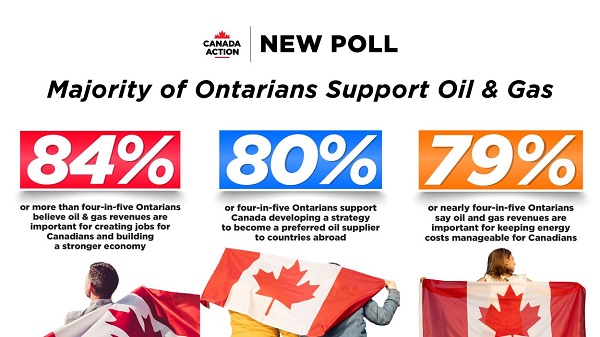
New Poll Shows Ontarians See Oil & Gas as Key to Jobs, Economy, and Trade

Alberta Next Panel calls for less Ottawa—and it could pay off

“Magnitude cannot be overstated”: Minnesota aid scam may reach $9 billion

Largest fraud in US history? Independent Journalist visits numerous daycare centres with no children, revealing massive scam

US Under Secretary of State Slams UK and EU Over Online Speech Regulation, Announces Release of Files on Past Censorship Efforts
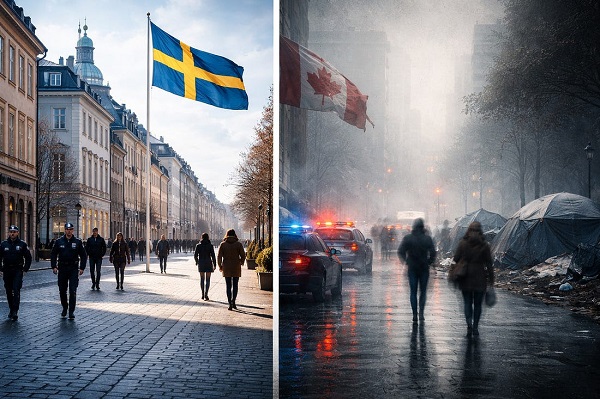
Sweden Fixed What Canada Won’t Even Name
Socialism vs. Capitalism
-
 Business1 day ago
Dark clouds loom over Canada’s economy in 2026
-
 Business1 day ago
The Real Reason Canada’s Health Care System Is Failing
-
 Business1 day ago
Federal funds FROZEN after massive fraud uncovered: Trump cuts off Minnesota child care money
-
 Addictions1 day ago
Coffee, Nicotine, and the Politics of Acceptable Addiction
-
 Opinion1 day ago
Globally, 2025 had one of the lowest annual death rates from extreme weather in history
-
 Business9 hours ago
The great policy challenge for governments in Canada in 2026
-
 International10 hours ago
Trump confirms first American land strike against Venezuelan narco networks
-
 Business10 hours ago
How convenient: Minnesota day care reports break-in, records gone