
Censorship Industrial Complex
A Democracy That Can’t Take A Joke Won’t Tolerate Dissent


From the Frontier Centre for Public Policy
By Collin May

Targeting comedians is a sign of political insecurity
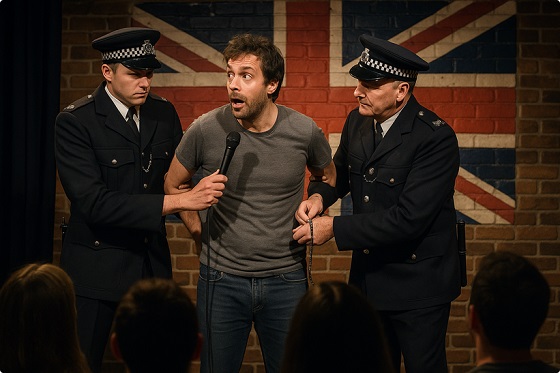
A democracy that fears its comedians is a democracy in trouble. That truth landed hard when Graham Linehan, the Irish writer behind Father Ted and The IT Crowd, stepped off a plane at Heathrow on Sept. 1, 2025, and was met by five London Metropolitan Police officers ready to arrest him for three posts on X.
Returning to the UK from Arizona, he was taken into custody on the charge of “suspicion of inciting violence”, an allegation levelled with increasing ease in an age wary of offence. His actual “crime” amounted to three posts, the most contentious being a joke about trans-identified men in exclusively female spaces and a suggestion that violated women respond with a swift blow to a very sensitive part of the male’s not-yet-physically-transitioned anatomy.
The reaction to Linehan’s arrest, from J.K. Rowling to a wide array of commentators, was unqualified condemnation. Many wondered whether free speech had become a museum piece in the UK. Asked about the incident, British Prime Minister Keir Starmer defended his country’s reputation for free expression but declined to address the arrest itself.
Canada has faced its own pressures on comedic expression. In 2022, comedian Mike Ward saw a 12-year legal saga end when the Supreme Court of Canada ruled five-to-four that the Quebec Human Rights Commission had no jurisdiction to hear a complaint about comments Ward made regarding a disabled Quebec boy. The ruling confirmed that human rights bodies cannot police artistic expression when no discrimination in services or employment has occurred. In that case, comic licence survived narrowly.
These cases reveal a broader trend. Governments and institutions increasingly frame comedy as a risk rather than a social pressure valve. In an environment fixated on avoiding perceived harm, humour becomes an easy and symbolic target. Linehan’s arrest underscores the fragility of free speech, especially in comedic form, in countries that claim to value democratic openness.
Comedy has long occupied an unusual place in public life. One of its earliest literary appearances is in Homer’s Iliad. A common soldier, Thersites, is ugly, sharp-tongued and irreverent. He speaks with a freedom others will not risk, mocking Agamemnon and voicing the frustrations of rank-and-file soldiers. He represents the instinct to puncture pretension. In this sense, comedy and philosophy share a willingness to speak uncomfortable truths that power prefers to avoid.
Aristotle, in his Poetics, noted that tragedy imitates noble actions and depicts people who are to be taken seriously. Comedy, by contrast, imitates those who appear inferior. Yet this lowly status is precisely what gives comedy its political usefulness. It allows performers to say what respectable voices cannot, revealing hypocrisies that formal discourse leaves untouched.
In the Iliad, Thersites does not escape punishment. Odysseus, striving to restore order, strikes him with Agamemnon’s staff, and the soldiers laugh as Thersites is silenced. The scene captures a familiar dynamic. Comedy can expose authority’s flaws, but authority often responds by asserting its dominance. The details shift across history, but the pattern endures.
Modern democracies are showing similar impatience. Comedy provides a way to question conventions without inviting formal conflict. When governments treat jokes as misconduct, they are not protecting the public from harm. They are signalling discomfort with scrutiny. Confident systems do not fear irreverence; insecure ones do.
The growing targeting of comedians matters because it reflects a shift toward institutions that view dissent, even in comedic form, as a liability. Such an approach narrows the space for open dialogue and misunderstands comedy’s role in democratic life. A society confident in itself tolerates mockery because it trusts its citizens to distinguish humour from harm.
In October, the British Crown Prosecution Service announced it would not pursue charges against Linehan. The London Metropolitan Police Service also said it would stop recording “non-crime hate incidents”, a controversial category used to document allegations of hateful behaviour even when no law has been broken. These reversals are welcome, but they do not erase the deeper unease that allowed the arrest to happen.
Comedy survives, but its environment is shifting. In an era where leaders are quick to adopt moral language while avoiding meaningful accountability, humour becomes more necessary, not less. It remains one of the few public tools capable of exposing the distance between political rhetoric and reality.
The danger is that in places where Agamemnon’s folly, leadership driven by pride and insecurity, takes root, those who speak uncomfortable truths may find themselves facing not symbolic correction but formal sanctions. A democracy that begins by targeting its jesters rarely stops there.
Collin May is a Senior Fellow with the Frontier Centre for Public Policy, a lawyer, and Adjunct Lecturer in Community Health Sciences at the University of Calgary, with degrees in law (Dalhousie University), a Masters in Theological Studies (Harvard) and a Diplome d’etudes approfondies (Ecole des hautes etudes, Paris).


From LifeSiteNews
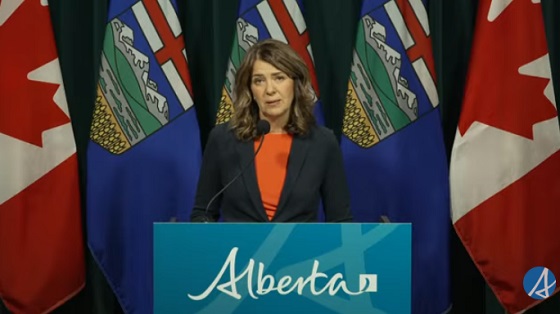
‘Peterson’s law,’ named for Canadian psychologist Jordan Peterson, was introduced by Alberta Premier Danielle Smith.
Alberta’s Conservative government introduced a new law that will set “clear expectations” for professional regulatory bodies to respect freedom of speech on social media and online for doctors, nurses, engineers, and other professionals.
The new law, named “Peterson’s law” after Canadian psychologist Jordan Peterson, who was canceled by his regulatory body, was introduced Thursday by Alberta Premier Danielle Smith.
“Professionals should never fear losing their license or career because of a social media post, an interview, or a personal opinion expressed on their own time,” Smith said in a press release sent to media and LifeSiteNews.
“Alberta’s government is restoring fairness and neutrality so regulators focus on competence and ethics, not policing beliefs. Every Albertan has the right to speak freely without ideological enforcement or intimidation, and this legislation makes that protection real.”
The law, known as Bill 13, the Regulated Professions Neutrality Act, will “set clear expectations for professional regulatory bodies to ensure professionals’ right to free expression is protected.”
According to the government, the new law will “Limit professional regulatory bodies from disciplining professionals for expressive off-duty conduct, except in specific circumstances such as threats of physical violence or a criminal conviction.”
It will also restrict mandatory training “unrelated to competence or ethics, such as diversity, equity, and inclusion training.”
Bill 13, once it becomes law, which is all but guaranteed as Smith’s United Conservative Party (UCP) holds a majority, will also “create principles of neutrality that prohibit professional regulatory bodies from assigning value, blame or different treatment to individuals based on personally held views or political beliefs.”
As reported by LifeSiteNews, Peterson has been embattled with the College of Psychologists of Ontario (CPO) after it mandated he undergo social media “training” to keep his license following posts he made on X, formerly Twitter, criticizing Trudeau and LGBT activists.
He recently noted how the CPO offered him a deal to “be bought,” in which the legal fees owed to them after losing his court challenge could be waived but only if he agreed to quit his job as a psychologist.
Early this year, LifeSiteNews reported that the CPO had selected Peterson’s “re-education coach” for having publicly opposed the LGBT agenda.
The Alberta government directly referenced Peterson’s (who is from Alberta originally) plight with the CPO, noting “the disciplinary proceedings against Dr. Jordan Peterson by the College of Psychologists of Ontario, demonstrate how regulatory bodies can extend their reach into personal expression rather than professional competence.”
“Similar cases involving nurses, engineers and other professionals revealed a growing pattern: individuals facing investigations, penalties or compulsory ideological training for off-duty expressive conduct. These incidents became a catalyst, confirming the need for clear legislative boundaries that protect free expression while preserving professional standards.”
Alberta Minister of Justice and Attorney General Mickey Amery said regarding Bill 13 that the new law makes that protection of professionals “real and holds professional regulatory bodies to a clear standard.”
Last year, Peterson formally announced his departure from Canada in favor of moving to the United States, saying his birth nation has become a “totalitarian hell hole.”


From Underdog to Top Broodmare
Federal major projects list raises questions

Google denies scanning users’ email and attachments with its AI software

Crown seeks to punish peaceful protestor Chris Barber by confiscating his family work truck “Big Red”

Health Canada indefinitely pauses plan to sell unlabeled cloned meat after massive public backlash
Alberta and Ottawa ink landmark energy agreement

Poilievre says West Coast Pipeline MOU is no guarantee
-
 Artificial Intelligence2 days ago
‘Trouble in Toyland’ report sounds alarm on AI toys
-
 Daily Caller2 days ago
Tom Homan Predicts Deportation Of Most Third World Migrants Over Risks From Screening Docs
-
 National1 day ago
Media bound to pay the price for selling their freedom to (selectively) offend
-
 Energy2 days ago
Canadians will soon be versed in massive West Coast LPG mega-project
-
 Bruce Dowbiggin1 day ago
Sometimes An Ingrate Nation Pt. 2: The Great One Makes His Choice
-
 Business7 hours ago
Canada’s future prosperity runs through the northwest coast
-
 Business1 day ago
Why Isn’t There a Cure for Alzheimer’s Disease?
-
 Brownstone Institute1 day ago
The Unmasking of Vaccine Science