
Alberta
Red Deer’s Joan Donald inducted into the Alberta Order of Excellence

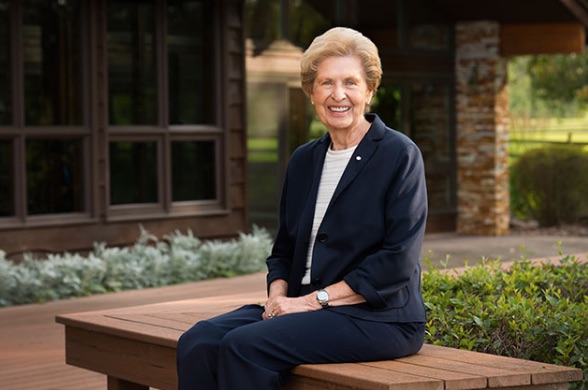
Eight exceptional Albertans will be inducted into the Alberta Order of Excellence in 2021.
“Our honourees have abundant strengths that have served our province well. These include great perseverance, a selfless commitment to giving back, and a steadfast focus on sharing their unique gifts and abilities in a way that enriches us all. I offer my heartfelt thanks to each of them for their remarkable contributions.”
“All of the recipients show a remarkable talent for innovative creativity in their fields. Whether in business, research, education or community building, their leadership has made all of our lives better, safer and richer. I congratulate this year’s inductees on their many accomplishments, proving brilliant ideas shine brighter when courage and collaboration stand together.”
The Alberta Order of Excellence recognizes Albertans who have made an outstanding provincial, national or international impact. It is the highest honour a citizen can receive as an official part of the Canadian Honours System. The new additions will bring the total membership of the Alberta Order of Excellence to 197.
The Alberta Order of Excellence members being invested in 2021 are:
- Joan Donald of Red Deer has enriched the social and economic health of her community by bringing governance and leadership to boardrooms of organizations that range from business, health and education to social justice, sport and culture.
- Cyril Kay of Edmonton is among the world’s eminent biochemists, unlocking the building blocks of life. His vision to create and lead internationally respected multidisciplinary teams has revolutionized biomedical research.
- Murray McCann of Calgary is an entrepreneur and community leader who reinvests his success into organizations that combat hunger, homelessness, fear and violence. He created programs that honour fallen soldiers and support homeless veterans.
- Barb Olson of Calgary is an internationally recognized researcher, entrepreneur and toxicology expert. Her research with husband Merle in veterinary medicine has led to a better understanding of bacterial infections and treatment in humans and animals.
- Merle Olson of Calgary is an internationally renowned veterinarian and researcher. His entrepreneurism with wife Barb has led to innovative biotech and pharmaceutical companies specializing in veterinary products to address animal welfare issues.
- Greg Powell of Calgary is a pioneering emergency physician, innovator and educator. He has saved countless lives by co-founding and leading the Shock Trauma Air Rescue Service (STARS) and revolutionizing emergency medicine.
- Cor Van Raay of Lethbridge has strengthened both agriculture and agribusiness in Western Canada through his innovation and entrepreneurship. His generosity and community building have enriched the lives of Albertans.
- Lena Heavy Shields-Russell (Ikkináínihki) of the Blood Reserve is an Elder, author, teacher and trailblazing translator. She created Alberta’s Blackfoot curriculum, safeguarding the language and culture to pass on to future generations.
Full biographies and official portraits of new members, and information about the program, are available at alberta.ca/AOE.
Joan Donald
“All through my life I have believed in helping out people in need and giving back to the community. I love to quote Maya Angelou: ‘You shouldn’t go through life with a catcher’s mitt on both hands; you need to be able to throw something back.”
Joan Donald is a Red Deer community leader, volunteer and mentor. She has enriched the social and economic health of her community by bringing governance and leadership to the boardrooms of organizations that range from business, health and education, to social justice, sport and culture.
Joan May Schultz was born on May 29, 1935, in Wetaskiwin, Alberta, and grew up on a farm near Millet as one of 11 children. Living on a farm meant there was always work to do, whether it was hauling water and wood into the house or bringing lunch to the men working in the field. “We came home from school and went right to work on our chores. We learned about being good neighbours. At harvest time, if our family finished first, we were there to help our neighbours,” she says.
Joan attended a one-room country school until Grade 9, when she moved with her parents and younger sister to Edmonton. While attending Garneau High School, she met Jack Donald (AOE 2015), her future husband. The couple married in 1955. After graduation, Joan worked at the Royal Bank of Canada, taking business classes in the evening. She worked hard at the bank, but soon realized she could work just as hard for herself. Partners in life, she and Jack decided to become partners in business, venturing into the service station business in 1957 in Edmonton.
In 1964, Joan and Jack moved to Red Deer to raise their children Kathy and John, reasoning that the smaller city would provide more opportunities for their young family. They marked their move by co-founding a new business, Parkland Oil Products Ltd. They expanded the business from a fledgling single gas station in Red Deer to 38 service station outlets across central Alberta before selling Parkland Oil in 1971.
Five years later, Joan and Jack again ventured into business together, buying a public company, Parkland Industries Ltd., the corporation behind the well-known Fas Gas service stations. “We have been a great team over the years. He’s the business mind and I’m the people person. We complement each other,” she says.
Joan served as Parkland’s Assistant Corporate Secretary from 1977 until her retirement in 2001, working in public and investor relations, annual meetings, all board planning, and serving on the board of directors for 28 years. By the time she retired, the company, now called Parkland Fuel Corp., had its own refinery and 454 retail service stations in Western and Northern Canada. She continues to serve as Vice- President of Parkland Properties Ltd., their personal investment and real estate company in Red Deer. Joan also served a four-year term on the Board of Directors of the Alberta Energy Company Ltd. (now EnCanada Corp./Ovintiv Inc.).
Many of Joan’s greatest contributions have been outside the corporate world. She began volunteering as soon as the family moved to Red Deer and has continued to do so for more than 50 years. She has repeatedly galvanized the community and volunteer teams, leading a multitude of community fundraising campaigns, while encouraging others to join her in giving their time and financial support.
In the early 1970s, she began organizing horse shows for Westerner Park, a role she enjoyed for the next two decades. Her interest in horses led to more volunteer work with the Quarter Horse Association of Alberta and the Waskasoo Handicapped Riding Association. Joan went on to serve four years on the board of directors – which governs Westerner Park, Red Deer’s events centre – and eight years on the executive team, including two as president. She has worked tirelessly with the board to introduce sound governance processes and, also as a shareholder for over 40 years, she has participated in or chaired many of the organization’s major committees. In 2007, Joan and Jack donated a substantial gift to assist in building a new Westerner administration building.
Joan was instrumental in starting the Festival of Trees in Red Deer in 1994. Under her guidance, the festival grew from a relatively small fundraiser to become the premiere community charitable event in the city, raising funds for the Red Deer Regional Hospital Foundation. Each year, she and the volunteers focused on growing the festival by adding new events and activities. Joan’s continued involvement, at leadership levels and now as a major donor, together with her unfailing enthusiasm, have been key reasons for the Festival of Trees’ success.
As long-time volunteers, Joan and Jack are both proud to support Red Deer College, now Red Deer Polytechnic. Joan has served on the Board of Governors and as honorary chair of the highly successful capital campaigns. Joan and Jack have also been major personal donors to Red Deer Polytechnic for many years, as have their companies.
In 2007, they generously supported the college’s expansion plan, a gesture that resulted in the college’s business faculty being named the Donald School of Business. This honoured more than their philanthropy and support of lifelong learning. It gives tribute to the entrepreneurialism and keen business sense it took to grow a single gas station into what has become Canada’s largest independent fuel marketer and distributor.
Another of their more sizable gifts to the college was for the Donald Health & Wellness Centre, which is dedicated to teaching and learning in the fields of health and wellness. They also contributed a significant gift for the new Library Information Common. Combined with previous leadership investments, they are the college’s largest philanthropic donors.
“We have continued to invest in Red Deer Polytechnic, because we believe in empowering local learners to give them the opportunities they need to be successful in their careers and lives. Our communities are strengthened tremendously with the high-quality individuals who are bettering themselves in their time on campus, and beyond,” says Joan.
She has volunteered on many other non-profit boards and fundraising campaigns, including her tireless work on the Board of Directors of STARS (Shock Trauma Air Rescue Service) and on two STARS capital campaigns, the second to acquire two new higher-capacity helicopters.
Over the years, Joan and Jack have donated substantial gifts and time to a number of non-profit community groups, including Central Alberta Child Advocacy Centre, Red Deer Hospice Society, United Way Central Alberta, and JA (Junior Achievement) Southern Alberta. She consistently “puts her money where her mouth is,” supporting the same organizations she has asked others to support.
While many people may write a cheque for a good cause, Joan realizes that fewer will become campaign leaders. That’s where she feels her legacy is. She has an enduring track record of starting organizations on the right foot with strong principles, plans and practices, then staying on to cultivate future leaders. She has mentored many community members, guiding fellow volunteers on how to best put together a fundraising team, how to lay out their goals and plans very clearly, and share what is expected of their team members to reach those goals.
Joan also invested in young people to cultivate future leaders for Alberta and Canada, developing a unique program with the Red Deer School Board. At Lindsay Thurber High School, she supported the Minerva Club for girls in Grade 9, where they examined careers in math, sciences and non-traditional areas.
Joan has received numerous awards over the years, including Queen Elizabeth II’s Golden Jubilee Medal in 2002, Red Deer Citizen of the Year in 2004, Queen Elizabeth II’s Diamond Jubilee Medal in 2012, and the Senate Canada 150 Medal in 2017. She and Jack have received the G.H. Dawe Memorial Award for philanthropic contributions to Red Deer Polytechnic for dedicated service to education in 2000, and the Philanthropic Family–Generosity of Spirit Award from the Calgary Chapter of the Association of Fundraising Professionals in 2005. In 2008, the Red Deer and District Community Foundation presented Joan with a Women of Excellence Lifetime Achievement Award and in 2015, she received the Festival of Trees Friends Award for her lifetime of significant contributions. In 2011, Joan was made a Member of the Order of Canada for her lifetime of distinguished community service.
Joan continues to actively volunteer and will continue to, as long as she sees a need. She and Jack have five married grandchildren and nine great grandchildren, with whom they spend as much time as they can when they’re not wintering at their home in San Diego, California.


From the Canadian Energy Centre
Canada’s energy landscape changed significantly in 2025, with mounting U.S. economic pressures reinforcing the central role oil and gas can play in safeguarding the country’s independence.
Here are the Canadian Energy Centre’s top five most-viewed stories of the year.
5. Alberta’s massive oil and gas reserves keep growing – here’s why

The Northern Lights, aurora borealis, make an appearance over pumpjacks near Cremona, Alta., Thursday, Oct. 10, 2024. CP Images photo
Analysis commissioned this spring by the Alberta Energy Regulator increased the province’s natural gas reserves by more than 400 per cent, bumping Canada into the global top 10.
Even with record production, Alberta’s oil reserves – already fourth in the world – also increased by seven billion barrels.
According to McDaniel & Associates, which conducted the report, these reserves are likely to become increasingly important as global demand continues to rise and there is limited production growth from other sources, including the United States.
4. Canada’s pipeline builders ready to get to work

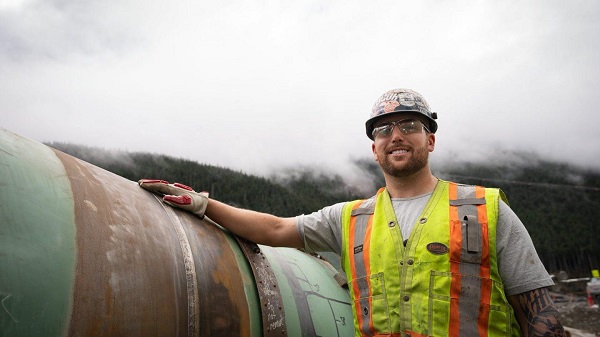
Photo courtesy Coastal GasLink
Canada could be on the cusp of a “golden age” for building major energy projects, said Kevin O’Donnell, executive director of the Mississauga, Ont.-based Pipe Line Contractors Association of Canada.
That eagerness is shared by the Edmonton-based Progressive Contractors Association of Canada (PCA), which launched a “Let’s Get Building” advocacy campaign urging all Canadian politicians to focus on getting major projects built.
“The sooner these nation-building projects get underway, the sooner Canadians reap the rewards through new trading partnerships, good jobs and a more stable economy,” said PCA chief executive Paul de Jong.
3. New Canadian oil and gas pipelines a $38 billion missed opportunity, says Montreal Economic Institute

Steel pipe in storage for the Trans Mountain Pipeline expansion in 2022. Photo courtesy Trans Mountain Corporation
In March, a report by the Montreal Economic Institute (MEI) underscored the economic opportunity of Canada building new pipeline export capacity.
MEI found that if the proposed Energy East and Gazoduq/GNL Quebec projects had been built, Canada would have been able to export $38 billion worth of oil and gas to non-U.S. destinations in 2024.
“We would be able to have more prosperity for Canada, more revenue for governments because they collect royalties that go to government programs,” said MEI senior policy analyst Gabriel Giguère.
“I believe everybody’s winning with these kinds of infrastructure projects.”
2. Keyera ‘Canadianizes’ natural gas liquids with $5.15 billion acquisition

Keyera Corp.’s natural gas liquids facilities in Fort Saskatchewan, Alta. Photo courtesy Keyera Corp.
In June, Keyera Corp. announced a $5.15 billion deal to acquire the majority of Plains American Pipelines LLP’s Canadian natural gas liquids (NGL) business, creating a cross-Canada NGL corridor that includes a storage hub in Sarnia, Ontario.
The acquisition will connect NGLs from the growing Montney and Duvernay plays in Alberta and B.C. to markets in central Canada and the eastern U.S. seaboard.
“Having a Canadian source for natural gas would be our preference,” said Sarnia mayor Mike Bradley.
“We see Keyera’s acquisition as strengthening our region as an energy hub.”
1. Explained: Why Canadian oil is so important to the United States

Enbridge’s Cheecham Terminal near Fort McMurray, Alberta is a key oil storage hub that moves light and heavy crude along the Enbridge network. Photo courtesy Enbridge
The United States has become the world’s largest oil producer, but its reliance on oil imports from Canada has never been higher.
Many refineries in the United States are specifically designed to process heavy oil, primarily in the U.S. Midwest and U.S. Gulf Coast.
According to the Alberta Petroleum Marketing Commission, the top five U.S. refineries running the most Alberta crude are:
- Marathon Petroleum, Robinson, Illinois (100% Alberta crude)
- Exxon Mobil, Joliet, Illinois (96% Alberta crude)
- CHS Inc., Laurel, Montana (95% Alberta crude)
- Phillips 66, Billings, Montana (92% Alberta crude)
- Citgo, Lemont, Illinois (78% Alberta crude)

Pathways Alliance CEO Kendall Dilling is interviewed at the World Petroleum Congress in Calgary, Monday, Sept. 18, 2023.THE CANADIAN PRESS/Jeff McIntosh
From Resource Works
Carbon capture gives biggest bang for carbon tax buck CCS much cheaper than fuel switching: report
Canada’s climate change strategy is now joined at the hip to a pipeline. Two pipelines, actually — one for oil, one for carbon dioxide.
The MOU signed between Ottawa and Alberta two weeks ago ties a new oil pipeline to the Pathways Alliance, which includes what has been billed as the largest carbon capture proposal in the world.
One cannot proceed without the other. It’s quite possible neither will proceed.
The timing for multi-billion dollar carbon capture projects in general may be off, given the retreat we are now seeing from industry and government on decarbonization, especially in the U.S., our biggest energy customer and competitor.
But if the public, industry and our governments still think getting Canada’s GHG emissions down is a priority, decarbonizing Alberta oil, gas and heavy industry through CCS promises to be the most cost-effective technology approach.
New modelling by Clean Prosperity, a climate policy organization, finds large-scale carbon capture gets the biggest bang for the carbon tax buck.
Which makes sense. If oil and gas production in Alberta is Canada’s single largest emitter of CO2 and methane, it stands to reason that methane abatement and sequestering CO2 from oil and gas production is where the biggest gains are to be had.
A number of CCS projects are already in operation in Alberta, including Shell’s Quest project, which captures about 1 million tonnes of CO2 annually from the Scotford upgrader.
What is CO2 worth?
Clean Prosperity estimates industrial carbon pricing of $130 to $150 per tonne in Alberta and CCS could result in $90 billion in investment and 70 megatons (MT) annually of GHG abatement or sequestration. The lion’s share of that would come from CCS.
To put that in perspective, 70 MT is 10% of Canada’s total GHG emissions (694 MT).
The report cautions that these estimates are “hypothetical” and gives no timelines.
All of the main policy tools recommended by Clean Prosperity to achieve these GHG reductions are contained in the Ottawa-Alberta MOU.
One important policy in the MOU includes enhanced oil recovery (EOR), in which CO2 is injected into older conventional oil wells to increase output. While this increases oil production, it also sequesters large amounts of CO2.
Under Trudeau era policies, EOR was excluded from federal CCS tax credits. The MOU extends credits and other incentives to EOR, which improves the value proposition for carbon capture.
Under the MOU, Alberta agrees to raise its industrial carbon pricing from the current $95 per tonne to a minimum of $130 per tonne under its TIER system (Technology Innovation and Emission Reduction).
The biggest bang for the buck
Using a price of $130 to $150 per tonne, Clean Prosperity looked at two main pathways to GHG reductions: fuel switching in the power sector and CCS.
Fuel switching would involve replacing natural gas power generation with renewables, nuclear power, renewable natural gas or hydrogen.
“We calculated that fuel switching is more expensive,” Brendan Frank, director of policy and strategy for Clean Prosperity, told me.
Achieving the same GHG reductions through fuel switching would require industrial carbon prices of $300 to $1,000 per tonne, Frank said.
Clean Prosperity looked at five big sectoral emitters: oil and gas extraction, chemical manufacturing, pipeline transportation, petroleum refining, and cement manufacturing.
“We find that CCUS represents the largest opportunity for meaningful, cost-effective emissions reductions across five sectors,” the report states.

Fuel switching requires higher carbon prices than CCUS.
Measures like energy efficiency and methane abatement are included in Clean Prosperity’s calculations, but again CCS takes the biggest bite out of Alberta’s GHGs.
“Efficiency and (methane) abatement are a portion of it, but it’s a fairly small slice,” Frank said. “The overwhelming majority of it is in carbon capture.”

From left, Alberta Minister of Energy Marg McCuaig-Boyd, Shell Canada President Lorraine Mitchelmore, CEO of Royal Dutch Shell Ben van Beurden, Marathon Oil Executive Brian Maynard, Shell ER Manager, Stephen Velthuizen, and British High Commissioner to Canada Howard Drake open the valve to the Quest carbon capture and storage facility in Fort Saskatchewan Alta, on Friday November 6, 2015. Quest is designed to capture and safely store more than one million tonnes of CO2 each year an equivalent to the emissions from about 250,000 cars. THE CANADIAN PRESS/Jason Franson
Credit where credit is due
Setting an industrial carbon price is one thing. Putting it into effect through a workable carbon credit market is another.
“A high headline price is meaningless without higher credit prices,” the report states.
“TIER credit prices have declined steadily since 2023 and traded below $20 per tonne as of November 2025. With credit prices this low, the $95 per tonne headline price has a negligible effect on investment decisions and carbon markets will not drive CCUS deployment or fuel switching.”
Clean Prosperity recommends a kind of government-backstopped insurance mechanism guaranteeing carbon credit prices, which could otherwise be vulnerable to political and market vagaries.
Specifically, it recommends carbon contracts for difference (CCfD).
“A straight-forward way to think about it is insurance,” Frank explains.
Carbon credit prices are vulnerable to risks, including “stroke-of-pen risks,” in which governments change or cancel price schedules. There are also market risks.
CCfDs are contractual agreements between the private sector and government that guarantees a specific credit value over a specified time period.
“The private actor basically has insurance that the credits they’ll generate, as a result of making whatever low-carbon investment they’re after, will get a certain amount of revenue,” Frank said. “That certainty is enough to, in our view, unlock a lot of these projects.”
From the perspective of Canadian CCS equipment manufacturers like Vancouver’s Svante, there is one policy piece still missing from the MOU: eligibility for the Clean Technology Manufacturing (CTM) Investment tax credit.
“Carbon capture was left out of that,” said Svante co-founder Brett Henkel said.
Svante recently built a major manufacturing plant in Burnaby for its carbon capture filters and machines, with many of its prospective customers expected to be in the U.S.
The $20 billion Pathways project could be a huge boon for Canadian companies like Svante and Calgary’s Entropy. But there is fear Canadian CCS equipment manufacturers could be shut out of the project.
“If the oil sands companies put out for a bid all this equipment that’s needed, it is highly likely that a lot of that equipment is sourced outside of Canada, because the support for Canadian manufacturing is not there,” Henkel said.
Henkel hopes to see CCS manufacturing added to the eligibility for the CTM investment tax credit.
“To really build this eco-system in Canada and to support the Pathways Alliance project, we need that amendment to happen.”
Resource Works News


Why Japan wants Western Canadian LNG

Disclosures reveal Minnesota politician’s husband’s companies surged thousands-fold amid Somali fraud crisis
What Do Loyalty Rewards Programs Cost Us?

Mainstream media missing in action as YouTuber blows lid off massive taxpayer fraud
-
 International21 hours ago
Trump confirms first American land strike against Venezuelan narco networks
-
 Business20 hours ago
How convenient: Minnesota day care reports break-in, records gone
-
 Business2 days ago
The Real Reason Canada’s Health Care System Is Failing
-
 Opinion2 days ago
Globally, 2025 had one of the lowest annual death rates from extreme weather in history
-
 Business20 hours ago
The great policy challenge for governments in Canada in 2026
-
 Business2 days ago
Federal funds FROZEN after massive fraud uncovered: Trump cuts off Minnesota child care money
-
 Addictions2 days ago
Coffee, Nicotine, and the Politics of Acceptable Addiction
-
 Business2 days ago
Dark clouds loom over Canada’s economy in 2026