
Business
Cost of federal government debt rising for Canadians

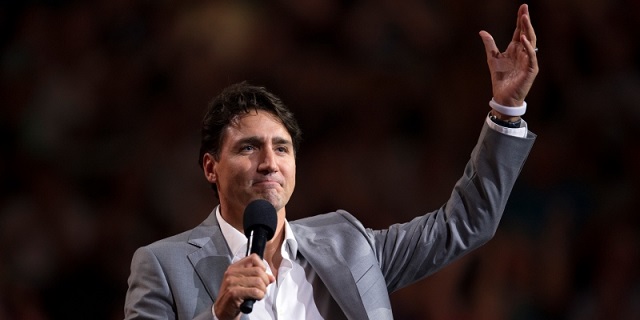
From the Fraser Institute
As the federal deficit persists and government debt mounts, the burden of debt interest costs is growing for Canadian taxpayers.
The Trudeau government is on track for another large budget deficit forecasted at $40.0 billion, slightly larger than the $35.3 billion deficit last year. The government’s long-term forecast suggests deficits will continue throughout the projection period, which ends in 2028/29.
There’s nothing new about the federal books being splashed with red ink. The Trudeau government has run significant deficits every year of its tenure. What’s different this time, however, is that due to higher interest rates the cost of the government’s borrowing is much higher. As a result, debt costs are set to increase significantly in the years ahead, which will burden taxpayers today and in the future while also making it harder for future prime ministers and finance ministers to balance their books.
Let’s dig a bit deeper into the numbers. When the Trudeau government took power during fiscal year 2015/16, debt interest costs were $21.8 billion. In 2021/22, despite a long string of deficits and huge increase in debt, low interest rates during the period of intensive borrowing prevented a surge in debt interest costs, which stood at $24.5 billion.
But last fiscal year marked the start of a new chapter in Canada’s fiscal history as higher interest rates combined with significant debt accumulation caused debt interest costs to rise substantially, from $24.5 billion to $35.0 billion. Another similar increase is expected this year, with debt costs forecasted to rise to $46.5 billion—a 90 per cent increase in just two years with a further projected increase to $52.4 billion for next year.
This sudden increase in debt interest costs has important and immediate implications for federal finances. In 2021/22, 5.9 per cent of all federal revenue was spent on paying the interest on federal debt. By next year, according to Trudeau government forecasts, this will rise to 10.8 per cent.
Canadian history shows us how debt interest costs can quickly spiral out of control. During the debt crisis of the early 1990s, after many years of continuous deficits, debt interest costs were consuming one-third of every dollar Ottawa collected. Today’s debt interest costs are not as high as they were in the 1990s, but there’s no reason to wait until a crisis develops to take action.
The fact that debt interest is taking a bigger bite out of federal revenue should not just be a matter of academic concern for public finance economists. It affects all Canadian taxpayers. A larger share of the money collected from individuals and businesses being spent on debt leaves less for other priorities such as tax relief, which can help encourage economic growth, or core public services that Canadians value.
The Trudeau government has often spoken about the benefits of fiscal restraint but has thus far failed to exercise much of it. If the prime minister and his cabinet want to halt the growth in debt interest they must reverse the free spending that has characterized their time in government to slow the accumulation of debt.
Authors:



From the Fraser Institute
By Tegan Hill and Jason Clemens
Recent court decision adds to growing uncertainty in B.C.
A recent decision by the B.C. Court of Appeal further clouds private property rights and undermines investment in the province. Specifically, the court determined British Columbia’s mineral claims system did not follow the province’s Declaration on the Rights of Indigenous Peoples Act (DRIPA), which incorporated the United Nations Declaration on the Rights of Indigenous Peoples (UNDRIP) into law.
DRIPA (2019) requires the B.C. provincial government to “take all measures necessary to ensure the laws of British Columbia are consistent with the Declaration,” meaning that all legislation in B.C. must conform to the principles outlined in the UNDRIP, which states that “Indigenous peoples have the right to the lands, territories and resources which they have traditionally owned, occupied or otherwise used or acquired.” The court’s ruling that the provincial government is not abiding by its own legislation (DRIPA) is the latest hit for the province in terms of ongoing uncertainty regarding property rights across the province, which will impose massive economic costs on all British Columbians until it’s resolved.
Consider the Cowichan First Nations legal case. The B.C. Supreme Court recently granted Aboriginal title to over 800 acres of land in Richmond valued at $2.5 billion, and where such aboriginal title is determined to exist, the court ruled that it is “prior and senior right” to other property interests. Put simply, the case puts private property at risk in BC.
The Eby government is appealing the case, yet it’s simultaneously negotiating bilateral agreements that similarly give First Nations priority rights over land swaths in B.C.
Consider Haida Gwaii, an archipelago on Canada’s west coast where around 5,000 people live—half of which are non-Haida. In April 2024, the Eby government granted Haida Aboriginal title over the land as part of a bilateral agreement. And while the agreement says private property must be honoured, private property rights are incompatible with communal Aboriginal title and it’s unclear how this conflict will be resolved.
Moreover, the Eby government attempted to pass legislation that effectively gives First Nations veto power over public land use in B.C. in 2024. While the legislation was rescinded after significant public backlash, the Eby’s government’s continued bilateral negotiations and proposed changes to other laws indicate it’s supportive of the general move towards Aboriginal title over significant parts of the province.
UNDRIP was adopted by the United Nations in 2007 and the B.C. Legislature adopted DRIPA in 2019. DRIPA requires that the government must secure “free, prior and informed consent” before approving projects on claimed land. Premier Eby is directly tied to DRIPA since he was the attorney general and actually drafted the interpretation memo.
The recent case centres around mineral exploration. Two First Nations groups—the Gitxaala Nation and the Ehattesaht First Nation—claimed the duty to consult was not adequately met and that granting mineral claims in their land “harms their cultural, spiritual, economic, and governance rights over their traditional territories,” which is inconsistent with DRIPA.
According to a 2024 survey of mining executives, more uncertainty is the last thing B.C. needs. Indeed, 76 per cent of respondents for B.C. said uncertainty around protected land and disputed land claims deters investment compared to only 29 per cent and 44 per cent (respectively) for Saskatchewan.
This series of developments have and will continue to fuel uncertainty in B.C. Who would move to or invest in B.C. when their private property, business, and investment is potentially at risk?
It’s no wonder British Columbians are leaving the province in droves. According to the B.C. Business Council, nearly 70,000 residents left B.C. for other parts of Canada last year. Similarly, business investment (inflation-adjusted) fell by nearly 5 per cent last year, exports and housing starts were down, and living standards in the province (as measured by per-person GDP) contracted in both 2023 and 2024.
B.C.’s recent developments will only worsen uncertainty in the province, deterring investment and leading to stagnant or even declining living standards for British Columbians. The Eby government should do its part to reaffirm private property rights, rather than continue fuelling uncertainty.

Tegan Hill
Director, Alberta Policy, Fraser Institute

Jason Clemens
Executive Vice President, Fraser Institute

From LifeSiteNews
Conservative MP Leslyn Lewis raised concerns about the Liberals’ major investment in AI, which could lead to digital ids and loss of freedoms.
Conservative MP Leslyn Lewis is sounding the alarm over the Liberals’ nearly billion-dollar AI infrastructure investment, which could lead to digital IDs
In a December 2 post on X, Lewis raised concerns over the Liberals’ 2025 budget, which funds a $925.6 million “Sovereign Canadian Cloud” and national AI compute infrastructure at the same time as the Liberals are pushing digital identification on Canadians.
“Who audits the algorithms behind government’s new digital systems?” Lewis challenged. “What protections exist for Canadians in this new infrastructure? Who builds it? Who controls it? Who owns the data?”
“Good technology isn’t the issue, our freedoms, surveillance and good accountable governance in a digital era are the real issues,” she warned.
“Digital infrastructure is power, and it must never be implemented in secrecy or without parliamentary scrutiny,” Lewis declared.
Despite spending nearly one billion taxpayer dollars on the project, Prime Minister Mark Carney provides surprisingly few details on how the infrastructure will work and what its purpose will be.
“Budget 2025 proposes to provide $925.6 million over five years, starting in 2025-26, to support a large-scale sovereign public AI infrastructure that will boost AI compute availability and support access to sovereign AI compute capacity for public and private research,” the budget read.
“The investment will ensure Canada has the capacity needed to be globally competitive in a secure and sovereign environment,” it continued.
Alarmingly, the funding comes at the same time as Liberals are moving forward with digital identification systems, despite warnings that they will infringe on Canadians freedoms.
In November, as reported by LifeSiteNews, Liberals moved ahead with digital identification for anyone seeking federal benefits, including seniors on Old Age Security.
Additionally, the Canadian government hired outside consultants tasked with looking into whether or not officials should proceed with creating a digital ID system for all citizens and residents.
Per a May 20 Digital Credentials Issue memo, and as noted by Blacklock’s Reporter, the “adoption” of such a digital ID system may be difficult.
Canada’s Privy Council research from 2023 noted that there is strong public resistance to the use of digital IDs to access government services.
Nonetheless, Conservative leader Pierre Poilievre sounded the alarm by promising to introduce a bill that would “expressly prohibit” digital IDs in Canada.
Critics have warned that the purpose of such IDs is actually to centralize control over citizens. This opinion seems to be mirrored by the general public, with a Bank of Canada survey finding that Canadians are wary of a government-backed digital currency, concluding that a “significant number” of citizens would resist the implementation of such a system.
Digital IDs and similar systems have long been pushed by globalist groups like the World Economic Forum, an organization with which Carney has extensive ties, under the guise of ease of access and security.


Trump Deals Biden’s EV Dreams A Death Blow

Canadian bishops condemn Liberal ‘hate speech’ proposal that could criminalize quoting Scripture

While Trump has southern border secure, hundreds of thousands of illegal immigrants still flooding in from Canada

Pharma Bombshell: President Trump Orders Complete Childhood Vaccine Schedule Review
-
 National1 day ago
Liberal bill “targets Christians” by removing religious exemption in hate-speech law
-
 Business2 days ago
The EU Insists Its X Fine Isn’t About Censorship. Here’s Why It Is.
-
 Business2 days ago
Canada invests $34 million in Chinese drones now considered to be ‘high security risks’
-
 Economy2 days ago
Affordable housing out of reach everywhere in Canada
-
 Bruce Dowbiggin2 days ago
Wayne Gretzky’s Terrible, Awful Week.. And Soccer/ Football.
-
 Business21 hours ago
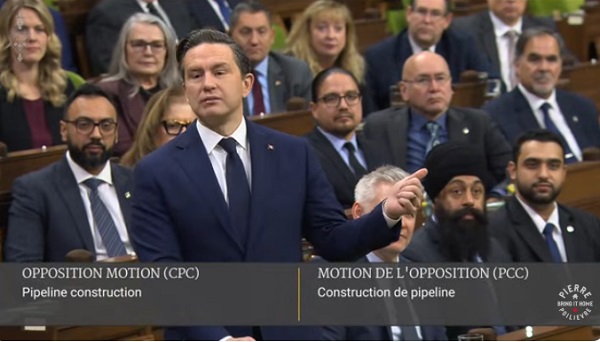
Looks like the Liberals don’t support their own Pipeline MOU
-
 Health2 days ago
CDC Vaccine Panel Votes to End Universal Hep B Vaccine for Newborns
-
 Health1 day ago
The Data That Doesn’t Exist