
MacDonald Laurier Institute
Canada is completing Confederation


From the MacDonald Laurier Institute
By Ken Coates
For generations, decisions about the North were made in Ottawa. While consultations improved, final decisions still rested outside the territory. That has now ended.
Something important is up in the Far North. With the signing of the Nunavut Devolution Agreement, Canada is completing Confederation.
Prime Minister Justin Trudeau travelled to Iqaluit to join Nunavut Premier P.J. Akeeagok, Nunavut Tunngavik Inc. president Aluki Kotierk, and federal Northern Affairs Minister Dan Vandal on Jan. 18, 2024, to sign the history-making document. What seems to be a technical administrative process is, in fact, a transformative event in the evolution of the North.
Canadians have had trouble coming to terms with their status as a colonial power, both on the broad front of the mismanagement of Indigenous affairs, and the more traditional colonial control exerted over the territories. In 1870, the Northwest Territories stretched from the Rocky Mountains to Labrador, and the 49th parallel to the Arctic Ocean and much of Baffin Island—much larger than the original four provinces.
Over more than 150 years, Canada slowly peeled back its colonial holdings. Manitoba grew from a “postage stamp” province to its current dimensions. Alberta and Saskatchewan were carved out of the Northwest Territories. The Arctic Islands were added in 1880. The Yukon gained separate territorial status in 1898. Ontario and Quebec had their boundaries extended northward. The remaining lands of the Northwest Territories covered much of the Far North until Nunavut was created as a separate territory in 1999.
The establishment of provincial and territorial boundaries did not establish political fairness across the country. Alberta, Manitoba, and Saskatchewan only secured control over natural resources in 1930, although the lack of consultation with Indigenous Peoples has resulted in a recent court challenge about the exclusion.
The Yukon only got responsible government in 1979; before then, the Yukon and the Northwest Territories were controlled by federally appointed commissioners.
When Canada patriated the Constitution, the final agreement virtually foreclosed the prospect of the Yukon, the Northwest Territories and Nunavut ever achieving full provincial status.
Given less than a perfect hand, the northern territories have systematically negotiated their way into partnership in Confederation. Modern treaties and self-government agreements that now cover much of the Yukon and Northwest Territories and all of Nunavut re-empowered Indigenous Peoples.
Devolution—the transfer of responsibilities (and the funding associated with these duties) from the federal government to the territorial governments—reduces the power of Ottawa and brings the territorial governments closer to province-like status.
The process unfolded slowly. The territories assumed responsibility for health care, education, highways, and many other duties over time.
But the most important transition, the transfer of responsibility for land and natural resources, remained to the end.
The recent Iqaluit signing was a celebration of this crucial stage. The agreement gives Nunavut province-like powers over resource development and land use.
The agreement promises a different future. Nunavut has impressive mineral resources and considerable opportunities to develop them. Akeeagok and his colleagues emphasized the importance of resource control and their eagerness to do it right, making it abundantly clear that the people of Nunavut are determined to change decision-making about the territory. This point is critical—and it is the main purpose of devolution.
For generations, decisions were made in Ottawa, with no direct engagement with the people of the territory. Judgments reflected southern or national priorities and not necessarily northern needs. While consultations improved, final decisions still rested outside the territory. That has now ended.
The transfer does not signal a retreat of the federal government from the North, nor does it mark an end of northern requests for federal financial support. Small and widely distributed populations, vast expanses of land, and the high cost of living, working, and building will always make the Far North reliant on southern funds. But the balance can shift. With control of natural resources and the ability to extract territorial revenue along with the minerals, Nunavut will secure more money and even greater autonomy from Ottawa.
The Nunavut agreement means that all three northern territories now have control of land and natural resources. The federal government has a significantly reduced role. Like the southern provinces, the Far North now has the power and responsibility needed to determine their own economic futures.
Ken Coates is a distinguished fellow and the director of Indigenous affairs at the Macdonald-Laurier Institute.

Indigenous
Residential school burials controversy continues to fuel wave of church arsons, new data suggests

By Edgardo Sepulveda for Inside Policy
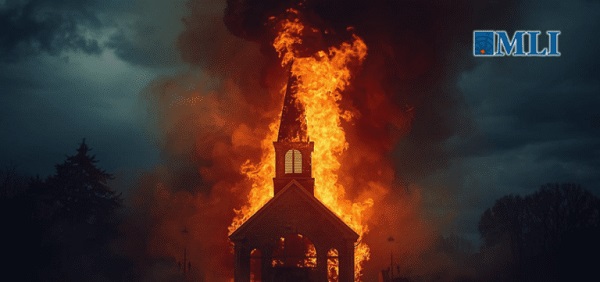
Church arsons surged again in 2024 according to new data released by Statistics Canada—continuing a disturbing trend first uncovered by a Macdonald-Laurier Institute investigation published last year.
Scorched Earth: A quantitative analysis of arson at Canadian religious institutions and its threat to reconciliation, which I published last April, warned that the arson wave – almost certainly spurred by ongoing anger over potential unmarked burials of children at residential schools –would not disappear without concerted government policy intervention.
Unfortunately, my prediction is proving accurate.
Newly available custom data from Statistics Canada confirms that arsons in 2024 continued at nearly double the baseline level established from 2011–17.
This persistent elevation is particularly concerning given that arson is a dangerous crime with significant financial costs and, in the case of religious institutions, broader implications for Canadian society and political discourse. Most importantly for those committed to Indigenous reconciliation, the apparent lack of effective policy response risks undermining public support for reconciliation efforts—suggesting these crimes are not being treated with the seriousness they deserve, particularly because many targets are Catholic churches associated with residential school legacies.
Scorched Earth developed specific terms and a conceptual framework to analyze arsons at religious institutions. First, I refer to “potential unmarked burials” rather than other terminology, including “mass graves” – language suggesting verified remains and, potentially, the site of clandestine burials. Neither has been established. No remains have been verified at any of the 21 announced sites. The Tk’emlúps te Secwépemc First Nation revised its own characterization of the Kamloops, BC, announcements in May 2024 to “probable unmarked burial sites,” a significant shift from its initial May 2021 announcement of “remains of 215 children.” This precipitated announcement, together with some of the initial media coverage in Canada and elsewhere, likely contributed to the intensity of the arson response.
Second, the conceptual framework, updated with the latest Statistics Canada data, separates “baseline” from “excess” arson associated with specific shocks, such as the announcements. It shows that arsons at religious institutions have remained elevated since the initial spike in 2021. Based on careful geographic statistical analysis presented in Scorched Earth, I demonstrated that the most likely explanation for elevated arsons was a criminal response prompted by the 17 announcements of potential unmarked burials at former residential schools, beginning in Kamloops, B.C., in May 2021. Four additional announcements occurred in 2024, bringing the total to 21. While data through 2023 showed no detectable increase in arsons related to the Israel-Gaza conflict, analysis of 2024 data suggests this changed: arsons in response to that conflict now constitute a minority of the increase above baseline levels, with the majority remaining those related to announcements of potential unmarked burials.
Investigation and Prosecution Rates Remain Insufficient for Effective Deterrence
Statistics Canada’s newly released custom clearance data for arson at religious institutions provides the first comprehensive official view of law enforcement effectiveness in these cases, superseding the preliminary compilation included in Scorched Earth.
Crimes in Canada are considered “solved” when police identify a suspect with sufficient evidence to support charges. Cases are then classified as “cleared” through two mechanisms: laying charges (“cleared by charge”) or alternative processes such as diversion programs (“cleared otherwise”).
As Figure 2 illustrates, the cleared-by-charge rate for all arson averaged 13.1 per cent over the 2011–24 period. For religious institutions, the yearly average reached 14.4 per cent—marginally higher but still concerning. The clearance rate for religious institutions shows significant year-over-year variability, reflecting the smaller statistical base compared to all arsons. The “cleared otherwise” category adds an average of 4.7 per cent for both arson types.
While these low clearance rates align with those for other property crimes, the continuing elevated arson rate suggests they provide insufficient deterrence for either first-time or serial arsonists. Evidence from Scorched Earth indicates that sustained clearance rates in the mid-30 per cent range—achieved by the National Church Arson Task Force (NCATF) in the United States during the 1990s—effectively reduced church arsons targeting predominantly Black congregations in the American South.
While my statistical analysis indicates that announcements of potential unmarked burials likely motivated many incidents, this remains circumstantial evidence. Direct evidence would require confessions or explicit statements of rationale from arrested arsonists, or credible claims of responsibility from organized groups. Out of the 306 arsons at religious institutions over the 2021-24 period, 53 resulted in charges and 13 were cleared through alternative processes, totaling 64 cleared incidents—an overall clearance rate of 21 per cent.
A clearance rate at this level, while insufficient for effective deterrence, makes it unlikely that most arsons during this period resulted from organized political, ideological, or anti-religious campaigns. A coordinated campaign would likely be visible to investigators even at this clearance level. Since police identify suspects in far more cases than they prosecute, investigators develop a broader perspective on potential culprits than clearance rates alone suggest. Law enforcement officials have not provided any indication of such organized campaigns.
Federal and Provincial Funding Addresses Searches But Ignores Consequences
Neither federal nor provincial governments have introduced policy initiatives addressing elevated arson rates at religious institutions, despite substantial new funding for related matters.
Following the Kamloops announcement, the federal government launched the Residential Schools Missing Children Community Support program, providing $246 million to hundreds of communities, including for research and field investigations. Separately, British Columbia, Alberta, Ontario, and other provinces have committed hundreds of millions in additional dollars, including programs to address mental health effects from the search process and announcements.
This funding inventory highlights a significant policy gap: substantial resources address the cause—announcements of potential unmarked burials—while none target the effect: arsons at religious institutions.
Even viewed narrowly as a crime issue, recent government responses to other property crimes demonstrate available policy tools. When auto theft peaked in 2023, the federal government announced $121 million in federal support, convened a national summit with all levels of government and law enforcement, and released a National Action Plan by May 2024.
Policy Gaps and a Call to Action
The NCATF, created in response to arsons targeting Black churches in the 1990s United States, achieved clearance rates sufficient to reduce incidents. Canada possesses the same policy tools but has not deployed them for residential school-related arsons.
This is not a matter of capacity or institutional precedent. Recent government responses to other serious property crimes, such as auto theft, demonstrate that Canada can mobilize coordinated federal-provincial action when it chooses to. The apparent policy inaction since 2021 for residential school-related arsons must end.
Canada is not powerless to stop the arsonists. The policy recommendations set out in Scorched Earth continue to be valid:
- Create a national or regional integrated police/fire investigations unit focused specifically on arson at religious institutions. This integrated unit would investigate arsons at all religious institutions—Christian, Muslim, Jewish, and others.
- Improve Indigenous police and fire protection services, including to ensure full Indigenous participation in the integrated unit.
- Complete the long-running project of building and maintaining a comprehensive and timely national and on-reserve database of fire statistics.
Law enforcement officials must thoroughly investigate and prosecute the arsonists. The attacks threaten reconciliation and full Indigenous equality—and they must be condemned by all Canadians.
Economist Edgardo Sepulveda has more than 30 years of experience advising clients in more than forty countries. He has written for Jacobin magazine, TVO Today, and the Alberta Federation of Labour, and has been lead author of three peer-reviewed academic articles in the last five years. He received his BA (Hon) from the University of British Columbia and his MA from Queen’s University, both in Economics. He established Sepulveda Consulting Inc. in 2006.


By Stephen Nagy for Inside Policy
Beijing understands what many Canadians still resist: that our greatest national virtues, including our desire to be an “honest broker” on the world stage, have become our most exploitable weaknesses.
On December 1, 2018, RCMP officers arrested Huawei CFO Meng Wanzhou at Vancouver International Airport. As Canadians know well, within days, China seized two Canadians, Michael Kovrig and Michael Spavor, on fabricated espionage charges. For 1,019 days, they endured arbitrary detention while Canada faced an impossible choice of abandoning the rule-of-law or watching its citizens suffer in Chinese prisons.
This was hostage diplomacy. But more insidiously, it was also the opening move in a broader campaign against Canada, guided by the ancient Chinese proverb “借刀杀人” (Jiè dāo shā rén), or “Kill with a borrowed knife.” Beijing’s strategy, like the proverb, exploits others to do its bidding while remaining at arm’s length. In this case, it seeks to exploit Canadian vulnerabilities such as our resource-dependent economy, our multicultural identity, our loosely governed Arctic territories, and our naïve belief that we can balance relationships with all major powers – even when those powers are in direct conflict with one another.
With its “borrowed knife” campaign, Beijing understands what many Canadians still resist: that our greatest national virtues, including our desire to be an “honest broker” on the world stage, have become our most exploitable weaknesses.
The Weaponization of Canadian Niceness
Canadian foreign policy rests on the Pearsonian tradition. It is the belief that our lack of imperial history and (now irrelevant) middle-power status uniquely positions us as neutral mediators. We pride ourselves on sending peacekeepers, not warfighters. We build bridges through dialogue and compromise.
Beijing exploited this subjective, imagined identity. When Canada arrested Meng pursuant to our extradition treaty with the United States, Chinese state media framed it as Canada “choosing sides” and betraying its honest broker role. This narrative trapped Canadian political culture. Our mythology says we transcend conflicts through enlightened multilateralism. But the modern world increasingly demands choosing sides.
When former Prime Minister Jean Chrétien and former Ambassador John McCallum advocated releasing Meng to free the “Two Michaels,” they weren’t acting as Chinese agents. They were expressing a genuinely Canadian impulse that conflict resolves through compromise. Yet this “Canadian solution” was precisely what Beijing sought, abandoning legal principles under pressure.
China’s economic coercion has followed a similar logic. When Beijing blocked Canadian canola, pork, and beef exports – targeting worth $2.7 billion worth of Prairie agricultural products – the timing was transparently political. However, China maintained the fiction of “quality concerns,” making it extremely difficult for Canada to challenge the restrictions via the World Trade Organization. At the same time, Prairie farmers pressured Ottawa to accommodate Beijing.
The borrowed knife was Canadian democratic debate itself, turned against Canadian interests. Beijing didn’t need to directly change policy, it mobilized Canadian farmers, business lobbies, and opposition politicians to do it instead.
The Arctic: Where Mythology Meets Reality
No dimension better illustrates China’s strategy than the Arctic. Canada claims sovereignty over vast northern territories while fielding six icebreakers to Russia’s forty. We conduct summer sovereignty operations that leave territories ungoverned for nine months annually. Chinese state-owned enterprises invest in Arctic mining, Chinese research vessels map Canadian waters, and Beijing now calls itself a “near-Arctic state,” a term appearing nowhere in international law.
This campaign weaponizes the gap between Canadian mythology and capacity. When China proposes infrastructure investment, our reflex is “economic opportunity.” When Chinese researchers request Arctic access, our instinct is accommodation because we’re co-operative multilateralists. Each accommodation establishes precedent, each precedent normalizes Chinese presence, and each normalized presence constrains future Canadian options.
Climate change accelerates these dynamics. As ice melts, the Northwest Passage becomes navigable. Canada insists these are internal waters. China maintains they’re international straits allowing passage. The scenario exposes Canada’s dilemma perfectly. Does Ottawa escalate against our second-largest trading partner over waters we cannot patrol, or accept Chinese transits as fait accompli? Either choice represents failure.
The Diaspora Dilemma
Canada’s multiculturalism represents perhaps our deepest national pride. The Chinese Communist Party has systematically weaponized this openness through United Front Work Department operations, an ostensibly independent community organization that provides genuine services while advancing Beijing’s agenda including: monitoring dissidents, mobilizing Chinese-Canadians for CCP-approved candidates, organizing counter-protests against Tibetan and Uyghur activists, and creating environments where criticism of Beijing risks community ostracism and threats to relatives in China.
The establishment of illegal Chinese police stations in Toronto and Vancouver represents this operation’s logical endpoint. These “overseas service centres” conducted intimidation operations, pressured targets to return to China, and maintained surveillance on diaspora communities.
Canada’s response illuminates our vulnerability. When investigations exposed how Chinese organized crime groups, operating with apparent CCP protection, laundered billions through Vancouver real estate while financing fentanyl trafficking, initial reactions accused investigators of anti-Chinese bias. When CSIS warned that MPs might be compromised, debate focused on whether the warning represented racial profiling rather than whether compromise occurred.
Beijing engineered this trap brilliantly. Legitimate criticism of CCP operations becomes conflated with anti-Chinese racism. Our commitment to multiculturalism gets inverted into paralysis when a foreign government exploits ethnic networks for political warfare. The borrowed knife is Canadian anti-racism, wielded against Canadian sovereignty and this leaves nearly two million Chinese-Canadians under a cloud of suspicion while actual operations continue with limited interference.

What Resistance Requires
Resisting comprehensive pressure demands abandoning comfortable myths and making hard choices.
First, recognize that 21st-century middle-power independence is increasingly fictional. The global order is re-polarizing. Canada cannot maintain equidistant relationships with Washington and Beijing during strategic competition. We can trade with China, but not pretend shared rhetoric outweighs fundamental disagreements about sovereignty and human rights. The Pearsonian honest-broker role is obsolete when major powers want you to choose sides.
Second, invest in sovereignty capacity, not just claims. Sovereignty is exercised or forfeited. This requires sustained investment in military forces, intelligence services, law enforcement, and Arctic infrastructure. It means higher defence spending, more robust counterintelligence, and stricter foreign investment screening, traditionally un-Canadian approaches, which is precisely why we need them.
Third, build coalitions with countries facing similar pressures. Australia, Japan, South Korea, Lithuania, and others have faced comparable campaigns. When China simultaneously blocks Canadian canola, Australian wine, and Lithuanian dairy, that’s not separate trade disputes but a pattern requiring coordinated democratic response. The borrowed knife only works when we’re isolated.
Fourth, Ottawa must do much more to protect diaspora communities while confronting foreign operations. Effective policy must shut down United Front operations and illegal police stations while ensuring actions don’t stigmatize communities. Success requires clear communication that we’re targeting a foreign government’s operations, not an ethnic community.
Finally, we must accept the necessity of selective economic diversification. Critical infrastructure, sensitive technologies, and strategic resources cannot be integrated with an authoritarian state weaponizing interdependence. This means higher costs and reduced export opportunities – but maximum efficiency sometimes conflicts with strategic resilience. Canada can achieve this objective with a synergistic relationship with the US and other allies and partners that understand the tangential link between economic security and national security.
Conclusion
Canada’s myths, that we transcend conflicts, that multiculturalism creates only strength, that resource wealth brings pure prosperity and positivity, coupled with our deep vein of light-but-arrogant anti-Americanism, have become exploitable weaknesses. Beijing systematically tested each myth and used the gap between self-conception and reality as leverage.
The borrowed knife strategy works because we keep handing over the knife. Our openness becomes the vector for interference. Our trade dependence becomes the lever for coercion. Our niceness prevents us from recognizing we’re under attack.
Resistance doesn’t require abandoning Canadian values. It requires understanding that defending them demands costs we’ve historically refused to pay. The Chinese “Middle Kingdom” that tells the world it has had 5,000 years of peaceful history has entered a world that doesn’t reward peaceability, it exploits it. The question is whether we’ll recognize the borrowed knife for what it is and put it down before we bleed out from self-inflicted wounds.
Stephen R. Nagy is a professor of politics and international studies at the International Christian University in Tokyo and a senior fellow and China Project lead at the Macdonald-Laurier Institute (MLI). The title for his forthcoming monograph is “Japan as a Middle Power State: Navigating Ideological and Systemic Divides.”


Terror in Australia: 12 killed after gunmen open fire on Hanukkah celebration

Death by a thousand clicks – government censorship of Canada’s internet

Hero bystander disarms shooter in Australian terror attack
Inflation Reduction Act, Green New Deal Causing America’s Energy Crisis
-
 Health18 hours ago
Saskatchewan woman approved for euthanasia urged to seek medical help in Canada rather than US
-
Indigenous17 hours ago
Residential school burials controversy continues to fuel wave of church arsons, new data suggests
-
 Health22 hours ago
Canadian gov’t considers sharing census data on gender-confused children
-
 International17 hours ago
FBI didn’t think it had cause to raid Trump but DOJ did it anyway
-
 Crime2 days ago
Trump designates fentanyl a ‘weapon of mass destruction’
-
 Business1 day ago
COP30 finally admits what resource workers already knew: prosperity and lower emissions must go hand in hand
-
 Digital ID2 days ago
Canada releases new digital ID app for personal documents despite privacy concerns
-
 Bruce Dowbiggin2 days ago
NFL Ice Bowls Turn Down The Thermostat on Climate Change Hysteria