
Energy
LNG NOW! Canada must act fast to prosper in changing times

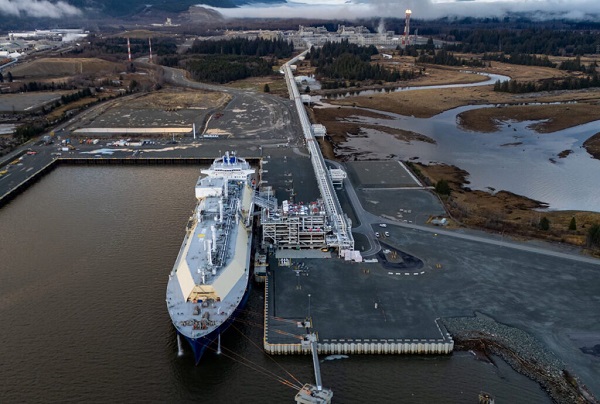

WUDONG, a liquefied natural gas (LNG) tanker, fills up at an LNG Canada facility, in an aerial view, in Kitimat, B.C., on Thursday, November 13, 2025. THE CANADIAN PRESS/Ethan Cairns
From Energy Now
By Nelson Bennett of Resource Works
Now that two major LNG proposals in B.C. have the full backing of the federal government, the final hurdle to final investment decisions is an economic one.
Can the owners of LNG Canada and Ksi Lisims LNG lock up enough bankable long-term contracts to justify billions in capital spending at a time when a wave of new LNG supplies threaten to create a global glut?
Several new global energy forecasts warn that, while the demand for natural gas and LNG is strong and now expected to continue growing into the 2040s, a wave of new LNG supply coming online, mostly from the U.S., could create a glut and drive LNG prices down.
That could pose challenges for new entrants and higher cost producers, and lends urgency to getting projects sanctioned in time to meet demand windows.
Both the Ksi Lisims LNG and a phase 2 expansion of LNG Canada have all the required environmental certificates in hand, and the full backing of the federal and provincial governments and key First Nations like the Haisla and Nisga’a.
One of them – Ksi Lisims – still needs to build a pipeline, while LNG Canada already has a pipeline: Coastal GasLink.
Both LNG Canada phase 2 and Ksi Lisims LNG have been listed on the federal government’s Major Projects list.
Also on that list is the North Coast Transmission Line — a key component of B.C.’s LNG and climate strategies, since it is needed to electrify new LNG projects.
All that is needed now are capital investment commitments of $40 billion or more.
The capital cost of the Ksi Lisims LNG project and associated Prince Rupert Gas Transmission line has been ballparked at $22 billion, but the Major Projects Office says Ksi Lisims would attract “nearly $30 billion in investment,” while LNG Canada Phase 2 would represent $33 billion.”
Given that LNG Canada Phase 1 plant in Kitimat was estimated to cost around $18 billion, the Major Projects Office is clearly including other associated investments in its figures, such as the North Coast Transmission Line, estimated at $6 billion.
Timing of the projects is critical, if they are to get into production before a potential global LNG surplus challenges their economic viability.
Outlooks project LNG overhang, lower prices
The 2025 outlooks from International Energy Agency (IEA), Oxford Institute of Energy Studies and BP all point to large amounts of new LNG supplies coming onto the world market, mostly from the U.S., which could depress prices and pose a challenge to the economics of the next wave of LNG projects.
While the just-released IEA 2025 World Energy Outlook is more bullish on oil and gas demand than it was just one year ago, and considerably more so than 2021, when it said no new major oil and gas investments would be needed, it warns of a potential looming glut of LNG coming onto global markets.
“Natural gas demand has been revised up in this year’s WEO, but questions still linger about where all the new LNG will go,” the IEA states in an outlook summary.
Get the Latest Canadian Focused Energy News Delivered to You! It’s FREE: Quick Sign-Up Here
The IEA’s forecasts should, perhaps, be taken with a grain of salt. In recent years, it has over-estimated the momentum of the energy transition and under-estimated the stickiness of fossil fuels.
Javier Blas, energy and commodities writer for Bloomberg, recently noted this, in response to the IEA’s latest outlook.
“Just two years ago, the International Energy Agency unequivocally said that fossil-fuel demand would peak before the end of this decade,” he writes.
“But it was premature, in part because it didn’t anticipate an obvious flaw: governments backpedaling on their clean-energy commitments.
“The flip-flopping has damaged the agency’s reputation, perhaps irreparably.”

Earlier this year, Daniel Yergin, vice chairman of S&P Global, co-authored a report for Foreign Affairs that also questioned the IEA’s over-estimation of the energy transition’s impacts on demand for oil and gas.
Yergin and his co-authors point out that energy demand in all its forms continues to grow, including for fossil fuels.
“As energy use grows, ‘carbonization’ will precede ‘decarbonization,’” they write. “Natural gas is a readily available option, and it’s a better alternative to coal…
“Although global oil demand seems slated to plateau in the early 2030s, natural gas consumption is expected to continue to increase well into the 2040s.”
The IEA’s forecasts vary depending on the scenarios used, such as net-zero targets being met by 2050.
It is worth noting that China and India – key markets for Canadian LNG – have net zero targets that are 10 and 20 years further out than the rest of the world: 2060 and 2070 respectively.
Asia remains the key growth market for LNG
And natural gas could play an important role in meeting them through coal-to-gas fuel switching for power generation – something that could be accelerated through lower LNG prices.
In its 2025 outlook, Shell – the major partner in LNG Canada – forecasts a 60% increase in demand for LNG out to 2040.
“More investment is needed to ensure supply can keep up with demand,” the company states.
But that investment is already being made in the U.S. and Qatar, which are expected to account for 50% and 20% of new LNG supplies respectively, with Canada and “others” making up the rest, according to the IEA.
A recent report on natural gas by the Oxford Institute for Energy Studies (OIES) estimates global LNG prices could fall from a long-term average of US$8 per MMBtu to US$6 as a result of all the new LNG coming onto world markets.
That could challenge the economics for new entrants and higher cost producers.
The upside of lower LNG prices is the potential demand response – one with positive implications for decarbonization.
The OIES notes that lower LNG prices could accelerate a switch from coal to natural gas power in Asia, which would create new longer-term demand for LNG.
If LNG prices were to fall to US$6 per MMBTU, “gas could become seriously competitive with coal,” the OIES notes.
The longer term demand for and price of natural gas and LNG will be affected by the pace of competing low-carbon energy sources (renewables, nuclear power, etc.), carbon pricing and climate action policies.
“However, lower coal plant capacity, higher electricity demand, and the forecast lower gas prices of $6 per MMBTU will contribute to sustaining gas demand in the power generation sector in the coming years, even alongside the rapid growth of renewables,” OIES notes.
But if new LNG projects are to avoid entering markets when LNG prices are falling, they will need to make final investment decisions soon.
“We’ve already seen the recent buildout of U.S. and Canadian LNG export capacity put pressure on global LNG prices, which have been trading around $11/MMBtu this winter – roughly 16% lower year on year,” says Ross Wyeno, LNG short-term analysis lead for S&P Global. “We expect that the (current) slate of sanctioned projects will continue to put downward pressure on LNG prices through the end of the decade, which will make it increasingly difficult for any pre-FID project – including those in Canada – to make FID if they have not done so already.”
Fortunately, B.C. has two big competitive advantages, when it comes to competing in the LNG space. It has a super-abundance of liquids-rich natural gas in the Montney formation, and is a low-cost producer. It also has proximity to the one region where the demand for LNG is still expected to grow: Asia.
Get the Latest Canadian Focused Energy News Delivered to You! It’s FREE: Quick Sign-Up Here

From the Frontier Centre for Public Policy
By Ian Madsen
Canada’s growing LNG exports are opening global markets and reducing dependence on U.S. prices, if Ottawa allows the pipelines and export facilities needed to reach those markets
Canada’s LNG advantage is clear, but federal bottlenecks still risk turning a rare opening into another missed opportunity
Canada is finally in a position to profit from global LNG demand. But that opportunity will slip away unless Ottawa supports the pipelines and export capacity needed to reach those markets.
Most major LNG and pipeline projects still need federal impact assessments and approvals, which means Ottawa can delay or block them even when provincial and Indigenous governments are onside. Several major projects are already moving ahead, which makes Ottawa’s role even more important.
The Ksi Lisims floating liquefaction and export facility near Prince Rupert, British Columbia, along with the LNG Canada terminal at Kitimat, B.C., Cedar LNG and a likely expansion of LNG Canada, are all increasing Canada’s export capacity. For the first time, Canada will be able to sell natural gas to overseas buyers instead of relying solely on the U.S. market and its lower prices.
These projects give the northeast B.C. and northwest Alberta Montney region a long-needed outlet for its natural gas. Horizontal drilling and hydraulic fracturing made it possible to tap these reserves at scale. Until 2025, producers had no choice but to sell into the saturated U.S. market at whatever price American buyers offered. Gaining access to world markets marks one of the most significant changes for an industry long tied to U.S. pricing.
According to an International Gas Union report, “Global liquefied natural gas (LNG) trade grew by 2.4 per cent in 2024 to 411.24 million tonnes, connecting 22 exporting markets with 48 importing markets.” LNG still represents a small share of global natural gas production, but it opens the door to buyers willing to pay more than U.S. markets.
LNG Canada is expected to export a meaningful share of Canada’s natural gas when fully operational. Statistics Canada reports that Canada already contributes to global LNG exports, and that contribution is poised to rise as new facilities come online.
Higher returns have encouraged more development in the Montney region, which produces more than half of Canada’s natural gas. A growing share now goes directly to LNG Canada.
Canadian LNG projects have lower estimated break-even costs than several U.S. or Mexican facilities. That gives Canada a cost advantage in Asia, where LNG demand continues to grow.
Asian LNG prices are higher because major buyers such as Japan and South Korea lack domestic natural gas and rely heavily on imports tied to global price benchmarks. In June 2025, LNG in East Asia sold well above Canadian break-even levels. This price difference, combined with Canada’s competitive costs, gives exporters strong margins compared with sales into North American markets.
The International Energy Agency expects global LNG exports to rise significantly by 2030 as Europe replaces Russian pipeline gas and Asian economies increase their LNG use. Canada is entering the global market at the right time, which strengthens the case for expanding LNG capacity.
As Canadian and U.S. LNG exports grow, North American supply will tighten and local prices will rise. Higher domestic prices will raise revenues and shrink the discount that drains billions from Canada’s economy.
Canada loses more than $20 billion a year because of an estimated $20-per-barrel discount on oil and about $2 per gigajoule on natural gas, according to the Frontier Centre for Public Policy’s energy discount tracker. Those losses appear directly in public budgets. Higher natural gas revenues help fund provincial services, health care, infrastructure and Indigenous revenue-sharing agreements that rely on resource income.
Canada is already seeing early gains from selling more natural gas into global markets. Government support for more pipelines and LNG export capacity would build on those gains and lift GDP and incomes. Ottawa’s job is straightforward. Let the industry reach the markets willing to pay.
Ian Madsen is a senior policy analyst at the Frontier Centre for Public Policy.

““He knows nothing; and he thinks he knows everything. That points clearly to a political career.” George Bernard Shaw
In the days immediately following Donald Trump’s rude intervention into the 2025 Canadian federal election— suggesting Canada might best choose American statehood— two schools of thought emerged.
The first and most impactful school in the short term was the fainting-goat response of Canadian’s elites. Sensing an opening in which to erode Pierre Poilievre’s massive lead in the 2024 polls over Justin Trudeau, the Laurentian elite concocted Elbows Up, a self-pity response long on hurt feelings and short on addressing the issues Trump had cited in his trashing of the Canadian nation state.
In short order they fired Trudeau into oblivion, imported career banker Mark Carney as their new leader in a sham convention and convinced Canada’s Boomers that Trump had the tanks ready to go into Saskatchewan at a moment’s notice. The Elbows Up meme— citing Gordie Howe— clinched the group pout.

(In fact, Trump has said that America is the world’s greatest market, and if those who’ve used it for free in the past [Canada] want to keep special access they need to pay tariffs to the U.S. or drop protectionist charges on dairy and more against the U.S.)
The ruse worked out better than they could have ever imagined with Trump even saying he preferred to negotiate with Carney over Poilievre. In short order the Tories were shoved aside, the NDP kneecapped and the pet media anointed Carney the genius skewing Canada away from its largest trade partner to the Eurosphere. We remain in that bubble, although the fulsome promises of Carney’s first days are now coming due.
Which brings us to the second reaction. That was Alberta premier Danielle Smith bolting to Mar A Lago in the days following Trump’s comments. Her goal was to put pride aside and accept that a new world order was in play for Canada. She met with U.S. officials and, briefly, with Trump to remind them that Canada’s energy industry was integral to American prosperity and Canadian stability.
Needless to say, the fainting goats pitched a fit that not everyone was clutching pearls and rending garments in the wake of Trump’s dismissive assessment of his northern neighbours. Their solution to Trump was to join China in retaliatory tariffs— the only two nations to do so— and to boycott American products and travel. Like the ascetic monks they cut themselves off from real life. Trump has yet to get back to Carney the Magnificent

And Smith? She was a “traitor” or a “subversive” who should be keel hauled in the North Saskatchewan. For much of the intervening months she has been attacked at home in Alberta by the N-Deeps and in Ottawa by just about everyone on CBC, CTV, Global and the Globe & Mail. “How could she meet with the Cheeto?”
Nonetheless conservatives in the province moved toward a more independence within Canada. Smith articulated her demands for Alberta to prevent a referendum on whether to remain within Confederation. At the top of her list were pipelines and access to tidewater. Ergo, a no-go for BC’s squish premier David Eby who is the process of handing over his province to First Nations.
It became obvious that for all of Carney’s alleged diplomacy in Europe and Asia (is the man ever home?) he had a brewing disaster in the West with Alberta and Saskatchewan growing restless. In a striking move against the status quo, Nutrien announced it would ship its potash to tidewater via the U.S., thereby bypassing Vancouver’s strike-prone, outdated port and denying them billions.

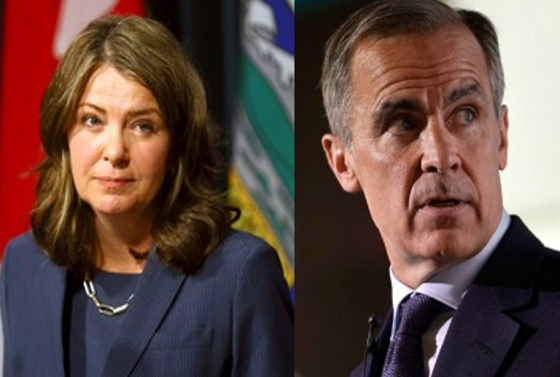
Suddenly, Smith’s business approach began making eminent good sense if the goal is to keep Canada as one. So we saw last week’s “memorandum of understanding” between Alberta and Ottawa trading off carbon capture and carbon taxes for potential pipelines to tidewater on the B.C. coast. A little bit of something for everyone and a surrender on other things.
The most amazing feature of the Mark Carney/Danielle Smith MOU is that both politicians probably need the deal to fail. Carney can tell fossil-fuel enemy Quebec that he tried to reason with Smith, and Smith can say she tried to meet the federalists halfway. Failure suits their larger purposes. Which is for Carney to fold Canada into Euro climate insanity and Smith into a strong leverage against the pro-Canada petitioners in her province.
Soon enough, at the AFN Special Chiefs Assembly, FN Chief Cindy Woodhouse Nepinak told Carney that “Turtle Island” (the FN term for North America popularized by white hippy poet Gary Snyder) belongs to the FN people “from coast to coast to coast.” The pusillanimous Eby quickly piped up about tanker bans and the sanctity of B.C. waters etc.
Others pointed out the massive flaw in a plan to attract private interests to build a vital bitumen pipeline if the tankers it fills are not allowed to sail through the Dixon Entrance to get to Asia.
But then Eby got Nutrien’s message that his power-sharing with the indigenous might cause other provinces to bypass B.C. (imagine California telling Texas it can’t ship through its ports over moral objections to a product). He’s now saying he’s open to pipelines but not to lift the tanker ban along the coast. Whatever.
Meanwhile the kookaburras of isolation back east continue with virtue signalling on American booze— N.S. to sell off its remains stocks — while dreaming that Trump’s departure will lead to the good-old days of reliance on America’s generosity.
But Smith looks to be wining the race. B.C.’s population shrank 0.04 percent in the second quarter of 2025, the only jurisdiction in Canada to do so. Meanwhile, Alberta is heading toward five million people, with interprovincial migrants making up 21 percent of its growth.
But what did you expect from the Carney/ Eby Tantrum Tandem? They keep selling fear in place of GDP. As GBS observed, “You have learnt something. That always feels at first as if you have lost something.”
Bruce Dowbiggin @dowbboy is the editor of Not The Public Broadcaster A two-time winner of the Gemini Award as Canada’s top television sports broadcaster, his new book Deal With It: The Trades That Stunned The NHL And Changed hockey is now available on Amazon. Inexact Science: The Six Most Compelling Draft Years In NHL History, his previous book with his son Evan, was voted the seventh-best professional hockey book of all time by bookauthority.org . His 2004 book Money Players was voted sixth best on the same list, and is available via brucedowbigginbooks.ca.


Media bound to pay the price for selling their freedom to (selectively) offend

Sometimes An Ingrate Nation Pt. 2: The Great One Makes His Choice

Recent price declines don’t solve Toronto’s housing affordability crisis

From Exception to Routine. Why Canada’s State-Assisted Suicide Regime Demands a Human-Rights Review
-
 Business2 days ago
Carney government should privatize airports—then open airline industry to competition
-
Bruce Dowbiggin17 hours ago
Integration Or Indignation: Whose Strategy Worked Best Against Trump?
-
 Energy2 days ago
Canada following Europe’s stumble by ignoring energy reality
-
 COVID-1918 hours ago
University of Colorado will pay $10 million to staff, students for trying to force them to take COVID shots
-
 Banks2 days ago
To increase competition in Canadian banking, mandate and mindset of bank regulators must change
-
 Business2 days ago
Loblaws Owes Canadians Up to $500 Million in “Secret” Bread Cash
-
 Focal Points2 days ago
Common Vaccines Linked to 38-50% Increased Risk of Dementia and Alzheimer’s
-
 espionage1 day ago
Western Campuses Help Build China’s Digital Dragnet With U.S. Tax Funds, Study Warns