
Business
Todayville At The Home Show With Canadian Closet




From the Daily Caller News Foundation
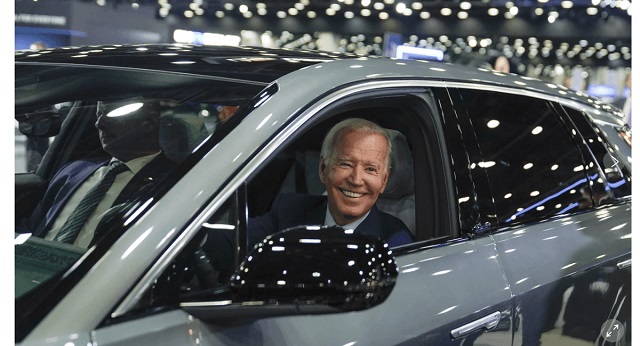
President Donald Trump dealt the dreams of former President Joe Biden for an all-electric fleet of American cars a fatal blow on Thursday by terminating the onerous Corporate Average Fuel Economy (CAFE) standards Biden invoked in 2022 and further tightened in 2024.
“We’re officially terminating Joe Biden’s ridiculously burdensome, horrible actually, CAFE standards, that imposed expensive restrictions… It puts tremendous pressure on upward car prices,” Trump said during a press conference held in the Oval Office Thursday afternoon.
The Biden standards, which cranked down on allowable tailpipe emissions and raised industry-wide average car mileage to a stratospheric 50.4 miles per gallon requirement by 2030, were the centerpiece of his strategy to force American consumers to buy electric vehicles by intentionally forcing up prices for traditional internal combustion models.
Dear Readers:
As a nonprofit, we are dependent on the generosity of our readers.
Please consider making a small donation of any amount here.
Thank you!
That’s right, America: Your government, led by Joe Biden’s autopen and the woke staffers who wielded it, intentionally and with malice aforethought drove up the prices of the gas powered cars you actually want to buy to try to force you to purchase electric models that poll after poll proves most of you don’t want. They did this all in the name of the global climate alarm religion, which far too many U.S. politicians use to justify a vast array of authoritarian actions.
The unbridled hubris involved in even entertaining this concept would have in the past been considered scandalous. Yet, today, it is completely in keeping with one of the central goals of the energy transition movement to drive up the costs of all traditional forms of energy to try to make the subsidized alternatives favored by the Democratic Party – wind, solar, and electric vehicles – competitive in the market. Activists in the climate alarm movement no longer even try to deny this goal – they proudly boast about it.
This was the real enterprise behind Biden’s ridiculous CAFE standards, and it is what President Trump interrupted on Thursday. It was just the latest in a series of body blows Trump and his officials have dealt the U.S. EV industry, one that could well prove fatal to many pure-play electric car companies and force major reallocations of capital budgets inside integrated automakers like Ford, GM, and Stellantis.

Naturally, the climate alarm activist community was outraged. “Trump’s action will feed America’s destructive use of oil, while hamstringing us in the green tech race against … foreign carmakers,” said Dan Becker, Director of the notorious far-left conflict group, the Center for Biological Diversity, according to the Guardian.
But here’s the thing: U.S. consumers don’t want to buy the alternative the climate alarm community and Biden administration were trying to force. Even with the attraction of Biden’s economically ruinous $7,500 per unit IRA subsidies, U.S. car buyers made clear their strong preference for big, full-size, gas-or-diesel-powered pickups and SUVs.
This reality is why Stellantis announced in September it was abandoning plans to introduce a full-size electric pickup to compete with Ford’s F-150 Lightning. Even worse for EV boosters, Ford has already cut back on production of the Lightning model, and is planning to eliminate it entirely soon, according to the Wall Street Journal. These decisions and plans were already underway long before Trump’s decision to rescind the CAFE standards, based on simple consumer demand.
Interestingly, many consumers believe Trump didn’t go far enough on Thursday, and that he should simply eliminate mileage requirements altogether. One commenter to my Substack newsletter writes, “why didn’t they just kill CAFE standards once and for all? From what clause in the Constitution does the federal government have the right to limit what type of car I can buy?…They should have just killed it outright.”
It’s a legitimate question: Why do federal regulators believe they have the right to control consumer behavior in the name of climate alarmism? In light of last year’s decision by the Supreme Court to rescind the Chevron deference – which helped facilitate the massive expansion of the federal bureaucracy for 40 long years – it’s a question that could be litigated in the months and years to come.
Joe Biden’s EV dreams are dead now, but that doesn’t mean the situation can’t possibly get even worse for the EV industry in America. Stay tuned.
David Blackmon is an energy writer and consultant based in Texas. He spent 40 years in the oil and gas business, where he specialized in public policy and communications.

From the Fraser Institute
By Gary Mauser
The government told Cape Bretoners they had two weeks to surrender their firearms to qualify for reimbursement or “buyback.” The pilot project netted a grand total of 22 firearms.
Five years after then-prime minister Justin Trudeau banned more than 100,000 types of so-called “assault-style firearms,” the federal government recently made the first attempt to force Canadians to surrender these firearms.
It didn’t go well.
The police chief in Cape Breton, Nova Scotia, volunteered to run a pilot “buyback” project, which began last month. The government told Cape Bretoners they had two weeks to surrender their firearms to qualify for reimbursement or “buyback.” The pilot project netted a grand total of 22 firearms.
This failure should surprise no one. Back in 2018, a survey of “stakeholders” warned the government that firearms owners wouldn’t support such a gun ban. According to Prime Minister Carney’s own Privy Council Office the “program faces a risk of non-compliance.” And federal Public Safety Minister Gary Anandasangaree was recently recorded admitting that the “buyback” is a partisan maneuver, and if it were up to him, he’d scrap it. What’s surprising is Ottawa’s persistence, particularly given the change in the government and the opportunity to discard ineffective policies.
So what’s really going on here?
One thing is for certain—this program is not, and never has been, about public safety. According to a report from the federal Department of Justice, almost all guns used in crimes in Canada, including in big cities such as Toronto, are possessed illegally by criminals, with many smuggled in from the United States. And according to Ontario’s solicitor general, more than 90 per cent of guns used in crimes in the province are illegally imported from the U.S. Obviously, the “buyback” program will have no effect on these guns possessed illegally by criminals.
Moreover, Canadian firearms owners are exceptionally law-abiding and less likely to commit murder than other Canadians. That also should not be surprising. To own a firearm in Canada, you must obtain a Possession and Acquisition Licence (PAL) from the RCMP after initial vetting and daily monitoring for possible criminal activity. Between 2000 and 2020, an average of 12 PAL-holders per year were accused of homicide, out of approximately two million PAL-holders. During that same 10-year period, the PAL-holder firearms homicide rate was 0.63 (per 100,000 PAL-holders) compared to 0.72 (per 100,000 adult Canadians)—that’s 14 per cent higher than the rate for PAL-holders.
In other words, neither the so-called “assault-style firearms” nor their owners pose a threat to the public.
And the government’s own actions belie its claims. If these firearms are such a threat to Canadians, why slow-roll the “buyback” program? If inaction increased the likelihood of criminality by law-abiding firearms owners, why wait five years before launching a pilot program in a small community such as Cape Breton? And why continue to extend the amnesty period for another year, which the government did last month at the same time its pilot project netted a mere 22 firearms?
To ask those questions is to answer them.
Another question—how much will the “buyback” program cost taxpayers?
The government continues to block any attempt to disclose the full financial costs (although the Canadian Taxpayers Federation has launched a lawsuit to try to force the government to honour its Access to Information Act request). But back in 2020 the Trudeau government said it would cost $200 million to compensate firearms owners (although the Parliamentary Budget Officer said compensation costs could reach $756 million). By 2024, the program had spent $67.2 million—remember, that’s before it collected a single gun. The government recently said the program’s administrative costs (safe storage, destruction of hundreds of thousands of firearms, etc.) would reach an estimated $1.8 billion. And according to Carney’s first budget released in November, his government will spend $364 million on the program this fiscal year—at a time of massive federal deficits and debt.
This is reminiscent of the Chretien government’s gun registry fiasco, which wound up costing more than $2 billion even after then-justice minister Allan Rock promised the registry program would “almost break even” after an $85 million initial cost. The Harper government finally scrapped the registry in 2012.
As the Carney government clings to the policies of its predecessor, Canadians should understand the true nature of Ottawa’s gun “buyback” program and its costs.

Gary Mauser
Professor Emeritus, Simon Fraser University


Media bound to pay the price for selling their freedom to (selectively) offend

Sometimes An Ingrate Nation Pt. 2: The Great One Makes His Choice

Recent price declines don’t solve Toronto’s housing affordability crisis

Tech Mogul Gives $6 Billion To 25 Million Kids To Boost Trump Investment Accounts
-
National24 hours ago
Media bound to pay the price for selling their freedom to (selectively) offend
-
Bruce Dowbiggin23 hours ago
Sometimes An Ingrate Nation Pt. 2: The Great One Makes His Choice
-
Business12 hours ago
Recent price declines don’t solve Toronto’s housing affordability crisis
-
Daily Caller13 hours ago
Tech Mogul Gives $6 Billion To 25 Million Kids To Boost Trump Investment Accounts
-
Business11 hours ago
Ottawa’s gun ‘buyback’ program will cost billions—and for no good reason
-
 Energy2 days ago
ELZABETH MAY HAS IT WRONG: An Alberta to Prince Rupert Oil Pipeline Will Contribute to Greater Global Oil Tanker Safety
-
 Energy14 hours ago
The Trickster Politics of the Tanker Ban are Hiding a Much Bigger Reckoning for B.C.
-
 COVID-192 days ago
Canadian legislator introduces bill to establish ‘Freedom Convoy Recognition Day’ as a holiday