
Alberta
Upgrades at Port of Churchill spark ambitions for nation-building Arctic exports


In August 2024, a shipment of zinc concentrate departed from the Port of Churchill — marking the port’s first export of critical minerals in over two decades. Photo courtesy Arctic Gateway Group
From the Canadian Energy Centre
By Will Gibson
‘Churchill presents huge opportunities when it comes to mining, agriculture and energy’
When flooding in northern Manitoba washed out the rail line connecting the Town of Churchill to the rest of the country in May 2017, it cast serious questions about the future of the community of 900 people on the shores of Hudson Bay.
Eight years later, the provincial and federal governments have invested in Churchill as a crucial nation-building corridor opportunity to get resources from the Prairies to markets in Europe, Africa and South America.
Direct links to ocean and rail

Aerial view of the Hudson Bay Railway that connects to the Port of Churchill. Photo courtesy Arctic Gateway Group
The Port of Churchill is unique in North America.
Built in the 1920s for summer shipments of grain, it’s the continent’s only deepwater seaport with direct access to the Arctic Ocean and a direct link to the continental rail network, through the Hudson Bay Railway.
The port has four berths and is capable of handling large vessels. Having spent the past seven years upgrading both the rail line and the port, its owners are ready to expand shipping.
“After investing a lot to improve infrastructure that was neglected for decades, we see the possibilities and opportunities for commodities to come through Churchill whether that is critical minerals, grain, potash or energy,” said Chris Avery, CEO of the Arctic Gateway Group (AGG), a partnership of 29 First Nations and 12 remote northern Manitoba communities that owns the port and rail line.
“We are pleased to be in the conversation for these nation-building projects.”
In May, Canada’s Western premiers called for the Prime Minister’s full support for the development of an economic corridor connecting ports on the northwest coast and Hudson’s Bay, ultimately reaching Grays Bay, Nunavut.
Investments in Port of Churchill upgrades

Workers at the Port of Churchill. Photo courtesy Arctic Gateway Group
AGG, which purchased the rail line and port from an American company in 2017, is not alone in the bullish view of Churchill’s future.
In February, Manitoba Premier Wab Kinew announced an investment of $36.4 million over two years in infrastructure projects at the port aimed at growing international trade.
“Churchill presents huge opportunities when it comes to mining, agriculture and energy,” Kinew said in a release.
“These new investments will build up Manitoba’s economic strength and open our province to new trading opportunities.”
In March, the federal government committed $175 million over five years to the project including $125 million to support the rail line and $50 million to develop the port.
“It’s important to point out that investing in Churchill was something that both the Liberal and Conservative parties agreed on during the federal election campaign,” said Avery, a British Columbian who worked in the airline industry for more than two decades before joining AGG.
Reduced travel time

Freight safety check at the Port of Churchill. Photo courtesy Arctic Gateway Group
The federal financial support helped AGG upgrade the rail line, repairing the 20 different locations where it was washed out by flooding in 2017.
Improvements included laying more than 1,600 rail cars worth of ballast rock for stabilization and drainage, installing almost 120,000 new railway ties and undertaking major bridge crossing rehabilitations and switch upgrades.
The result has seen travel time by rail reduced by three hours — or about 10 per cent — between The Pas and Churchill.
AGG also built a dedicated storage facility for critical minerals and other commodities at the port, the first new building in several decades.
Those improvements led to a milestone in August 2024, when a shipment of zinc concentrate was shipped from the port to Belgium. It was the first critical minerals shipment from Churchill in more than two decades.
The zinc concentrate was mined at Snow Lake, Manitoba, loaded on rail cars at The Pas and moved to Churchill. It’s a scenario Avery hopes to see repeated with other commodities from the Prairies.
Addressing Arctic challenges

The Port of Churchill. Photo courtesy Arctic Gateway Group
The emergence of new technologies has helped AGG work around the challenges of melting permafrost under the rail line and ice in Hudson Bay, he said.
Real-time ground-penetrating radar and LiDAR data from sensors attached to locomotives can identify potential problems, while regular drone flights scan the track, artificial intelligence mines the data for issues, and GPS provides exact locations for maintenance.
The group has worked with permafrost researchers from the University of Calgary, Université Laval and Royal Military College to better manage the challenge. “Some of these technologies, such as artificial intelligence and LiDAR, weren’t readily available five years ago, let alone two decades,” Avery said.
On the open water, AGG is working with researchers from the University of Manitoba to study sea ice and the change in sea lanes.
“Icebreakers would be a game-changer for our shipping operations and would allow year-round shipping in the short-term,” he said.
“Without icebreakers, the shipping season is currently about four and a half months of the year, from April to early November, but that is going to continue to increase in the coming decades.”
Interest from potential shippers, including energy producers, has grown since last year’s election in the United States, Avery said.
“We’re going to continue to work closely with all levels of government to get Canada’s products to markets around the world. That’s building our nation. That’s why we are excited for the future.”

From Melissa Lantsman
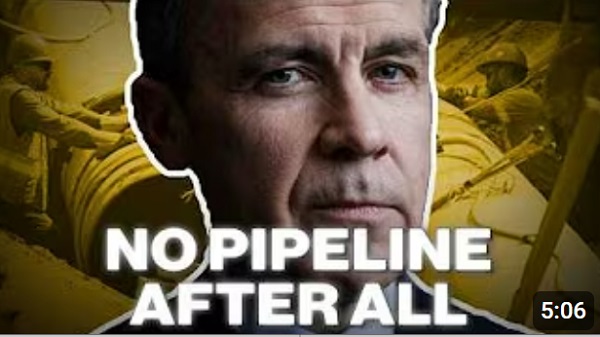
Turns out the anti-development wing of the Liberal Party never stopped running the show.
Today, we’ll see if the Liberals vote for the pipeline they just finished bragging about.
Spoiler: they won’t. Because with the Liberals, the announcements are real, but the results never are.
Alberta
Premier Smith: Canadians support agreement between Alberta and Ottawa and the major economic opportunities it could unlock for the benefit of all

From Energy Now
By Premier Danielle Smith
Get the Latest Canadian Focused Energy News Delivered to You! It’s FREE: Quick Sign-Up Here
If Canada wants to lead global energy security efforts, build out sovereign AI infrastructure, increase funding to social programs and national defence and expand trade to new markets, we must unleash the full potential of our vast natural resources and embrace our role as a global energy superpower.
The Alberta-Ottawa Energy agreement is the first step in accomplishing all of these critical objectives.
Recent polling shows that a majority of Canadians are supportive of this agreement and the major economic opportunities it could unlock for the benefit of all Canadians.
As a nation we must embrace two important realities: First, global demand for oil is increasing and second, Canada needs to generate more revenue to address its fiscal challenges.
Nations around the world — including Korea, Japan, India, Taiwan and China in Asia as well as various European nations — continue to ask for Canadian energy. We are perfectly positioned to meet those needs and lead global energy security efforts.
Our heavy oil is not only abundant, it’s responsibly developed, geopolitically stable and backed by decades of proven supply.
If we want to pay down our debt, increase funding to social programs and meet our NATO defence spending commitments, then we need to generate more revenue. And the best way to do so is to leverage our vast natural resources.
At today’s prices, Alberta’s proven oil and gas reserves represent trillions in value.
It’s not just a number; it’s a generational opportunity for Alberta and Canada to secure prosperity and invest in the future of our communities. But to unlock the full potential of this resource, we need the infrastructure to match our ambition.
There is one nation-building project that stands above all others in its ability to deliver economic benefits to Canada — a new bitumen pipeline to Asian markets.
The energy agreement signed on Nov. 27 includes a clear path to the construction of a one-million-plus barrel-per-day bitumen pipeline, with Indigenous co-ownership, that can ensure our province and country are no longer dependent on just one customer to buy our most valuable resource.
Indigenous co-ownership also provide millions in revenue to communities along the route of the project to the northwest coast, contributing toward long-lasting prosperity for their people.
The agreement also recognizes that we can increase oil and gas production while reducing our emissions.
The removal of the oil and gas emissions cap will allow our energy producers to grow and thrive again and the suspension of the federal net-zero power regulations in Alberta will open to doors to major AI data-centre investment.
It also means that Alberta will be a world leader in the development and implementation of emissions-reduction infrastructure — particularly in carbon capture utilization and storage.
The agreement will see Alberta work together with our federal partners and the Pathways companies to commence and complete the world’s largest carbon capture, utilization and storage infrastructure project.
This would make Alberta heavy oil the lowest intensity barrel on the market and displace millions of barrels of heavier-emitting fuels around the globe.
We’re sending a clear message to investors across the world: Alberta and Canada are leaders, not just in oil and gas, but in the innovation and technologies that are cutting per barrel emissions even as we ramp up production.
Where we are going — and where we intend to go with more frequency — is east, west, north and south, across oceans and around the globe. We have the energy other countries need, and will continue to need, for decades to come.
However, this agreement is just the first step in this journey. There is much hard work ahead of us. Trust must be built and earned in this partnership as we move through the next steps of this process.
But it’s very encouraging that Prime Minister Mark Carney has made it clear he is willing to work with Alberta’s government to accomplish our shared goal of making Canada an energy superpower.
That is something we have not seen from a Canadian prime minister in more than a decade.
Together, in good faith, Alberta and Ottawa have taken the first step towards making Canada a global energy superpower for benefit of all Canadians.
Danielle Smith is the Premier of Alberta


Trump Deals Biden’s EV Dreams A Death Blow

Canadian bishops condemn Liberal ‘hate speech’ proposal that could criminalize quoting Scripture

While Trump has southern border secure, hundreds of thousands of illegal immigrants still flooding in from Canada

Pharma Bombshell: President Trump Orders Complete Childhood Vaccine Schedule Review
-
 National21 hours ago
Liberal bill “targets Christians” by removing religious exemption in hate-speech law
-
 Business2 days ago
The EU Insists Its X Fine Isn’t About Censorship. Here’s Why It Is.
-
 Business2 days ago
Canada invests $34 million in Chinese drones now considered to be ‘high security risks’
-
 Economy2 days ago
Affordable housing out of reach everywhere in Canada
-
 Bruce Dowbiggin2 days ago
Wayne Gretzky’s Terrible, Awful Week.. And Soccer/ Football.
-
 Business18 hours ago
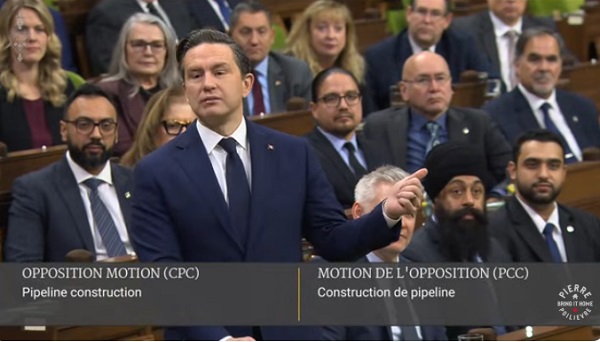
Looks like the Liberals don’t support their own Pipeline MOU
-
 Health2 days ago
CDC Vaccine Panel Votes to End Universal Hep B Vaccine for Newborns
-
 Business1 day ago
The Climate-Risk Industrial Complex and the Manufactured Insurance Crisis