
espionage
U.S. Experts Warn Canada Is Losing the Fight Against PRC Criminal Networks—Washington Has Run Out of Patience

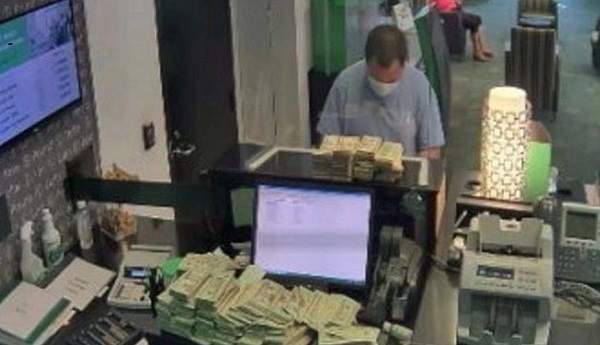
Video evidence of a cash delivery at a TD Bank branch in the DOJ case.

In Part 2 of The Bureau’s exclusive series, a senior U.S. government intelligence expert on Chinese threat networks offers a sobering warning: as U.S. authorities continue an aggressive clampdown on fentanyl supply routes at the southern border, Canada is fast becoming a replacement hub.
The expert says Canada’s lax financial controls and underpowered legal tools are attracting transnational criminal groups from both China and Mexico. Not only is Canada serving as a backdoor for fentanyl and money laundering—it is increasingly functioning as a production and redistribution proxy for Chinese triads and cartel-linked operations based in Toronto and Vancouver.
The second half of this explosive interview reveals the extent to which U.S. authorities believe Canadian financial institutions—specifically TD Bank—have become vulnerable to infiltration by Chinese drug syndicates.
“TD has some serious exposure—directly—from victims,” the expert said. “Think about the 500,000-plus Americans that died [from 2015 to 2024]. Yes, $9 million fine in Canada. But it’s not done.”
They added a simplistic focus on fentanyl as the only toxic commodity that U.S. national security is concerned with, misses the point.
Canadian cannabis, grown legally or under false licensing schemes, is now a major export commodity for these Chinese crime networks, the expert said. Black-market marijuana is flooding into New York and New Jersey, undercutting legitimate growers in both countries. But more alarmingly, marijuana trafficking is being integrated with fentanyl operations.
“They’re polydrug traffickers, and they’re transnational. The fentanyl cash, the marijuana, the ketamine—it’s all moving through the same networks.”
In one investigation, U.S. agents uncovered evidence that a Chinese student hired to move fentanyl proceeds was also selling cannabis and ketamine. In Vancouver, The Bureau reported, authorities found precursor chemicals and crystalline substances at Chinese mafia-run cannabis farms. The expert confirmed this is no coincidence.
“Absolutely. I’ve seen marijuana laced with all kinds of substances—including fentanyl.”
This hybrid Western Hemisphere trafficking model, U.S. experts contend, is now headquartered in Canadian cities. In the assessment of some analysts, Chinese-Canadian crime lords have eclipsed their Mexican-Chinese counterparts. Whatever the hierarchy—fluid, compartmentalized, and shaped by Chinese political dynamics—it remains of interest to Western intelligence. Figures such as Tse Chi Lop, Xizi Li, and Zhenli Ye Gon are not mere criminal outliers. They are billionaire architects of underground economies, maneuvering through illicit financial systems and Communist Party influence networks with the sophistication of multinational CEOs.
“Very easy for them to stash $200 or $300 million in one of their properties,” at any time, the senior U.S. expert confirmed.
The only difference between these financial masters and traditional corporate barons, is that toxically fatal synthetic drugs and weaving blood money into China’s global economic footprint is their main business line.
The second half of this interview begins with a crucial question for Canada’s financial system and governance: Are Canadian banks exposed directly to Chinese organized crime—and could U.S. government criminal investigations and civil actions reach into corporate and government realms in Canada?
The U.S. government expert makes the sensitive observation that in the TD Bank case, senior management appears to have turned a blind eye to branches staffed by, and serving, the Chinese community—branches that accepted massive deliveries of drug cash. The deliveries can be seen on video tapes from the DOJ’s case.
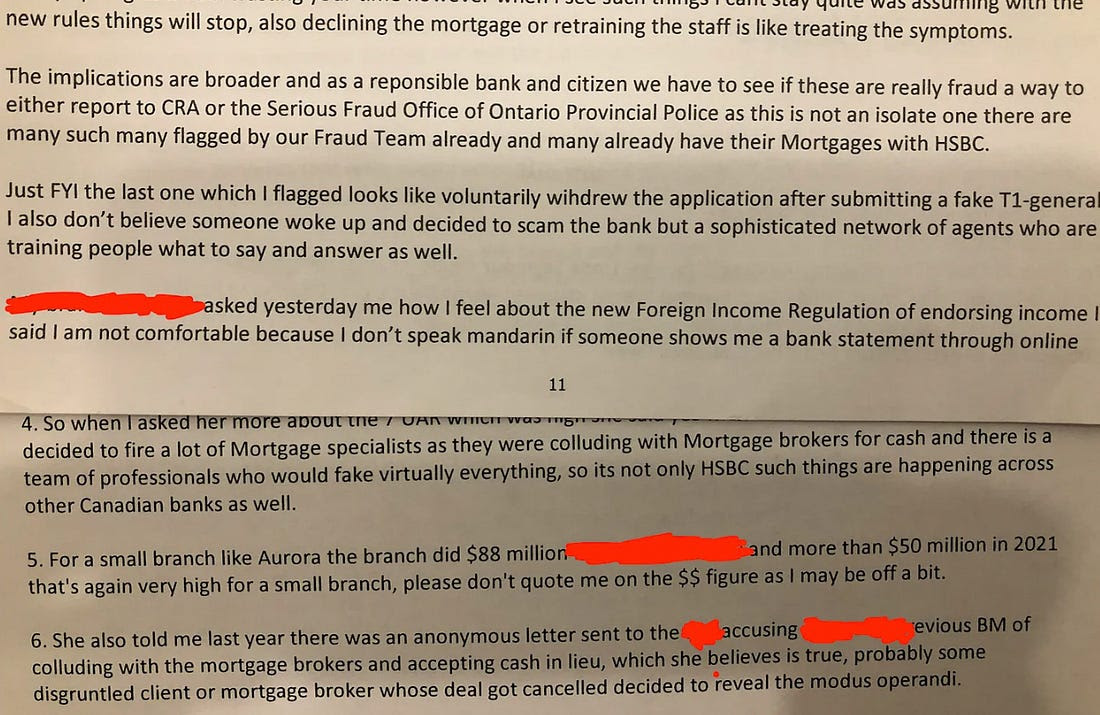
In The Bureau’s own investigation into a scheme involving massive, fraudulent Chinese income mortgage loans in Toronto, branch-level staff at HSBC serving the Chinese community were implicated. Offshore income verifications were signed off for earnings that were plainly absurd and easily disprovable: individuals living in Toronto during the COVID-19 pandemic claiming to earn over $300,000 in remote-work jobs purportedly based in China.
According to a whistleblower, the same community-level structure and lax compliance oversight at senior levels were clearly at play. Documents in this groundbreaking report support those claims—drawing striking parallels between the U.S. Department of Justice’s investigation into TD Bank and The Bureau’s own findings in Toronto diaspora community banking.
 |
Additionally, the U.S. senior expert spoke to the political and financial turmoil surrounding President Donald Trump’s global tariff regime, which appears to be tied to the growing risk of direct superpower conflict. The expert connected these events to U.S. government efforts to secure North America—and degrade China’s economic and warfighting capacity—through trade and financial network regulation and realignment.
“Listen, the world is not what it was 10 years ago,” they said.” You have wars in Ukraine. You’ve got Gaza-Israel. You have Taiwan. You have Iran. You’ve got Yemen. So you have a lot of instability. And the one thing we’re going to do as a nation is make sure that our borders are safe—especially in an unstable world. So I think that’s also part of the much broader geopolitical picture of what’s going on.”
To begin the second half of the interview, the U.S. expert offered this blunt observation:
“It’s an interesting take on TD. I remember that case vividly—bags of cash going straight into the bank. I mean, if you or I brought a bag of cash into a branch, what would happen to us? Right?”
This interview was edited lightly for length and clarity.
Sam Cooper: So let me ask you this—because I really want to dig into this. I broke the story about the bags of cash moving through casinos in British Columbia, and now I’m seeing some clear connectivity. Is that what made TD Bank an outlier?
Senior U.S. Expert: I think the highest-level actors we saw were Chinaloa and her husband, Xizi Li. In recent years, from a money laundering perspective, he was designated a CPO for the DEA—that’s a Consolidated Priority Organization Target. Basically, he reached the level of a top-tier target. He’s kingpin level. I mean, the guy owned casinos too.
Can I say I know they had many pickups that they orchestrated in New York? Absolutely. The issue is you’re in an Asian community, Chinese organized crime, and you’ve got access to millions of dollars in cash, and you need to get it into a system—culturally—if a Chinese national comes in with $100,000, most people in the community would say, “Oh, you saved that.” Whereas maybe if I went and did that, it would set off alarms everywhere, right?
Sam Cooper: It’s not happening.
Senior U.S. Expert: But if you’ve got a 21-year-old showing up with $3 million, $4 million, $5 million, $6 million—and you have multiple students now going to the same branch, dropping off millions of dollars—and you’re only issuing suspicious activity reports.
Because now, you’re doing the regulatory responsibility of “Let me cover my ass.”
The problem that we’ve seen is the accounts stay open. And the flow of money, without any kind of diligence on that, is tremendously problematic. And the money continues to flow. So the bank is doing great. I’m a branch. I’m bringing in 10X my closest bank branch. Now you’re getting kudos. That manager is being looked at as extremely successful.
So from my risk perspective, I look at it and say, “There’s something going on.” At what level are the protocols in place for that bank to be able to determine that risk? And is it just here—granular, right at the branch level? Is there a regional? Is there a national? Is there an international level? And I think that that was the wake-up call for TD. Now, let me say this to you: I don’t think it’s done with TD.
Sam Cooper: Well, that is something that frankly, really should be important to a lot of the political discussion and national conversation in Canada. It should be part of our current election discourse. Can you talk more about that?
Senior U.S. Expert: I think TD now—because of that indictment—think about the victims. Think about the 500,000-plus Americans that died. This is 2015 to 2024 of overdoses and poisonings. I think TD has some serious exposure—directly—from victims.
So what’s the next phase then? Civil litigation. Yes, $9 million fine in Canada, but it’s not done.
Sam Cooper: This raises what I wanted to ask you. In my mind—and I’m thinking I guess along the lines of natural principles of justice, I’m not a trained lawyer—why would they not go after the Canadian government?
Because I’ve read a massive FINTRAC report—one that’s particularly revealing when it comes to the Chinese actors involved, as well as the lawyers and law firms it touches on. I’ve seen wire transfers coming in from Hong Kong to a Chinese politically exposed individual in Toronto who is closely connected to Justin Trudeau at a high political level. The same people I’ve investigated in election interference networks—I’m now seeing them show up in FINTRAC.
And so in essence, this massive FINTRAC court disclosure provides visibility over the system that you are telling me about in the U.S. government TD Bank case on the student cash collectors.
It also brings in wire transfers from Hong Kong. Essentially, it says: “Here’s a group of students in Vancouver and Toronto, and here are electronic funds purportedly sent to cover tuition and housing costs.” But for some reason, these random students are being flagged for moving large sums into not just TD Bank, but most major Canadian banks.
From my read, FINTRAC clearly understands the entire scheme.
But my point here is: what’s the Canadian government done to stop it?
Senior U.S. Expert: Well, I mean, listen, you’ve heard my opinions on what needs to happen. So again, we are talking about hundreds of law enforcement entities that are also seizing drugs coming down from Canada. It is not only CBP at the border with Canada.
Now, listen, Sam, I think the issue with Canada and drug trafficking is a growing issue. I mean, it’s pretty clear if you seize dozens of laboratories since 2018 in Canada, laboratories to me are a strong indicator that the Mexican cartels and the U.S. drug flows are not meeting the demand in Canada.
So now the production is going to increase to meet that demand in Canada. So they’re way more susceptible to that problem that is continuing to grow.
Sam Cooper: Okay, I want to be clear and underline this because it is really contentious in Canada. I’m speaking to a senior U.S. expert that has said that for Canadians, whether they’re in media or government, to focus on 1% on CBP seizure—one, that doesn’t capture all the other reporting. Two, they’re not looking at the super labs, they’re not looking at Chinese Triad command and control in Toronto. They’re not looking at the banks. And they’re basically wrong?
Senior U.S. Expert: Sam, they’re wrong. The issue isn’t a lack of skill—there are tremendously capable investigators in the RCMP. The problem is they don’t have the legal tools to back them up.
For example, if I seize a drug lab, I’m required to immediately disclose the evidence. That exposes our tradecraft. Once the network knows it’s being investigated, we can’t pursue them effectively anymore.
So, in effect, the laws are protecting these criminal groups. That’s why they’re expanding—they’re not going away.
Sam Cooper: And that’s why they’re bigger in Canada.
Senior U.S. Expert: Exactly. And this is a critical point I want to make. As the U.S. tightens control over the southwest border and ramps up efforts against cartels in Mexico, what do you think happens in Canada? The demand from the U.S. doesn’t go away. So who becomes the supplier?
It won’t be the U.S.—we’ll shut down those labs, just like we did with the biker gangs in the ’80s and ’90s.
But Canada? Canada’s role will grow. That’s my prediction: as the southern border tightens and fewer drugs get through, drug production in Canada will increase.
Sam Cooper: That explains the super labs we’re seeing. It all adds up. So just to reiterate—Dr. David Asher, a senior U.S. expert, says the Stinchcombe disclosure rule is enabling Chinese triads and cartels to thrive in Canada. And as the U.S. cracks down, it’s only going to get worse north of the border. And you agree with Asher?
Senior U.S. Expert: That’s right.
Sam Cooper: Can you expand on this a bit more? You’ve said that the tri-state investigation—and parts of the TD Bank case—show that the U.S. government understands Chinese organized crime is operating across the border. They’re running pill presses in both countries. They’re laundering money from Canada. And Canadian cannabis—whether legally grown with licenses in Canada or not—is flowing into the U.S.
Senior U.S. Expert: That’s right. We call it black-market marijuana here. So even if it’s legal in a Canadian province or a U.S. state, once it crosses the border illegally, it’s black market. And it’s flooding the U.S. It’s undercutting legitimate cannabis businesses down here. We’re seeing criminal organizations making billions off Canadian black-market marijuana.
Sam Cooper: And you’d link that to the fentanyl networks too?
Senior U.S. Expert: Here’s how they’re connected, Sam. In an investigation into a fentanyl distribution ring in New York, we discovered that the traffickers—let’s say a Dominican distributor—would deliver cash proceeds to a Chinese student. But that same student was also selling marijuana and ketamine.
So we start seeing overlap: fentanyl cash, black-market marijuana, ketamine—it’s all flowing through the same networks. They’re polydrug traffickers, and they’re transnational. That’s the real challenge—these networks aren’t siloed. They’re integrated and global.
Sam Cooper: That connects to something I saw in Canada. In a bust involving high-level Chinese Communist Party–connected organized crime in Vancouver, they raided a grow-op and found chemical crystals—brown and other colors—in the workshop. That suggests to me they might be lacing the cannabis with serious chemicals.
So that brings together the medical pot licenses in Canada and the Chinese precursor networks in Vancouver. And raised concerns maybe about fentanyl. Have you seen anything like that?
Senior U.S. Expert: Absolutely. I’ve seen marijuana laced with all kinds of substances—including fentanyl. One big trend in certain U.S. states is cannabis laced with PCP.
Sam Cooper: Okay, let’s pivot back to the major players at the top in Canada and Mexico. Are you able to color in anything more about this Tse Chi Lap network in Toronto?
Senior U.S. Expert: What I know about him is—he was one of these guys that came across our radar early on, but more heavily Asia- and Canada-focused. He crossed into the U.S. He was one of the biggest guys in the world at the time.
And now that he kind of opened a door for a lot of this—in my opinion—he’s one of those guys that was a trailblazer in international crime in the Chinese community.
So that’s how I see him. I kind of see him—You remember Zhenli Ye Gon?
Sam Cooper: Yeah. The $200 million seized in his hacienda in Mexico City, right?
Senior U.S. Expert: $207 million—that was reported. Where was the other $300 million?
My point is that you’re talking about these high-level, high-stakes movers and shakers that are connected to the government of China, to organized crime, and to other international organized crime groups. The other thing is the portion of that money was in euros. So how is he getting euros in Mexico City? So it wasn’t like he was just making money in the United States. It was literally a global empire.
Sam Cooper: He’s international. So you put Tse Chi Lap from Toronto of Sam Gor in that type of placement?
Senior U.S. Expert: I’d say absolutely. He’s operating at that level. No question about it—if not higher.
Sam Cooper: And to put it in perspective—these are the type of people that in one of their mansions that are around the world, at any time you could find $200–300 million, just sitting around.
Senior U.S. Expert: Yes. Very easy. Or it’s invested in other areas. I think there was so much money with Zhenli Ye Gon, there was more money in the financial system that I think was never tracked.
Arguably there’s well over half a billion still out there. So that’s the sort of level that you’re operating on.
And now—quite frankly—things have changed from then to now. I think because there’s a lot more scrutiny, but at least in the U.S.—not the same in Canada.
I think Canada is behind the U.S. in their ability to go after these international criminal networks. And I think that as talented as many of their investigators are, I think there’s a plan for change. At least there’s a fundamental plan for change in law enforcement in Canada.
The issue is the law. I understand that there’s a balance between privacy and security. I completely respect that. But you’ve got to be able to save human lives.
Because the impact of a criminal group is not just the most obvious impact—someone dies. It’s the community. It’s the family. It’s the town. It’s the village. It’s the city.
It’s all the ramifications of the healthcare system, of the criminal justice system. All those things are now impacted by criminality and to the tunes of unimaginable amounts of money.
So as a country, it’s a balance. You have to have the tools and the ability to hold people accountable. It’s a very fundamental principle of human nature. Without it—it’s chaos.
Sam Cooper: I think you just very poetically nailed what I think—and what I believe that smart people with a lot of experience in the United States and Canada now feel. They know that Canada’s balance has gone off in that area. And that’s why some people up high in the U.S. government are looking at Canada.
Senior U.S. Expert: Yes. Because I think the balance has shifted in Canada in recent times. And that’s why you had a Trump administration very much focused on national security—and obviously the tariffs—but also, I think that all goes hand in hand. I don’t think it’s one versus the other. I think it’s all part of a much broader strategy.
That we have to safeguard our economies. We have to safeguard our citizens. And Canada has to do the same thing. Canada has to do the same thing—especially going forward.
Listen, the world is not what it was 10 years ago. You have wars in Ukraine. You’ve got obviously Gaza-Israel. You have growing threats from China surrounding Taiwan. You have Iran. You’ve got Yemen. So you have a lot of instability.
And the one thing we’re going to do as a nation is make sure that our borders are safe—especially in an unstable world. So I think that’s also part of the much broader geopolitical picture of what’s going on.
Sam Cooper: So that’s a good message for Canadians that are upset and worried—and frankly, they feel disrespected—about the tariffs. But you’re saying there’s a bigger global picture—smart people are trying to secure themselves.
Senior U.S. Expert: Of course. Look what’s going on across the world. Why do you see Vice President Vance going to Greenland? I mean, why would we go there? This is why we’re in Panama.
You have 17 People’s Republic of China ports in the Western Hemisphere. Look at the port down in Peru they built. That’s a military-size port that’s run by a Chinese governor.
So we have changing conditions, changing environment.
And so it calls for tight security. Certainly, as an American, we see Canadians as our closest allies. That’s not going to change. We’re so similar. We are.
But we’re in precarious times right now, Sam. And so that’s why I say all these things are interconnected. It’s not just one percent of fentanyl coming from Canada to the United States.
And for someone to look at one piece of data—you’re missing the point completely. Right? So that’s what I would end with on that.
The Bureau is a reader-supported publication.
To receive new posts and support my work, consider becoming a free or paid subscriber.
Subscribe to The Bureau.
For the full experience, please upgrade your subscription and support a public interest startup.
We break international stories and this requires elite expertise, time and legal costs.

From LifeSiteNews
Files from State Department officials as early as the 1970s show the US government helping the family of radical leftist financier George Soros secure deals and funding.
The U.S. State Department has been working with the Soros family for at least 50 years, Mike Benz demonstrated using diplomatic cables published to Wikileaks.
Benz, a former deputy assistant secretary at the U.S. State Department, explained in a video posted to X on Sunday that he searched for the terms “Soros” and “Open Society Foundation,” which was created by Soros, in Wikileaks’ collection of diplomatic cables. His goal was to “create a comprehensive tapestry of all U.S. state department involvement with Soros and the Open Society Foundation in every country in the world.”
The former state department official, now the executive director of the Foundation for Freedom Online, wanted to document why it was said that George Soros is treated by the U.S. like an “independent entity” akin to a country.
In a 1995 piece published by The New Yorker, former U.S. Ambassador to Turkey Morton Abramowitz said of Soros, “he’s the only man in the US who has his own foreign policy — and can implement it.”
Strobe Tallbott, former deputy secretary of state, also said of the far-left financier, “It’s like working with a friendly, allied, independent entity, if not a government. We try to synchronize our approach to the former Communist countries with Germany, France, Great Britain — and with George Soros.” This he “added with a grin,” wrote Connie Bruck.
Benz reviewed key cables from State Department officials as far back as the 1970s demonstrating the U.S. government’s involvement with the Soros family in what appeared to be a quid pro quo relationship.
In one 1976 cable from former U.S. Secretary of State Henry Kissinger, it was shown that the Brown & Root (now Halliburton), a CIA-linked company known for work on military installations and off-shore drilling platforms, wanted to “go all out” for the construction of a port in Santa Clara, Gabon, a country on the west coast of Africa.
It is noteworthy that Brown & Root’s co-founder Herman Brown was granted a covert security clearance for work with the CIA in 1953 “for use as a covert associate.” As of the 2000s, the company was one of George Soros’ top five holdings, Benz showed.
Referencing Brown & Root’s Manager of International Sales, Kissinger wrote, “O’Sullivan has just come from detailed discussions with Soros Associates to develop background for on-site estimates of construction timetable and costs … to be used in forthcoming talks with Gabon officials.”
Soros Associates, Benz explained, was run by George Soros’ older brother Paul Soros, now deceased.
The cable, addressed to the U.S. Embassy in Gabon, seemed to pressure assistance for the construction of this port, noting that while the request for help with it came at a “difficult time,” “strong interest” in the project and other reasons “preclud[ed] deferral.”
Another series of messages show that the U.S. Department helped the Soros family to secure a contract for the port in Gabon.
According to one cable, the director of the Santa Clara port, named as “Damas,” “said that meetings had been held within the Government of Gabon and were continuing which should lead shortly to the elimination of all but a few offers and that Soros was in a very good position.”
Benz remarked, “Here is the head of the State Department in Gabon backchanneling with the head of the port to make sure that Paul Soros won the bid. Eliminate all of the opposition.”
Another message read, “It appears Soros Associates virtually certain to get engineering contract for Port.”
“Not only is the US State Department negotiating Soros’ deals, helping him secure the deals. They’re also backchanneling so that foreign governments can pay [S]oros so that Soros makes his appropriate profit on the deal,” remarked Benz.
“There is this favors-for-favors relationship that goes back five decades, And those are just the earliest cables we have,” he added.
The exposure of these cables has been described as an “ultra massive find” by journalist Alex Jones.
The find is massive because George Soros himself, as was admitted by Morton Abramowitz and Strobe Tallbott, has foreign policy interests independent of the U.S. and over the past decades has demonstrated influence on U.S. domestic policy in favor of an impotent justice system, internet censorship, and a wide range of left-wing causes such as abortion, euthanasia, and population control, as well as homosexual “marriage,” and transgenderism. In other words, as some commentators have put it, his impact has been to erode the moral fabric of America and weaken the country.

President Trump moved Wednesday to end years of secrecy surrounding one of the nation’s most notorious scandals, signing legislation that compels the Department of Justice to hand Congress virtually every scrap of material tied to Jeffrey Epstein. The president announced the move on Truth Social, writing, “I HAVE JUST SIGNED THE BILL TO RELEASE THE EPSTEIN FILES!”
Trump reminded supporters that he personally pressed House Speaker Mike Johnson and Senate Majority Leader John Thune to fast-track the legislation. “Because of this request, the votes were almost unanimous in favor of passage,” he wrote, pointing to the rare level of bipartisan agreement behind a bill that forces unprecedented transparency. The Epstein Files Transparency Act requires the DOJ to deliver all unclassified records — and as much classified material as possible — to Congress within 30 days. It also directs Attorney General Pam Bondi to provide lawmakers with a list of government officials and other “politically exposed persons” tied to Epstein within just 15 days.
The measure sailed through the House in a staggering 427–1 vote Tuesday before clearing the Senate unanimously. Its path to passage wasn’t always straightforward. For months, the Trump administration had sparred with lawmakers pushing for the release, with the president often calling the frenzy around “Epstein files” a Democrat-driven hoax designed to smear him.
In his Truth Social post, Trump leaned into the history, reminding Americans that Epstein “was charged by the Trump Justice Department in 2019 (Not the Democrats!)” and that the disgraced financier “was a lifelong Democrat” who poured money into Democrat campaigns. The president also pointed to Epstein’s well-documented relationships with high-profile Democrats, listing figures such as Bill Clinton — “who traveled on his plane 26 times” — former Treasury Secretary Larry Summers, activist billionaire Reid Hoffman, House Minority Leader Hakeem Jeffries, and Delegate Stacey Plaskett. “Perhaps the truth about these Democrats, and their associations with Jeffrey Epstein, will soon be revealed,” Trump wrote.
He added that the DOJ, under his direction, has already provided Congress nearly 50,000 pages of Epstein-related material — a stark contrast, he said, to the Biden administration, which “did not turn over a SINGLE file or page related to Democrat Epstein, nor did they ever even speak about him.”
For Trump, the transparency push is as much about exposing what Democrats don’t want voters to see as it is about delivering documents. He argued that the left had leaned on “the ‘Epstein’ issue” to distract from the “AMAZING Victories” of his administration. Now, with the bill signed and agencies under a firm deadline, he predicted the political tables are about to turn.
“This latest Hoax will backfire on the Democrats just as all of the rest have!” he wrote — a warning, and a promise, as Washington braces for whatever the next 30 days will reveal.


From Underdog to Top Broodmare
Will the New West Coast Pipeline MoU Lead to Results? Almost Certainly Not According to AI

Poilievre says West Coast Pipeline MOU is no guarantee
Carney forces Alberta to pay a steep price for the West Coast Pipeline MOU
-
 Energy1 day ago
Canadians will soon be versed in massive West Coast LPG mega-project
-
 Alberta2 days ago
Keynote address of Premier Danielle Smith at 2025 UCP AGM
-
 Daily Caller1 day ago
Tom Homan Predicts Deportation Of Most Third World Migrants Over Risks From Screening Docs
-
 COVID-192 days ago
The dangers of mRNA vaccines explained by Dr. John Campbell
-
 C2C Journal23 hours ago
Learning the Truth about “Children’s Graves” and Residential Schools is More Important than Ever
-
 National1 day ago
Media bound to pay the price for selling their freedom to (selectively) offend
-
 Alberta24 hours ago
New era of police accountability
-
 Artificial Intelligence2 days ago
‘Trouble in Toyland’ report sounds alarm on AI toys