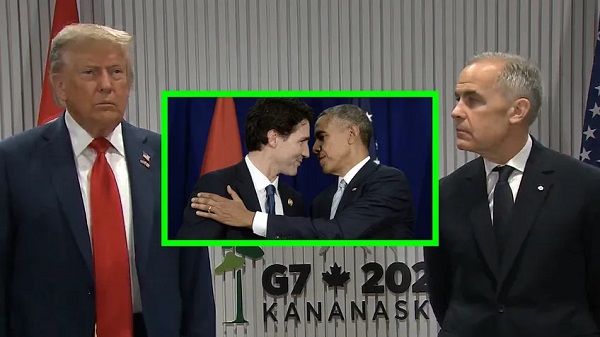
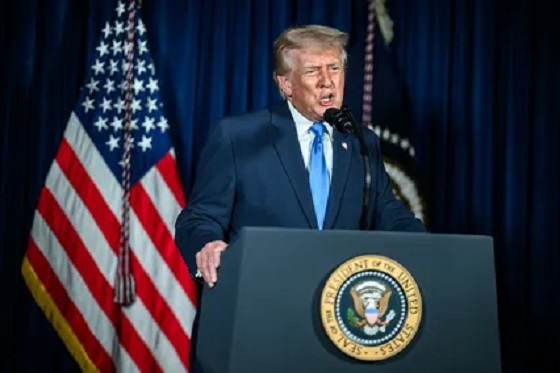
Trump Rips Into Obama and Trudeau at G7 for a “Very Big Mistake” on Russia
At the G7 in Canada, President Trump didn’t just speak—he delivered a headline-making indictment.
Standing alongside Canada’s Prime Minister, he directly blasted Barack Obama and Justin Trudeau, accusing them of committing a “very big mistake” by booting Russia out of the G8. He warned that this move didn’t deter conflict—it unleashed it, and he insists it paved the way for the war in Ukraine.
Before the working sessions began, the two leaders fielded questions. The first topic: the ongoing trade negotiations between the U.S. and Canada. Trump didn’t hesitate to point out that the issue wasn’t personal—it was philosophical.
“It’s not so much holding up. I think we have different concepts,” Trump said. “I have a tariff concept, Mark [Carney] has a different concept, which is something that some people like.”
He made it clear that he prefers a more straightforward approach. “I’ve always been a tariff person. It’s simple, it’s easy, it’s precise and it just goes very quickly.”
Carney, he added, favors a more intricate framework—“also very good,” Trump said. The goal now, according to Trump, is to examine both strategies and find a path forward. “We’re going to look at both and we’re going to come out with something hopefully.”
When asked whether a deal could be finalized in a matter of days or weeks, Trump didn’t overpromise, but he left the door open. “It’s achievable but both parties have to agree.”
Then the conversation took an unexpected turn.
Trump went off script and straight to one of the most explosive foreign policy critiques of the day. Without any prompting, he shifted from trade to Russia’s removal from the G8, calling it one of the most consequential mistakes in recent memory.
Standing next to Canada’s Prime Minister, whose predecessor helped lead that push, Trump argued that isolating Moscow may have backfired. “The G7 used to be the G8,” he said, pointing to the moment Russia was kicked out.
He didn’t hold back. “Barack Obama and a person named Trudeau didn’t want to have Russia in, and I would say that was a mistake because I think you wouldn’t have a war right now if you had Russia in.”
This wasn’t just a jab at past leaders. Trump was drawing a direct line from that decision to the war in Ukraine. According to him, expelling Russia took away any real chance at diplomacy before things spiraled.
“They threw Russia out, which I claimed was a very big mistake even though I wasn’t in politics then, I was loud about it.” For Trump, diplomacy doesn’t mean agreement—it means keeping adversaries close enough to negotiate.
“It was a mistake in that you spent so much time talking about Russia, but he’s no longer at the table. It makes life more complicated. You wouldn’t have had the war.”
Then he made it personal. Trump compared two timelines—one with him in office, and one without. “You wouldn’t have a war right now if Trump were president four years ago,” he said. “But it didn’t work out that way.”
Before reporters could even process Trump’s comments on Russia, he shifted gears again—this time turning to Iran.
Asked whether there had been any signs that Tehran wanted to step back from confrontation, Trump didn’t hesitate. “Yeah,” he said. “They’d like to talk.”
The admission was short but revealing. For the first time publicly, Trump confirmed that Iran had signaled interest in easing tensions. But he made it clear they may have waited too long.
“They should have done that before,” he said, referencing a missed 60-day negotiation window. “On the 61st day I said we don’t have a deal.”
Even so, he acknowledged that both sides remain under pressure. “They have to make a deal and it’s painful for both parties but I would say Iran is not winning this war.”
Then came the warning, delivered with unmistakable urgency. “They should talk and they should talk IMMEDIATELY before it’s too late.”
Eventually, the conversation turned back to domestic issues: specifically, immigration and crime.
He confirmed he’s directing ICE to focus its efforts on sanctuary cities, which he accused of protecting violent criminals for political purposes.
He pointed directly at major Democrat-led cities, saying the worst problems are concentrated in deep blue urban centers. “I look at New York, I look at Chicago. I mean you got a really bad governor in Chicago and a bad mayor, but the governor is probably the worst in the country, Pritzker.”
And he didn’t stop there. “I look at how that city has been overrun by criminals and New York and L.A., look at L.A. Those people weren’t from L.A. They weren’t from California most of those people. Many of those people.”
According to Trump, the crime surge isn’t just a local failure—it’s a direct consequence of what he called a border catastrophe under President Biden. “Biden allowed 21 million people to come into our country. Of that, vast numbers of those people were murderers, killers, people from gangs, people from jails. They emptied their jails into the U.S. Most of those people are in the cities.”
“All blue cities. All Democrat-run cities.”
He closed with a vow—one aimed squarely at the ballot box. Trump said he’ll do everything in his power to stop Democrats from using illegal immigration to influence elections.
“They think they’re going to use them to vote. It’s not going to happen.”
Just as the press corps seemed ready for more, Prime Minister Carney stepped in.
The momentum had clearly shifted toward Trump, and Carney recognized it. With a calm smile and hands slightly raised, he moved to wrap things up.
“If you don’t mind, I’m going to exercise my role, if you will, as the G7 Chair,” he said. “Since we have a few more minutes with the president and his team. And then we actually have to start the meeting to address these big issues, so…”
Trump didn’t object. He didn’t have to.
By then, the damage (or the impact) had already been done. He had steered the conversation, dropped one headline after another, and reshaped the narrative before the summit even began.
By the time Carney tried to regain control, it was already too late.
Wherever Trump goes, he doesn’t just attend the event—he becomes the event.
Thanks for reading! This post took time and care to put together, and we did our best to give this story the coverage it deserved.
If you like my work and want to support me and my team and help keep this page going strong, the most powerful thing you can do is sign up for the email list and become a paid subscriber.
Your monthly subscription goes further than you think. Thank you so much for your support.
This story was made possible with the help of Overton —I couldn’t have done it without him.
If you’d like to support his growing network, consider subscribing for the month or the year. Your support helps him expand his team and cover more stories like this one.
After 15 years as a TV reporter with Global and CBC and as news director of RDTV in Red Deer, Duane set out on his own 2008 as a visual storyteller. During this period, he became fascinated with a burgeoning online world and how it could better serve local communities. This fascination led to Todayville, launched in 2016.
Initial public offerings down 94% since 2010, reflecting country’s economic stagnation
Canadian equity markets are flashing red lights reflective of the larger stagnation, lack of productivity growth and lacklustre innovation of the
country’s economy, with the number of publicly listed companies down 32.7 per cent and initial public offerings down 92.5 per cent since 2010, finds a new report published Friday by the Fraser Institute, an independent, non-partisan Canadian public policy think-tank.
“Even though the value of the companies trading on Canada’s stock exchanges has risen substantially over time, there has been an alarming decrease in the number of companies listed on the exchanges as well as the number of companies choosing to go public,” said Ben Cherniavsky, co-author of Canada’s Shrinking Stock Market: Causes and Implications for Future Economic Growth.
The study finds that over the past 15 years, the number of companies listed on Canada’s two stock markets (the TSX and the TSXV) has fallen from 3,141 in 2010 to 2,114 in 2024—a 32.7 per cent decline.
Similarly, the number of new public stock listings (IPOs) on the two Canadian exchanges has also plummeted from 67 in 2010 to just four in 2024, and only three the year before.
Previous research has shown that well-functioning, diverse public stock markets are significant contributors to economic growth, higher productivity and innovation by supplying financing (i.e. money) to the business sector to enable growth and ongoing investments.
At the same time, the study also finds an explosion of investment in what’s known as private equity in Canada, increasing assets under management from $21.7 billion (US) in 2010 to over $93.1 billion (US) in 2024.
“The shift to private equity has enormous implications for average investors, since it’s difficult if not impossible for average investors to access private equity funds for their savings and investments,” explained Cherniavsky.
Crucially, the study makes several recommendations to revitalize Canada’s stagnant capital markets, including reforming Canada’s complicated regulatory regime for listed companies, scaling back corporate disclosure requirements, and pursuing policy changes geared to improving Canada’s lacklustre performance on business investment, productivity growth, and new business formation.
“Public equity markets play a vital role in raising capital for the business sector to expand, and they also provide an accessible and low-cost way for Canadians to invest in the commercial success of domestic businesses,” said Jock Finlayson, a senior fellow with the Fraser Institute and study co-author.
“Policymakers and all Canadians should be concerned by the alarming decline in the number of publicly traded companies in Canada, which risks economic stagnation and lower living standards ahead.”
Canada’s Shrinking Stock Market: Causes and Implications for Future Economic Growth
Public equity markets are an important part of the wider financial system.
Since the early 2000s, the number of public companies has fallen in many countries, including Canada. In 2008, for instance, Canada had 3,520 publicly traded companies on its two exchanges, compared to 2,114 in 2024.
This trend reflects [1] the impact of mergers and acquisitions, [2] greater access to private capital, [3] increasing regulatory and governance costs facing publicly traded businesses, and [4] the growth of index investing.
Canada’s poor business climate, including many years of lacklustre business investment and little or no productivity growth, has also contributed to the decline in stock exchange listings.
The number of new public stock listings (IPOs) on Canadian exchanges has plummeted: between 2008 and 2013, the average was 47 per year, but this dropped to 16 between 2014 and 2024, with only 5 new listings recorded in 2024.
At the same time, the value of private equity in Canada has skyrocketed from $12.8 billion in 2008 to $93.2 billion in 2024. These trends are concerning, as most Canadians cannot easily access private equity investment vehicles, so their domestic investment options are shrinking.
The growth of index investing is contributing to the decline in public listings, particularly among smaller companies. In 2008, there were 1,232 listed companies on the TSX Composite and 84 exchange-traded funds; in 2024, there were only 709 listed companies on the TSX and 1,052 exchange-traded funds.
The trends discussed in this study are also important because Canada has relied more heavily than other jurisdictions on public equity markets to finance domestic businesses.
Revitalizing Canada’s stagnant stock markets requires policy reforms, particularly regulatory changes to reduce costs to issuers and policies to improve the conditions for private-sector investment and business growth.
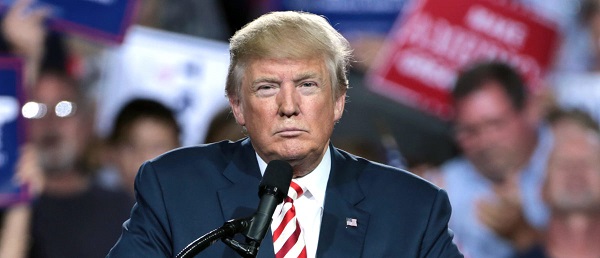
President Donald Trump signed an executive order moving marijuana from a Schedule I to a Schedule III controlled substance, despite many Republican lawmakers urging him not to.
“I want to emphasize that the order I am about to sign is not the legalization [of] marijuana in any way, shape, or form – and in no way sanctions its use as a recreational drug,” Trump said. “It’s never safe to use powerful controlled substances in recreational manners, especially in this case.”
“Young Americans are especially at risk, so unless a drug is recommended by a doctor for medical reasons, just don’t do it,” he added. “At the same time, the facts compel the federal government to recognize that marijuana can be legitimate in terms of medical applications when carefully administered.”
Under the Controlled Substances Act, Schedule I drugs are defined as having a high potential for abuse and no accepted medical use. Schedule III drugs – such as anabolic steroids, ketamine, and testosterone – are defined as having a moderate potential for abuse and accepted medical uses.
Although marijuana is still illegal at the federal level, 24 states and the District of Columbia have fully legalized marijuana within their borders, while 13 other states allow for medical marijuana.
Advocates for easing marijuana restrictions argue it will accelerate scientific research on the drug and allow the commercial marijuana industry to boom. Now that marijuana is no longer a Schedule I drug, businesses will claim an estimated $2.3 billion in tax breaks.
Chair of The Marijuana Policy Project Betty Aldworth said the reclassification “marks a symbolic victory and a recalibration of decades of federal misclassification.”
“Cannabis regulation is not a fringe experiment – it is a $38 billion economic engine operating under state-legal frameworks in nearly half of the country that has delivered overall positive social, educational, medical, and economic benefits, including correlation with reductions in youth use in states where it’s legal,” Aldworth said.
Opponents of the reclassification, including 22 Republican senators who sent Trump a warning letter Wednesday, point out the negative health impact of marijuana use and its effects on occupational and road safety.
“The only winners from rescheduling will be bad actors such as Communist China, while Americans will be left paying the bill. Marijuana continues to fit the definition of a Schedule I drug due to its high potential for abuse and its lack of an FDA-approved use,” the lawmakers wrote. “We cannot reindustrialize America if we encourage marijuana use.”
Marijuana usage is linked to mental disorders like depression, suicidal ideation, and psychotic episodes; impairs driving and athletic performance; and can cause permanent IQ loss when used at a young age, according to the Substance Abuse and Mental Health Administration.
Additionally, research shows that “people who use marijuana are more likely to have relationship problems, worse educational outcomes, lower career achievement, and reduced life satisfaction,” SAMHA says.