
National
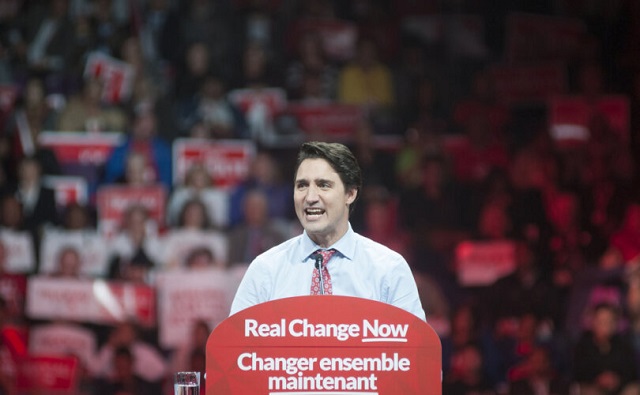
Trudeau says he considers ‘quitting every day’ but vows to stay on as prime minister

From LifeSiteNews
Conservative Party leader Pierre Poilievre said that while Trudeau thinks about quitting, Canadians think about firing him.
Prime Minister Justin Trudeau has told Canadians that he considers quitting “every day,” but that he is determined to stay on anyway.
During a March 15 interview with Radio-Canada, the French arm of the government-funded Canadian Broadcasting Corporation (CBC), Trudeau revealed that he routinely thinks about abandoning his role as prime minister and views his job as “super platte,” a French phrase that directly translates to “super flat.”
“I think about quitting every day. It’s a crazy job I’m doing, making the personal sacrifices,” he said. “Of course, it’s super tough. It’s very challenging at times.”
However, Trudeau noted that he “could not be the man I am and abandon the fight at this point.”
Trudeau’s interview sparked controversy online as the British Broadcasting Corporation’s (BBC) originally reported that Trudeau said he found his job “super boring” when he used the French phrase “super platte.”
Shortly after, the Crown outlet changed Trudeau’s statement to “very challenging” following backlash from a Canadian columnist. The outlet failed to explain why they made the change or if Trudeau’s office had anything to do with it.
“Super platte,” which can be translated as “super boring,” could also mean “super unfortunate” or a number other of similar statements.
The interview garnished ridicule from Conservative Party leader Pierre Poilievre, who blasted Trudeau for his statement suggesting that serving Canadians is “boring.”
“Canadians are not the only ones suffering,” Poilievre Poilievre said at an “Axe the Tax” rally in Fredericton, New Brunswick this weekend.
“Justin Trudeau has it very tough,” he continued sarcastically. “You hear about this? He’s a little bit bored… incredible this quote, I gotta read these quotes here today. He said this in French in an interview with Rad Can, he said, ‘I think about quitting every day.’ Isn’t that funny? We think about firing him every day.”
“‘It’s a crazy job making the personal sacrifices,’” he added, referring to the interview.
“Yeah right, like flying off to Billionaire Island. Burning thousands and thousands of liters of jet fuel at our expense into the atmosphere. And in these 80, 90 $100,000 vacations you take – sounds like a terrible personal sacrifice,” Poilievre challenged.
“I’m quoting you: ‘Of course, it’s super tough. It’s super boring at times,’” he quoted.
“Wow. Thinks the job is boring .. [but] serving the people is not boring. serving the people is what we do,” he declared.
In the original BBC story, Justin Trudeau said he was "super bored" with being PM. That line disappeared from the story over claims of mistranslation. Really?? @PierrePoilievre says if Trudeau feels like quitting every day, Canadians feel like firing him just as frequently. pic.twitter.com/Bjixo8ZcZ6
— David Krayden (@DavidKrayden) March 17, 2024
The interview comes as a recent poll found that 70 percent of Canadians believe country is “broken” as Trudeau focuses on less important issues. Similarly, in January, most Canadians reported that they’re worse off financially since Trudeau took office.
Additionally, a January poll showed that 46 percent of Canadians expressed a desire for the federal election to take place sooner rather than the latest mandated date in the fall of 2025.
Recent polls show that the scandal-plagued government has sent the Liberals into a nosedive with no end in sight. Per a recent LifeSiteNews report, according to polls, were a Canadian federal election held today, Conservatives under Poilievre would win a majority in the House of Commons over Trudeau’s Liberals.


From the Fraser Institute
By Tegan Hill and Jason Clemens
Recent court decision adds to growing uncertainty in B.C.
A recent decision by the B.C. Court of Appeal further clouds private property rights and undermines investment in the province. Specifically, the court determined British Columbia’s mineral claims system did not follow the province’s Declaration on the Rights of Indigenous Peoples Act (DRIPA), which incorporated the United Nations Declaration on the Rights of Indigenous Peoples (UNDRIP) into law.
DRIPA (2019) requires the B.C. provincial government to “take all measures necessary to ensure the laws of British Columbia are consistent with the Declaration,” meaning that all legislation in B.C. must conform to the principles outlined in the UNDRIP, which states that “Indigenous peoples have the right to the lands, territories and resources which they have traditionally owned, occupied or otherwise used or acquired.” The court’s ruling that the provincial government is not abiding by its own legislation (DRIPA) is the latest hit for the province in terms of ongoing uncertainty regarding property rights across the province, which will impose massive economic costs on all British Columbians until it’s resolved.
Consider the Cowichan First Nations legal case. The B.C. Supreme Court recently granted Aboriginal title to over 800 acres of land in Richmond valued at $2.5 billion, and where such aboriginal title is determined to exist, the court ruled that it is “prior and senior right” to other property interests. Put simply, the case puts private property at risk in BC.
The Eby government is appealing the case, yet it’s simultaneously negotiating bilateral agreements that similarly give First Nations priority rights over land swaths in B.C.
Consider Haida Gwaii, an archipelago on Canada’s west coast where around 5,000 people live—half of which are non-Haida. In April 2024, the Eby government granted Haida Aboriginal title over the land as part of a bilateral agreement. And while the agreement says private property must be honoured, private property rights are incompatible with communal Aboriginal title and it’s unclear how this conflict will be resolved.
Moreover, the Eby government attempted to pass legislation that effectively gives First Nations veto power over public land use in B.C. in 2024. While the legislation was rescinded after significant public backlash, the Eby’s government’s continued bilateral negotiations and proposed changes to other laws indicate it’s supportive of the general move towards Aboriginal title over significant parts of the province.
UNDRIP was adopted by the United Nations in 2007 and the B.C. Legislature adopted DRIPA in 2019. DRIPA requires that the government must secure “free, prior and informed consent” before approving projects on claimed land. Premier Eby is directly tied to DRIPA since he was the attorney general and actually drafted the interpretation memo.
The recent case centres around mineral exploration. Two First Nations groups—the Gitxaala Nation and the Ehattesaht First Nation—claimed the duty to consult was not adequately met and that granting mineral claims in their land “harms their cultural, spiritual, economic, and governance rights over their traditional territories,” which is inconsistent with DRIPA.
According to a 2024 survey of mining executives, more uncertainty is the last thing B.C. needs. Indeed, 76 per cent of respondents for B.C. said uncertainty around protected land and disputed land claims deters investment compared to only 29 per cent and 44 per cent (respectively) for Saskatchewan.
This series of developments have and will continue to fuel uncertainty in B.C. Who would move to or invest in B.C. when their private property, business, and investment is potentially at risk?
It’s no wonder British Columbians are leaving the province in droves. According to the B.C. Business Council, nearly 70,000 residents left B.C. for other parts of Canada last year. Similarly, business investment (inflation-adjusted) fell by nearly 5 per cent last year, exports and housing starts were down, and living standards in the province (as measured by per-person GDP) contracted in both 2023 and 2024.
B.C.’s recent developments will only worsen uncertainty in the province, deterring investment and leading to stagnant or even declining living standards for British Columbians. The Eby government should do its part to reaffirm private property rights, rather than continue fuelling uncertainty.

Tegan Hill
Director, Alberta Policy, Fraser Institute

Jason Clemens
Executive Vice President, Fraser Institute
From LifeSiteNews
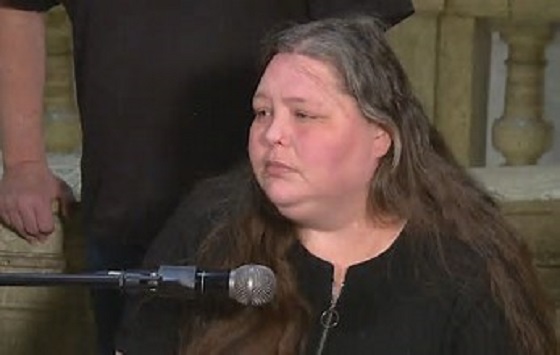
Jolene Van Alstine was approved for euthanasia after tiring of waiting years for surgery in Canada
A Canadian woman is looking to die by state-sanctioned euthanasia because she has had to endure long wait times to get what she considers to be proper care for a rare parathyroid disease.
The woman is Jolene Van Alstine, whose condition, normocalcemic primary hyperparathyroidism (nPHPT), causes her to experience vomiting, nausea, and bone pain.
As noted in a recent CBC report, Van Alstine claims she is not able to get proper surgery to remove her parathyroid in her home province of Saskatchewan, as there are no surgeons in that province who can perform that type of surgery.
She has said her “friends have stopped visiting me” and she is “isolated” and living “alone lying on the couch for eight years, sick and curled up in a ball, pushing for the day to end.”
“I go to bed at six at night because I can’t stand to be awake anymore,” she said.
As a result of her frustrations with the healthcare system, Van Alstine applied for Canada’s Medical Assistance in Dying (MAiD). She was approved for the procedure on January 7, 2026.
Saskatchewan Health Minister Jeremy Cockrill met with Van Alstine last month to try to see if he could help her, but what they talked about remains confidential.
“The Government of Saskatchewan expresses its sincere sympathy for all patients who are suffering with a difficult health diagnosis,” the government said.
As reported by LifeSiteNews, over 23,000 Canadians have died while on wait lists for medical care as Prime Minister Mark Carney’s Liberal government is focused on euthanasia expansions.
A new Euthanasia Prevention Coalition report revealed that Canada has euthanized 90,000 people since 2016, the year it was legalized.
Americans offering Jolene surgery help now say they have made contact with her
Van Alstine’s story has gone viral on the social media platform X, catching the attention of well-known American personalities, some who have claimed they can help her.
“If there is any surgeon in America who can do this, I’ll pay for this patient to come down here for treatment,” Glenn Beck wrote Tuesday on X.
“THIS is the reality of ‘compassionate’ progressive healthcare. Canada must END this insanity and Americans can NEVER let it spread here.”
According to Beck in a subsequent X post, he has had “surgeons who emailed us standing by to help her.”
“We are in contact with Jolene and her husband! Please continue to pray for her health,” he wrote on X.
“Will update more soon.”
As reported by LifeSiteNews recently, a Conservative MP’s private member’s bill that, if passed, would ban euthanasia for people with mental illness received the full support of the Euthanasia Prevention Coalition.
Lobby groups have pushed for MAiD to be expanded to minors.
Desiring to expand the procedure to even more Canadians, former Prime Minister Justin Trudeau’s government sought to expand from just the chronically and terminally ill to those suffering solely from mental illness. The current Liberal government appears to want to continue with the MAiD regime.
However, in February, after pushback from pro-life, medical, and mental health groups as well as most of Canada’s provinces, the federal government delayed the mental illness expansion until 2027.


Trump Deals Biden’s EV Dreams A Death Blow

Canadian bishops condemn Liberal ‘hate speech’ proposal that could criminalize quoting Scripture

While Trump has southern border secure, hundreds of thousands of illegal immigrants still flooding in from Canada

Pharma Bombshell: President Trump Orders Complete Childhood Vaccine Schedule Review
-
 National17 hours ago
Liberal bill “targets Christians” by removing religious exemption in hate-speech law
-
 Business2 days ago
The EU Insists Its X Fine Isn’t About Censorship. Here’s Why It Is.
-
 Business1 day ago
Canada invests $34 million in Chinese drones now considered to be ‘high security risks’
-
 Bruce Dowbiggin2 days ago
Wayne Gretzky’s Terrible, Awful Week.. And Soccer/ Football.
-
 Business14 hours ago
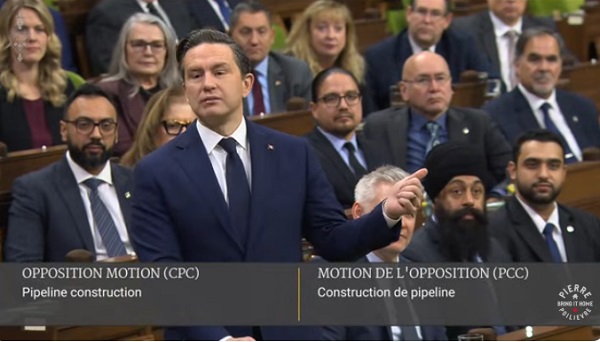
Looks like the Liberals don’t support their own Pipeline MOU
-
 Economy1 day ago
Affordable housing out of reach everywhere in Canada
-
 Health2 days ago
CDC Vaccine Panel Votes to End Universal Hep B Vaccine for Newborns
-
 Business1 day ago
The Climate-Risk Industrial Complex and the Manufactured Insurance Crisis