
Business
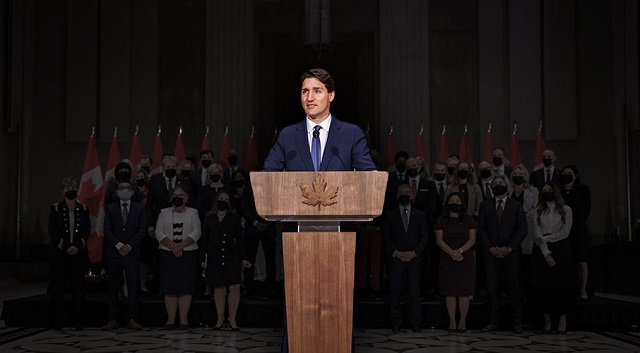
Trudeau launches assault on property rights to answer housing shortage

From the MacDonald Laurier Institute
By Aaron Wudrick and Jon Hartley
Liberals crack down on short-term rental owners in fiscal update — while ignoring the need for mass-scale construction of private builds
In Tuesday’s fiscal update, the Trudeau government found itself trying to bury the lede in a bad news story of bigger deficits, higher debt payments and a weakened economy.
Following a slew of opinion polls that show the Liberals trailing the opposition Conservatives by a widening margin, the update also exuded a palpable sense of urgency as the government scrambles to address a critical issue on which they were caught completely off guard: housing.
Housing has emerged, in recent months, as arguably the single biggest political concern in Canada. It impacts middle- and lower-income Canadians most severely and is a significant part of why the Liberals have been bleeding support amongst these key constituencies, which disproportionately include younger Canadians.
In response to their slide in the polls, the Liberals have belatedly started to act on the file — by removing the GST on new rental builds and dedicating $4 billion to a housing accelerator program that aims to incentivize municipalities to remove prohibitive zoning barriers. The fiscal update boasted that this fund has already signed agreements with nine cities to build 21,000 homes over the next three years, which sounds impressive until you consider that Canada needs approximately 3.5 million new homes by 2030 to fix the affordability crisis.
While any new housing supply will be welcome, the measures amount to knee-jerk reactions by a government that tries to solve problems by hastily showering them with money. While the Housing Accelerator Fund correctly focuses on scrapping restrictive zoning, the real goal should be to incentivize the construction of privately built housing on a mass scale, rather than simply subsidize additional public housing. The real cause of Canada’s housing shortage is not market failure but a series of policy failures on multiple fronts and levels.
Perhaps most alarming is the government’s assault on short-term rental housing by reducing tax deductions available to property owners, framed as a crusade against greedy landlords profiting from tourists while everyday Canadians scramble to keep a roof over their heads. The implicit assumption seems to be that, by making short-term rentals less attractive, these units will be magically transformed into long-term rental accommodations (which is wishful thinking, to say the least). In so doing, the government overlooks the diverse array of reasons Canadians choose to rent out properties on a short-term basis.
Flexibility — as facilitated by platforms like Airbnb — is essential for those who do not wish to commit to full-time landlord responsibilities. Additionally, Canadians may have family members who intermittently require housing, such as aging parents or university students. Long-term tenancy, burdened with compliance issues and eviction challenges, is unappealing to many property owners. If the government instead chose to make the work of a landlord more attractive, it wouldn’t need to make short-term rentals less appealing.
Even more troubling is the broader trend of the government encroaching on Canadians’ property rights, ostensibly to compensate for its own housing policy failures. Dictating how citizens use their own property raises serious concerns about the government overstepping its bounds. In a country with well-established property rights, it is inappropriate and misguided for the government to meddle in the choices of families seeking to make ends meet by renting out their properties.
On a practical level, the government’s chosen channels to tackle housing — relying on more government subsidies, undermining the short-term rental market, discouraging institutional investors from buying single-family homes and foreign buyer taxes or bans — will ultimately be too small to meaningfully grow the total stock of housing but will cause a number of harmful unintended consequences.
The bottom line is this: to make any kind of impact on housing affordability at scale, especially for individuals living below the median income, Canada needs a much larger housing supply — and the amount of capital investment this requires can only come from private developers.
All in all, the fiscal update shows the slapdash nature of the Trudeau government’s frantic attempts to address housing concerns, as well as its unfortunate inclination to resort to heavy-handed interventions, particularly in the realm of short-term rentals. The government’s indifference to infringing on private property rights underscores the need for a more supply-oriented approach to housing policy — one that works with, rather than against, the rights of property owners.
Aaron Wudrick is the domestic policy director at the Macdonald-Laurier Institute.
Jon Hartley is a senior fellow at the Macdonald-Laurier Institute and a research fellow at the Foundation for Research on Equal Opportunity.



You’ve certainly been asked (begged!) to join up for at least one loyalty “points” program – like PC Optimum, Aeroplan, or Hilton Honors – over the years. And the odds are that you’re currently signed up for at least one of them. In fact, the average person apparently belongs to at no less than 14 programs. Although, ironically, you’ll need to sign up to an online equivalent of a loyalty program to read the source for that number.
Well all that warm, fuzzy “belonging” comes with some serious down sides. Let’s see how much they might cost us.
To be sure, there’s real money involved here. Canadians redeem at least two billion dollars in program rewards each year, and payouts will often represent between one and ten percent of the original purchase value.
At the same time, it’s estimated that there could be tens of billions of unredeemed dollars due to expirations, shifting program terms, and simple neglect. So getting your goodies isn’t automatic.
The Audit is a reader-supported publication.
To receive new posts and support my work, consider becoming a free or paid subscriber.
Just why do consumer-facing corporations agree to give away so much money in the fist place?
As you probably already know, it’s about your data. Businesses are willing to pay cold, hard cash in exchange for detailed descriptions of your age, sex, ethnicity, wealth, location, employment status, hobbies, preferences, medical conditions, political leanings, and, of course, shopping habits.
Don’t believe it works? So then why, after all these years, are points programs still giving away billions of dollars?
Every time you participate in such a program, the data associated with that activity will be collected and aggregated along with everything else known about you. It’s more than likely that points-based data is being combined with everything connected to your mobile phone account, email addresses, credit cards, provincial health card, and – possibly – your Social Insurance number. The depth and accuracy of your digital profile improves daily.
What happens to all that data? A lot of it is shared with – or sold to – partners or affiliates for marketing purposes. Some of it is accidentally (or intentionally) leaked to organized criminal gangs driving call center-related scams. But it’s all about getting to know you better in ways that maximize someone’s profits.
One truly scary way this data is used involves surveillance pricing (also known as price discrimination) – particularly as it’s described in a recent post by Professor Sylvain Charlebois.
The idea is that retailers will use your digital profile to adjust the prices you pay at the cash register or when you’re shopping online. The more loyal you are as a customer, the more you’ll pay. That’s because regular (“loyal”) customers are already reliable revenue sources. Companies don’t need to spend anything to build a relationship with you. But they’re more than willing to give up a few percentage points to gain new friends.
I’m not talking about the kind of price discrimination that might lead to higher prices for sales in, say, urban locations to account for higher real estate and transportation costs. Those are just normal business decisions.
What Professor Charlebois described is two customers paying different prices for the same items in the same stores. In fact, a recent Consumer Reports experiment in the U.S. involving 437 shoppers in four cities found the practice to be quite common.
But the nasty bit here is that there’s growing evidence that retailers are using surveillance pricing in grocery stores for basic food items. Extrapolating from the Consumer Reports study, such pricing could be adding $1,200 annually to a typical family’s spending on basic groceries.
I’m not sure what the solution is. It’s way too late to “unenroll” from our loyalty accounts. And government intervention would probably just end up making things worse.
But perhaps getting the word out about what’s happening could spark justified mistrust in the big retailers. No retailer enjoys dealing with grumpy customers.
Be grumpy.
The Audit is a reader-supported publication.
To receive new posts and support my work, consider becoming a free or paid subscriber.
Business
Largest fraud in US history? Independent Journalist visits numerous daycare centres with no children, revealing massive scam


A young journalist has uncovered perhaps the largest fraud scheme in US history.
He certainly isn’t a polished reporter with many years of experience, but 23 year old independent journalist Nick Shirley seems to be getting the job done. Shirley has released an incredible video which appears to outline fraud after fraud after fraud in what appears to be a massive taxpayer funded scheme involving up to $9 Billion Dollars.
In one day of traveling around Minneapolis-St. Paul, Shirley appears to uncover over $100 million in fraudulent operations.
🚨 Here is the full 42 minutes of my crew and I exposing Minnesota fraud, this might be my most important work yet. We uncovered over $110,000,000 in ONE day. Like it and share it around like wildfire! Its time to hold these corrupt politicians and fraudsters accountable
We ALL… pic.twitter.com/E3Penx2o7a
— Nick shirley (@nickshirleyy) December 26, 2025

Largest fraud in US history? Independent Journalist visits numerous daycare centres with no children, revealing massive scam

Be Careful What You Wish For In 2026: Mark Carney With A Majority
The Top News Stories That Shaped Canadian Energy in 2025 and Will Continue to Shape Canadian Energy in 2026

“Magnitude cannot be overstated”: Minnesota aid scam may reach $9 billion
-
Business1 day ago
Largest fraud in US history? Independent Journalist visits numerous daycare centres with no children, revealing massive scam
-
Business1 day ago
“Magnitude cannot be overstated”: Minnesota aid scam may reach $9 billion
-
 Censorship Industrial Complex1 day ago
US Under Secretary of State Slams UK and EU Over Online Speech Regulation, Announces Release of Files on Past Censorship Efforts
-
Business9 hours ago
What Do Loyalty Rewards Programs Cost Us?
-
 Haultain Research9 hours ago
Sweden Fixed What Canada Won’t Even Name
-
 Daily Caller2 days ago
Is Ukraine Peace Deal Doomed Before Zelenskyy And Trump Even Meet At Mar-A-Lago?