After attacks by Islamic extremists, a familiar pattern follows. Debate erupts. Commentary and interviews flood the media. Op-eds, narratives, talking points, and competing interpretations proliferate in the immediate aftermath of bloodshed. The brief interval since the Bondi beach attack is no exception.
Many of these responses condemn the violence and call for solidarity between Muslims and non-Muslims, as well as for broader societal unity. Their core message is commendable, and I support it: extremist violence is horrific, societies must stand united, and communities most commonly targeted by Islamic extremists—Jews, Christians, non-Muslim minorities, and moderate Muslims—deserve to live in safety and be protected.
Yet many of these info-space engagements miss the mark or cater to a narrow audience of wonks. A recurring concern is that, at some point, many of these engagements suggest, infer, or outright insinuate that non-Muslims, or predominantly non-Muslim societies, are somehow expected or obligated to interpret these attacks through an Islamic or Muslim-impact lens. This framing is frequently reinforced by a familiar “not a true Muslim” narrative regarding the perpetrators, alongside warnings about the risks of Islamophobia.
These misaligned expectations collide with a number of uncomfortable but unavoidable truths. Extremist groups such as ISIS, Al-Qaeda, Hamas, Hezbollah, and decentralized attackers with no formal affiliations have repeatedly and explicitly justified their violence through interpretations of Islamic texts and Islamic history. While most Muslims reject these interpretations, it remains equally true that large, dynamic groups of Muslims worldwide do not—and that these groups are well prepared to, and regularly do, use violence to advance their version of Islam.
Islamic extremist movements do not, and did not, emerge in a vacuum. They draw from the broader Islamic context. This fact is observable, persistent, and cannot be wished or washed away, no matter how hard some may try or many may wish otherwise.
Given this reality, it follows that for most non-Muslims—many of whom do not have detailed knowledge of Islam, its internal theological debates, historical divisions, or political evolution—and for a considerable number of Muslims as well, Islamic extremist violence is perceived as connected to Islam as it manifests globally. This perception persists regardless of nuance, disclaimers, or internal distinctions within the faith and among its followers.
THE COST OF DENIAL AND DEFLECTION
Denying or deflecting from these observable connections prevents society from addressing the central issues following an Islamic extremist attack in a Western country: the fatalities and injuries, how the violence is perceived and experienced by surviving victims, how it is experienced and understood by the majority non-Muslim population, how it is interpreted by non-Muslim governments responsible for public safety, and how it is received by allied nations. Worse, refusing to confront these difficult truths—or branding legitimate concerns as Islamophobia—creates a vacuum, one readily filled by extremist voices and adversarial actors eager to poison and pollute the discussion.
Following such attacks, in addition to thinking first of the direct victims, I sympathize with my Muslim family, friends, colleagues, moderate Muslims worldwide, and Muslim victims of Islamic extremism, particularly given that anti-Muslim bigotry is a real problem they face. For Muslim victims of Islamic extremism, that bigotry constitutes a second blow they must endure. Personal sympathy, however, does not translate into an obligation to center Muslim communal concerns when they were not the targets of the attack. Nor does it impose a public obligation or override how societies can, do, or should process and respond to violence directed at them by Islamic extremists.
As it applies to the general public in Western nations, the principle is simple: there should be no expectation that non-Muslims consider Islam, inter-Islamic identity conflicts, internal theological disputes, or the broader impact on the global Muslim community, when responding to attacks carried out by Islamic extremists. That is, unless Muslims were the victims, in which case some consideration is appropriate.
Quite bluntly, non-Muslims are not required to do so and are entitled to reject and push back against any suggestion that they must or should. Pointedly, they are not Muslims, a fact far too many now seem to overlook.
The arguments presented here will be uncomfortable for many and will likely provoke polarizing discussion. Nonetheless, they articulate an important, human-centered position regarding how Islamic extremist attacks in Western nations are commonly interpreted and understood by non-Muslim majority populations.
Non-Muslims are free to give no consideration to Muslim interests at any time, particularly following an Islamic extremist attack against non-Muslims in a non-Muslim country. The sole exception is that governments retain an obligation to ensure the safety and protection of their Muslim citizens, who face real and heightened threats during these periods. This does not suggest that non-Muslims cannot consider Muslim community members; it simply affirms that they are under no obligation to do so.
The impulse for Muslims to distance moderate Muslims and Islam from extremist attacks—such as the targeting of Jews in Australia or foiled Christmas market plots in Poland and Germany—is understandable.
Muslims do so to protect their own interests, the interests of fellow Muslims, and the reputation of Islam itself. Yet this impulse frequently collapses into the “No True Scotsman” fallacy, pointing to peaceful Muslims as the baseline while asserting that the attackers were not “true Muslims.”
Such claims oversimplify the reality of Islam as it manifests globally and fail to address the legitimate political and social consequences that follow Islamic extremist attacks in predominantly non-Muslim Western societies. These deflections frequently produce unintended effects, such as strengthening anti-Muslim extremist sentiments and movements and undermining efforts to diminish them.
The central issue for public discourse after an Islamic extremist attack is not debating whether the perpetrators were “true” or “false” Muslims, nor assessing downstream impacts on Muslim communities—unless they were the targets.
It is a societal effort to understand why radical ideologies continue to emerge from varying—yet often overlapping—interpretations of Islam, how political struggles within the Muslim world contribute to these ideologies, and how non-Muslim-majority Western countries can realistically and effectively confront and mitigate threats related to Islamic extremism before the next attack occurs and more non-Muslim and Muslim lives are lost.
Addressing these realities directly is the only path toward protecting communities, confronting extremism, and preventing further loss of life.
Ian Bradbury, a global security specialist with over 25 years experience, transitioned from Defence and NatSec roles to found Terra Nova Strategic Management (2009) and 1NAEF (2014). A TEDx, UN, NATO, and Parliament speaker, he focuses on terrorism, hybrid warfare, conflict aid, stability operations, and geo-strategy.
The Bureau is a reader-supported publication.
To receive new posts and support my work, consider becoming a free or paid subscriber.
Todayville is a digital media and technology company. We profile unique stories and events in our community. Register and promote your community event for free.
Following an alarming rise in fentanyl deaths in recent years, President Donald Trump is taking another step in cracking down on the deadly drug seeping its way onto American streets by designating it a weapon of mass destruction.
The president signed the executive order Monday during an event in the Oval Office, saying the illicit drug “is closer to a chemical weapon than a narcotic.”
The designation comes on the heels of the administration’s increasing military presence in the Caribbean, targeting narco-terrorists and “successful” meetings with Chinese leaders, who have vowed to crack down on the production of precursors of the drug.
Critics of Trump’s move want to address the fentanyl crisis through a different way. For example, a 2024 bill from attorneys general asking former President Joe Biden to do the same thing expressed concerns about political optics and the language akin to military. Overreach and blurred lines in domestic actions, such as rounding up users.
The order would provide the secretaries of the Department of War and Department of Homeland Security to “update all directives regarding the armed forces’ response to chemical incidents in the homeland to include the threat of illicit fentanyl.”
Trump said the fentanyl drug trade “threatens” national security by fueling “lawlessness” in the Western Hemisphere. This is the area of North America and South America, and the islands near each.
“The production and sale of fentanyl by foreign terrorist organizations and cartels fund these entities’ operations – which include assassinations, terrorist acts, and insurgencies around the world – and allow these entities to erode our domestic security and the well-being of our nation,” the order says in part.
Trump said two cartels are predominantly responsible. The Sinaloa Cartel and the Jalisco New Generation Cartel, known also as CJNG, are based in Mexico.
The Drug Enforcement Agency said last December that in 2023, more than 107,000 people died from drug overdoses, with nearly 70% attributed to opioids, like fentanyl.
In late February, the U.S. Centers for Disease Control and Prevention via its National Vital Statistics System predicted a 24% decline in drug overdose deaths for the 12 months ending in September. The finding was based on 87,000 drug overdose deaths from October 2023 to September 2024, down from 114,000 the year prior.
Trump declared opioid overdose a public health emergency in 2017 during his first term.
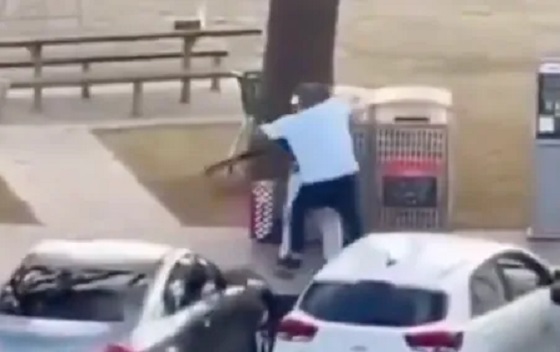
Insane footage shows a bystander attacking and disarming one of the terrorists, who appears to have been armed with a long rifle, during today’s shooting attack on an event celebrating Hanukkah at Bondi Beach in Sydney, Australia. pic.twitter.com/mJceco22bJ
The chaos that struck Australia on Sunday night produced one moment of astonishing courage: a Sydney shopkeeper, armed with nothing but instinct and grit, charged a gunman at Bondi Beach and wrestled the rifle out of his hands as terrified families ran for cover. Authorities say the act likely prevented even more deaths in what officials have already called an antisemitic terror attack that left 12 people dead and dozens wounded during a Hanukkah celebration along the water.
The hero has been identified as 43-year-old fruit shop owner Ahmed Al Ahmed, a father of two who happened to be nearby when gunfire erupted at the beachfront event “Hanukkah by the Sea,” which had drawn more than 200 people. Footage captured the moment he marched toward the shooter, grabbed hold of the rifle, and overpowered him in a brief, violent struggle. As the gunman hit the pavement, Al Ahmed momentarily pointed the weapon back at him but didn’t fire, instead placing it against a tree before another attacker opened up from a bridge above. He was hit in the hand and shoulder and is now recovering after emergency surgery.
A relative told Australia’s Channel Seven that Al Ahmed had never handled a gun in his life. “He’s a hero — he’s 100 percent a hero,” the family member said. New South Wales Premier Chris Minns echoed the praise, calling the scene “unbelievable,” adding, “A man walked up to someone who had just fired on the community and single-handedly disarmed him. Many people are alive tonight because of his bravery.”
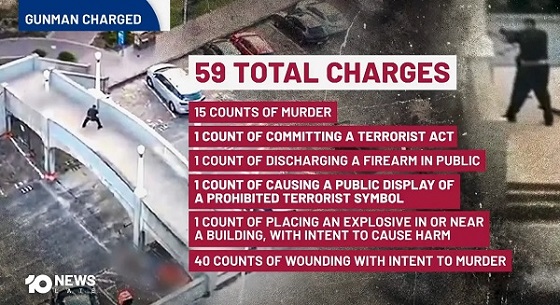
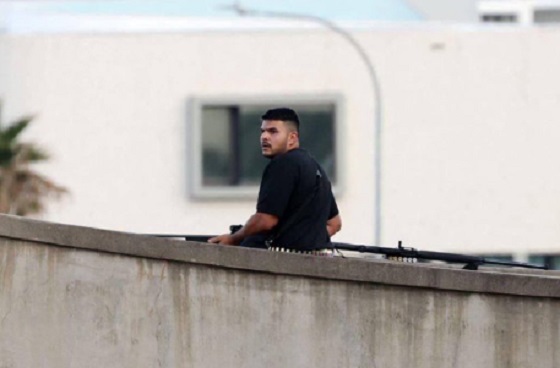
Police say two shooters stepped out of a vehicle along Campbell Parade around 6:40 p.m. and began firing toward the beach. One gunman was killed, the other is in custody in critical condition. Detectives are also investigating whether a third attacker was involved, and bomb units swept the area after reports that an explosive device may have been planted beneath a pedestrian bridge. The toll is staggering: 12 dead, including one shooter, and at least 29 wounded — among them children and two police officers.
Prime Minister Anthony Albanese condemned what he called “a targeted attack on Jewish Australians on the first day of Hanukkah,” saying, “What should have been a night of joy and peace has been shattered by this horrifying evil attack.” Emergency crews flooded the beach as hundreds of panicked people sprinted away from the gunfire. Video shows one attacker firing down toward the sand from the bridge behind Bondi Park before being shot himself in a final standoff captured by drone footage. Both gunmen appeared to be carrying ammunition belts, with witnesses estimating up to 50 rounds were fired.
Australian police have cordoned off properties linked to the suspects and continue to canvass Bondi for additional threats. What remains clear is that Sunday’s attack was met with extraordinary acts of self-sacrifice, none more dramatic than a shopkeeper from Sutherland who walked into gunfire to stop further slaughter.