
Alberta
Premier Smith sending teachers back to school and setting up classroom complexity task force

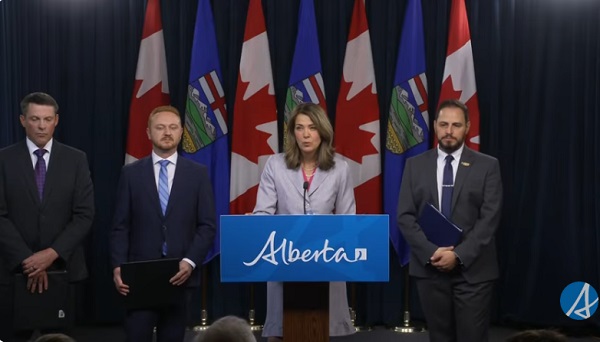
Taking action on classroom complexity
As schools reopen, Alberta’s government is taking action by appointing a class size and complexity task force to meet the challenge of increasingly complex classrooms.
Across Alberta, teachers are seeing more students with diverse learning needs and behavioural challenges, while incidents of classroom aggression are rising. To address these challenges head on, and in response to concerns raised by teachers, Alberta’s government will be appointing a Class Size and Complexity Task Force.
We recently formed the Aggression and Complexity in Schools Action Team to identify practical classroom focused solutions. Alberta’s government has received the action team’s draft final report and will use its recommendations to create a roadmap for safer classrooms. Alberta’s government will release the final report, and the task force will implement solutions, work with school boards to gather more data on classroom complexity and begin work to replace the 2004 Standards for Special Education.
“Teachers have made it clear that addressing classroom complexity and safety are among the most critical improvements needed in our education system. We are taking real action to meet those needs by strengthening classroom supports, hiring more teachers and educational assistants, and acting on the recommendations of the Aggression and Complexity in Schools Action Team. Parents, teachers and students all want the same thing – safe and supportive classrooms where every child can succeed.”
Teachers are vital to the success of Alberta’s education system. Over the next three years, school boards will be provided with funding to hire 3,000 teachers and 1,500 new education assistants to support students with complex needs. These funds may also be allocated to additional student support through assessments for complex needs, occupational therapy, physiotherapy or speech-language pathology, and other in-the-classroom supports.
“No teacher should ever be harmed while doing their job. We know that aggressive incidents have gone up sharply in recent years, and classrooms are becoming more complex. That’s why we’re doubling down on efforts to make classrooms safer and to give extra support to students who need it. Our goal is to create learning environments where every student can succeed.”
In November, Alberta’s government will work with school boards to gather information and data about class sizes and composition to ensure students are receiving the support they need. Information will be made available as soon as it is available and will be released annually thereafter.
Quick facts
- Between July and September 2025, the action team conducted engagement sessions with teachers, education partners and school boards through in-person and virtual sessions.
- This included front-line educators, families, disability organizations, community agencies, early learning experts and social service professionals.
- Budget 2025 included $55 million to help address classroom complexity – a 20 per cent increase from the previous year.
Getting Alberta’s kids back to school
If passed, Bill 2, the Back to School Act, will restore stability in Alberta’s education system and ensure students can return to learning without further disruption.
The ongoing teachers’ strike has disrupted classrooms across Alberta, setting back student learning and deepening achievement gaps. Each day schools remain closed, students lose critical instructional time, routine and support. This proposed legislation will end the strike and establish reasonable terms for a new teacher collective agreement.
“This strike has gone on long enough. It’s clear there’s no path forward unless we act. The Back to School Act refocuses everyone on what matters most, the education of Alberta’s students. Bill 2 puts students back at the centre of our system, while we continue to work with teachers and families to build lasting stability in Alberta’s schools.”
The Back to School Act legislates the terms of the September 2025 tentative agreement, which provided a 12 per cent salary increase over four years, additional market adjustments of up to 17 per cent for most teachers, and the hiring of 3,000 teachers and 1,500 educational assistants. The collective agreement will be in effect from Sept. 1, 2024, to Aug. 31, 2028.
“The time for labour stability is now. This legislation provides a positive path forward despite an interrupted school year. This is a necessary step and the most responsible decision for kids, teachers and parents. If Bill 2 is passed, it is my hope that classes will resume as soon as Wednesday, October 29.”
The last deal put on the table by the Alberta Teachers’ Association demanded an additional $2 billion from government. This was a clear display that the union had no intention to bargain in a reasonable manner with the government and present a fair offer.
“We believe invoking the notwithstanding clause is a necessary measure to end the undue hardship caused by the teacher strike. This strike has reached a point that is causing irreparable harm on student learning. Our government will not hesitate to use every available legal tool in defence of students.”
This legislation is the only responsible path forward to restore stability, protect students and ensure Alberta’s classrooms focus back on learning. Alberta’s government remains fully committed to strengthening the education system, supporting teachers, and putting the success and well-being of students at the heart of every decision made.
Key facts
- Bill 2 would end the province-wide teachers’ strike and legislates a new collective agreement.
- The agreement covers Sept. 1, 2024, to Aug. 31, 2028 and provides:
- A 12 per cent salary increase over four years.
- Additional market adjustments of up to 17 per cent for 95 per cent of members.
- 3,000 new teachers and 1,500 educational assistants to reduce class sizes and enhance support.
- These terms reflect the September 2025 tentative agreement recommended by the Alberta Teachers’ Association leadership.
- The legislation includes financial penalties for non-compliance and suspends local bargaining during the agreement to ensure labour stability through 2028.



From the Fraser Institute
By Nadeem Esmail, Mackenzie Moir and Lauren Asaad
In October, Alberta’s provincial government announced forthcoming legislative changes that will allow patients to pay out-of-pocket for any diagnostic test they want, and without a physician referral. The policy, according to the Smith government, is designed to help improve the availability of preventative care and increase testing capacity by attracting additional private sector investment in diagnostic technology and facilities.
Unsurprisingly, the policy has attracted Ottawa’s attention, with discussions now taking place around the details of the proposed changes and whether this proposal is deemed to be in line with the Canada Health Act (CHA) and the federal government’s interpretations. A determination that it is not, will have both political consequences by being labeled “non-compliant” and financial consequences for the province through reductions to its Canada Health Transfer (CHT) in coming years.
This raises an interesting question: While the ultimate decision rests with Ottawa, does the Smith government’s new policy comply with the literal text of the CHA and the revised rules released in written federal interpretations?
According to the CHA, when a patient pays out of pocket for a medically necessary and insured physician or hospital (including diagnostic procedures) service, the federal health minister shall reduce the CHT on a dollar-for-dollar basis matching the amount charged to patients. In 2018, Ottawa introduced the Diagnostic Services Policy (DSP), which clarified that the insured status of a diagnostic service does not change when it’s offered inside a private clinic as opposed to a hospital. As a result, any levying of patient charges for medically necessary diagnostic tests are considered a violation of the CHA.
Ottawa has been no slouch in wielding this new policy, deducting some $76.5 million from transfers to seven provinces in 2023 and another $72.4 million in 2024. Deductions for Alberta, based on Health Canada’s estimates of patient charges, totaled some $34 million over those two years.
Alberta has been paid back some of those dollars under the new Reimbursement Program introduced in 2018, which created a pathway for provinces to be paid back some or all of the transfers previously withheld on a dollar-for-dollar basis by Ottawa for CHA infractions. The Reimbursement Program requires provinces to resolve the circumstances which led to patient charges for medically necessary services, including filing a Reimbursement Action Plan for doing so developed in concert with Health Canada. In total, Alberta was reimbursed $20.5 million after Health Canada determined the provincial government had “successfully” implemented elements of its approved plan.
Perhaps in response to the risk of further deductions, or taking a lesson from the Reimbursement Action Plan accepted by Health Canada, the province has gone out of its way to make clear that these new privately funded scans will be self-referred, that any patient paying for tests privately will be reimbursed if that test reveals a serious or life-threatening condition, and that physician referred tests will continue to be provided within the public system and be given priority in both public and private facilities.
Indeed, the provincial government has stated they do not expect to lose additional federal health care transfers under this new policy, based on their success in arguing back previous deductions.
This is where language matters: Health Canada in their latest CHA annual report specifically states the “medical necessity” of any diagnostic test is “determined when a patient receives a referral or requisition from a medical practitioner.” According to the logic of Ottawa’s own stated policy, an unreferred test should, in theory, be no longer considered one that is medically necessary or needs to be insured and thus could be paid for privately.
It would appear then that allowing private purchase of services not referred by physicians does pass the written standard for CHA compliance, including compliance with the latest federal interpretation for diagnostic services.
But of course, there is no actual certainty here. The federal government of the day maintains sole and final authority for interpretation of the CHA and is free to revise and adjust interpretations at any time it sees fit in response to provincial health policy innovations. So while the letter of the CHA appears to have been met, there is still a very real possibility that Alberta will be found to have violated the Act and its interpretations regardless.
In the end, no one really knows with any certainty if a policy change will be deemed by Ottawa to run afoul of the CHA. On the one hand, the provincial government seems to have set the rules around private purchase deliberately and narrowly to avoid a clear violation of federal requirements as they are currently written. On the other hand, Health Canada’s attention has been aroused and they are now “engaging” with officials from Alberta to “better understand” the new policy, leaving open the possibility that the rules of the game may change once again. And even then, a decision that the policy is permissible today is not permanent and can be reversed by the federal government tomorrow if its interpretive whims shift again.
The sad reality of the provincial-federal health-care relationship in Canada is that it has no fixed rules. Indeed, it may be pointless to ask whether a policy will be CHA compliant before Ottawa decides whether or not it is. But it can be said, at least for now, that the Smith government’s new privately paid diagnostic testing policy appears to have met the currently written standard for CHA compliance.

Nadeem Esmail

Mackenzie Moir

Lauren Asaad
Policy Analyst, Fraser Institute

From the Fraser Institute
By Tegan Hill and Austin Thompson
In cities across the country, modest homes have become unaffordable for typical families. Calgary and Edmonton have not been immune to this trend, but they’ve weathered it better than most—largely by making it easier to build homes.
Specifically, faster permit approvals, lower municipal fees and fewer restrictions on homebuilders have helped both cities maintain an affordability edge in an era of runaway prices. To preserve that edge, they must stick with—and strengthen—their pro-growth approach.
First, the bad news. Buying a home remains a formidable challenge for many families in Calgary and Edmonton.
For example, in 2023 (the latest year of available data), a typical family earning the local median after-tax income—$73,420 in Calgary and $70,650 in Edmonton—had to save the equivalent of 17.5 months of income in Calgary ($107,300) or 12.5 months in Edmonton ($73,820) for a 20 per cent down payment on a typical home (single-detached house, semi-detached unit or condominium).
Even after managing such a substantial down payment, the financial strain would continue. Mortgage payments on the remaining 80 per cent of the home’s price would have required a large—and financially risky—share of the family’s after-tax income: 45.1 per cent in Calgary (about $2,757 per month) and 32.2 per cent in Edmonton (about $1,897 per month).
Clearly, unless the typical family already owns property or receives help from family, buying a typical home is extremely challenging. And yet, housing in Calgary and Edmonton remains far more affordable than in most other Canadian cities.
In 2023, out of 36 major Canadian cities, Edmonton and Calgary ranked 8th and 14th, respectively, for housing affordability (relative to the median after-tax family income). That’s a marked improvement from a decade earlier in 2014 when Edmonton ranked 20th and Calgary ranked 30th. And from 2014 to 2023, Edmonton was one of only four Canadian cities where median after-tax family income grew faster than the price of a typical home (in Calgary, home prices rose faster than incomes but by much less than in most Canadian cities). As a result, in 2023 typical homes in Edmonton cost about half as much (again, relative to the local median after-tax family income) as in mid-sized cities such as Windsor and Kelowna—and roughly one-third as much as in Toronto and Vancouver.
To be clear, much of Calgary and Edmonton’s improved rank in affordability is due to other cities becoming less and less affordable. Indeed, mortgage payments (as a share of local after-tax median income) also increased since 2014 in both Calgary and Edmonton.
But the relative success of Alberta’s two largest cities shows what’s possible when you prioritize homebuilding. Their approach—lower municipal fees, faster permit approvals and fewer building restrictions—has made it easier to build homes and helped contain costs for homebuyers. In fact, homebuilding has been accelerating in Calgary and Edmonton, in contrast to a sharp contraction in Vancouver and Toronto. That’s a boon to Albertans who’ve been spared the worst excesses of the national housing crisis. It’s also a demographic and economic boost for the province as residents from across Canada move to Alberta to take advantage of the housing market—in stark contrast to the experience of British Columbia and Ontario, which are hemorrhaging residents.
Alberta’s big cities have shown that when governments let homebuilders build, families benefit. To keep that advantage, policymakers in Calgary and Edmonton must stay the course.

Tegan Hill
Director, Alberta Policy, Fraser Institute

Austin Thompson
Senior Policy Analyst, Fraser Institute


Argentina’s Milei delivers results free-market critics said wouldn’t work

‘Almost Sounds Made Up’: Jeffrey Epstein Was Bill Clinton Plus-One At Moroccan King’s Wedding, Per Report
Saskatchewan woman approved for euthanasia urged to seek medical help in Canada rather than US

Danielle Smith slams Skate Canada for stopping events in Alberta over ban on men in women’s sports
-
Business1 day ago
Argentina’s Milei delivers results free-market critics said wouldn’t work
-
 espionage22 hours ago
Carney Floor Crossing Raises Counterintelligence Questions aimed at China, Former Senior Mountie Argues
-
 Business2 days ago
State of the Canadian Economy: Number of publicly listed companies in Canada down 32.7% since 2010
-
 Business17 hours ago
Taxing food is like slapping a surcharge on hunger. It needs to end
-
Alberta2 days ago
Alberta’s new diagnostic policy appears to meet standard for Canada Health Act compliance
-
 International2 days ago
DOJ fails to fully comply with Friday deadline for Epstein files release
-
 Bruce Dowbiggin2 days ago
Hunting Poilievre Covers For Upcoming Demographic Collapse After Boomers
-
 Health8 hours ago
FDA warns ‘breast binder’ manufacturers to stop marketing to gender-confused girls