
Opinion
Pope Leo XIV’s Christmas night homily


By Pope Leo XIV
Vatican City, Dec 24, 2025
Pope Leo XIV celebrated Christmas Mass during the Night in St. Peter’s Basilica on Wednesday. The Mass was attended by an estimated 6,000 people inside the basilica, while around 5,000 people gathered outside in St. Peter’s Square, according to the Vatican.
Below is the full text of the pope’s Christmas night homily:
Dear brothers and sisters,
For millennia, across the earth, peoples have gazed up at the sky, giving names to the silent stars, and seeing images therein. In their imaginative yearning, they tried to read the future in the heavens, seeking on high for a truth that was absent below amidst their homes. Yet, as if grasping in the dark, they remained lost, confounded by their own oracles. On this night, however, “the people who walked in darkness have seen a great light; those who dwelt in a land of deep darkness, on them has light shined” (Is 9:2).
Behold the star that astonishes the world, a spark newly lit and blazing with life: “To you is born this day in the city of David a Savior, who is the Messiah, the Lord” (Lk 2:11). Into time and space — in our midst — comes the One without whom we would not exist. He who gives his life for us lives among us, illuminating the night with his light of salvation. There is no darkness that this star does not illumine, for by its light all humanity beholds the dawn of a new and eternal life.
It is the birth of Jesus, Emmanuel. In the Son made man, God gives us nothing less than his very self, in order to “redeem us from all iniquity and purify for himself a people of his own” (Titus 2:14). Born in the night is the One who redeems us from the night. The hint of the dawning day is no longer to be sought in the distant reaches of the cosmos, but by bending low, in the stable nearby.
The clear sign given to a darkened world is indeed “a child wrapped in bands of cloth and lying in a manger” (Lk 2:12). To find the Savior, one must not gaze upward, but look below: The omnipotence of God shines forth in the powerlessness of a newborn; the eloquence of the eternal Word resounds in an infant’s first cry; the holiness of the Spirit gleams in that small body, freshly washed and wrapped in swaddling clothes. The need for care and warmth becomes divine since the Son of the Father shares in history with all his brothers and sisters. The divine light radiating from this Child helps us to recognize humanity in every new life.
To heal our blindness, the Lord chooses to reveal himself in each human being, who reflect his true image, according to a plan of love begun at the creation of the world. As long as the night of error obscures this providential truth, then “there is no room for others either, for children, for the poor, for the stranger” (Benedict XVI, Homily, Christmas Mass during the Night, 24 December 2012).
These words of Pope Benedict XVI remain a timely reminder that on earth, there is no room for God if there is no room for the human person. To refuse one is to refuse the other. Yet, where there is room for the human person, there is room for God; even a stable can become more sacred than a temple, and the womb of the Virgin Mary become the Ark of the New Covenant.
Let us marvel, dear brothers and sisters, at the wisdom of Christmas. In the Child Jesus, God gives the world a new life: his own, offered for all. He does not give us a clever solution to every problem, but a love story that draws us in. In response to the expectations of peoples, he sends a child to be a word of hope. In the face of the suffering of the poor, he sends one who is defenseless to be the strength to rise again. Before violence and oppression, he kindles a gentle light that illumines with salvation all the children of this world. As St. Augustine observed, “human pride weighed you down so heavily that only divine humility could raise you up again” (St. Augustine, Sermon 188, III, 3). While a distorted economy leads us to treat human beings as mere merchandise, God becomes like us, revealing the infinite dignity of every person. While humanity seeks to become “god” in order to dominate others, God chooses to become man in order to free us from every form of slavery. Will this love be enough to change our history?
The answer will come as soon as we wake up from a deadly night into the light of new life, and, like the shepherds, contemplate the child Jesus. Above the stable of Bethlehem, where Mary and Joseph watch over the newborn Child with hearts full of wonder, the starry sky is transformed into “a multitude of the heavenly host” (Lk 2:13). These are unarmed and disarming hosts, for they sing of the glory of God, of which peace on earth is the true manifestation (cf. v. 14). Indeed, in the heart of Christ beats the bond of love that unites heaven and earth, Creator and creatures.
For this reason, exactly one year ago, Pope Francis affirmed that the Nativity of Jesus rekindles in us the “gift and task of bringing hope wherever hope has been lost,” because “with him, joy flourishes; with him, life changes; with him, hope does not disappoint” (Homily, Christmas Mass during the Night, 24 December 2024). With these words, the holy year began. Now, as the jubilee draws to a close, Christmas becomes for us a time of gratitude and mission; gratitude for the gift received, and mission to bear witness to it before the world. As the Psalmist sings: “Tell of his salvation from day to day. Declare his glory among the nations, his marvelous deeds among all the peoples” (Ps 96:2–3).
Brothers and sisters, contemplation of the Word made flesh awakens in the whole Church a new and true proclamation. Let us therefore announce the joy of Christmas, which is a feast of faith, charity, and hope. It is a feast of faith, because God becomes man, born of the Virgin. It is a feast of charity, because the gift of the redeeming Son is realized in fraternal self-giving. It is a feast of hope, because the child Jesus kindles it within us, making us messengers of peace. With these virtues in our hearts, unafraid of the night, we can go forth to meet the dawn of a new day.


From the Frontier Centre for Public Policy
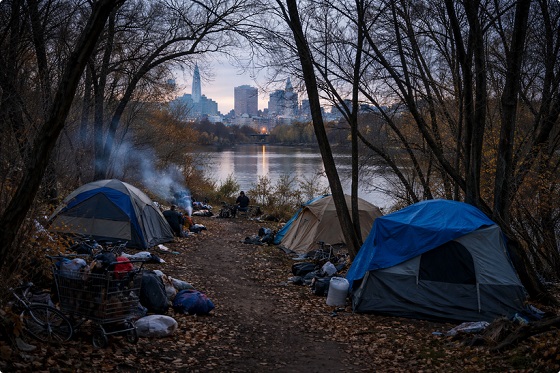
Canada’s homelessness crisis has intensified dramatically, with about 60,000 people homeless this Christmas and chronic homelessness becoming entrenched as shelters overflow and encampments spread. Policy failures in immigration, housing, monetary policy, shelters, harm reduction, and Indigenous governance have driven the crisis. Only reversing these policies can meaningfully address it.
Encampments that were meant to be temporary have become a permanent feature in our communities
As Canadians settle in for the holiday season, 60,000 people across this country will spend Christmas night in a tent, a doorway, or a shelter bed intended to be temporary. Some will have been there for months, perhaps years. The number has quadrupled in six years.
In October 2024, enumerators in 74 Canadian communities conducted the most comprehensive count of homelessness this country has attempted. They found 17,088 people sleeping without shelter on a single autumn night, and 4,982 of them living in encampments. The count excluded Quebec entirely. The real number is certainly higher.
In Ontario alone, homelessness increased 51 per cent between 2016 and 2024. Chronic homelessness has tripled. For the first time, more than half of all homelessness in that province is chronic. People are no longer moving through the system. They are becoming permanent fixtures within it.
Toronto’s homeless population more than doubled between April 2021 and October 2024, from 7,300 to 15,418. Tents now appear in places that were never seen a decade ago. The city has 9,594 people using its shelter system on any given night, yet 158 are turned away each evening because no beds are available.
Calgary recorded 436 homeless deaths in 2023, nearly double the previous year. The Ontario report projects that without significant policy changes, between 165,000 and 294,000 people could experience homelessness annually in that province alone by 2035.
The federal government announced in September 2024 that it would allocate $250 million over two years to address encampments. Ontario received $88 million for ten municipalities. The Association of Municipalities of Ontario calculated that ending chronic homelessness in their province would require $11 billion over ten years. The federal contribution represents less than one per cent of what is needed.
Yet the same federal government found $50 billion for automotive subsidies and battery plants. They borrow tonnes of money to help foreign car manufacturers with EVs, while tens of thousands are homeless. But money alone does not solve problems. Pouring billions into a bureaucratic system that has failed spectacularly without addressing the policies that created the crisis would be useless.
Five years ago, tent cities were virtually unknown in most Canadian communities. Recent policy choices fuelled it, and different choices can help unmake it.
Start with immigration policy. The federal government increased annual targets to over 500,000 without ensuring housing capacity existed. Between 2021 and 2024, refugees and asylum seekers experiencing chronic homelessness increased by 475 per cent. These are people invited to Canada under federal policy, then abandoned to municipal shelter systems already at capacity.
Then there is monetary policy. Pandemic spending drove inflation, which made housing unaffordable. Housing supply remains constrained by policy. Development charges, zoning restrictions, and approval processes spanning years prevent construction at the required scale. Municipal governments layer fees onto new developments, making projects uneconomical.
Shelter policy itself has become counterproductive. The average shelter stay increased from 39 days in 2015 to 56 days in 2022. There are no time limits, no requirements, no expectations. Meanwhile, restrictive rules around curfews, visitors, and pets drive 85 per cent of homeless people to avoid shelters entirely, preferring tents to institutional control.
The expansion of harm reduction programs has substituted enabling for treatment. Safe supply initiatives provide drugs to addicts without requiring participation in recovery programs. Sixty-one per cent cite substance use issues, yet the policy response is to make drug use safer rather than to make sobriety achievable. Treatment programs with accountability would serve dignity far better than an endless supply of free drugs.
Indigenous people account for 44.6 per cent of those experiencing chronic homelessness in Northern Ontario despite comprising less than three per cent of the general population. This overrepresentation is exacerbated by policies that fail to recognize Indigenous governance and self-determination as essential. Billions allocated to Indigenous communities are never scrutinized.
The question Canadians might ask this winter is whether charity can substitute for competent policy. The answer is empirically clear: it cannot. What is required before any meaningful solutions is a reversal of the policies that broke it.
Marco Navarro-Genie is vice-president of research at the Frontier Centre for Public Policy and co-author with Barry Cooper of Canada’s COVID: The Story of a Pandemic Moral Panic (2023).

From the Fraser Institute
The holidays are a time when families reconnect and share cherished traditions, hearty meals and, occasionally, heated debates. This year, housing policy might be a touchy subject at the holiday dinner table. Homebuilding has not kept pace with housing demand in Canada, causing a sharp decline in affordability. Efforts to accelerate homebuilding are also changing neighbourhoods, sometimes in ways that concern residents. Add in a generational divide in how Canadians have experienced the housing market, and it’s easy to see how friends and family can end up talking past one another on housing issues.
Some disagreement about housing policy is inevitable. But in the spirit of the holidays, we can keep the conversation charitable and productive by grounding it in shared facts, respecting one another’s housing choices, and acknowledging the trade-offs of neighbourhood change.
One way to avoid needless conflict is to start with a shared factual baseline about just how unaffordable housing is today—and how that compares to the past.
The reality is that today’s housing affordability challenges are severe, but not entirely unprecedented. Over the past decade, prices for typical homes have grown faster than ordinary families’ after-tax incomes in nearly every major city. At the pandemic-era peak, the mortgage burden for a typical purchase was the worst since the early 1980s. The housing market has cooled in some cities since then, but not enough to bring affordability back to pre-pandemic levels—when affordability was already strained.
These facts provide some useful context for the holiday dinner table. Today’s aspiring homebuyers aren’t wrong to notice how hard it has become to enter the market, and earlier generations aren’t exaggerating when they recall the shock of double-digit interest rates. Housing affordability crises have happened in the past, but they are not the norm. Living through a housing crisis is not, and should not be, a generational rite of passage. Canada has had long periods of relative housing affordability—that’s what we should all want to work towards.
Even when we agree on the facts about affordability, conflicts can flare up when we judge one another’s housing choices. Casual remarks like “Who would want to live in a shoebox like that?” or “Why would anyone pay that much for so little?” or “Why are you still renting at your age?” may be well-intentioned but they ignore the constraints and trade-offs that shape where and how people live.
A small townhome with no yard might seem unappealing to someone who already owns a single-detached house, but for a first-time homebuyer who prioritizes living closer to work or childcare, it might be the best option they can afford.
At first glance, a new condo or townhome might look “overpriced” compared with nearby older single-family homes that offer more space. But buyers must budget for the full cost of ownership, including heating bills, maintenance and renovations, which can make the financial math on some “overpriced” new homes pencil out.
And renting isn’t necessarily a sign that someone is falling behind. Many renters are intentionally keeping their options open: to pursue job opportunities in other cities, to sort out their romantic lives before committing to homeownership, or to invest their money outside of real estate.
This isn’t just a dinner-table issue. The belief that “no one wants to live like that” leads some to support policies restricting apartments, townhomes or purpose-built rentals on the premise that they’re inherently undesirable. A better approach is to set fair rules and let builders respond to what Canadian families choose for themselves—not what we think they should want.
The hardest housing conversations are about where new homes should go, and who gets a say as neighbourhoods change.
It’s natural for homeowners to feel uneasy about how their neighbourhoods might change as a consequence of housing redevelopment. But aspiring homebuyers are also right to be frustrated when local restrictions prevent the kinds of homes Canadian families want from being built in the places they want to live. The economics is clear—allowing more housing styles to be built in more places means greater options and lower prices for renters and homebuyers.
There’s no simple way to balance the competing views of existing residents and aspiring homebuyers. But the conversation becomes more productive if both sides recognize an unavoidable trade-off—resistance to neighbourhood change reliably restricts housing options and makes housing less affordable, but redevelopment can entail real downsides for existing residents.
Everyone wants better housing outcomes for Canadian families, but we won’t get them by talking past one another. If we bring empathy to the table and stay clear eyed about the trade-offs, we’ll collectively make better housing policy decisions—and have calmer holiday dinners.


Australian PM booed at Bondi vigil as crowd screams “shame!”

There’s No Bias at CBC News, You Say? Well, OK…

Georgia county admits illegally certifying 315k ballots in 2020 presidential election

FDA warns ‘breast binder’ manufacturers to stop marketing to gender-confused girls
-
International2 days ago
Georgia county admits illegally certifying 315k ballots in 2020 presidential election
-
 International2 days ago
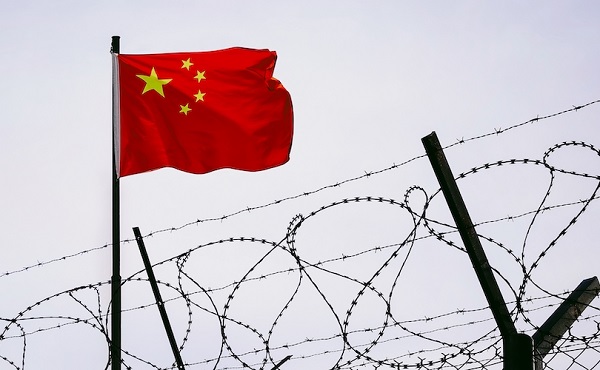
Communist China arrests hundreds of Christians just days before Christmas
-
 Energy24 hours ago
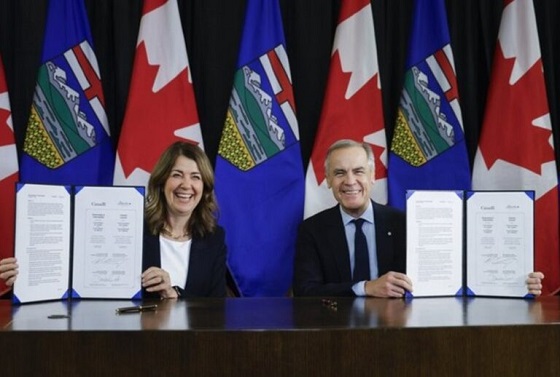
The Top News Stories That Shaped Canadian Energy in 2025 and Will Continue to Shape Canadian Energy in 2026
-
 Business1 day ago
Some Of The Wackiest Things Featured In Rand Paul’s New Report Alleging $1,639,135,969,608 In Gov’t Waste
-
 Alberta2 days ago
Calgary’s new city council votes to ban foreign flags at government buildings
-
 International23 hours ago
$2.6 million raised for man who wrestled shotgun from Bondi Beach terrorist
-
 Alberta2 days ago
What are the odds of a pipeline through the American Pacific Northwest
-
 Alberta1 day ago
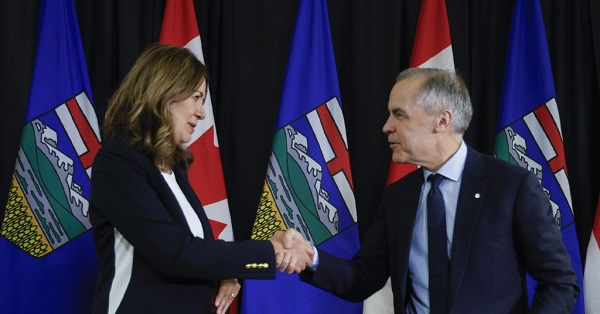
Ottawa-Alberta agreement may produce oligopoly in the oilsands