
National
Poilievre promises ‘non-confidence’ vote against Trudeau at ‘earliest possible’ moment
From LifeSiteNews
Poilievre said that it is “put up or shut up time for the NDP” under its leader Jagmeet Singh, who pulled his official support for Trudeau’s Liberals on September 4.
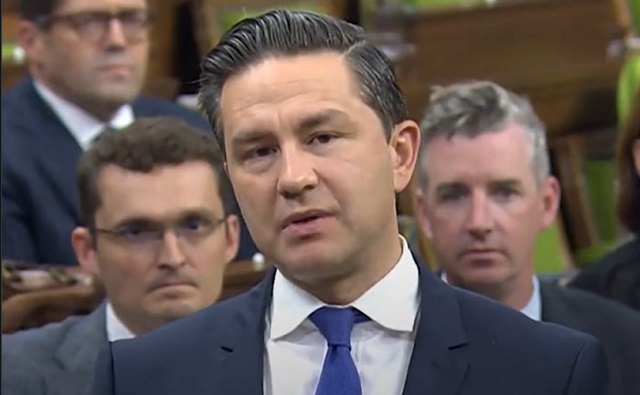
Leader of Canada’s Conservative Party Pierre Poilievre said that at the “earliest possible opportunity” he will bring forth a non-confidence motion against Prime Minister Justin Trudeau’s Liberal government which, if successful, would force an immediate election.
“I’m announcing the common-sense Conservatives will put forward a non-confidence motion at the earliest possible opportunity,” said Poilievre to reporters at a press conference in Ottawa Wednesday.
Poilievre said that it is “put up or shut up time for the NDP” under its leader Jagmeet Singh, who pulled his official support for Trudeau’s Liberals on September 4.
“If you’re pulling out, you have to vote non-confidence. If you don’t, you’re still in the agreement, no matter what your video stunt would have everyone else believe,” said Poilievre.
He then questioned whether the NDP will vote non-confidence to “bring down the costly coalition and trigger a carbon tax election,” or if Singh instead will “sell out Canadians again?”
For a non-confidence motion to be successful, Poilievre will need the direct support of both the NDP and separatist Bloc Québécois.
Parliament is set to resume sitting next week.
As reported by LifeSiteNews, the Bloc Québécois recently hinted that an alliance between the separatist party and the Liberals under Trudeau could become a reality. However, Bloc leader Yves-François Blanchet has since flip-flopped and said this would not be the case.
As for Singh, on Wednesday he would not commit to voting with the Conservatives, instead saying he would “make a determination of what’s in the best interest of Canadians.”
Regardless of the outcome, Trudeau political woes continue to mount. LifeSiteNews recently reported how national elections campaign director for the Liberal Party announced he was stepping down because, according to sources close to the party, he does not think Trudeau can win a fourth consecutive election.
The most recent poll, which was taken after Singh terminated his agreement with Trudeau, shows that were an election held today, Poilievre’s Conservatives would grab 51 percent of voters in Ontario alone, the highest number ever recorded.
Canada-wide, 45 percent of Canadians said they would vote Conservative, with the Liberals coming in at second place with 25 percent, followed by the NDP at 15 percent
Economy
Affordable housing out of reach everywhere in Canada
From the Fraser Institute
By Steven Globerman, Joel Emes and Austin Thompson
According to our new study, in 2023 (the latest year of comparable data), typical homes on the market were unaffordable for families earning the local median income in every major Canadian city
The dream of homeownership is alive, but not well. Nearly nine in ten young Canadians (aged 18-29) aspire to own a home—but share a similar worry about the current state of housing in Canada.
Of course, those worries are justified. According to our new study, in 2023 (the latest year of comparable data), typical homes on the market were unaffordable for families earning the local median income in every major Canadian city. It’s not just Vancouver and Toronto—housing affordability has eroded nationwide.
Aspiring homeowners face two distinct challenges—saving enough for a downpayment and keeping up with mortgage payments. Both have become harder in recent years.
For example, in 2014, across 36 of Canada’s largest cities, a 20 per cent downpayment for a typical home—detached house, townhouse, condo—cost the equivalent of 14.1 months (on average) of after-tax income for families earning the median income. By 2023, that figure had grown to 22.0 months—a 56 per cent increase. During the same period for those same families, a mortgage payment for a typical home increased (as a share of after-tax incomes) from 29.9 per cent to 56.6 per cent.
No major city has been spared. Between 2014 and 2023, the price of a typical home rose faster than the growth of median after-tax family income in 32 out of 36 of Canada’s largest cities. And in all 36 cities, the monthly mortgage payment on a typical home grew (again, as a share of median after-tax family income), reflecting rising house prices and higher mortgage rates.
While the housing affordability crisis is national in scope, the challenge differs between cities.
In 2023, a median-income-earning family in Fredericton, the most affordable large city for homeownership in Canada, had save the equivalent of 10.6 months of after-tax income ($56,240) for a 20 per cent downpayment on a typical home—and the monthly mortgage payment ($1,445) required 27.2 per cent of that family’s after-tax income. Meanwhile, a median-income-earning family in Vancouver, Canada’s least affordable city, had to spend the equivalent of 43.7 months of after-tax income ($235,520) for a 20 per cent downpayment on a typical home with a monthly mortgage ($6,052) that required 112.3 per cent of its after-tax income—a financial impossibility unless the family could rely on support from family or friends.
The financial barriers to homeownership are clearly greater in Vancouver. But, crucially, neither city is truly “affordable.” In Fredericton and Vancouver, as in every other major Canadian city, buying a typical home with the median income produces a debt burden beyond what’s advisable. Recent house price declines in cities such as Vancouver and Toronto have provided some relief, but homeownership remains far beyond the reach of many families—and a sharp slowdown in homebuilding threatens to limit further gains in affordability.
For families priced out of homeownership, renting doesn’t offer much relief, as rent affordability has also declined in nearly every city. In 2014, rental rates for the median-priced rental unit required 19.8 per cent of median after-tax family income, on average across major cities. By 2023, that figure had risen to 23.5 per cent. And in the least affordable cities for renters, Toronto and Vancouver, a median-priced rental required more than 30 per cent of median after-tax family income. That’s a heavy burden for Canada’s renters who typically earn less than homeowners. It’s also an added financial barrier to homeownership— many Canadian families rent for years before buying their first home, and higher rents make it harder to save for a downpayment.
In light of these realities, Canadians should ask—why have house prices and rental rates outpaced income growth?
Poor public policy has played a key role. Local regulations, lengthy municipal approval processes, and costly taxes and fees all combine to hinder housing development. And the federal government allowed a historic surge in immigration that greatly outpaced new home construction. It’s simple supply and demand—when more people chase a limited (and restricted) supply of homes, prices rise. Meanwhile, after-tax incomes aren’t keeping pace, as government policies that discourage investment and economic growth also discourage wage growth.
Canadians still want to own homes, but a decade of deteriorating affordability has made that a distant prospect for many families. Reversing the trend will require accelerated homebuilding, better-paced immigration and policies that grow wages while limiting tax bills for Canadians—changes governments routinely promise but rarely deliver.
Business
Canada invests $34 million in Chinese drones now considered to be ‘high security risks’
From LifeSiteNews
Of the Royal Canadian Mounted Police’s fleet of 1,200 drones, 79% pose national security risks due to them being made in China
Canada’s top police force spent millions on now near-useless and compromised security drones, all because they were made in China, a nation firmly controlled by the Communist Chinese Party (CCP) government.
An internal report by the Royal Canadian Mounted Police (RCMP) to Canada’s Senate national security committee revealed that $34 million in taxpayer money was spent on a fleet of 973 Chinese-made drones.
Replacement drones are more than twice the cost of the Chinese-made ones between $31,000 and $35,000 per unit. In total, the RCMP has about 1,228 drones, meaning that 79 percent of its drone fleet poses national security risks due to them being made in China.
The RCMP said that Chinese suppliers are “currently identified as high security risks primarily due to their country of origin, data handling practices, supply chain integrity and potential vulnerability.”
In 2023, the RCMP put out a directive that restricted the use of the made-in-China drones, putting them on duty for “non-sensitive operations” only, however, with added extra steps for “offline data storage and processing.”
The report noted that the “Drones identified as having a high security risk are prohibited from use in emergency response team activities involving sensitive tactics or protected locations, VIP protective policing operations, or border integrity operations or investigations conducted in collaboration with U.S. federal agencies.”
The RCMP earlier this year said it was increasing its use of drones for border security.
Senator Claude Carignan had questioned the RCMP about what kind of precautions it uses in contract procurement.
“Can you reassure us about how national security considerations are taken into account in procurement, especially since tens of billions of dollars have been announced for procurement?” he asked.
“I want to make sure national security considerations are taken into account.”
The use of the drones by Canada’s top police force is puzzling, considering it has previously raised awareness of Communist Chinese interference in Canada.
Indeed, as reported by LifeSiteNews, earlier in the year, an RCMP internal briefing note warned that agents of the CCP are targeting Canadian universities to intimidate them and, in some instances, challenge them on their “political positions.”
The final report from the Foreign Interference Commission concluded that operatives from China may have helped elect a handful of MPs in both the 2019 and 2021 Canadian federal elections. It also concluded that China was the primary foreign interference threat to Canada.
Chinese influence in Canadian politics is unsurprising for many, especially given former Prime Minister Justin Trudeau’s past admiration for China’s “basic dictatorship.”
As reported by LifeSiteNews, a Canadian senator appointed by Trudeau told Chinese officials directly that their nation is a “partner, not a rival.”
China has been accused of direct election meddling in Canada, as reported by LifeSiteNews.
As reported by LifeSiteNews, an exposé by investigative journalist Sam Cooper claims there is compelling evidence that Carney and Trudeau are strongly influenced by an “elite network” of foreign actors, including those with ties to China and the World Economic Forum. Despite Carney’s later claims that China poses a threat to Canada, he said in 2016 the Communist Chinese regime’s “perspective” on things is “one of its many strengths.”
-
Automotive2 days agoTrump Deals Biden’s EV Dreams A Death Blow
-
Business1 day agoLoblaws Owes Canadians Up to $500 Million in “Secret” Bread Cash
-
Automotive2 days agoCanada’s EV Mandate Is Running On Empty
-
Business1 day agoWhy Does Canada “Lead” the World in Funding Racist Indoctrination?
-
Dan McTeague1 day agoWill this deal actually build a pipeline in Canada?
-
Media1 day agoThey know they are lying, we know they are lying and they know we know but the lies continue
-
Censorship Industrial Complex1 day agoUS Condemns EU Censorship Pressure, Defends X
-
Banks1 day agoTo increase competition in Canadian banking, mandate and mindset of bank regulators must change