
Business
PBO report projects soaring deficit and debt interest charges


The Canadian Taxpayers Federation is calling on Prime Minister Mark Carney to cut spending following today’s Parliamentary Budget Officer report forecasting the deficit to “increase sharply.”
“The PBO report should be a five-alarm siren to end the government’s debt-fueled spending spree,” said Franco Terrazzano, CTF Federal Director. “Carney must change course and cut spending because taxpayers can’t afford to pay more than $1 billion every week to cover the government’s debt interest charges.”
The PBO’s Economic and Fiscal Outlook projects this year’s “deficit to increase sharply to $68.5 billion.”
Carney’s annual borrowing will add about $255 billion to the debt over four years, according to today’s PBO report. For comparison, former prime minister Justin Trudeau planned on increasing the debt by $131 billion over those years, according to the most recent Fall Economic Statement.
Debt interest charges will cost taxpayers $55.3 billion this year, according to the PBO. That means the federal government will waste more money paying interest on the debt than it sends to the provinces in health-care transfers ($54.7 billion). Debt interest charges will cost taxpayers $82.4 billion in 2030.
“The federal debt-to-GDP ratio is projected to increase from 41.7 per cent in 2024-25, rising above 43 per cent over the medium term,” according to the PBO.
The Carney government’s spending is projected to increase by billions of dollars every year, according to the PBO.
“Carney sold Canadians on the idea he wasn’t like Trudeau and when it comes to the debt here’s the truth: Carney plans to borrow billions of dollars more than Trudeau,” Terrazzano said. “After a decade of out-of-control spending, Carney must make government more affordable and cut spending.”
The Carney government will release its first budget on Nov. 4.


From LifeSiteNews
Ex-Finance Minister Chrystia Freeland announced her resignation from Parliament amid Conservative criticism that she can’t serve Canada while working for a foreign government.
Liberal MP Chrystia Freeland is stepping down from Parliament after being appointed as an adviser in Ukraine.
In a January 5 post on X, Ukrainian President Volodymyr Zelensky shared the appointment of Freeland as an economic adviser to Ukraine, prompting Freeland to announce her resignation from the Canadian Parliament hours later.
“Today, I appointed Chrystia Freeland @cafreeland as an Advisor on Economic Development,” Zelensky wrote. “Chrystia is highly skilled in these matters and has extensive experience in attracting investment and implementing economic transformations.”
News of her appointment was blasted by Conservatives, who quickly pointed out that Freeland’s position in the Ukrainian government would compromise her work within the Canadian Parliament.
“You cannot serve as a member of Parliament (and collect an MP salary) while working for a foreign government,” Conservative MP Andrew Lawton wrote on X. “It’s that simple.”
Freeland responded to the backlash just hours later, revealing that she plans to resign from Parliament in the coming weeks.
“In accepting this voluntary position, I will be stepping aside from my role as the Prime Minister’s Special Representative for the Reconstruction of Ukraine,” she wrote.
“In the coming weeks, I will also leave my seat in Parliament. I want to thank my constituents for their years of confidence in me. I am so grateful to have been your representative,” Freeland concluded.
Despite serving as a Canadian MP, Freeland’s dedication to Ukraine has played an important role in her career since the beginning of the Ukraine and Russia conflict in 2022. Already, Freeland was serving as Prime Minister Mark Carney’s Canada’s new Special Representative for the Reconstruction of Ukraine.
In May, Freeland was appointed minister of transport and internal trade in Carney’s cabinet after the federal election. Freeland was previously former Prime Minister Justin Trudeau’s deputy prime minister and finance minister.
However, she resigned from these positions in December 2024 after Trudeau requested her resignation as finance minister.
During her time in power, Freeland was known for her ties to globalist groups and her heavy-handed response to anti-mandate protesters during COVID.
During the 2022 Freedom Convoy to protest ongoing COVID regulations, Freeland froze the bank accounts of Canadians, who donated to the protest without a court order.
Later, hearings revealed that Freeland told fellow cabinet members the Freedom Convoy supporters whose bank accounts were frozen under the Emergencies Act would not be able to access their funds until they first reported to police.
Freeland was also personally commended by Klaus Schwab, the founder of the World Economic Forum, for working to achieve his globalist goals.
In addition to attending WEF meetings, Freeland is currently a member of the WEF Board of Trustees.
Freeland also touted the WEF’s anti-carbon narrative just days after a “renewable” energy crisis left many Canadians without power during one of 2024’s coldest weeks.
Business
President Trump And The Doomsday Glacier… a blow to the planet, or to funding for climate alarmism?


From the Daily Caller News Foundation
By Steve Milloy
President Donald Trump is driving climate researchers literally to the ends of the Earth as they try to save their taxpayer funding. Expect to see a slew of hand-wringing reports about, and even perhaps from, the Thwaites (aka “Doomsday”) glacier in West Antarctica.
The glacier got its nickname from a Rolling Stone reporter in 2017 in an article titled: “The Doomsday Glacier: In the farthest reaches of Antarctica, a nightmare scenario of crumbling ice – and rapidly rising seas – could spell disaster for a warming planet.”
Past the ominous title, the scare is that the Thwaites is melting and could raise sea levels by 10 feet, which would submerge about 2-3 percent of the global land mass, excluding Antarctica.
Last May, the Trump administration announced it would cut funding for the Nathaniel B. Palmer, a football field-long icebreaker that has been taking researchers to study the Thwaites glacier. In its 2026 budget request, the National Science Foundation said it was terminating the lease. There is no replacement ship on the horizon.
Researchers wanting to go to Antarctica, where it is now summer, have had to scramble for ships. This scramble has been made more challenging because ship owners and researchers, afraid of losing taxpayer funding, are also taking reporters and their crews along to dramatize the budget cuts using the backdrop of the scariest thing they can imagine – the Doomsday glacier.
New York Times reporter Raymond Zhong has already filed articles since Dec. 30. PBS has a reporter aboard a ship sending alarmist reports. Undoubtedly, there are other reports on their way as well.
Will the Doomsday glacier live up to its name? Or will it be another in a long line of failed, if not dishonest, apocalyptic climate predictions?
It seems to be true that the Thwaites glacier is melting. But there’s much more to consider just than that.
The rate of melting is very slow. A 2023 study estimated that over the next 50 years, the Thwaites glacier might add as much as a few millimeters (about one-tenth of an inch) to global sea level over the next 50 years. That is a far cry from the claim of 10 feet of sea level rise.
Next, the fate of the Thwaites doesn’t seem to have anything to do with emissions or “global warming.” Research indicates that there are 91 volcanoes under the West Antarctic ice sheet. Not surprisingly, the Thwaites glacier is melting from the inferno beneath.
Of course, the Thwaites couldn’t be melting at the surface because there’s been no warming in West Antarctica since the late 1990s. In fact, West Antarctica has cooled by about 3°F since 1999.
Another recent study reported that the Thwaites glacier started melting in the 1940s as the result of an El Nino, a little-understood, but periodic natural warming of the Pacific Ocean: “The glacier retreat in the Amundsen Sea was initiated by natural climate variability in the 1940s. That ice streams such as Thwaites Glacier and Pine Island Glacier have continued to retreat since then indicates that they were unable to recover after the exceptionally large El Niño event of the 1940s,” the researchers concluded.
The more one reads about the Thwaites glacier, the easier it becomes to understand why they have to call it the “Doomsday glacier.” Once you understand the non-threatening reality, the only way to make it scary is to give it a scary name and hope people are too frightened to look past it.
Three cheers for Trump for defunding this and other climate research. As these researchers lose their funding, maybe they can move to Hollywood and try writing disaster scripts.
Steve Milloy is a biostatistician and lawyer. He posts on X at @JunkScience.


The U.S. Just Removed a Dictator and Canada is Collateral Damage
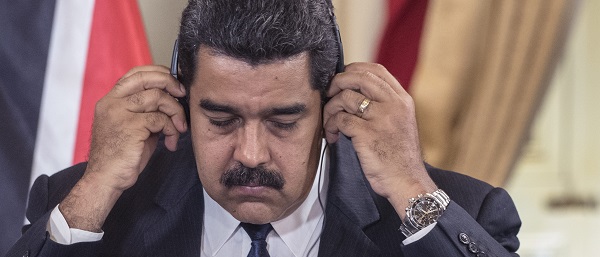
Scathing Indictment Claims Nicolás Maduro Orchestrated Drug-Fueled ‘Culture Of Corruption’ Which Plagued Entire Region

US Justice Department Accusing Maduro’s Inner Circle of a Narco-State Conspiracy
Trump Says U.S. Strike Captured Nicolás Maduro and Wife Cilia Flores; Bondi Says Couple Possessed Machine Guns
-
 Daily Caller1 day ago
Minnesota Governor resigns from re-election campaign as massive government frauds revealed
-
 Environment1 day ago
Left-wing terrorists sabotage German power plant, causing massive power outage
-
 International20 hours ago
Poilievre, Carney show support for Maduro capture as NDP’s interim leader denounces it
-
 Energy1 day ago
Trump’s Venezuela Move: A $17 Trillion Reset of Global Geopolitics and a Pivotal Shift in US Energy Strategy
-
 International1 day ago
Maduro, wife plead not guilty in first court appearance
-
 Frontier Centre for Public Policy1 day ago
Is Canada still worth the sacrifice for immigrants?
-
 Education1 day ago
Mother petitions Supreme Court after school hid daughter’s ‘gender transition’
-
 Bruce Dowbiggin1 day ago
The Olympic Shutout: No Quebec Players Invited For Canada