
C2C Journal
Parks Canada Tries to Cancel Sir John A. Macdonald in his Own Home

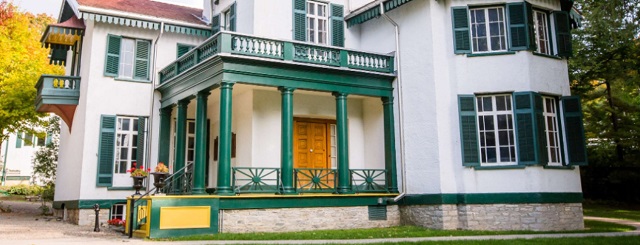
From the C2C Journal
By Greg Piasetzki
“You can’t go home again,” American novelist Thomas Wolfe once wrote. Should the same advice apply to the home of Canada’s most important political personality? Greg Piasetzki first visited Bellevue House, one-time Kingston abode of Canada’s founding father Sir John A. Macdonald, when he was a university student in the 1970s. Now, following a controversial renovation of the site by Parks Canada that aims to tell “broader, more inclusive stories about Canada’s first prime minister” – a makeover that includes signs denouncing Macdonald as “a monster” in his own home – Piasetzki returns to Bellevue House to take the measure of the changes.
When my wife and I were students at Queen’s University in Kingston, Ontario in 1978, we often spent our weekends enjoying the city’s many delightful amenities, including sailing on Lake Ontario and visiting local historic sites. Among the places we frequented was Bellevue House, the one-time home of Kingston’s most famous resident and Canada’s first prime minister, Sir John A. Macdonald.
Built in 1840 by a wealthy local merchant and rented to Macdonald and his wife Isabella in 1848-1849, the house is a striking example of the Italianate style of architecture that was new at the time and quickly became popular among the well-to-do. With expectations that Kingston might soon become the capital of Canada, the ambitious Macdonald settled into the glamourous residence as a recently-elected legislator for Canada West (present-day Ontario) in pre-Confederation Canada.
 Bellevue House was the Kingston, Ontario home of Sir John A. Macdonald, Canada’s first prime minister, (top left) and his wife Isabella (top right) in the 1840s; it was later purchased by the federal government ahead of Canada’s 1967 Centennial and designated a National Historic Site in 1995. At bottom, the house circa 1891. (Source of bottom photo: Courtesy of Agnes Etherington Art Centre)
It was not a happy time for the young family, unfortunately. The rent on the house was beyond their modest means and their first son, John Jr., died there as an infant. The Macdonalds left Bellevue House shortly afterwards. The house remained a private residence until the federal government purchased it in 1964 and turned it into an historic park as part of Canada’s 1967 Centennial celebrations; it was designated a national historic site in 1995. When we first visited, Bellevue House looked every one of its 138 years.
Despite its fascinating backstory, Bellevue House in 1978 was a rather dreary experience. There was no bright and airy visitor centre on the grounds to welcome guests, as there is now. The house itself was poorly lit and signage inside said little about Macdonald or his many accomplishments. (Perhaps because most visitors learned all about him in school.) Several of the upstairs rooms were closed to the public and the washrooms were located in a grim basement. The surrounding gardens were also quite spartan. Visitors mostly came to admire the architecture and period furnishings (or what they could make out in the gloom) and pay homage to Canada’s founding father.
Major renovations were carried out in the 1980s, including construction of a reception centre where the carriage house used to be. Two upstairs rooms were re-opened as period bedrooms and the basement was returned to its original role as a scullery; the public washrooms were moved to the new visitor centre. Despite the improvements, however, the house’s aging infrastructure – floors, wiring, roof, and so on – remained largely untouched and slowly rotted away during the ensuing years.
In 2012, Prime Minister Stephen Harper’s Conservative government dramatically reduced Parks Canada funding as part of its plan to return the federal budget to balance. Along with many other historic sites across the country, Bellevue House had its opening hours and staff sharply reduced. Necessary structural repairs were also put off. By 2017 it was in such bad shape that it was closed year-round. This past May it was finally reopened to the public. According to Parks Canada, which oversees Canada’s historic sites, the “extensive renewal” of Bellevue House now “tells broader, more inclusive stories about Canada’s first Prime Minister, Sir John A. Macdonald.” It’s a good news/bad news situation.
 “Extensive renewal”: Bellevue House was closed in 2017 due to its deteriorating condition; Parks Canada re-opened it to the public in May 2024 following a comprehensive modernization project. Shown, Bellevue House undergoing repairs in 2020. (Source of photo: Bellevue House National Historic Site/Facebook)
First the Good News
This summer my wife and I returned to Bellevue House for the first time since our student days. We are pleased to report it looks fantastic. The new stucco, moulding, panelling, paint and roof work have the place literally gleaming. The gardens have been enlarged and are now well-suited to a leisurely ramble. A spacious parking area has also been added since we last visited. The well-lit rooms are packed with decorative and practical articles from Macdonald’s era. And a team of eager young staff seem well-informed and keen to engage with visitors, although they’ll leave you alone if you prefer to wander at your own pace.
Given the impressive modernization effort, Bellevue House is arguably in better shape today than when it was first built. And that is important. While Macdonald’s short stay at Bellevue House was not a particularly happy one, the building itself is clearly part of Canada’s political and historical heritage. It certainly has a stronger claim on our patrimony than the many colonial-era inns throughout New England that boast “George Washington once slept here” have on America’s past. As Canada’s most important historical figure, part of Macdonald’s legacy is embodied in this house. And now it has been returned to the state of its glory days in the 1840s when Kingston was a city of destiny and Macdonald a young politician on the move. That alone is a very good thing.
 This old house looks great: The renovations of Bellevue House have transformed the structure into a beautiful representation of upper-class living in pre-Confederation Canada. Clockwise from top left: the visitor centre, Parks Canada staff in period garb, the dining room and the parlour. (Sources of photos: (top and bottom left) Bellevue House National Historic Site/Facebook; (bottom right) Dan Taekema/CBC)
Then the Bad News
Unfortunately, Bellevue House has become yet another battlefield in the federal Liberal’s war against what are sneeringly referred to as “dead white males” and the alleged evils of colonialism. As such, it reflects the lamentable decline in historical competency throughout Parks Canada’s portfolio. Bellevue House further reveals the apparent requirement under the Justin Trudeau government’s sweeping policy of “reconciliation” that Indigenous opinion be inserted into all possible government activities and institutions, regardless of relevancy or accuracy. As such, no opportunity is missed to paint our first prime minister in as unfavourable a light as possible. The goal, it appears, is to cancel Macdonald in his own house. This makes for a rather odd visitor experience.
After making one’s way through the welcome centre, guests are confronted with a variety of messages along the path to Bellevue House. Purportedly garnered from comments by earlier visitors, the messages range from entirely factual, such as, “We wouldn’t have Canada without him,” to the deliberately unsetting “He was a monster.” Without any context for this commentary, visitors – and especially impressionable young schoolchildren – will quickly figure out which responses comprise the “proper” view of the man.
 The bad news: In keeping with the Justin Trudeau government’s apparent mission to denigrate and erase important figures from Canada’s colonial history, a sign on the path to Bellevue House claims Macdonald was a “monster”. (Source of photo: Dan Taekema/CBC)
The federal government’s plan to tell “broader and more inclusive stories” about Macdonald is as subtle as a sledgehammer. According to its opening-day press release, Parks Canada “formed working groups with Indigenous partners, culturally diverse members of Kingston and area communities…to share stories and develop new exhibit content.” Native Canadians may have plenty of stories to tell about Macdonald (although no Indigenous person alive today knew Macdonald personally or had any direct experience of him). But are they historically true and relevant to his time at Bellevue?
As visitors make their way through the house, they will notice nearly every room has some sort of aboriginal artifact on display. Some additions are modest and easily overlooked. On the main floor, for example, a dining room filled with Victorian-era dishes, candelabra and other knick-knacks also holds a side table with a collection of indigenous herbs such as sweetgrass, tobacco and sage; there are also books of native art on the shelves. It seems unlikely any of this would have been here when Macdonald rented the house. Then again, nearly all the items on display have no direct connection to Macdonald.
Upstairs the mood turns far more serious. A nursery with cradle (possibly the only authentic Macdonald artifact in the entire house) evokes a somber mood given the death of John Jr. On display in the same room, however, is a cradleboard used to secure an aboriginal infant to her mother’s back. And on the walls are excerpts from Macdonald’s speeches in the House of Commons promoting residential schools as the means to assimilate native children into Canadian society.
 Repeat after me, colonialism, genocide and racism: Bellevue House is incongruously filled with numerous Indigenous artifacts and informational displays that attack or undermine Macdonald’s many great accomplishments. (Source of photo: Bellevue House National Historic Site/Facebook)
The obvious goal is to remind visitors of the impact residential schools had on aboriginal children in the very bedroom where Macdonald’s own child died. If visitors still don’t get the message, a video screen blares out interviews with residential school “survivors” on an endless loop. Children as young as four-years old, guests are informed, were forcibly removed from their families and sent to such schools, perpetrating “violent assimilation and abuse”. We are meant to have no sympathy for Macdonald’s own tragic loss.
In other second floor rooms, informative panels variously describe Macdonald the man, the politician and nation builder. These achievements – saving the Canadian colonies from being swallowed up by the United States, bringing them together into Confederation and binding the country with a transcontinental railway, among other feats of statesmanship – will be familiar to anyone who has read one of the many biographies of Macdonald, including Richard Gwyn’s magnificent two-volume work.
But wherever Macdonald’s very real achievements are mentioned, they are always married with some sort of attack on his policies, personal character or the era in which he lived. Besides residential schools, this includes the starvation of Indigenous tribes on the Prairies in the 1890s, the Chinese head tax and on and on. “His vision for Canada did not include everyone,” states one sign, deliberately undercutting his commitment to Canadian democracy. A lexicon helpfully defines key terms visitors will encounter repeatedly throughout the house: colonialism, genocide, racism et cetera.
“Stories” in Abundance, Truth in Short Supply
At Bellevue House’s reopening ceremonies in May, Rodrick Donald Maracle, Chief of the Mohawks of the Bay of Quinte, exclaimed, “Macdonald supported oppression of Indigenous Peoples’ identity; their language, spirituality, the places they came from were stripped from them…The new exhibits at Bellevue House provide a place where truths about Macdonald are able to be fully discussed.”
Maracle’s unrestrained antipathy towards Macdonald is clearly the prime example of the “broader and more inclusive stories” Parks Canada wants Bellevue House to tell. Despite its explicit mandate to “protect and present nationally significant examples of Canada’s natural and cultural heritage and foster public understanding,” Parks Canada makes no effort to let visitors know which stories are legitimate and which are pure fiction.
In an interview with a travel writer for The Globe and Mail, Tamara van Dyk, Bellevue’s Visitor Experience Manager, said, “We can’t tell [visitors] how to feel about this history. But we can help them to understand this history…we share facts, non-biased facts.” This is a transparent cop-out; Parks Canada controls the narrative by choosing which “facts” to present and which to omit. Indeed, it deliberately misses numerous opportunities to provide visitors with crucial “non-biased” facts about Macdonald’s actual accomplishments and beliefs. (The Globe article is also noteworthy for its grotesque error in claiming the “confirmation, in 2021, of hundreds of unmarked graves discovered on the grounds of Canada’s residential schools.” There was never any such “confirmation” and, where excavations at suspected grave sites have been subsequently performed, no human remains have been unearthed.)
 Controlling the narrative: Rodrick Donald Maracle, Chief of the Mohawks of the Bay of Quinte, used the re-opening ceremonies at Bellevue House to declare that “Macdonald supported oppression of Indigenous Peoples’ identity.”
Among the ample exculpatory evidence about Macdonald missing from Bellevue House’s numerous information plaques and displays is that most Indigenous students during Macdonald’s era went to day schools, not residential schools. Further, between 1891, when Macdonald died, and 1950, half of all residential school students dropped out after grade 1, hardly indicative of a program of “violent assimilation”. Children at residential schools were also sent home to their parents for a two-month summer holiday every year and, if practical, for the Christmas and Easter holidays as well. These facts – verifiable and true – are entirely inconsistent with the suggestion Macdonald deliberately plotted genocide, cultural or otherwise.
Also unmentioned is the Macdonald government’s extremely successful smallpox vaccination campaign for native Canadians. Over a period of more than 20 years, the Government of Canada sought to inoculate every Indigenous resident. Some natives were inoculated twice and, in at least one instance, a group of natives received their shots before local white residents did. If genocide was Macdonald’s goal, why go to such trouble to save so many Indigenous people from disease?
Similarly, despite the surfeit of Indigenous content in nearly every room, no mention is ever made of Macdonald’s many friendships with prominent aboriginal Canadians. This includes Oronhyatekha (aka Burning Cloud), a member of the Six Nations Confederacy who attended the Mohawk Institute Residential School and later graduated from the universities of Toronto and Oxford. Oronhyatekha campaigned for Macdonald in the 1872 election and later named his first child after him.
 Despite the surfeit of Indigenous content in Bellevue House, there is no mention of Macdonald’s friendship with several prominent aboriginal Canadians, including Oronhyatekha, aka Burning Cloud (left) and Kahkewaquonaby, aka Peter Jones (right). Both earned university degrees (Oronhyatekha also attended a residential school) and played significant roles in Macdonald’s political campaigns.
Another close contact was Kahkewaquonaby (aka Peter Jones), the head chief of the Mississauga of New Credit, who received his medical degree from Queen’s University in 1866 and acted as a political organizer for Macdonald. He was also consulted on changes to the federal Electoral Franchise Act in 1885, an effort by Macdonald to give all native Canadians the vote, but which was stymied by his political opponents.
As to the Chinese head tax, the historical record shows Macdonald was a consistent foe of the idea; his instincts were always to defend minority rights. It was his political adversaries, largely anti-immigrant nativists in British Columbia, who forced Macdonald’s hand on the matter. When head tax proponents first demanded a $100-per-person tax, he appointed a Commission that countered with a very modest $10. And while Macdonald’s government eventually settled on $50, the tax had no appreciable impact on Chinese immigration. It was Macdonald’s Liberal successor, Sir Wilfrid Laurier, who hiked it to an unaffordable $500, effectively shutting down Chinese immigration for many years.
The Summing Up
Parks Canada’s revitalization of Bellevue House presents an opportunity to make a meaningful contribution to the debate about Macdonald’s place in our country’s history at a time when his reputation has come under assault from many sides. Clearly, this effort is not entirely successful. A magnificent renovation and modernization project has been marred by decolonization faddism. But is the good of its physical make-over outweighed by the bad of the historical nonsense?
Putting myself in a judge’s seat and based on my experiences at the property in 1978 and today, I find the changes to Bellevue House are, on balance, a benefit to Canada. The haphazard insertion of Indigenous artifacts in the room displays and the validation of untrue or hopelessly biased “stories” about Macdonald is certainly disconcerting and distracting at times. Yet many of these additions are so irrelevant or harmless – the native herbs in the dining room, a red ribbon dress in Macdonald’s own dressing room – that the visitor can easily disregard them.
 For all time: Macdonald’s significance as Canada’s pre-eminent statesman is what draws visitors to Bellevue House. And this record of achievement is sturdy enough to survive any attempt to cancel him, even by the current federal government. Shown, Macdonald, standing at centre, in Robert Harris’ famous painting Fathers of Confederation, circa 1884.


By Peter Best
What do children owe their parents? Love, honour and respect are a good start. But what about parents who were once political figures – does the younger generation owe a duty of care to the beliefs of their forebears?
Two recent cases in Canada highlight the inter-generational conflict at play in Canada over Indigenous politics. One concerns Prime Minister Mark Carney and his father Robert. The other, a recent book on the life of noted aboriginal thinker William Wuttunee edited by his daughter Wanda. In each case, the current generation has let its ancestors down – and left all of Canada worse off.
William Wuttunee was born in 1928 in a one-room log cabin on a reserve in Saskatchewan, where he endured a childhood of poverty and hardship. Education was his release, and he went on to become the first aboriginal to practice law in Western Canada; he also served as the inaugural president of the National Indian Council in 1961.
Wuttunee rose to prominence with his controversial 1971 book Ruffled Feathers, that argued for an end to Canadian’s Indian Reserve system, which he believed trapped his people in poverty and despair. He dreamed of a Canada where Indigenous people lived side-by-side all other Canadians and enjoyed the same rights and benefits.
Such an argument for true racial equality put Wuttunee at odds with the illiberal elite of Canada’s native community, who still believe in a segregated, race-based relationship between Indigenous people and the rest of Canada. For telling truth to power, Wuttunee was ostracized from the native political community and banned from his own reserve. He died in 2015.
This year, William’s daughter Wanda had the opportunity to rectify the past mistreatment of her father. In the new book Still Ruffling Feathers – Let Us Put Our Minds Together, Wanda, an academic at the University of Manitoba, and several other contributors claim to “fearlessly engage” with her father’s ideas. Unfortunately, the authors mostly seek to bury, rather than
praise, Wuttunee’s vision of one Canada for all.
Wanda claims her father’s desire for a treaty-free, reserve-free Canada would be problematic today because it would have required giving up all the financial and legal goodies that have since been showered upon Indigenous groups. But there is a counterfactual to consider. What if Indigenous Canadians had simply enjoyed the same incremental gains in income, health and other social indicators as the rest of the country during this time?
Ample evidence on the massive and longstanding gap between native and non-native Canadians across a wide variety of socio-economic indicators suggest that integration would have been the better bet. The life expectancy for Indigenous Albertans, for example, is a shocking 19 years shorter than for a non-native Albertans. William Wuttunee was right all along about the damage done by the reserve system. And yet nearly all of the contributors to Wanda’s new book refuse to admit this fact.
The other current example concerns Robert Carney, who had a long and distinguished career in aboriginal education. When the future prime minister was a young boy, Robert was the principal of a Catholic day school in Fort Smith, Northwest Territories; he later became a government administrator and a professor of education. What he experienced throughout his
lifetime led the elder Carney to become an outspoken defender of Canada’s now-controversial residential schools.
When the 1996 Royal Commission on Aboriginal Peoples (RCAP) attacked the legacy of residential schools, Carney penned a sharp critique. He pointed out that the schools were not jails despite frequent claims that students were there against their will; in fact, parents had to sign an application form to enroll their children in a residential school. Carney also bristled at
the lack of context in the RCAP report, noting that the schools performed a key social welfare function in caring for “sick, dying, abandoned and orphaned children.”
In the midst of the 2025 federal election campaign, Mark Carney was asked if he agreed with his father’s positive take on residential schools. “I love my father, but I don’t share those views,” he answered. Some Indigenous activists have subsequently accused Robert Carney of residential school “denialism” and “complicity” in the alleged horrors of Canada’s colonial education system.
Like Wanda Wuttunee, Mark Carney let his father down by distancing himself from his legacy for reasons of political expediency. He had an opportunity to offer Canadians a courageous and fact-based perspective on a subject of great current public interest by drawing upon his intimate connection with an expert in the field. Instead, Mark Carney caved to the
requirements of groupthink. As a result, his father now stands accused of complicity in a phony genocide.
As for William Wuttunee, he wanted all Canadians – native and non-native alike – to be free from political constraints. He rejected racial segregation, discrimination and identity politics in all forms. And yet in “honouring” his life’s work, his daughter misrepresents his legacy by sidestepping the core truths of his central belief.
No one doubts that Wanda Wuttunee and Mark Carney each loved their dads, as any son or daughter should. And there is no requirement that a younger generation must accept without question whatever their parents thought. But in the case of Wuttunee and Carney, both offspring have deliberately chosen to tarnish their fathers’ legacies in obedience to a poisonous
ideology that promotes the entirely un-Canadian ideal of permanent racial segregation and inequity. And all of Canada is the poorer for it.
Peter Best is a retired lawyer living in Sudbury, Ontario. The original, longer version of this story first appeared in C2CJournal.ca.
Artificial Intelligence
The Emptiness Inside: Why Large Language Models Can’t Think – and Never Will
This is a special preview article from the:
Early attempts at artificial intelligence (AI) were ridiculed for giving answers that were confident, wrong and often surreal – the intellectual equivalent of asking a drunken parrot to explain Kant. But modern AIs based on large language models (LLMs) are so polished, articulate and eerily competent at generating answers that many people assume they can know and, even
better, can independently reason their way to knowing.
This confidence is misplaced. LLMs like ChatGPT or Grok don’t think. They are supercharged autocomplete engines. You type a prompt; they predict the next word, then the next, based only on patterns in the trillions of words they were trained on. No rules, no logic – just statistical guessing dressed up in conversation. As a result, LLMs have no idea whether a sentence is true or false or even sane; they only “know” whether it sounds like sentences they’ve seen before. That’s why they often confidently make things up: court cases, historical events, or physics explanations that are pure fiction. The AI world calls such outputs
“hallucinations”.
But because the LLM’s speech is fluent, users instinctively project self-understanding onto the model, triggered by the same human “trust circuits” we use for spotting intelligence. But it is fallacious reasoning, a bit like hearing someone speak perfect French and assuming they must also be an excellent judge of wine, fashion and philosophy. We confuse style for substance and
we anthropomorphize the speaker. That in turn tempts us into two mythical narratives: Myth 1: “If we just scale up the models and give them more ‘juice’ then true reasoning will eventually emerge.”
Bigger LLMs do get smoother and more impressive. But their core trick – word prediction – never changes. It’s still mimicry, not understanding. One assumes intelligence will magically emerge from quantity, as though making tires bigger and spinning them faster will eventually make a car fly. But the obstacle is architectural, not scalar: you can make the mimicry more
convincing (make a car jump off a ramp), but you don’t convert a pattern predictor into a truth-seeker by scaling it up. You merely get better camouflage and, studies have shown, even less fidelity to fact.
Myth 2: “Who cares how AI does it? If it yields truth, that’s all that matters. The ultimate arbiter of truth is reality – so cope!”
This one is especially dangerous as it stomps on epistemology wearing concrete boots. It effectively claims that the seeming reliability of LLM’s mundane knowledge should be extended to trusting the opaque methods through which it is obtained. But truth has rules. For example, a conclusion only becomes epistemically trustworthy when reached through either: 1) deductive reasoning (conclusions that must be true if the premises are true); or 2) empirical verification (observations of the real world that confirm or disconfirm claims).
LLMs do neither of these. They cannot deduce because their architecture doesn’t implement logical inference. They don’t manipulate premises and reach conclusions, and they are clueless about causality. They also cannot empirically verify anything because they have no access to reality: they can’t check weather or observe social interactions.
Attempting to overcome these structural obstacles, AI developers bolt external tools like calculators, databases and retrieval systems onto an LLM system. Such ostensible truth-seeking mechanisms improve outputs but do not fix the underlying architecture.
The “flying car” salesmen, peddling various accomplishments like IQ test scores, claim that today’s LLMs show superhuman intelligence. In reality, LLM IQ tests violate every rule for conducting intelligence tests, making them a human-prompt engineering skills competition rather than a valid assessment of machine smartness.
Efforts to make LLMs “truth-seeking” by brainwashing them to align with their trainer’s preferences through mechanisms like RLHF miss the point. Those attempts to fix bias only make waves in a structure that cannot support genuine reasoning. This regularly reveals itself through flops like xAI Grok’s MechaHitler bravado or Google Gemini’s representing America’s Founding Fathers as a lineup of “racialized” gentlemen.
Other approaches exist, though, that strive to create an AI architecture enabling authentic thinking:
Symbolic AI: uses explicit logical rules; strong on defined problems, weak on ambiguity;
Causal AI: learns cause-and-effect relationships and can answer “what if” questions;
Neuro-symbolic AI: combines neural prediction with logical reasoning; and
Agentic AI: acts with the goal in mind, receives feedback and improves through trial-and-error.
Unfortunately, the current progress in AI relies almost entirely on scaling LLMs. And the alternative approaches receive far less funding and attention – the good old “follow the money” principle. Meanwhile, the loudest “AI” in the room is just a very expensive parrot.
LLMs, nevertheless, are astonishing achievements of engineering and wonderful tools useful for many tasks. I will have far more on their uses in my next column. The crucial thing for users to remember, though, is that all LLMs are and will always remain linguistic pattern engines, not epistemic agents.
The hype that LLMs are on the brink of “true intelligence” mistakes fluency for thought. Real thinking requires understanding the physical world, persistent memory, reasoning and planning that LLMs handle only primitively or not all – a design fact that is non-controversial among AI insiders. Treat LLMs as useful thought-provoking tools, never as trustworthy sources. And stop waiting for the parrot to start doing philosophy. It never will.
The original, full-length version of this article was recently published as Part I of a two-part series in C2C Journal. Part II can be read here.
Gleb Lisikh is a researcher and IT management professional, and a father of three children, who lives in Vaughan, Ontario and grew up in various parts of the Soviet Union.

Trump Deals Biden’s EV Dreams A Death Blow
Liberal bill “targets Christians” by removing religious exemption in hate-speech law

Pharma Bombshell: President Trump Orders Complete Childhood Vaccine Schedule Review

Senate votes to reopen Alaska Coastal Plain to energy leasing
-
National1 day ago
Liberal bill “targets Christians” by removing religious exemption in hate-speech law
-
 Business1 day ago
Looks like the Liberals don’t support their own Pipeline MOU
-
 Business2 days ago
The Climate-Risk Industrial Complex and the Manufactured Insurance Crisis
-
 Crime1 day ago
Inside the Fortified Sinaloa-Linked Compound Canada Still Can’t Seize After 12 Years of Legal War
-
 Health2 days ago
The Data That Doesn’t Exist
-
 Business20 hours ago
Conservative MP warns Liberals’ national AI plan could increase gov’t surveillance
-
 Business1 day ago
Canada Can Finally Profit From LNG If Ottawa Stops Dragging Its Feet
-
 Business19 hours ago
Storm clouds of uncertainty as BC courts deal another blow to industry and investment