
Business
Ottawa’s Plastics Registry A Waste Of Time And Money

From the Frontier Centre for Public Policy
By Lee Harding
Lee Harding warns that Ottawa’s new Federal Plastics Registry (FPR) may be the most intrusive, bureaucratic burden yet. Targeting everything from electronics to fishing gear, the FPR requires businesses to track and report every gram of plastic they use, sell, or dispose of—even if plastic is incidental to their operations. Harding argues this isn’t about waste; it’s about control. And with phase one due in 2025, companies are already overwhelmed by confusion, cost, and compliance.
Businesses face sweeping reporting demands under the new Federal Plastics Registry
Canadian businesses already dealing with inflation, labour shortages and tariff uncertainties now face a new challenge courtesy of their own federal government: the Federal Plastics Registry (FPR). Manufacturers are probably using a different F-word than “federal” to describe it.
The registry is part of Ottawa’s push to monitor and eventually reduce plastic waste by collecting detailed data from companies that make, use or dispose of plastics.
Ottawa didn’t need new legislation to impose this. On Dec. 30, 2023, the federal government issued a notice of intent to create the registry under the 1999 Canadian Environmental Protection Act. A final notice followed on April 20, 2024.
According to the FPR website, companies, including resin manufacturers, plastic producers and service providers, must report annually to Environment Canada. Required disclosures include the quantity and types of plastics they manufacture, import and place on the market. They must also report how much plastic is collected and diverted, reused, repaired, remanufactured, refurbished, recycled, turned into chemicals, composted, incinerated or sent to landfill.
It ties into Canada’s larger Zero Plastic Waste agenda, a strategy to eliminate plastic waste by 2030.
Even more troubling is the breadth of plastic subcategories affected: electronic and electrical equipment, tires, vehicles, construction materials, agricultural and fishing gear, clothing, carpets and disposable items. In practice, this means that even businesses whose core products aren’t plastic—like farmers, retailers or construction firms—could be swept into the reporting requirements.
Plastics are in nearly everything, and now businesses must report everything about them, regardless of whether plastic is central to their business or incidental.
The FPR website says the goal is to collect “meaningful and standardized data, from across the country, on the flow of plastic from production to its end-of-life management.” That information will “inform and measure performance… of various measures that are part of Canada’s zero plastic waste agenda.” Its stated purpose is to “keep plastics in the economy and out of the environment.”
But here’s the problem: the government’s zero plastic waste goal is an illusion. It would require every plastic item to last forever or never exist in the first place, leaving businesses with an impossible task: stay profitable while meeting these demands.
To help navigate the maze, international consultancy Reclay StewardEdge recently held a webinar for Canadian companies. The discussion was revealing.
Reclay lead consultant Maanik Bagai said the FPR is without precedent. “It really surpasses whatever we have seen so far across the world. I would say it is unprecedented in nature. And obviously this is really going to be tricky,” he said.
Mike Cuma, Reclay’s senior manager of marketing and communications, added that the government’s online compliance instructions aren’t particularly helpful.
“There’s a really, really long list of kind of how to do it. It’s not particularly user-friendly in our experience,” Cuma said. “If you still have questions, if it still seems confusing, perhaps complex, we agree with you. That’s normal, I think, at this point—even just on the basic stuff of what needs to be reported, where, when, why. Don’t worry, you’re not alone in that feeling at all.”
The first reporting deadline, for 2024 data, is Sept. 29, 2025. Cuma warned that businesses should “start now”—and some “should maybe have started a couple months ago.”
Whether companies manage this in-house or outsource to consultants, they will incur significant costs in both time and money. September marks the first phase of four, with each future stage becoming more extensive and restrictive.
Plastics are petroleum products—and like oil and gas, they’re being demonized. The FPR looks less like environmental stewardship and more like an attempt to regulate and monitor a vast swath of the economy.
A worse possibility? That it’s a test run for a broader agenda—top-down oversight of every product from cradle to grave.
While seemingly unrelated, the FPR and other global initiatives reflect a growing trend toward comprehensive monitoring of products from creation to disposal.
This isn’t speculation. A May 2021 article on the World Economic Forum (WEF) website spotlighted a New York-based start-up, Eon, which created a platform to track fashion items through their life cycles. Called Connected Products, the platform gives each fashion item a digital birth certificate detailing when and where it was made, and from what. It then links to a digital twin and a digital passport that follows the product through use, reuse and disposal.
The goal, according to WEF, is to reduce textile waste and production, and thereby cut water usage. But the underlying principle—surveillance in the name of sustainability—has a much broader application.
Free markets and free people build prosperity, but some elites won’t leave us alone. They envision a future where everything is tracked, regulated and justified by the supposed need to “save the planet.”
So what if plastic eventually returns to the earth it came from? Its disposability is its virtue. And while we’re at it, let’s bury the Federal Plastics Registry and its misguided mandates with it—permanently.
Lee Harding is a research associate for the Frontier Centre for Public Policy.

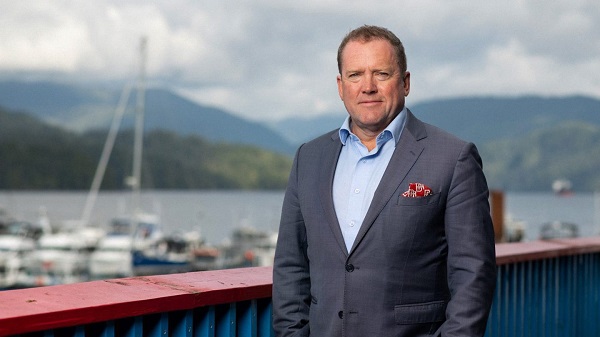
Prince Rupert Port Authority CEO Shaun Stevenson. Photo courtesy Prince Rupert Port Authority
From the Canadian Energy Centre
A strategic gateway to the world
Tucked into the north coast of B.C. is the deepest natural harbour in North America and the port with the shortest travel times to Asia.
With growing capacity for exports including agricultural products, lumber, plastic pellets, propane and butane, it’s no wonder the Port of Prince Rupert often comes up as a potential new global gateway for oil from Alberta, said CEO Shaun Stevenson.
Thanks to its location and natural advantages, the port can efficiently move a wide range of commodities, he said.
That could include oil, if not for the federal tanker ban in northern B.C.’s coastal waters.

The Port of Prince Rupert on the north coast of British Columbia. Photo courtesy Prince Rupert Port Authority
“Notwithstanding the moratorium that was put in place, when you look at the attributes of the Port of Prince Rupert, there’s arguably no safer place in Canada to do it,” Stevenson said.
“I think that speaks to the need to build trust and confidence that it can be done safely, with protection of environmental risks. You can’t talk about the economic opportunity before you address safety and environmental protection.”
Safe Transit at Prince Rupert
About a 16-hour drive from Vancouver, the Port of Prince Rupert’s terminals are one to two sailing days closer to Asia than other West Coast ports.
The entrance to the inner harbour is wider than the length of three Canadian football fields.
The water is 35 metres deep — about the height of a 10-storey building — compared to 22 metres at Los Angeles and 16 metres at Seattle.
Shipmasters spend two hours navigating into the port with local pilot guides, compared to four hours at Vancouver and eight at Seattle.
“We’ve got wide open, very simple shipping lanes. It’s not moving through complex navigational channels into the site,” Stevenson said.
A Port on the Rise
The Prince Rupert Port Authority says it has entered a new era of expansion, strengthening Canada’s economic security.
The port estimates it anchors about $60 billion of Canada’s annual global trade today. Even without adding oil exports, Stevenson said that figure could grow to $100 billion.
“We need better access to the huge and growing Asian market,” said Heather Exner-Pirot, director of energy, natural resources and environment at the Macdonald-Laurier Institute.
“Prince Rupert seems purpose-built for that.”
Roughly $3 billion in new infrastructure is already taking shape, including the $750 million rail-to-container CANXPORT transloading complex for bulk commodities like specialty agricultural products, lumber and plastic pellets.

The Ridley Island Propane Export Terminal, Canada’s first marine propane export terminal, started shipping in May 2019. Photo courtesy AltaGas Ltd.
Canadian Propane Goes Global
A centrepiece of new development is the $1.35-billion Ridley Energy Export Facility — the port’s third propane terminal since 2019.
“Prince Rupert is already emerging as a globally significant gateway for propane exports to Asia,” Exner-Pirot said.
Thanks to shipments from Prince Rupert, Canadian propane – primarily from Alberta – has gone global, no longer confined to U.S. markets.
More than 45 per cent of Canada’s propane exports now reach destinations outside the United States, according to the Canada Energy Regulator.
“Twenty-five per cent of Japan’s propane imports come through Prince Rupert, and just shy of 15 per cent of Korea’s imports. It’s created a lift on every barrel produced in Western Canada,” Stevenson said.
“When we look at natural gas liquids, propane and butane, we think there’s an opportunity for Canada via Prince Rupert becoming the trading benchmark for the Asia-Pacific region.”
That would give Canadian production an enduring competitive advantage when serving key markets in Asia, he said.
Deep Connection to Alberta
The Port of Prince Rupert has been a key export hub for Alberta commodities for more than four decades.
Through the Alberta Heritage Savings Trust Fund, the province invested $134 million — roughly half the total cost — to build the Prince Rupert Grain Terminal, which opened in 1985.
The largest grain terminal on the West Coast, it primarily handles wheat, barley, and canola from the prairies.

The Prince Rupert Grain Terminal. Photo courtesy Prince Rupert Port Authority
Today, the connection to Alberta remains strong.
In 2022, $3.8 billion worth of Alberta exports — mainly propane, agricultural products and wood pulp — were shipped through the Port of Prince Rupert, according to the province’s Ministry of Transportation and Economic Corridors.
In 2024, Alberta awarded a $250,000 grant to the Prince Rupert Port Authority to lead discussions on expanding transportation links with the province’s Industrial Heartland region near Edmonton.
Handling Some of the World’s Biggest Vessels
The Port of Prince Rupert could safely handle oil tankers, including Very Large Crude Carriers (VLCCs), Stevenson said.
“We would have the capacity both in water depth and access and egress to the port that could handle Aframax, Suezmax and even VLCCs,” he said.
“We don’t have terminal capacity to handle oil at this point, but there’s certainly terminal capacities within the port complex that could be either expanded or diversified in their capability.”
Market Access Lessons From TMX
Like propane, Canada’s oil exports have gained traction in Asia, thanks to the expanded Trans Mountain pipeline and the Westridge Marine Terminal near Vancouver — about 1,600 kilometres south of Prince Rupert, where there is no oil tanker ban.
The Trans Mountain expansion project included the largest expansion of ocean oil spill response in Canadian history, doubling capacity of the West Coast Marine Response Corporation.

The K.J. Gardner is the largest-ever spill response vessel in Canada. Photo courtesy Western Canada Marine Response Corporation
The Canada Energy Regulator (CER) reports that Canadian oil exports to Asia more than tripled after the expanded pipeline and terminal went into service in May 2024.
As a result, the price for Canadian oil has gone up.
The gap between Western Canadian Select (WCS) and West Texas Intermediate (WTI) has narrowed to about $12 per barrel this year, compared to $19 per barrel in 2023, according to GLJ Petroleum Consultants.
Each additional dollar earned per barrel adds about $280 million in annual government royalties and tax revenues, according to economist Peter Tertzakian.
The Road Ahead
There are likely several potential sites for a new West Coast oil terminal, Stevenson said.
“A pipeline is going to find its way to tidewater based upon the safest and most efficient route,” he said.
“The terminal part is relatively straightforward, whether it’s in Prince Rupert or somewhere else.”
Under Canada’s Marine Act, the Port of Prince Rupert’s mandate is to enable trade, Stevenson said.
“If Canada’s trade objectives include moving oil off the West Coast, we’re here to enable it, presuming that the project has a mandate,” he said.
“If we see the basis of a project like this, we would ensure that it’s done to the best possible standard.”

From the Fraser Institute
By Gary Mauser
The government told Cape Bretoners they had two weeks to surrender their firearms to qualify for reimbursement or “buyback.” The pilot project netted a grand total of 22 firearms.
Five years after then-prime minister Justin Trudeau banned more than 100,000 types of so-called “assault-style firearms,” the federal government recently made the first attempt to force Canadians to surrender these firearms.
It didn’t go well.
The police chief in Cape Breton, Nova Scotia, volunteered to run a pilot “buyback” project, which began last month. The government told Cape Bretoners they had two weeks to surrender their firearms to qualify for reimbursement or “buyback.” The pilot project netted a grand total of 22 firearms.
This failure should surprise no one. Back in 2018, a survey of “stakeholders” warned the government that firearms owners wouldn’t support such a gun ban. According to Prime Minister Carney’s own Privy Council Office the “program faces a risk of non-compliance.” And federal Public Safety Minister Gary Anandasangaree was recently recorded admitting that the “buyback” is a partisan maneuver, and if it were up to him, he’d scrap it. What’s surprising is Ottawa’s persistence, particularly given the change in the government and the opportunity to discard ineffective policies.
So what’s really going on here?
One thing is for certain—this program is not, and never has been, about public safety. According to a report from the federal Department of Justice, almost all guns used in crimes in Canada, including in big cities such as Toronto, are possessed illegally by criminals, with many smuggled in from the United States. And according to Ontario’s solicitor general, more than 90 per cent of guns used in crimes in the province are illegally imported from the U.S. Obviously, the “buyback” program will have no effect on these guns possessed illegally by criminals.
Moreover, Canadian firearms owners are exceptionally law-abiding and less likely to commit murder than other Canadians. That also should not be surprising. To own a firearm in Canada, you must obtain a Possession and Acquisition Licence (PAL) from the RCMP after initial vetting and daily monitoring for possible criminal activity. Between 2000 and 2020, an average of 12 PAL-holders per year were accused of homicide, out of approximately two million PAL-holders. During that same 10-year period, the PAL-holder firearms homicide rate was 0.63 (per 100,000 PAL-holders) compared to 0.72 (per 100,000 adult Canadians)—that’s 14 per cent higher than the rate for PAL-holders.
In other words, neither the so-called “assault-style firearms” nor their owners pose a threat to the public.
And the government’s own actions belie its claims. If these firearms are such a threat to Canadians, why slow-roll the “buyback” program? If inaction increased the likelihood of criminality by law-abiding firearms owners, why wait five years before launching a pilot program in a small community such as Cape Breton? And why continue to extend the amnesty period for another year, which the government did last month at the same time its pilot project netted a mere 22 firearms?
To ask those questions is to answer them.
Another question—how much will the “buyback” program cost taxpayers?
The government continues to block any attempt to disclose the full financial costs (although the Canadian Taxpayers Federation has launched a lawsuit to try to force the government to honour its Access to Information Act request). But back in 2020 the Trudeau government said it would cost $200 million to compensate firearms owners (although the Parliamentary Budget Officer said compensation costs could reach $756 million). By 2024, the program had spent $67.2 million—remember, that’s before it collected a single gun. The government recently said the program’s administrative costs (safe storage, destruction of hundreds of thousands of firearms, etc.) would reach an estimated $1.8 billion. And according to Carney’s first budget released in November, his government will spend $364 million on the program this fiscal year—at a time of massive federal deficits and debt.
This is reminiscent of the Chretien government’s gun registry fiasco, which wound up costing more than $2 billion even after then-justice minister Allan Rock promised the registry program would “almost break even” after an $85 million initial cost. The Harper government finally scrapped the registry in 2012.
As the Carney government clings to the policies of its predecessor, Canadians should understand the true nature of Ottawa’s gun “buyback” program and its costs.

Gary Mauser
Professor Emeritus, Simon Fraser University


From Underdog to Top Broodmare
Ottawa and Alberta’s “MOU” a step in the right direction—but energy sector still faces high costs and weakened competitiveness

Canadians will soon be versed in massive West Coast LPG mega-project

‘No Critical Thinking’: Parents Sound Alarm As Tech Begins To ‘Replace The Teacher’
-
Energy2 days ago
Canadians will soon be versed in massive West Coast LPG mega-project
-
 Daily Caller2 days ago
Tom Homan Predicts Deportation Of Most Third World Migrants Over Risks From Screening Docs
-
 Daily Caller7 hours ago
Tech Mogul Gives $6 Billion To 25 Million Kids To Boost Trump Investment Accounts
-
 National1 day ago
Media bound to pay the price for selling their freedom to (selectively) offend
-
 Alberta1 day ago
New era of police accountability
-
 C2C Journal1 day ago
Learning the Truth about “Children’s Graves” and Residential Schools is More Important than Ever
-
 Artificial Intelligence2 days ago
‘Trouble in Toyland’ report sounds alarm on AI toys
-
 Bruce Dowbiggin1 day ago
Sometimes An Ingrate Nation Pt. 2: The Great One Makes His Choice